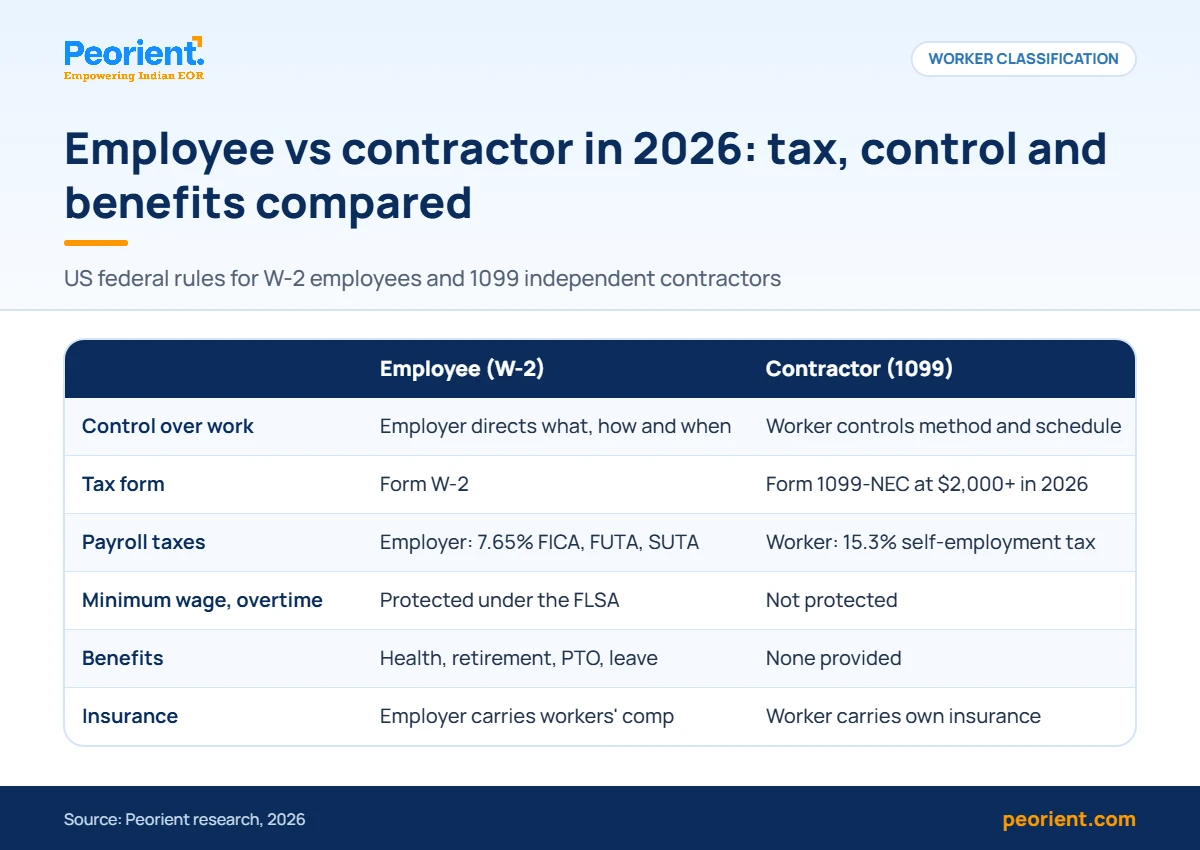
Employee vs Contractor: the Short Answer
An employee works under the direction and control of an employer, receives a Form W-2, and is entitled to minimum wage, overtime, and benefits protections under the Fair Labor Standards Act. An independent contractor runs their own business, controls how and when the work gets done, receives a Form 1099-NEC when annual payments cross the reporting threshold, and gets none of those statutory protections. The label on the contract does not decide the question. The IRS is explicit that it is not bound by a contract calling someone an independent contractor: how the parties actually work together is what determines status.
Once you have decided someone is a contractor, our complete guide to independent contractors covers contracts, payments and tax.
What makes 2026 unusual is that there is no single federal answer. The Department of Labor proposed a new rule on 26 February 2026 that would restore the two-core-factor test from 2021 and rescind the Biden-era 2024 rule. It has not been finalized. The comment period closed on 28 April 2026. Until a final rule publishes, the 2024 rule technically remains on the books while DOL investigators have been instructed to ignore it. Meanwhile the IRS runs an entirely separate common-law test, and states like California and New Jersey apply a stricter ABC test that no federal rulemaking touches.
That is the practical situation this guide addresses: which test applies to you, what each one asks, what misclassification actually costs in 2026 dollars, when to hire each type, and how to convert or hire across borders without creating the exposure in the first place.
Employee vs Contractor: At-a-Glance Comparison
The Three-Clocks Problem: Which Test Applies to You Right Now
Most guides published in 2026 tell you the DOL changed the independent contractor rule. That is not quite what happened, and the difference is expensive.
The DOL announced a Notice of Proposed Rulemaking on 26 February 2026 and published it in the Federal Register the following day, cited as 91 FR 9932 under RIN 1235-AA46. A proposed rule is a proposal. The 60-day comment period closed at 11:59 pm ET on 28 April 2026, and the Department is now working through the docket. Nothing about your legal obligations changed on 26 February.
What you actually face is three separate clocks running at once, and which one you are on depends entirely on who is asking the question.
There is a second-order point that most coverage misses. Even once the 2026 rule finalizes, its practical force is limited. As Jackson Lewis notes, nearly every federal circuit has already built its own body of classification case law, and after the Supreme Court’s decision in Loper Bright Enterprises v. Raimondo removed Chevron deference, courts are not obliged to follow the DOL’s view at all. The rule does carry one concrete benefit: it states that employers may rely on it under Section 10 of the Portal-to-Portal Act, which is a good-faith defense worth having. But treating a final DOL rule as a safe harbor against private litigation would be a mistake.
The DOL’s own rulemaking page is the authoritative place to track finalization. Comments are public at regulations.gov under docket WHD-2026-0001.
The Classification Tests, in Detail
1. The IRS common-law test
This is the test that governs your federal tax obligations, and it runs independently of everything the DOL does. The IRS organizes the analysis into three categories of evidence:
Two clarifications from the IRS worth internalizing. First, on the type of relationship: hiring someone with the expectation that the relationship continues indefinitely, rather than for a defined project or period, is itself evidence of employment. Second, there is no scoring threshold. The IRS states plainly in Worker Classification 101 that no single factor decides it and none stands alone.
If a classification is genuinely close, you can file Form SS-8 and ask the IRS to determine status formally. Be realistic about the timeline: the IRS advises that a determination can take at least six months, and either the business or the worker can file it, which means a disgruntled contractor can start that clock without you.
2. The DOL economic reality test
The FLSA question is different from the tax question. It asks whether the worker is economically dependent on your business or genuinely in business for themselves. As Fact Sheet 13 puts it, employment under the FLSA is broader than the common-law control standard used elsewhere in federal law.
Here is what the February 2026 proposed rule would establish if finalized. Two core factors carry greater weight:
- The nature and degree of control over the work. Weighs toward employee status where the business exercises substantial control over key aspects of performance, such as setting the schedule or workload, or requiring exclusivity.
- The worker’s opportunity for profit or loss based on initiative and/or investment. Weighs toward contractor status where the worker exercises managerial skill, business judgment, or manages their own capital expenditure.
Three additional factors inform the analysis, particularly when the two core factors disagree: the amount of skill required, the degree of permanence of the relationship, and whether the work is part of an integrated unit of production.
One useful carve-out in the proposal, flagged by Butler Snow: requirements that a contractor comply with specific legal obligations, meet health and safety standards, carry insurance, hit contractually agreed deadlines, or satisfy quality control terms do not constitute the kind of control that makes someone an employee. Those are normal terms of a business-to-business relationship.
The proposal also extends the same analysis to the Family and Medical Leave Act and the Migrant and Seasonal Agricultural Worker Protection Act, which the 2024 rule did not do. It does not redefine contractor status under the Internal Revenue Code or the National Labor Relations Act, and it does not touch state law. The SBA Office of Advocacy estimates the rescission would save small businesses roughly $2.31 billion over ten years, or $329 million annualized.
3. State ABC tests
California, New Jersey, Massachusetts, and Illinois, among others, apply an ABC test that inverts the burden. As Mayer Brown summarizes, every worker is presumed an employee unless the hiring entity proves all three of:
- The worker is free from the hiring entity’s control and direction, both under the contract and in fact.
- The work performed is outside the usual course of the hiring entity’s business.
- The worker is customarily engaged in an independently established trade, occupation, or business of the same nature as the work performed.
Prong B is where most classifications die. A software company engaging a contract software engineer fails prong B on its face, no matter how much autonomy that engineer has, because the work is squarely within the company’s usual course of business. This is the trap that catches companies who pass every IRS and DOL factor and still lose.
No federal rulemaking changes this. If you have workers in an ABC state, the ABC test governs there regardless of what the DOL finalizes.
Tax and Reporting: W-2 vs 1099-NEC in 2026
The $2,000 threshold, and the year-boundary trap
Section 70433 of the One Big Beautiful Bill Act, signed on 4 July 2025, raised the reporting threshold for Forms 1099-NEC and 1099-MISC from $600 to $2,000. Starting in 2027 the threshold is indexed for inflation, rounded to the nearest $100. Backup withholding under Code Section 3406 moves to the same $2,000 level.
Here is the part that trips people up, and it is worth reading twice. The new threshold applies to payments made on or after 1 January 2026. It does not apply to the forms you filed in January and February 2026, because those reported tax year 2025 payments, and tax year 2025 still runs on $600. As Littler notes, the change begins in 2026, meaning the $2,000 threshold first shows up on forms filed in early 2027. Applying $2,000 to a 2025 payment means missed filings and penalties. Applying $600 to a 2026 payment just means unnecessary paperwork. Only one of those two errors costs money.
Regardless of the threshold, all income remains taxable. A contractor paid $1,500 in 2026 receives no 1099-NEC and still owes tax on $1,500. Keep collecting Form W-9 from every contractor before the first payment, without exception. Annual totals are unpredictable, and a missing W-9 on a vendor who later crosses $2,000 turns into backup withholding you did not budget for.
Who pays what
A contractor is not saving you the 7.65% employer FICA in the way it looks on paper. Experienced contractors price the 15.3% self-employment burden into their rate. The real saving is in benefits, unemployment insurance, workers’ compensation, equipment, and severance exposure, not in the payroll tax line.
The Real Cost Difference: Working the Numbers
Take a role with $100,000 in base compensation and price both paths honestly.
The premium is real, but treating it as pure waste is the error that produces misclassification. What you buy with it is control over method, exclusivity, retention, IP assignment that actually holds, and the ability to direct work moment to moment. If you want those things, you are describing an employee, and paying contractor rates for them is not a saving. It is an unfunded liability with a delay fuse.
Note also what the table does not show: turnover cost. Replacing an employee typically runs half to twice their annual salary. Contractors are cheaper to replace but churn more, and the cost of that churn does not appear on any invoice.
What Misclassification Actually Costs in 2026
Exposure stacks across four independent authorities, and each one can act without the others. This is the part most cost comparisons skip.
1. IRS employment tax liability (IRC Section 3509)
Where misclassification was unintentional, Section 3509 caps your employment tax exposure at reduced rates. Where it was willful, the reductions disappear entirely.
Note the mechanic: filing the 1099 halves your rate. The company that quietly paid a misclassified worker off the books is in materially worse shape than the one that misclassified openly and filed the form.
2. Information return penalties (IRC Section 6721)
Separate from the tax itself, failing to file required returns carries its own penalty, and the figure most articles quote is badly out of date. The often-repeated “$50 per W-2” has not been current for years. For 2025 forms filed in 2026, the penalty is $340 per form, with a maximum of $4,098,500 for large businesses and $1,366,000 for small businesses, defined as those averaging $5 million or less in gross receipts over the three prior tax years.
Intentional disregard removes the ceiling. The penalty becomes the greater of $680 per form or 10% of the aggregate amount required to be reported, with no maximum at all.
3. FLSA back wages and DOL enforcement
Misclassification strips workers of minimum wage and overtime protections, which is a Wage and Hour Division matter. Exposure includes back wages, and for willful violations retroactive claims can reach back three years rather than two. Liquidated damages can double the back-wage figure. Workers can report misclassification directly to the DOL through the Wage and Hour Division hotline, which means enforcement does not require an audit to start: one call does it.
Enforcement is not limited to money. The DOL has issued stop-work orders against contractors who misclassified workers, and in some jurisdictions the consequence extends to losing the ability to do business in the state.
4. State penalties
California is the sharpest example and the one most often misquoted. Labor Code Section 226.8 sets two distinct tiers, and collapsing them into a single range, as many guides do, understates the pattern-and-practice risk:
- Willful misclassification: $5,000 to $15,000 per violation.
- A pattern or practice of willful misclassification: $10,000 to $25,000 per violation.
Per violation, not per audit. A company with forty misclassified workers is doing multiplication, not addition. Add unpaid unemployment insurance contributions, unpaid workers’ compensation premiums, and state tax assessments on top.
5. The relief valves, and their conditions
Three federal provisions can reduce exposure, and all three have conditions worth knowing before you need them:
- Section 530 safe harbor. Relieves retroactive employment tax liability if you had a reasonable basis for the treatment, treated all similar workers consistently, and filed all required information returns on a consistent basis. The consistency requirements are strict and most companies fail on the filing prong. Note that Section 530 relief does not make the worker a contractor. It only relieves your tax liability.
- Section 3402(d). Reduces employer liability where the worker has already paid their own income tax on the compensation.
- The Voluntary Classification Settlement Program. Lets you reclassify workers as employees prospectively with partial relief from federal employment taxes, by filing Form 8952 and entering a closing agreement with the IRS. Eligibility conditions apply and it is prospective only.
The pattern across all three is the same: they reward the company that self-identifies and moves first. None of them help the company that waits for a worker to file Form 8919 or call the WHD hotline.
Decision Framework: When to Hire Which
Work through these in order. If you stop at any “employee” answer, stop there. The remaining questions do not rescue the classification.
Hire a contractor when the work is project-scoped with defined deliverables, needs specialized skill you do not need permanently, and you can genuinely hand over control of the method. Hire an employee when the role is core to what you sell, requires ongoing direction and collaboration, handles sensitive or proprietary work, or when you simply want the person to be there next year.
The honest test is simpler than any factor list: if you would be upset to learn your contractor took on three other clients this month and reordered their week around them, you are describing an employee. Price the role accordingly.
How to Convert a Contractor to an Employee
This is the most common good outcome of a classification review, and the sequence matters. Doing it badly can convert a quiet compliance gap into a documented admission.
- Assess the exposure before you announce anything. Determine how long the misclassification ran and in which jurisdictions. Do this with counsel. Conversion is not a defence against liability for the period already elapsed, and the way you document the decision now will be read later.
- Check whether the VCSP fits. If the arrangement qualifies, filing Form 8952 gives prospective reclassification with partial federal employment tax relief. This decision has to happen before conversion, not after, so it belongs at step two rather than as an afterthought.
- Confirm state registration. You need to be registered as an employer in every state where you will have employees. A contractor in a state where you have no registration becomes an employee you cannot legally pay until registration completes, and that lead time is real.
- Reprice the role honestly. Take the contractor rate and work back to a base salary that leaves the person whole after benefits are added. A contractor billing $120,000 is not a $120,000 employee: they were carrying 15.3% self-employment tax and their own insurance. Landing near $95,000 to $100,000 base plus benefits is often roughly neutral for both sides. Model it before you make an offer.
- Have the conversation with the numbers ready. Contractors frequently read conversion as a pay cut. Show the total compensation comparison, including the employer FICA half you now absorb, the insurance, the retirement match, and paid leave. Most objections dissolve at that table.
- Paper it properly. Employment contract, Form W-4, Form I-9 within the statutory window, state new-hire reporting, benefits enrolment, and payroll onboarding. Missing I-9s across a converted population is its own audit exposure with Homeland Security and ICE, independent of the tax question.
- Reassign the IP. Contractor IP assignment clauses and employee invention assignment provisions work differently. Do not assume the old agreement carries over. This is routinely the step that gets skipped and then discovered during diligence.
- Set the date cleanly. Convert at a payroll period boundary, ideally a quarter boundary. Mid-period conversions create split reporting that nobody enjoys reconciling in January.
Hiring International Contractors vs Employees
Everything above is US law. The moment your worker sits in another country, US tests become irrelevant and local law governs, which is where most cross-border classification failures originate. Companies apply their home-country instincts to a jurisdiction that never adopted them.
The pattern is consistent and predictable. A company hires an overseas contractor to test a market. The engagement works. Twelve months later that contractor is full-time in everything but paperwork: fixed hours, company laptop, internal Slack, reporting line, no other clients. Local authorities look at exactly those facts, and almost every jurisdiction reaches the same conclusion, because the underlying economic reality test is broadly similar everywhere even where the statute is not.
Where enforcement bites hardest
A distinct risk sits alongside misclassification and is often the more expensive one: permanent establishment. A long-term worker acting on your behalf in a foreign country, especially one who can negotiate or conclude contracts, can create a taxable presence for your company in that jurisdiction. The exposure is corporate tax on attributed profits, not just employment penalties, and it can substantially exceed the misclassification cost.
The three ways to engage someone abroad
The break-even is arithmetic, not ideology. At $300 to $800 per employee per month, twenty employees in one country runs roughly $6,000 to $16,000 monthly, which starts to exceed the annualized cost of running your own entity. Below that headcount, the EOR is almost always cheaper once you price the real overhead of an entity you have to maintain whether it is busy or not. Our International PEO guide works through the break-even in detail, and our EOR vs PEO comparison covers which model fits which situation. If you are early-stage, EOR services for startups addresses the specific constraints of a first international hire.
One frequent point of confusion worth settling: a PEO co-employs and generally requires you to already have a local entity, while an EOR becomes the legal employer and does not. If you have no entity in the country, a PEO is not the tool. There are signs worth checking if you are unsure which side of that line you are on, and PEO vs HRIS is worth reading if you are actually shopping for software rather than an employment solution.
On the payroll mechanics underneath all three models, see what global payroll actually covers and how EOR payroll works.
The India Corridor: Hiring Employees in India
India deserves its own section because it is where the contractor-first instinct is strongest and the compliance gap widest. It is also, in our experience advising on this corridor, where the classification question is most often asked too late.
Companies default to contractors in India for understandable reasons: the talent is available, rates are attractive, and setting up an Indian entity looks daunting. The instinct is right about the entity and wrong about the contractor. India’s statutory framework, covering Provident Fund, Employees’ State Insurance, gratuity, and the contract labour regime, is built around a substance-over-form reading of the relationship. A “contractor” working fixed hours for a single client over eighteen months is not a contractor under Indian law, whatever the agreement says.
The exposure is not theoretical: retrospective PF and ESI contributions with interest and damages, gratuity liability, and the permanent establishment question that follows a long-term worker acting on your behalf.
Frequently Asked Questions
Getting the Classification Right
The classification question in 2026 does not have one federal answer, and the companies that get burned are usually the ones who found the friendliest of the three tests and stopped reading. Classify against the strictest test that could plausibly reach you, document the reality of the relationship rather than the aspiration, and remember that the paperwork only helps if it matches what actually happens on a Tuesday.
If you are weighing contractors against employees for an international hire, or converting an arrangement that has drifted, talk to our advisory team. We help companies choose between contractor engagement, EOR, PEO, and entity setup based on headcount, country, and timeline. No obligation, and we will tell you when you do not need us.
Sources. This guide is grounded in primary sources including the IRS worker classification guidance, IRS Topic 762, DOL Wage and Hour Fact Sheet 13, and the DOL 2026 rulemaking record. Legal analysis referenced from Jackson Lewis, Mayer Brown, Nixon Peabody, McGuireWoods, Butler Snow, and Littler. This article is general information, not legal or tax advice. Consult qualified counsel before making classification decisions.