Your first US employee may be one person working from home. But before they start, you still need to decide who employs them, which state’s rules apply, what the full cost will be, and who handles payroll and benefits.
Choosing the cheapest provider before answering those questions leaves too much of the decision to a sales proposal.
To hire employees in the US, a foreign company should define the role and work location, choose an employment structure, budget the full cost, recruit and assess candidates, issue suitable employment documents, and complete work authorization checks and payroll setup.
At Peorient, we generally recommend evaluating an employer of record first when a company wants one US employee or a small team to test the market. Our role is to research and compare providers so employers can make an informed choice. This guide combines that evaluation approach with official US sources.
Can a foreign company hire employees in the US?
Hiring through an employer of record
Yes. One route is an employer of record, or EOR, that employs the person through its US operation and administers the agreed payroll, tax and benefits services. Your company manages the employee’s work.
For a foreign business without a US employment setup, this can reduce the administrative work involved in a first hire. Our Employer of Record USA guide explains the model in more detail.
However, an EOR contract is not a blanket exemption from US obligations. Ask counsel to assess any responsibilities your business retains, including potential joint employment exposure and corporate tax obligations. The IRS explains that employees working in the US on behalf of a foreign corporation can create a US trade or business. Tax treaty protection and filing requirements depend on the facts. Do not assume that using an EOR settles that analysis.
Hiring directly through your own business
A foreign company can also explore direct employment through a US subsidiary or, where appropriate, through the foreign company with the necessary registrations. Forming a new US subsidiary is not the only possible direct employment structure. The IRS provides tax rules for people employed by foreign employers.
Direct hiring means arranging the relevant business registrations, payroll tax accounts, insurance, employment documents and ongoing filings. An EIN identifies the employer for federal tax purposes. It does not replace state registrations. Companies whose principal business is outside the US should follow the IRS instructions for international EIN applicants.
State registration also needs a separate review. The SBA’s business registration guidance explains how operating in additional states can require foreign qualification. In this context, “foreign” can mean a business formed in another US state, as well as one formed abroad.
Our view: direct employment deserves closer consideration when your US operation has a lasting commercial purpose, dedicated management or an expansion plan that justifies the setup. There is no universal employee count at which it becomes the better choice.
Using a PEO or payroll service
A domestic professional employer organization, or PEO, commonly provides HR, payroll and benefits support through a co-employment arrangement with an existing employer. A payroll service processes pay. Neither label, by itself, confirms that the provider will employ your first US worker through its own entity.
The IRS guidance on PEO arrangements explains that outsourcing payroll generally does not remove the common-law employer’s tax responsibilities, although specific arrangements have different rules.
Ask one direct question before comparing prices: “Which legal entity employs this person, and which responsibilities remain with our company?”
How do you hire your first US employee step by step?
Step 1: Define the role and actual work location
Write down the job’s purpose, reporting manager, required skills, working hours and expected results in the first 90 days. For a sales position, also define the territory, travel requirements and authority to negotiate or sign contracts.
Record the state and city where the person will physically work. “Remote in the US” is not enough for payroll and employment planning. If the person will work from several locations, identify those before approving the arrangement.
This also helps distinguish recruiting from employment administration. If you have no candidate yet, you may need a recruiter alongside an EOR. Our guide to EORs and staffing agencies explains their different roles. Confirm whether candidate sourcing is included, optional or unavailable.
Step 2: Set a local salary range and full hiring budget
Benchmark the occupation and location rather than converting a salary from your home country into dollars. The Bureau of Labor Statistics publishes wage data by occupation and area, which provides a useful starting point. Adjust for seniority, specialist skills, responsibilities and the package you plan to offer.
Peorient’s US salary guide provides wider context. For location research, see our guides to California salaries, New York salaries and Texas salaries.
Approve a budget that includes employer taxes, benefits, insurance and administration before advertising. A candidate’s salary expectation and your total cost are different figures.
Step 3: Find and assess candidates
Use a mix of employee referrals, professional networks, relevant job boards and specialist recruiters. Match the channel to the role. A senior enterprise salesperson and a junior operations associate do not need the same search process.
Give candidates a clear description of the role, eligible work locations, pay range, benefits, interview stages and proposed employer. If an EOR will issue the employment documents, explain that before the final offer.
Use the same core questions and assessment criteria across candidates. A short, relevant work sample can show how someone thinks, but avoid requesting substantial unpaid work that your company could use commercially.
Check applicable pay transparency rules before publishing a vacancy. For example, California’s Labor Commissioner explains pay scale requirements for covered employers with 15 or more employees, including positions that may be filled remotely in California. Do not assume having only one proposed US hire settles the employer-size analysis.
If you use a background screening company, follow the applicable disclosure, authorization and adverse-action procedures. The joint EEOC and FTC guidance on employment background checks explains the federal requirements. State and local restrictions also need checking.
Step 4: Confirm the employment arrangement
Before agreeing to a start date, confirm the employing entity, coverage in the employee’s state, payroll funding process, benefits availability and responsibility for employment documents.
For direct hiring, establish the required accounts and operational support. For an EOR, request a written scope identifying the services and exclusions. Ask whether any local partner or subcontractor will be involved and who resolves an error.
An employee should not become a contractor simply because your employment setup is unfinished. The IRS classification framework examines behavioral control, financial control and the relationship between the parties. Wage law and state tests require their own assessment. Our 1099 versus W-2 guide explains the practical distinction.
Step 5: Prepare the offer and employment documents
Have the employer and its advisers prepare documents suitable for the role and work location. Include the employing entity, title, location, start date, pay, pay frequency, reporting arrangement, benefits and applicable employment terms.
Document bonuses and commissions clearly. Specify how they are earned, when they are paid and what happens when employment ends. Address confidentiality, intellectual property, equipment, expenses and remote work. Review restrictive clauses under applicable law rather than copying a contract used in another country.
For an EOR arrangement, check how intellectual property rights pass from the employee through the employing entity to your business. Keep the employee-facing offer consistent with the commercial service agreement.
Step 6: Complete onboarding and prepare the first payroll
Use an onboarding checklist with a named owner for every item. Core federal steps include:
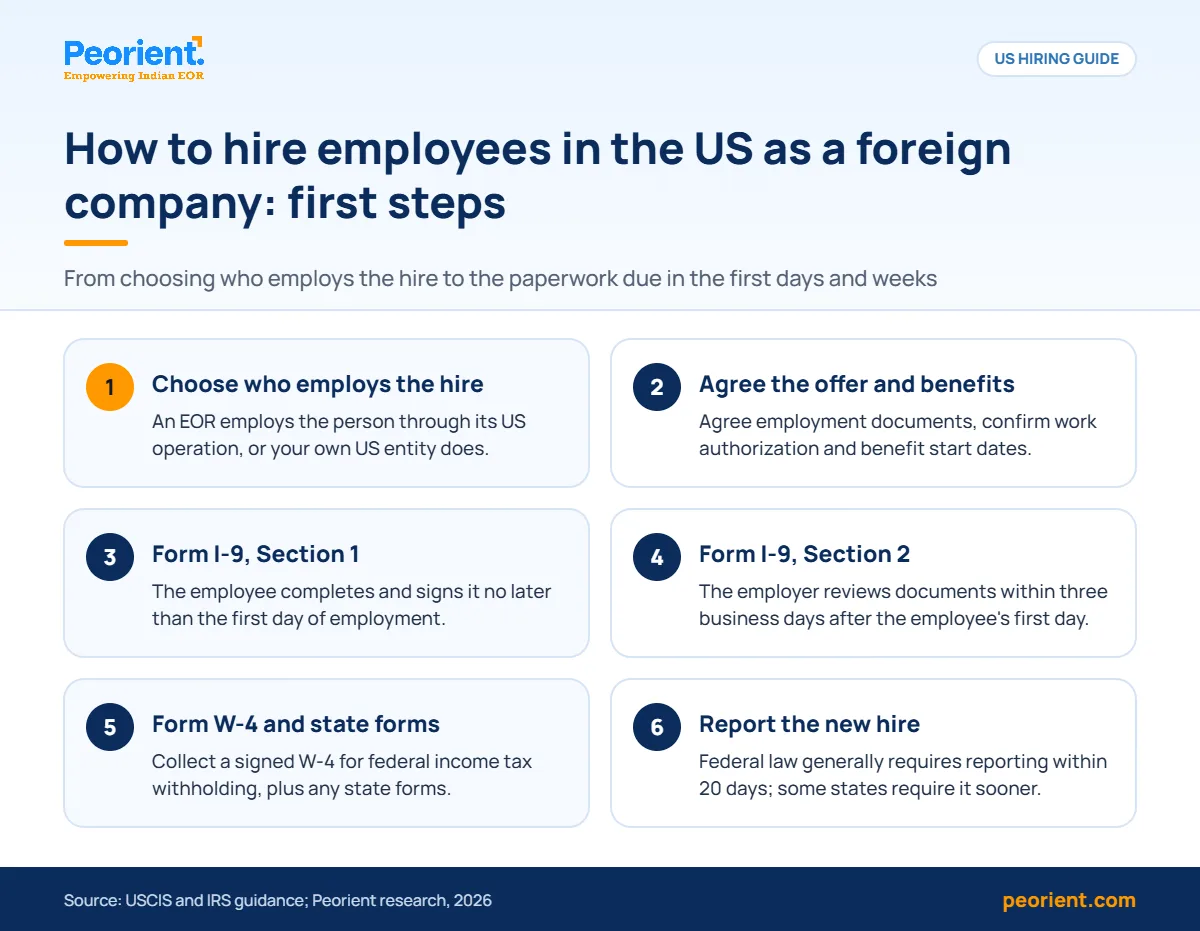
- Form I-9, Section 1: the employee completes and signs it no later than their first day of employment, after accepting the offer. See USCIS Section 1 guidance.
- Form I-9, Section 2: the employer or authorized representative completes the review within three business days after the employee’s first day. For employment lasting fewer than three business days, complete it on the first day. Follow USCIS Section 2 guidance.
- Form W-4: request a signed form when the employee starts and use it for federal income tax withholding. Arrange applicable state forms as well. See the IRS Employer’s Tax Guide.
- New hire reporting: federal law generally requires reporting within 20 days, while state rules can require an earlier report. Follow the federal new hire reporting guidance and the applicable state process.
- Confirm insurance and benefit effective dates, payroll cutoffs, time tracking where needed, equipment delivery and access permissions. Schedule a first-week check-in and verify the first payslip. Our EOR payroll guide explains the administrative workflow.
Which US employment rules should foreign companies check?
Minimum wage, overtime and classification
The federal minimum wage is $7.25 an hour for covered nonexempt employees. Federal overtime generally requires at least 1.5 times the regular rate after 40 hours in a workweek. Higher state or local standards can apply. These are the baseline rules in the Department of Labor’s FLSA guidance.
Paying a salary does not automatically make someone exempt from overtime. Many exemptions require the role to satisfy duties and pay tests. The DOL’s executive, administrative and professional exemption guidance explains those tests. Confirm the current state rules too.
Treat employee-versus-contractor status and exempt-versus-nonexempt status as separate decisions. An employee can be salaried and still entitled to overtime.
Benefits, leave and insurance
Separate legal requirements from the benefits needed to attract your candidate.
The federal FLSA does not generally require paid vacation or holidays, as the DOL’s vacation guidance explains. But state and local paid leave laws, applicable federal contract rules and your own policies can create obligations.
The Affordable Care Act’s employer shared responsibility rules generally apply to employers averaging at least 50 full-time employees, including full-time equivalents, in the preceding year. Aggregation and new-employer rules matter. Check the IRS employer health coverage guidance rather than assuming that one US hire resolves the issue.
Whether required or offered voluntarily, review the actual health plan: network, employer contribution, employee contribution, deductible, dependent coverage and coverage start date. A promise of “competitive benefits” does not tell your candidate what they will receive.
Workers’ compensation requirements vary by state. For example, California generally requires coverage even with one employee. Ask for confirmation covering the role and location, rather than accepting a general statement that the provider has insurance.
Remote work, state rules and termination
Use the DOL’s state minimum wage directory to start the location review, then check state and local rules for paydays, leave, breaks, notices, expense reimbursement and final wages.
If your employee wants to move, review the new work location before approving it. An existing arrangement in one state should not be assumed to cover another.
At-will employment, where applicable, does not permit dismissal for an unlawful reason. Discrimination, retaliation, contractual commitments and state protections still matter. The US government’s termination guidance explains the limits. Final-pay deadlines also differ. California’s final-wage guidance illustrates why payroll must be involved before a termination is communicated.
How much does it cost to hire an employee in the US?
Build the cost from separate components
Use this budget structure:
Annual employment cost = gross compensation + employer payroll taxes + employer-funded benefits + required insurance and contributions + employment administration + recruitment and equipment costs.
For ordinary wages subject to US Social Security and Medicare taxes, the 2026 employer rates are 6.2% on Social Security wages up to $184,500 and 1.45% on Medicare wages without a wage cap. The additional 0.9% Medicare withholding for higher-paid employees has no employer match. See IRS Social Security and Medicare rates.
Federal unemployment tax, or FUTA, is generally 6% on the first $7,000 of covered annual wages, before available credits. With the full credit, it becomes 0.6%, or $42 per employee who reaches that wage base. Credit reductions and other circumstances can increase the amount. See the IRS FUTA guidance.
State unemployment, workers’ compensation and other state programs require a separate calculation. Do not apply one national percentage to every hire.
Illustrative budget for a $100,000 salary
This example is a planning illustration, not a provider quote, market average or Peorient client case. It assumes a full year of ordinary taxable wages, the full FUTA credit and no special exemption.
The subtotal is about $10,174 per month when spread across 12 months. Actual cash requirements will vary by payroll schedule and tax timing.
Add state unemployment, workers’ compensation, applicable state program charges, bonuses, retirement contributions, recruitment, equipment and any other agreed fees. Obtain the actual tax and insurance treatment from the employing entity. Employee income tax withholding comes out of gross salary and should not be added again as an employer cost unless you have agreed a tax gross-up.
Compare the invoice and the cash required upfront
Ask every provider for the same employee, location, salary and benefits assumptions. Request separate lines for setup, monthly administration, off-cycle payroll, foreign exchange, background checks, benefits administration, termination and transfer fees.
Also ask about payroll deposits, advance funding and refund terms. A refundable security deposit affects cash flow even when it is not an employment expense. Do not count it as a recurring fee, but do not leave it out of your launch budget.
Peorient’s view is that a lower advertised fee only becomes useful after you know what the complete arrangement costs.
How should you evaluate a provider for your first US hire?
Check the service behind the proposal
Our research process combines conversations with provider client success teams or customers, cross-checks on review platforms such as G2 and TrustRadius, and comparison with competing services. We use our proprietary scoring software to organize the findings and identify gaps.
That process supports a recommendation. It should not be mistaken for a legal compliance certification. A review score is evidence about customer experience, not proof that every tax account, insurance policy or contract is correct.
For US hiring, we recommend requesting the following evidence:
Match experience to your company
Ask references about the work after the contract was signed. Was the first payroll correct? Were benefits active when promised? Who handled a problem? Did the final invoice match the proposal?
Check experience with your industry and with employers based in your home country. That can matter for communication, invoicing, cross-border coordination and understanding your internal approval process.
A larger provider can be worth considering when you need support across countries or several US states. Size alone does not establish suitability. Confirm who will support a one-person account, which services are included and how quickly issues reach someone who can solve them.
How long does it take to hire your first US employee?
Separate provider selection from the employment start date
Peorient’s provider recommendation turnaround is 24 hours, and clients pay no fee for the matching service.
That is the time for our shortlist and recommendation. Recruitment, interviews, offer acceptance and the chosen provider’s onboarding are separate stages. A candidate search cannot be assigned the same timeline as onboarding someone who has already accepted an offer.
Ask the provider to confirm the proposed start date against business verification, contracts, work authorization, benefits, state coverage, payroll cutoffs and funding. For direct hiring, add the registrations and operational setup that remain outstanding.
Check what must be ready before work starts
Use these questions to judge whether the proposed date is realistic:
- Has the employing entity approved the role and work location?
- Are the employment documents agreed and the offer accepted?
- Is work authorization established, with the required verification process arranged?
- Are required insurance and payroll arrangements ready?
- Are benefit effective dates understood by the employee?
- Has the company met the funding deadline?
- Does the employee have equipment, a manager and a first-week plan?
The fastest credible timeline is the one whose dependencies have been checked. An unsupported promise of immediate onboarding is not enough to plan a start date around.
What would a first US hire look like in practice?
An illustrative market-entry scenario
Consider an overseas software company that wants one US-based sales employee for a 12-month market test. It has no US employment setup and wants to avoid building an HR function for one person. This is an illustrative scenario, not a completed Peorient engagement.
We would begin by clarifying the work location, salary and commission plan, travel, benefits, reporting line and whether the person will negotiate or sign customer contracts. We would also ask whether a candidate has already been selected.
An EOR would be a reasonable option to evaluate. Alongside that comparison, the company’s tax adviser should review the proposed US activities. The employee’s commercial authority and working arrangements matter to that review, regardless of which company processes payroll.
Compare delivery against the actual hiring plan
The provider comparison should use the same salary and benefits brief. Each candidate provider should confirm the employing entity, state coverage, plan options, total charges and onboarding dependencies.
If the business still needs a salesperson, recruitment should have a separate scope, fee and timeline. If it already has a candidate, the focus shifts to the employment package and readiness to start.
Before signing, ask how the employee could move to the company’s own US operation later. Review benefit continuity, payroll tax treatment, employment documents and transfer fees at that point. This keeps the initial decision connected to the next stage of expansion.
How does Peorient help foreign companies hire in the US?
A ranked provider shortlist within 24 hours
We gather your hiring requirements, research suitable service providers and contact them about coverage, timelines and costs. We collate that information with ratings and customer experience findings, then send our ranked recommendations. You choose the provider you want to work with.
To make the comparison useful, share your company’s home country, industry, employee work location, role, headcount, salary budget, benefits needs and target start date. Tell us whether you already have a US entity and whether you need candidate sourcing.
Our turnaround is 24 hours. The matching service is free for clients. Read how Peorient’s advisory service works.
How the free service is funded
We receive referral fees through agreements with partner providers. Our agreed referral payment is the same across those partners, so the payment does not give us a financial incentive to recommend one partner over another.
You do not pay Peorient for the shortlist. The provider you choose charges separately for its services, and the employee’s salary, benefits, taxes and other employment costs remain payable under that arrangement.
What else do foreign employers ask about US hiring?