Best Employer of Record in Canada (2026) | Reviewed & Compared
Compare the 10 best Employer of Record services in Canada for 2026. Expert reviews covering payroll, CPP/EI compliance, benefits, and provincial regulations.
March 27, 2026
Blog
Best Employer of Record in Canada (2026) | Reviewed & Compared
Compare the 10 best Employer of Record services in Canada for 2026. Expert reviews covering payroll, CPP/EI compliance, benefits, and provincial regulations.
March 27, 2026
📌 Quick Definition
An Employer of Record (EOR) in Canada is a third-party organization that legally employs workers on behalf of foreign or domestic companies. It manages payroll, statutory contributions (CPP, EI, provincial income taxes), employment contracts, benefits administration, and compliance with federal and provincial labour laws: without requiring the hiring company to set up a Canadian legal entity.
An Employer of Record in Canada is a legal entity that hires employees on your behalf under Canadian law. The EOR becomes the official employer for payroll, tax, benefits, and regulatory purposes, while your company retains full operational control over the employee’s daily work, performance, and strategic direction.
This model allows international companies to hire Canadian talent within one to three weeks, compared to the three to six months typically required to incorporate a Canadian subsidiary. The EOR absorbs all employment liability, including Canada Pension Plan (CPP) contributions, Employment Insurance (EI) premiums, federal and provincial income tax withholding, and statutory benefits administration.
⚠️ Key Distinction
The EOR is the legal employer. Your company is the operational employer. You manage what the employee does; the EOR manages how employment law is satisfied. This split is what makes compliant hiring without entity setup possible.
How Does an EOR Work in Canada?
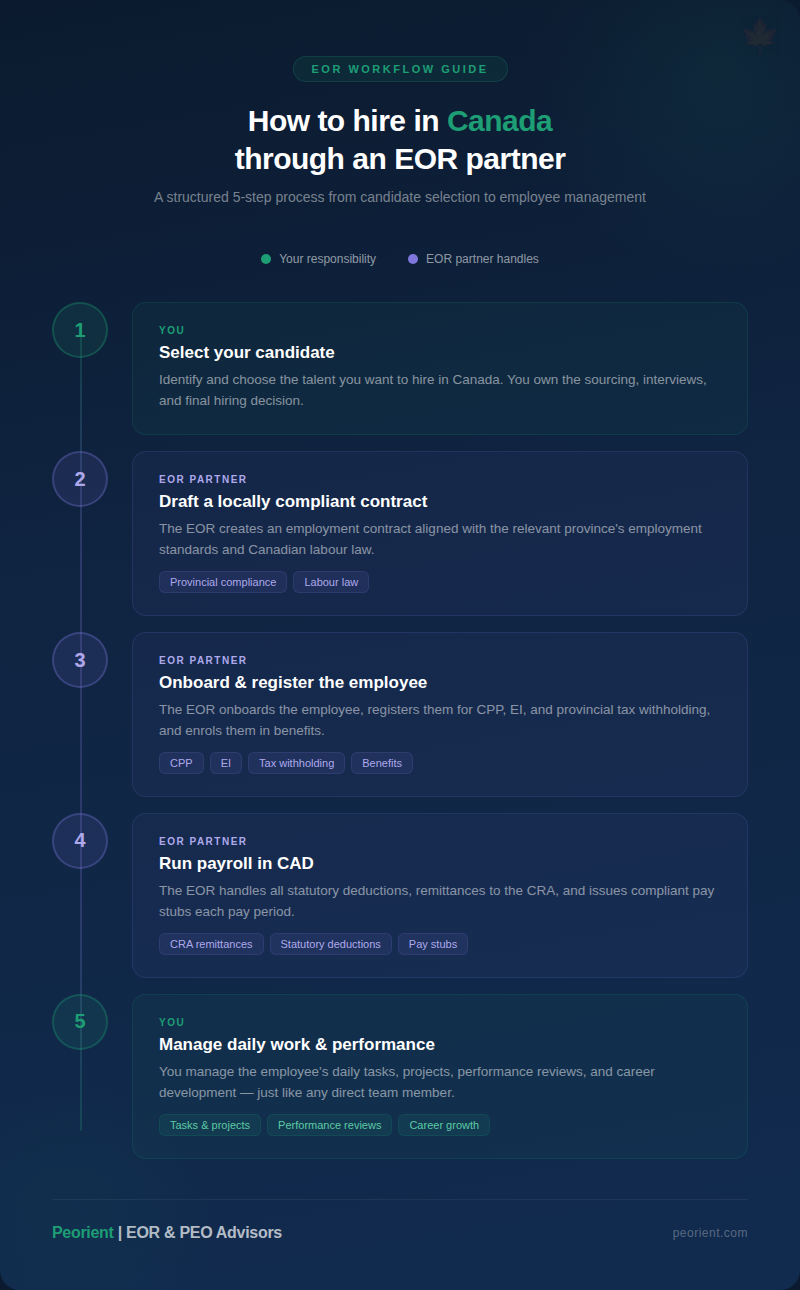
When you partner with an EOR to hire in Canada, the workflow follows a structured process:
You identify and select the candidate you want to hire.
The EOR drafts a locally compliant employment contract aligned with the relevant province’s employment standards.
The EOR onboards the employee, registers them for CPP, EI, and provincial tax withholding, and enrols them in benefits.
The EOR runs payroll in CAD, handles all statutory deductions and remittances to the CRA, and issues pay stubs.
You manage the employee’s daily tasks, projects, performance reviews, and career development.
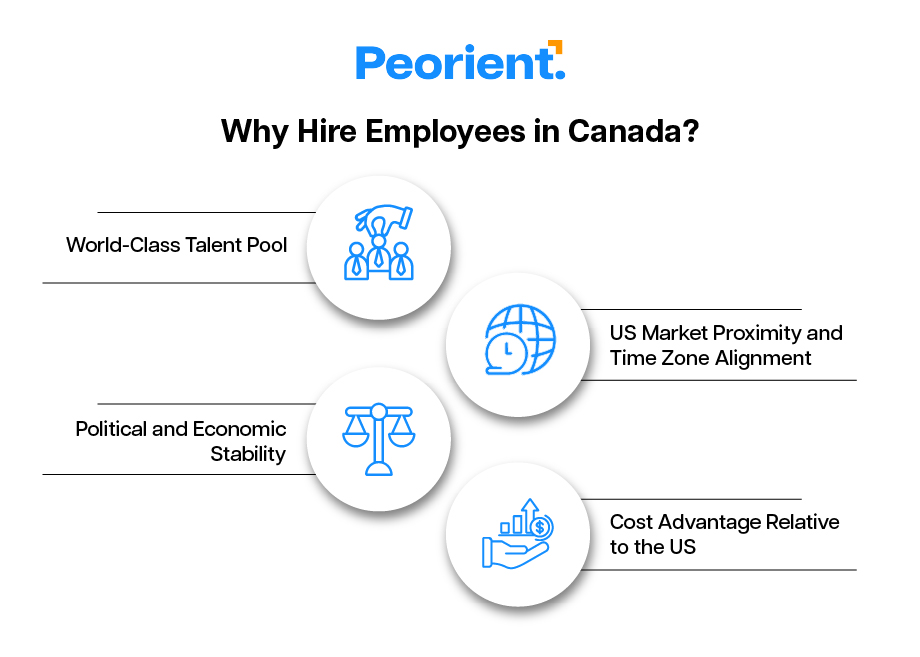
Why Hire Employees in Canada?
Canada offers a combination of talent depth, political stability, regulatory predictability, and geographic proximity to the US market that few countries match. Here are the key reasons international companies choose Canada for expansion.
World-Class Talent Pool
Canada produces globally competitive graduates in technology, engineering, finance, healthcare, and AI research. Cities like Toronto, Montreal, and Vancouver are established tech hubs. Montreal is a world leader in AI and machine learning research. The country’s immigration policies actively support skilled workforce inflow through programs like the Global Talent Stream, which can process work permits in as little as two weeks.
US Market Proximity and Time Zone Alignment
Canadian teams operate in overlapping time zones with major US business centres, enabling real-time collaboration. Cultural alignment and strong English (and French) communication skills make cross-border team integration seamless. Many companies use Canadian teams to support North American and global customers.
Canada ranks consistently high in global indices for rule of law, regulatory enforcement, and business environment stability. Employment disputes follow predictable legal frameworks. Intellectual property protections are robust. The country is a member of USMCA (formerly NAFTA), G7, and G20.
Cost Advantage Relative to the US
While not a “low-cost” destination, Canadian salaries in technology and professional services are typically 20–40% lower than equivalent roles in US tech hubs like San Francisco, New York, or Seattle. The favourable CAD-to-USD exchange rate amplifies this advantage for US-based companies.
Canadian Employment Law: What EORs Must Navigate
Canada operates under a federal system where employment standards are primarily controlled at the provincial level. This creates a layered compliance environment that is one of the most complex in the developed world for international employers.
Federal vs. Provincial Jurisdiction
Federal laws govern taxation, employment insurance, and the Canada Pension Plan. They apply to federally regulated industries such as banking, telecommunications, and interprovincial transportation. Provincial employment laws regulate wages, working hours, overtime, leave policies, termination notice, and severance for all other employers. Each of Canada’s 10 provinces and 3 territories has distinct employment standards legislation.
📋 Provincial Complexity Example
An employee working remotely from Nova Scotia for a Toronto-headquartered company must be paid under Nova Scotia’s employment standards and have Nova Scotia provincial tax withheld; not Ontario’s. The province of work, not the province of the employer’s head office, determines which rules apply.
2026 Statutory Payroll Obligations
Every Canadian EOR must accurately calculate and remit the following payroll deductions and employer contributions:
Obligation
Employee Rate (2026)
Employer Rate (2026)
CPP (first ceiling)
5.95% on earnings $3,500–$74,600
5.95% (matching)
CPP2 (second ceiling)
4% on earnings $74,600–$85,000
4% (matching)
Employment Insurance (EI)
$1.63 per $100 insurable earnings
$2.28 per $100 (1.4x employee rate)
Max EI Insurable Earnings
$68,900
$68,900
Max Annual EI Premium
$1,123.07 (employee)
$1,572.30 (employer)
Federal Income Tax
14%–33% (progressive brackets)
Withholding at source
Provincial Income Tax
Varies by province (4%–20%+)
Withholding at source
🚨 Quebec Exception
Quebec operates its own pension system (QPP instead of CPP) and parental insurance plan (QPIP instead of federal EI parental benefits). EI premium rates for Quebec employees are $1.30 per $100 of insurable earnings (vs. $1.63 elsewhere). EOR providers must maintain separate payroll configurations for Quebec employees.
Minimum Wage by Province (2026)
Province/Territory
Minimum Wage (per hour)
Effective Date
Nunavut
$19.75
Sep 1, 2025
British Columbia
$18.25 (forthcoming)
Jun 1, 2026
Federal
$18.15 (forthcoming)
Apr 1, 2026
Yukon
$17.94
Apr 1, 2025
Ontario
$17.60
Oct 1, 2025
Prince Edward Island
$17.00 (forthcoming)
Apr 1, 2026
Newfoundland & Labrador
$16.35 (forthcoming)
Apr 1, 2026
Quebec
$16.10
May 1, 2025
Manitoba
$16.00
Oct 1, 2025
New Brunswick
$15.90 (forthcoming)
Apr 1, 2026
Saskatchewan
$15.35
Oct 1, 2025
Alberta
$15.00
Since 2019
Employee Benefits Expectations
While Canada has universal public healthcare (Medicare), employer-sponsored supplementary benefits are considered standard for full-time professional roles. A competitive benefits package in Canada typically includes:
Extended health insurance (prescription drugs, paramedical services, hospital upgrades)
Dental coverage (preventive, basic, and major dental)
Vision care (eye exams, glasses, contact lenses)
Group life insurance and accidental death & dismemberment (AD&D)
Short-term and long-term disability insurance
Employee Assistance Program (EAP) for mental health support
Group RRSP or pension plan contributions
Vacation, Leave, and Statutory Holidays
Vacation entitlement begins at two weeks (10 days) annually for most provinces after one year of service, increasing to three weeks after five years in many jurisdictions. Vacation pay is typically 4% of gross earnings (6% after longer tenure in some provinces).
Statutory holidays vary by province. Ontario recognises nine public holidays. Quebec follows a different statutory calendar that includes the National Holiday (June 24) but excludes some federal holidays. British Columbia has 10 statutory holidays. Employers must track and comply with the specific holiday schedule for each employee’s province of work.
Parental leave provisions are generous by global standards. Federal EI-funded parental leave allows up to 12 months of standard benefits or up to 18 months of extended benefits (at a reduced rate). Quebec’s QPIP provides separate and often more generous parental leave benefits.
10 Best Employer of Record Services in Canada for 2026
The Canadian EOR market includes both global platforms with broad country coverage and regional specialists with deep Canadian expertise. The providers listed below have been evaluated based on payroll ownership model, provincial compliance depth, benefits administration, onboarding speed, pricing transparency, and real-world client outcomes.
EOR in Canada Provider Comparison Chart
Provider
Payroll Model
Compliance
Benefits
Pricing
Best For
Deel
Hybrid (owned + partners)
Strong
Standard to advanced
$500–$700/mo
Rapid scaling teams
Remote
Direct entity
Strong
Advanced
$599–$799/mo
Distributed teams
Papaya Global
Partner-led
Good
Payroll-centric
Custom
Finance reporting
Velocity
Hybrid + Advisory
Strong
Flexible
Custom
Regulated industries
Safeguard
Hybrid
Strong
Robust
Custom
Enterprise complexity
Oyster
Hybrid
Good
Standard
$499–$699/mo
Remote-first startups
G-P
Partner-led
Broad
Comprehensive
Premium
Large enterprises
Atlas
Direct + HRIS
Strong
Integrated
Custom
Scale + HR
Horizons
Hybrid
Strong
Basic to mid
$399–$599/mo
Fast market entry
Boundless
Direct entity
Strong
Standard
$500–$650/mo
US–Canada hiring
Detailed Canada EOR Provider Reviews
Deel
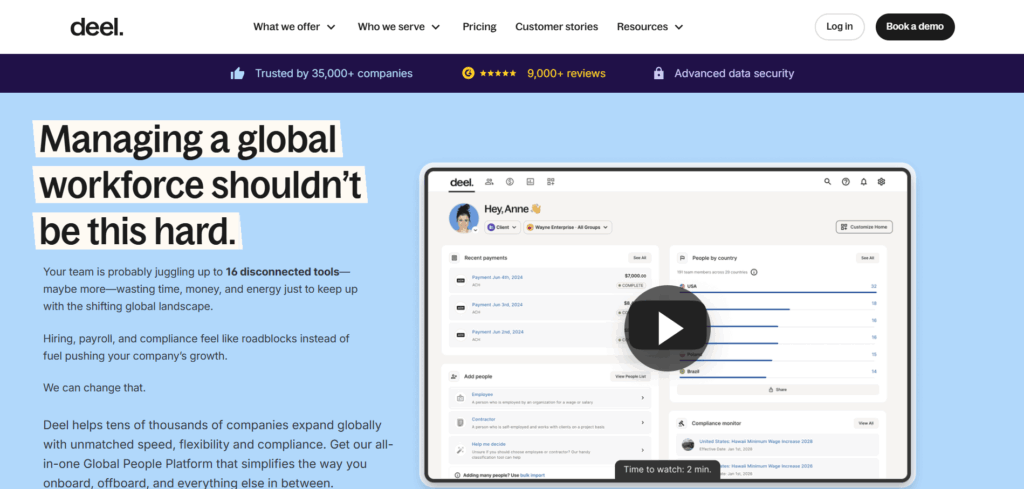
Deel is one of the most widely adopted EOR platforms globally, known for fast onboarding and a streamlined compliance workflow. In Canada, Deel supports federal and provincial tax compliance through a hybrid model that combines owned entities with local partners. Onboarding typically completes within three to five business days. Documentation is centralised, and contract generation is automated.
Benefits are compliant but lean toward standardised packages. The hybrid model supports scale across multiple countries but can create slight service variation between provinces depending on the local partner. Deel suits companies that prioritise speed-to-hire and need to scale teams quickly across Canadian provinces alongside other countries.
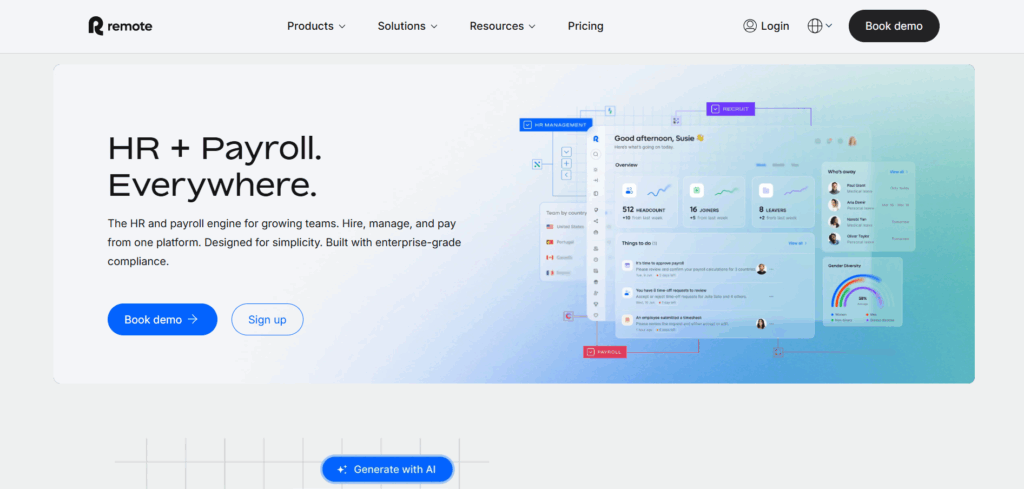
Remote operates through a direct-entity model in Canada, meaning it employs workers through its own legal entity rather than through third-party partners. This generally provides more consistent payroll execution and compliance handling across provinces. Remote’s benefits packages are more structured and customisable than most peers, with dental, vision, and group RRSP options.
Employee experience is a clear focus. Payslips, leave tracking, and documentation are transparent and accessible through a self-service portal. Remote works well for companies building stable, long-term distributed teams in Canada with five or more employees.
Papaya Global is payroll-intelligence-led by design. Its strength lies in consolidated reporting, multi-country analytics, and financial dashboards. Canadian payroll is managed through local partners, with compliance alerts and standardised processes that reduce manual oversight. The platform favours finance teams and CFOs who need clear visibility across multiple international jurisdictions.
Local issue resolution may take longer than with direct-entity providers due to the partner layer. Papaya fits organisations prioritising payroll reporting and analytics over deep HR customisation.
Velocity Global (Now Pebl)
Velocity Global emphasises compliance advisory and risk mitigation. Its Canadian EOR services handle regulated roles effectively, with payroll, benefits, and contracts adapted by province. Immigration support is available for roles requiring work permits or LMIA applications. Legal guidance tends to be proactive rather than reactive.
Velocity Global suits risk-sensitive industries such as financial services, healthcare, and energy, as well as companies making senior-level hires where compliance errors carry outsised consequences.
Safeguard Global
Safeguard Global brings deep payroll expertise with a platform that supports multi-entity payroll, statutory reporting, and complex tax scenarios. Canadian compliance handling is strong, particularly for organisations with employees in multiple provinces. Benefits administration is robust and well-structured.
The platform favours control and visibility over speed. Onboarding can take longer than newer tools. Safeguard Global fits enterprises managing payroll complexity at scale where accuracy is paramount.
Oyster
Oyster is designed for remote-first teams and startups. It supports Canadian payroll and compliance with a user-friendly employee interface. Contractor-to-employee transitions are supported, making it useful for companies that initially engage Canadians as contractors and later convert them to full-time.
Benefits and payroll are compliant but standardised. Complex payroll questions may take longer to resolve. Oyster works well for startups and smaller distributed teams under 20 employees.
Globalization Partners (G-P)
Globalization Partners operates a large global EOR network. In Canada, services are delivered through local partners. Payroll and HR compliance are reliable, and support is high-touch and enterprise-oriented. The platform is mature and well-established.
Pricing is typically premium compared to newer entrants. Onboarding can be slower due to manual processes. G-P suits large organisations with structured expansion plans and existing enterprise vendor relationships.
Atlas
Atlas uses a direct-entity model combined with HRIS (Human Resource Information System) functionality. Canadian payroll, benefits, and compliance are integrated into one system, improving visibility and reducing dependency on third parties. Workforce analytics support long-term planning.
Atlas suits enterprises scaling teams while aligning EOR with broader HR systems and wanting a unified platform for payroll, benefits, and people analytics.
Horizons (Remote People)
Horizons blends owned entities with partners to enable fast entry into Canada. Payroll and statutory benefits are handled locally, and compliance coverage is strong across provinces. Pricing is competitive for mid-market companies.
Interface limitations may appear in complex multi-province setups. Horizons fits mid-sized companies entering Canada for the first time with a team of two to ten employees.
Boundless
Boundless focuses specifically on North America. It operates a direct entity in Canada, with consistent payroll and compliance handling across provinces. Benefits are straightforward and compliant.
The platform is less global than competitors like Deel or Remote but regionally strong. Boundless suits companies hiring exclusively across the US and Canada who want a provider specialised in North American employment law.
If you are a startup and country is not a factor that restricts your expansion plan, we recommend you read our detailed blog on EOR services for startups.
Struggling to Compare EOR Providers?
Peorient cuts through the noise with clear comparisons and context-driven guidance tailored to your specific hiring goals.
Choosing between an EOR and establishing your own Canadian legal entity is one of the most consequential decisions in international expansion. Here’s how they compare across the dimensions that matter most:
Factor
Employer of Record (EOR)
Own Legal Entity
Time to hire
1–3 weeks
3–6 months
Setup cost
$0 (no entity required)
$15,000–$50,000+
Monthly cost
$400–$900 /employee/month
Internal admin + legal + payroll
Compliance liability
EOR assumes liability
Your company assumes liability
Payroll & tax filings
Handled by EOR
Your responsibility
Benefits admin
Managed by EOR
Your responsibility
Operational control
Full (you manage the work)
Full
IP ownership
Assign via contract
Direct ownership
Scalability
Add/remove employees easily
Fixed overhead regardless of headcount
Best for
Testing markets, small teams, speed
Long-term, large teams, full control
💡 Strategic Tip
Many companies start with an EOR for their first 5–10 Canadian hires, then transition to their own entity once the team reaches 15–20 employees and the long-term commitment is clear. Planning for this transition early; especially around employment contract portability, avoids legal complications later.
How to Choose the Right EOR in Canada: Selection Criteria
Selecting an EOR should begin with a clear risk assessment, not a features comparison. The following criteria separate providers that are genuinely strong in Canada from those with surface-level coverage.
Critical Evaluation Factors
Payroll Ownership Model: Does the provider operate its own entity in Canada, or does it rely on third-party payroll partners? Direct entities generally provide faster resolution and more consistent compliance.
Multi-Province Compliance Depth: Canada has 13 distinct employment jurisdictions. Ask how the provider handles provincial differences in minimum wage, overtime, vacation, termination notice, and statutory holidays.
Quebec-Specific Capability: Quebec’s QPP, QPIP, and French-language requirements create a compliance layer that trips up many providers. Verify whether the EOR handles Quebec independently or through a sub-partner.
Benefits Customisation: Can you offer competitive supplementary health, dental, vision, disability, and RRSP/pension plans, or are benefits a rigid, standardised package?
Termination and Offboarding Support: Canadian termination law includes statutory notice periods, severance obligations, and common-law reasonable notice. Ask how the provider handles involuntary terminations and whether legal counsel is included.
Immigration and Work Permit Support: If hiring non-Canadian residents, verify whether the EOR supports LMIA applications, Global Talent Stream processing, and work permit sponsorship.
Data Privacy and PIPEDA Compliance: Employee data must be handled in accordance with the Personal Information Protection and Electronic Documents Act (PIPEDA) and any applicable provincial privacy legislation.
Pricing Transparency: Request a full cost breakdown including base fees, benefits premiums, setup fees, and termination costs. Hidden fees are a common issue in this space.
Questions to Ask Before Signing
Does the EOR own its own entity in Canada, or does it rely on third-party vendors?
Does it have local legal counsel on staff? How quickly can it resolve payroll errors? Does it handle Quebec separately?
What happens to employment contracts if we transition to our own entity?
EOR Costs and Pricing in Canada
EOR pricing in Canada typically ranges from $400 to $900 per employee per month. This range reflects differences in service depth, payroll model, benefits complexity, and provider margin. Here’s what drives cost variation:
What’s Typically Included
Employment contract drafting and compliance
Payroll processing in CAD with all statutory deductions
CPP, CPP2, and EI employer contributions
Federal and provincial income tax withholding and remittance
T4/T4A year-end tax form issuance
Basic statutory benefits administration
Compliance monitoring and regulatory updates
What May Cost Extra
Supplementary health, dental, and vision insurance premiums (passed through at cost or marked up)
Group RRSP or pension plan administration
Immigration and work permit support (LMIA, Global Talent Stream)
Equity compensation administration
Termination and severance processing fees
Setup or onboarding fees (one-time, $200–$500)
💰 Cost Perspective
Incorporating a Canadian legal entity typically costs $15,000–$50,000 in legal, accounting, and registration fees, plus ongoing annual compliance costs of $10,000–$25,000. For teams under 15 employees, an EOR is almost always more cost-effective. The break-even point where entity ownership becomes cheaper depends on team size, duration, and complexity.
Risks of Using an EOR in Canada (and How to Mitigate Them)
While EOR services significantly reduce compliance risk compared to direct hiring without local expertise, they are not risk-free. Understanding the potential pitfalls helps you make a more informed provider selection.
Misclassification Risk: If the EOR or your company structures the relationship incorrectly, the CRA may reclassify workers. Ensure the EOR uses proper employment contracts, not disguised contractor arrangements.
Provider Insolvency or Exit: If your EOR provider exits the Canadian market or faces financial difficulties, your employees’ employment continuity is at risk. Choose providers with direct entity ownership and strong financial backing.
Limited Control Over Benefits: Standardised benefits packages may not be competitive enough to attract top talent in Canada’s competitive hiring market. Negotiate for custom benefits where possible.
Termination Complexity: Canadian common law provides employees with “reasonable notice” that can significantly exceed statutory minimums, especially for senior or long-tenured employees. Ensure your EOR has legal counsel experienced in Canadian termination law.
IP Assignment Gaps: Intellectual property created by EOR-employed workers should be assigned to your company through explicit contractual provisions. Verify that the employment contract includes robust IP assignment clauses.
Data Residency Concerns: Some EOR providers store employee data outside Canada. Under PIPEDA and provincial privacy laws, this may require additional consent or safeguards. Ask about data storage locations.
Core EOR Services in Canada
A comprehensive Canadian EOR should provide the following services. Use this checklist to evaluate providers against your specific requirements:
Service
Standard (Most EORs)
Premium (Select EORs)
Employment contracts
Province-compliant drafting
Custom terms + legal review
Payroll processing
Monthly/bi-weekly in CAD
Multi-currency + real-time dashboards
Tax withholding & remittance
CPP, EI, federal & provincial
CPP2, WCB, provincial health levies
Benefits administration
Basic statutory
Full supplementary health + RRSP
Compliance monitoring
Annual updates
Real-time regulatory alerts
Termination support
Statutory notice processing
Common-law notice + legal counsel
Immigration support
Basic guidance
LMIA, Global Talent Stream, permits
Equity compensation
Not included
Stock option/RSU administration
Employee self-service
Pay stubs + leave requests
Full HRIS portal
How Peorient Helps You Choose the Right EOR
Choosing an EOR is not about brand recognition. It is about the right fit for your specific hiring goals, risk exposure, team size, and long-term plans. The right provider depends on your context, not marketing claims.
Peorient helps businesses compare Employer of Record services in Canada with clarity and objectivity. Our platform delivers structured insights, clear side-by-side comparisons, and practical guidance grounded in trusted industry partnerships. We focus on how providers actually operate in Canadian provinces, not how they market themselves.
Our advisory services include shortlist development, cost-benefit analysis, contract review guidance, and transition planning for companies that may later establish their own Canadian entity.
Peorient’s EOR advisory is absolutely free! Always!
Ready to Hire in Canada with Confidence?
Peorient helps you compare EOR providers based on real operational capabilities. Our advisory is 100% free and includes expert shortlisting, cost analysis, and transition planning.
An Employer of Record (EOR) in Canada is a third-party organisation that legally employs workers on your behalf. It handles payroll, tax withholding, CPP and EI contributions, benefits administration, and compliance with federal and provincial employment laws. Your company manages the employee’s daily work while the EOR manages all legal employment obligations.
How much does an EOR cost in Canada?
EOR services in Canada typically cost between $400 and $900 per employee per month, depending on service depth, benefits complexity, and provider. Some providers charge additional setup fees ($200–$500) and pass through supplementary benefits premiums at cost.
Can I use an EOR to hire both full-time employees and contractors in Canada?
Yes, most EOR providers support both full-time employee engagement and independent contractor management. However, contractor classification in Canada must follow strict CRA guidelines. Misclassification carries penalties including back taxes, CPP/EI contributions, and interest.
How long does it take to onboard an employee through a Canadian EOR?
Onboarding typically takes one to three weeks, depending on documentation completeness, the province of employment, and whether immigration support is required. Direct-entity EOR providers generally onboard faster than those relying on third-party partners.
What are the standard working hours in Canada?
Standard working hours range from 40 to 44 hours per week, depending on the province. Overtime eligibility is mandatory beyond these thresholds. Overtime pay is typically 1.5 times the regular hourly rate. Some provinces have daily overtime thresholds as well (e.g., British Columbia triggers overtime after 8 hours in a day).
Does my company need a Canadian bank account when using an EOR?
No. The EOR manages all payroll accounts, tax remittances, and employee payments in CAD. Your company pays the EOR a consolidated invoice (typically monthly) in your preferred currency. The EOR handles all in-country banking.
What happens if I want to transition from an EOR to my own entity?
Transitioning from an EOR to your own Canadian entity requires terminating the EOR employment relationship and re-hiring employees under your entity. This must be handled carefully to preserve employee tenure, benefits continuity, and to comply with termination notice and severance requirements. Plan for this transition early and verify that your EOR supports it contractually.
What are the risks of non-compliance when hiring in Canada?
Non-compliance consequences include CRA audits, back payment of unpaid taxes and contributions, financial penalties, interest charges, and reputational damage. In serious cases, non-compliance can result in restrictions on future hiring in Canada. Provincial employment standards violations can result in additional fines and employee claims.
Rohan Deshmukh
HR Technology Strategist
MBA, SIBM Pune · PHRi Certified · Wharton People Analytics
Rohan brings 9+ years in HR technology consulting and workforce analytics. Previously at Deloitte Human Capital, he specializes in PEO platform evaluations, payroll automation, and total cost of employment modeling for distributed global teams.