A detailed, independent guide comparing 10 Deel alternatives for 2026. Covers Remote, Rippling, Oyster HR, Multiplier, Papaya Global, G-P, Velocity Global, Remofirst, Skuad, and Remunance. Includes pricing tables, pros/cons grids, and a decision framework for picking the right EOR.
Deel is still the broadest EOR platform in 2026, but it is not the best fit for every company.
Remote is the strongest option for owned-entity compliance. Rippling stands out for businesses that want HR, IT, and Finance unified in one ecosystem. Multiplier and Remofirst remain strong price-focused choices, while Oyster delivers one of the cleanest user experiences in the market.
For India-specific hiring, compliance, payroll, and long-term workforce support, Remunance remains the strongest specialist.
Deel built its name on speed. You could hire an engineer in Germany or a contractor in Brazil in under a week, without registering a local entity. For many teams, that was enough.
But speed alone no longer wins the shortlist.
Pricing has climbed. Deel’s EOR service is now listed at $599 per employee per month, which adds up fast when your team grows past a handful of hires. A 10-person international team costs roughly $71,880 per year before benefits, onboarding fees, and any add-ons.
Legal structure matters more, too. Deel uses a mix of owned entities and local partners, which means compliance depth varies by country. If your legal or finance team is asking who is actually liable in France or Brazil, the answer with Deel can get murky. Remote and G-P both offer cleaner entity-ownership chains.
There is also the ongoing litigation with Rippling, which has put procurement teams on alert. And for companies that only hire in one or two countries, paying for Deel’s 150-country coverage feels like renting a stadium for a dinner party.
If you are new to the EOR model, our What is an Employer of Record guide covers the basics before you evaluate providers. If you have already benchmarked pricing across vendors, check our global payroll services cost breakdown for 2026 market rates.
Different EOR providers solve different operational problems. This comparison highlights where alternative platforms may offer stronger advantages.
| Pain Point | Who It Hits Hardest | Better Alternative |
|---|---|---|
| $599/mo EOR pricing | Startups, sub-10 person teams | Remofirst ($199), Multiplier ($400) |
| Partner entities in key markets | Legal teams needing owned-entity chain | Remote, G-P |
| Support response delays | Complex jurisdictions, compliance queries | Velocity Global, Remunance |
| Rippling-Deel litigation risk | Enterprise procurement | Remote, Rippling (ironically) |
| Too much platform for simple needs | 1-3 country hiring | Oyster, Multiplier |
| India-specific depth | Companies scaling in India | Remunance |
| IT + HR fragmentation | US-first teams going global | Rippling |
Peorient is an independent EOR advisory platform. We do not accept placement fees from any provider on this list.
Our scoring framework assessed entity ownership model, pricing transparency, country coverage depth (not just breadth), support quality verified via G2 and Capterra reviews from 2025–2026, onboarding timelines, and India-specific operational capability.
Compare pricing, entity structure, country coverage, and ideal use cases to identify the right Employer of Record platform for your expansion plans.
| Provider | EOR Price/mo | Countries | Entity Model | Best Use Case |
|---|---|---|---|---|
| Remote | $299-$599 | 100+ | Owned | Multi-country, compliance-first |
| Rippling | $499-$700+ | 80+ | Mixed | US-first, unified HR + IT |
| Oyster HR | $599 | 180+ | Partner | Mid-market, clean UX |
| Multiplier | $400 | 150+ | Mixed | Budget-conscious global hiring |
| Papaya Global | Custom | 160+ | Partner | Enterprise payroll consolidation |
| G-P | $800-$1,000+ | 180+ | Mixed | Enterprise, 30+ countries |
| Velocity Global | $399-$599 | 185+ | Owned+Partner | High-touch, M&A, immigration |
| Remofirst | $199 | 180+ | Partner | Startups, cost-sensitive teams |
| Skuad | Custom | 160+ | Partner | Volume discounts, APAC |
| Remunance | Custom | India | Owned (India) | Deep India EOR specialist |
We compare providers across 30+ evaluation criteria and match businesses to the right EOR partner based on hiring goals, compliance requirements, expansion plans, and operational fit.
Get a Free, Unbiased EOR ConsultationBest for: Owned-entity compliance and predictable pricing
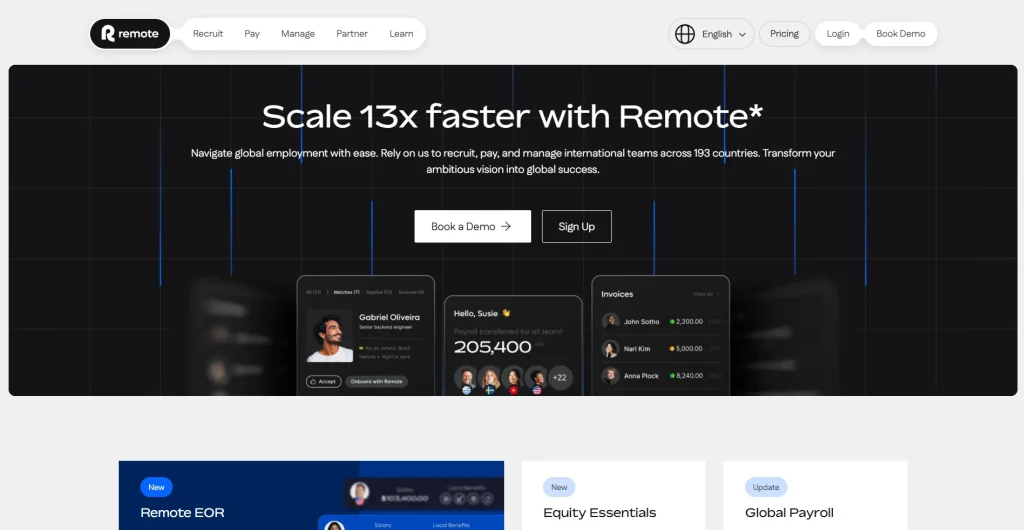
Remote built its entire infrastructure on a single principle: own the entities, don’t just partner with them. In markets where Deel relies on third-party partners, Remote has its own legal presence. That makes a real difference when your general counsel asks who carries liability for a wrongful termination in France.
Coverage currently spans 100+ countries for EOR, with owned entities in 60+ markets. That is narrower than Deel’s 150+ country list, but the entity depth is stronger where it counts.
Remote’s pricing is among the clearest in the category. The EOR plan starts at $599/employee/month on monthly billing and drops to $299/employee/month on annual billing for eligible markets. There are no setup fees and no per-seat onboarding charges.
If you are hiring across 10+ countries and need a board-ready compliance narrative, Remote is probably the safest single vendor. Our international PEO services guide explains when owned-entity structures matter most for risk management.
A quick breakdown of where Remote performs strongly and where businesses may face operational or pricing tradeoffs.
| Pros | Cons |
|---|---|
|
Owned entities in 60+ countries
|
Narrower country breadth than Deel
|
|
Transparent per-employee pricing
|
Higher cost vs budget alternatives
|
|
Strong in Germany, UK, Netherlands
|
Slower onboarding in some markets (2-4 weeks)
|
|
Clean employer-of-record liability chain
|
Fewer HRIS integrations
|
|
Free contractor plan available
|
Best for: Legal-first teams, CFO-driven procurement, companies hiring across 10+ countries with compliance transparency requirements.
Pricing: EOR from $299/mo (annual) to $599/mo (monthly). Contractor management: $29/contractor/month.
Best for: US-first companies unifying HR, IT, and Finance
Rippling does not compete with Deel on EOR-only terms. Its pitch is different: one platform for your entire workforce operating system, from payroll and benefits to device management and app provisioning.
When you onboard an engineer in Portugal using Rippling, the system can simultaneously provision a laptop, grant GitHub access, and run local payroll. That level of automation is not available anywhere else in the category.
EOR coverage spans 80+ countries, well below Deel’s breadth. The strength is in US domestic depth plus a handful of high-demand international markets. Our Rippling competitors overview has more detail on how Rippling stacks up against pure-play EOR providers.
Pricing is quote-based. EOR typically runs $499 to $700+ per employee per month depending on country and module tier. If you are comparing Rippling to Deel, the calculus is not just EOR cost. It’s whether the consolidated platform value offsets the per-seat premium.
As of 2026, Deel and Rippling are involved in active litigation over alleged corporate espionage and employee intelligence concerns.
Enterprise procurement and legal teams should review the latest case status, contractual implications, and compliance exposure before final vendor selection.
| Pros | Cons |
|---|---|
|
Full HR + IT + Finance in one platform
|
EOR covers only 80+ countries
|
|
Eliminates multi-vendor complexity
|
Complex setup, 4-8 weeks for full rollout
|
|
90-second payroll processing
|
Higher total cost with all modules
|
|
600+ native integrations
|
Active litigation with Deel adds risk
|
|
Strong US domestic payroll depth
|
Not ideal for pure EOR buyers
|
Best for: US-headquartered teams already on Rippling domestic HR, companies that want to eliminate fragmentation across HR, IT, and Finance.
Pricing: Base HR from $8/user/month. EOR custom-quoted, typically $499-$700+/employee/month.
Review pricing, compliance depth, platform fit, and real-world support quality before choosing the right EOR provider.
Read Our In-Depth Deel Competitors ReviewBest for: Remote-first teams that prioritise platform experience
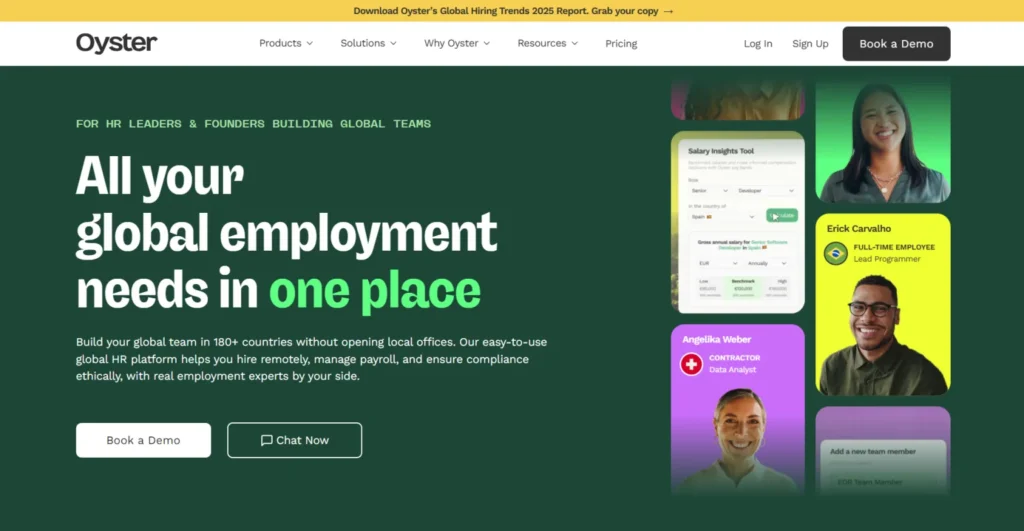
Oyster is the cleanest product in this category. The onboarding flow is guided and intuitive. Benefits are easy to compare and configure. Hiring managers can complete most workflows without opening a support ticket.
Coverage runs to 180+ countries for payroll, with EOR available in 120+ markets. Pricing is straightforward: EOR at $599/employee/month, contractor management starting at $29/contractor/month.
The platform’s standout feature is Total Rewards, a built-in compensation benchmarking tool that compares your offer against local market data. For distributed teams hiring across different cost-of-labour markets, that context is genuinely useful.
Oyster uses a partner-entity model in most markets, similar to Deel. The differentiator is UX and mission alignment rather than structural compliance depth. If your team cares about a remote-first, worker-positive approach to employment, Oyster resonates in a way that more utilitarian platforms do not.
| Pros | Cons |
|---|---|
|
Best UX and onboarding experience
|
Partner entities, not owned, in most markets
|
|
Total Rewards compensation benchmarking
|
EOR pricing matches Deel at $599 per month
|
|
Contractor management from $29 per month
|
Fewer enterprise integrations
|
|
No setup fees
|
Not the deepest support for complex terminations
|
|
Strong in emerging markets
|
Best for: Mid-market companies (10-100 employees) that want an intuitive platform their hiring managers can navigate without HR Ops support.
Pricing: EOR: $599/employee/month. Contractors: $29/contractor/month. Global Payroll: $25/employee/month.
Best for: Cost-effective global hiring with pricing transparency
Multiplier’s main selling point is flat-rate pricing at $400/employee/month for EOR, making it one of the most affordable credible EOR options between Remofirst and Oyster.
Coverage spans 150+ countries. The platform is strongest in Southeast Asia, with its Singapore headquarters giving it faster local support than Western-HQ’d competitors in that region.
Multiplier also offers multi-currency payroll, expense management, and stock option support in one product. For startups and scale-ups with a distributed team in the $1,000-$5,000 monthly payroll range per country, Multiplier delivers solid value.
The main limitation is support depth for complex compliance scenarios. Oyster and Remote offer more robust human interpretation of collective agreements and unusual termination situations.
| Pros | Cons |
|---|---|
|
Flat $400 per month EOR pricing with transparent structure
|
Less compliance depth for complex EU markets
|
|
Strong APAC coverage and regional support
|
Support quality may vary across regions
|
|
Multi-currency support including crypto payout options
|
Fewer enterprise integrations than Rippling
|
|
Good onboarding for Southeast Asia hiring
|
Limited US domestic payroll capability
|
|
Competitive contractor management pricing
|
Best for: Budget-conscious companies expanding in Asia, startups prioritising predictable costs, teams with APAC as the primary hiring region.
Pricing: EOR: $400/employee/month. Contractor management: $40/month per contractor.
Most EOR providers publish list pricing, but annual commitments often unlock discounts ranging from 15–25% depending on hiring volume and contract structure.
Bundling EOR with contractor management, payroll, or compliance services in a single agreement can create additional leverage during negotiations.
Always bring competitor pricing or proposal benchmarks into the discussion before signing long-term contracts.
Best for: Enterprise payroll consolidation across 8+ countries
Papaya Global approaches the category from a finance-first angle. Its core product is multi-country payroll consolidation, not EOR-first hiring. If you are a CFO trying to get a single, auditable view of labour costs across 12 countries, Papaya’s reporting layer is the strongest in the market.
Coverage spans 160+ countries. Onboarding typically takes 4-8 weeks, which is slower than Deel or Remote. But the payroll engine and total cost of ownership modelling tools justify that timeline for enterprise buyers running 12-24 month budget cycles.
Pricing is custom-quoted. Papaya does not publish rates, which makes upfront comparison harder. Budget for the higher end of the market if your team size exceeds 100 employees across multiple countries.
For a broader comparison of enterprise HR platforms, our best HRIS systems review covers Papaya alongside Workday, Rippling, and other enterprise-grade tools.
| Pros | Cons |
|---|---|
|
Best-in-class multi-country payroll reporting
|
Pricing is opaque and custom-quoted only
|
|
Finance-friendly audit trails
|
4-8 week implementation timeline
|
|
Strong support for 20+ country operations
|
Not built for small teams or fast hiring
|
|
Real-time FX and cost visibility
|
Less intuitive UI than Oyster
|
Best for: Finance-led reviews, companies with payroll complexity across 8+ countries, enterprises needing consolidated TCO modelling.
Pricing: Custom-quoted. Expect premium pricing for enterprise deployments.
Best for: Enterprise buyers needing category-pioneer credibility
G-P invented the modern EOR category in 2012. That history still carries weight in enterprise procurement reviews where vendor tenure matters as much as feature sets.
Coverage is 180+ countries with a mix of owned and partner entities. Their EOR pricing ranges from $800 to $1,000+ per employee per month, making them the most expensive option on this list. That premium pays for a rebuilt platform (launched in 2024), established compliance teams, and a sales process that enterprise legal and procurement teams trust.
G-P does not offer mass payout tools or contractor-first workflows. The product is built around full-time employment, with enterprise implementation timelines and service levels to match.
One note: G-P’s platform has historically carried UI debt from its older product. The 2024 rebuild addressed some of this, but current G2 reviews still flag UX as a weak point relative to Oyster or Remote.
| Pros | Cons |
|---|---|
|
180+ countries with a long global operating track record
|
$800-$1,000+ monthly pricing makes it the most expensive option
|
|
Enterprise procurement and compliance-friendly workflows
|
Slower sales cycles and implementation timelines
|
|
In-house compliance teams across major hiring markets
|
UI experience still behind Oyster and Remote
|
|
Full-time employment focus backed by strong SLAs
|
No mass payout or contractor management tools
|
Best for: Large enterprises (500+ employees) needing 30+ country EOR coverage, companies where vendor tenure and enterprise procurement compliance matter.
Pricing: $800-$1,000+/employee/month. Custom enterprise agreements available.
Our advisors evaluate global EOR providers across compliance depth, pricing structure, operational scalability, onboarding quality, and country-specific expertise.
Book a Free Advisory Call with the Peorient TeamBest for: High-touch support, M&A integrations, immigration
Velocity Global rebranded to Pebl in late 2025 but the underlying product has strong continuity. The platform covers 185+ countries and operates with a mix of owned entities and vetted local partners.
What sets Velocity Global apart is the quality of its human support layer. Account management is genuinely consultative, not just triage-based. If you are navigating a post-M&A workforce integration, running visa sponsorships, or hiring into unusual markets, their in-house immigration and legal teams add real value that self-serve platforms cannot match.
Pricing runs $399-$599/employee/month, sitting between Multiplier and G-P. For companies willing to pay a modest premium over budget alternatives in exchange for hands-on support, Velocity Global is a strong contender.
If you are building a team in Canada, our EOR in Canada guide covers how Velocity Global and other top providers perform in that market specifically.
| Pros | Cons |
|---|---|
|
185+ countries coverage
|
Higher pricing than budget alternatives
|
|
Best-in-class human support quality
|
Less automation than Rippling or Deel
|
|
In-house immigration and legal teams
|
Implementation can run 6-12 weeks
|
|
160+ cross-border M&A deals on record
|
Less suited for pure contractor management
|
|
Consultative account management
|
Best for: Companies managing M&A integrations, visa-heavy hiring, or complex regulatory markets where human advisory support matters more than platform speed.
Pricing: $399-$599/employee/month. Custom pricing for volume and enterprise accounts.
Best for: Startups and early-stage teams watching every dollar
Remofirst starts at $199/employee/month, the lowest published EOR price from a credible provider in 2026. For a 5-person international team, that saves roughly $24,000 per year compared to Deel’s list price.
Coverage spans 180+ countries through a partner-entity model. The platform covers the essentials: contract generation, payroll processing, leave management, and compliance documentation. You will not find Rippling-level automation or Oyster-level UX, but the fundamentals work.
Support is responsive but operates at smaller scale. There is no dedicated account manager below significant volume thresholds. For relatively straightforward markets (UK, Canada, India, Philippines), that is fine. For complex terminations in Germany or Brazil, you may want additional legal counsel.
Remofirst is particularly well-suited for companies hiring in India on a tight budget. For a deeper look at India-specific EOR options, our best EOR in India guide compares Remofirst, Remunance, Deel, and Remote on India-specific compliance depth.
| Pros | Cons |
|---|---|
|
$199 per month EOR pricing, lowest in the credible segment
|
Support depth limited for complex jurisdictions
|
|
180+ country global coverage
|
No dedicated account manager at lower pricing tiers
|
|
No minimum employee headcount requirements
|
Less automation than premium competitors
|
|
Clean onboarding for straightforward hiring markets
|
Platform UI feels basic compared to Oyster
|
Best for: Seed and Series A startups, bootstrapped companies, teams hiring first 2-5 international employees in lower-complexity markets.
Pricing: EOR: $199/employee/month. Contractor management: $25/contractor/month.
Best for: Scaling teams seeking volume discounts in APAC
Skuad covers 160+ countries with custom-quoted pricing that rewards volume. If you plan to hire 20+ employees across the same set of countries, Skuad’s volume-discount model can bring per-seat costs below most published flat rates.
The platform handles EOR, contractor management, and multi-currency payroll. Its APAC coverage is particularly strong, with dedicated compliance and payroll infrastructure in India, Singapore, Australia, and the Philippines.
For small businesses evaluating a broader range of HR tools alongside EOR, our best HRIS systems for small businesses guide positions Skuad relative to full-stack HRIS alternatives.
Skuad does not suit teams that need rapid onboarding or a self-serve-first experience. Their strength is in structured, volume-oriented deployments where procurement negotiates rates upfront.
| Pros | Cons |
|---|---|
|
Volume discount pricing for teams with 20+ hires
|
Pricing is custom-only and not transparent upfront
|
|
Strong APAC compliance infrastructure
|
Slower onboarding compared to Deel or Remote
|
|
Handles EOR, contractor, and payroll in one platform
|
Less suited for small teams or single-country hiring
|
|
Good India and Singapore operational coverage
|
Limited US domestic capabilities
|
Best for: Mid-market companies scaling distributed teams in APAC, procurement-led buying processes, organisations needing 20+ seats with negotiated pricing.
Pricing: Custom-quoted. Volume discounts start at 10+ employees. Request a demo for pricing.
Best for: Deep India EOR with 21+ years of local expertise
Every EOR platform on this list covers India. Only one was built for India. Remunance operates exclusively in the Indian market, with 21+ years of in-country experience handling payroll, PF, ESI, professional tax, gratuity, and the full spectrum of Indian labour law.
When a global provider enters India, they typically partner with a local entity to handle compliance. Remunance is that local entity. Their knowledge of state-by-state tax rules, the nuances of contract-to-employee transitions under Indian law, and the practical realities of Indian banking make them the strongest specialist in the market.
Pricing is custom-quoted based on headcount and services. For companies hiring more than 5 employees in India, the depth-to-cost ratio typically beats any global provider.
Read our full Remunance review on Peorient for a detailed assessment of their payroll accuracy, support quality, and compliance track record.

India’s labour law ecosystem involves both central and state-level regulations, including frameworks such as the Shops and Establishments Act, Payment of Gratuity Act, EPF, ESIC, Professional Tax, and state-specific compliance requirements.
A global EOR covering 150+ countries may not always have the in-house operational depth required to navigate state-level edge cases, payroll interpretations, regional labour practices, and compliance escalation handling within India.
| Pros | Cons |
|---|---|
|
21+ years of operational experience in the Indian market
|
India-only focus with no global EOR capability
|
|
Deep expertise in state-level Indian labour law compliance
|
Custom pricing requires a discovery and consultation call
|
|
Full payroll handling including PF, ESI, PT, and gratuity
|
Less self-serve and more relationship-led operational support
|
|
Direct entity execution instead of partner relay structures
|
Not ideal for companies avoiding India-specific vendors
|
|
Highly personalised support and compliance coordination
|
Best for: Any company hiring in India that wants genuine specialist compliance depth rather than a global platform’s generalised India coverage.
Pricing: Custom-quoted. Ideal for 5+ India employees. Contact via Peorient for pricing benchmarks.
Compare Remunance against Deel, Remote, and other India-covering providers across compliance depth, payroll execution, onboarding quality, and local expertise.
Read the Full Remunance ReviewAll prices below reflect published or market-reported 2026 rates. Most providers offer 10-25% discounts on annual commitments. Custom enterprise pricing is available for 20+ hires at all major providers.
| Provider | EOR/mo | Contractor/mo | Payroll/mo | Free Trial? |
|---|---|---|---|---|
| Deel | $599 | $49 | $29 | Demo only |
| Remote | $299-$599 | $29 | $29 | Free contractor |
| Rippling | $499-$700+ | Custom | $8+ base | Demo only |
| Oyster HR | $599 | $29 | $25 | Demo only |
| Multiplier | $400 | $40 | Custom | Demo only |
| Papaya Global | Custom | Custom | Custom | Demo only |
| G-P | $800-$1,000+ | N/A | N/A | No |
| Velocity Global | $399-$599 | Custom | Custom | Demo only |
| Remofirst | $199 | $25 | Custom | Demo only |
| Skuad | Custom | Custom | Custom | Demo only |
| Remunance | Starting from $99 | N/A | Custom | Consultation |
Published EOR fees rarely reflect the actual long-term operational cost. Businesses should evaluate onboarding fees, benefits coordination markups, offboarding charges, HRIS seat costs, currency conversion spreads, and ongoing compliance support expenses.
Most buyer mistakes in this category come from starting with features. Start with your specific constraint instead.
| Your Situation | Start Here |
|---|---|
| Budget is the hard limit | Remofirst ($199), then Multiplier ($400) |
| Compliance certainty is non-negotiable | Remote (owned entities), then G-P |
| You are hiring mainly in India | Remunance, then Remofirst |
| You are US-first and want one platform | Rippling, then Deel |
| UX matters for non-HR hiring managers | Oyster, then Remote |
| You have 30+ countries to cover | Deel, then G-P |
| You need M&A or visa support | Velocity Global (Pebl) |
| CFO-driven with 8+ country payroll | Papaya Global |
| You want volume discounts for scale | Skuad, then Multiplier |
Ask every shortlisted provider: for each country where you plan to hire, is the entity owned or a third-party partner?
A partner entity is not automatically worse. But you need to know the answer before signing, not after a compliance issue arises.
G2 and Capterra reviews from 2025-2026 show a consistent pattern: slow escalation for complex compliance questions is the most common complaint across Deel, Oyster, and G-P standard accounts. Velocity Global and Remunance consistently receive the strongest support ratings in their respective segments. Check the Peorient review hub for our ongoing assessments.
Build a 12-month cost model. Include: EOR monthly fees, onboarding and offboarding charges, benefits administration markups, FX spreads, and any HRIS platform fees. Our global payroll services cost guide includes a template you can adapt for your specific hiring plan.
We have benchmarked 40+ EOR providers across 100+ countries to help teams compare pricing, onboarding costs, compliance depth, and operational fit.
There is no single answer. The right Deel alternative is the one that solves your specific constraint.
If compliance certainty is your priority, choose Remote or G-P.
If budget is the constraint, start with Remofirst.
If you are already using Rippling domestically, adding Rippling EOR is the path of least resistance.
If your team is expanding in India, Remunance delivers depth that no global provider can match.
If platform experience matters to your hiring managers, Oyster is the cleanest product in the category.
And if you genuinely need to hire across 20+ countries fast, Deel is still the most efficient single platform for that specific use case.
What Peorient recommends before you sign anything: build the 12-month cost model, verify entity ownership in your key markets, check 2025-2026 support reviews on G2, and talk to at least two providers. If you want help shortlisting, our independent EOR advisory service compares providers across 30+ criteria at no cost to you.
No vendor fees. No platform bias. Just the right Employer of Record recommendation based on your hiring model, compliance needs, and expansion goals.
Get a Free, Unbiased Provider RecommendationDeel remains the broadest single-platform EOR provider. For companies hiring across 5+ countries who want speed and a single dashboard, it is still the default starting point. The case against Deel is specific: price sensitivity, owned-entity requirements, or an existing Rippling stack.
Remofirst at $199/employee/month is the lowest published price from a credible EOR provider. For contractor management only, Remote and Oyster both offer plans starting at $29/contractor/month, below Deel's $49.
In most cases, yes, there is a transition period. Employment contracts are tied to the EOR entity. Switching involves new contract issuance, which requires employee consent in some jurisdictions. Most providers will help manage the transition, but allow 4-8 weeks for complex markets.
Yes. Many companies use a global EOR (like Deel or Remote) for most countries and a specialist like Remunance for India. This is called a split-provider model. It adds administrative overhead but often delivers better compliance depth and cost-effectiveness for India-heavy teams. Our best EOR in India guide covers this approach in detail.
A PEO co-employs workers in markets where you have an existing entity. An EOR acts as the sole legal employer, enabling you to hire without an entity. For most international hiring situations, EOR is the relevant model. Our international PEO services guide explains the structural difference with worked examples.
In markets where Deel uses a partner entity, a third-party local company is the actual legal employer, not Deel. Deel manages the relationship and platform experience, but compliance liability sits with the local partner. For most markets, this works fine. For high-stakes terminations or disputes in complex jurisdictions, the chain of accountability is less clean than an owned-entity provider.
Cost of Living vs Salary in India: A 2026 Guide for Global Employers
India pairs some of the world’s lowest living costs with fast-rising, city-specific salaries, so the real question for global employers is not whether pay is cheap but whether it is fair. This guide maps cost of living against salary across India’s main hubs to help you set competitive, compliant offers.