Global payroll services help businesses manage employee payments across multiple countries by handling taxes, compliance, multi-currency processing, and reporting. They simplify international hiring and ensure accurate, timely, and compliant global payroll operations.
Managing payroll in a single country is complex. Across several countries, it gets much more complicated. That is where global payroll services come into play for organisations expanding into new geographies. Global payroll services are aimed at leveraging automation, compliance, and real-time reporting. Therefore, these organisations can pay their workers in another country accurately, on time, and without breaking any local laws.
Cost will always be a deciding factor when selecting a global payroll service.
How much does global payroll cost?
What are the hidden costs of per-employee pricing?
And what if you are the HR or finance team for 2026’s budget?
This in-depth pricing guide is meant to discuss how global payroll services are priced, average payroll costs, hidden payroll costs, and questions to ask before signing an agreement.
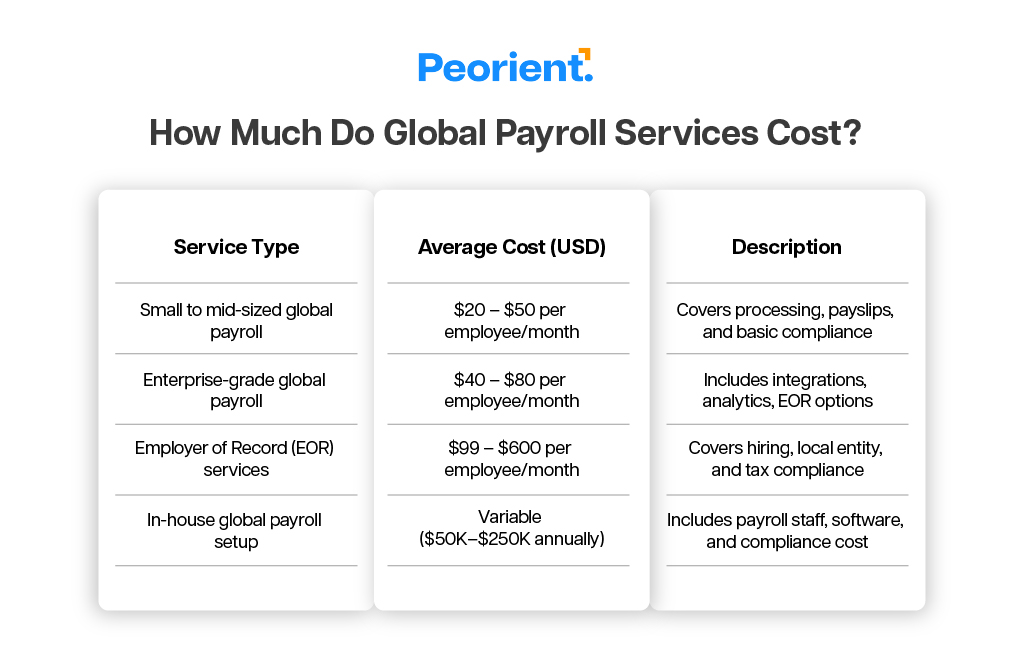
How Much Do Global Payroll Services Cost?
The price of global payroll services will be based on a number of factors. These include headcount, number of operating countries, pay frequency, and the complexity of compliance with local laws and regulations, as well as if you are using an Employer of Record (EOR) or your own legal entities.
Global payroll services are different from domestic payroll systems. Because they combine multi-country payroll processing with international tax, social contributions, and legal compliance with local labour law obligations within one platform.
Most providers in 2026 charge either a per-employee, per-month (PEPM) or per-payroll-run pricing method. According to the data collected from People Managing People, ADP, and Forbes Advisor.A simple rule applies — the more countries you operate in, the higher your per-employee cost. A company running payroll in five countries may spend $25 per employee monthly, while one managing payroll in 25 countries may pay closer to $50–$70.
Besides, costs depend heavily on whether payroll is centralised (managed by HQ) or localised (managed per country). Centralised models usually offer better economies of scale but require robust technology integration.
Global Payroll Services Cost Pricing Models
Familiarity with the pricing models will allow you to compare vendors in an exacting manner. Let’s go over the predominant models used in global payroll:
1. Per-Employee, Per-Month (PEPM)
Most providers in global payroll – most notably ADP and Deel – use this pricing model. The provider charges a fixed monthly fee for each active employee.
Example: If the PEPM rate is $35 and you have 300 employees in 6 countries, it will cost $10,500 each month (300 x $35), or roughly $126,000 annually. This model works well for companies that have a steady headcount with predictable payroll cycles.
2. Base Fee + Variable Employee Fee
Some providers charge a base platform fee, which includes the employee for free, then a variable charge for every employee after that. This model is common for hybrid global payroll systems using ERP tools.
Example: Base fee $150/month + $12 per employee/month. For 500 employees, that’s $150+ (500 x $12) = $6,150 monthly.
3. Per-Payroll-Run Pricing
Companies that run payroll on a weekly or bi-weekly basis tend to prefer this pricing model. The provider charges each time payroll is run; usually between $2 and $15 per employee, per run. This model may suit companies that pay hourly or contract employees, but it can significantly increase total annual spend.
4. Custom or Enterprise Pricing
Large enterprises operating in ten or more countries are generally offered custom pricing that includes dedicated compliance support, system integration, and local tax filing. These contracts usually start at $100,000+ annually, based on the complexity of the international environment.
5. Employer of Record (EOR) Pricing
An EOR acts as the legal employer in foreign countries, handling compliance, taxes, and payroll. Prices range widely from $99 to $600 per employee/month depending on the region. For example, EORs such as Deel, Remote, and Oyster typically bundle benefits administration and HR compliance with payroll processing in a way that relieves some of the enterprise risk for companies that do not have an operational local entity.
Pricing Comparison Table
Pricing Model
Cost Range
Best For
Advantages
Considerations
PEPM
$20–$50
Global SMEs
Predictable cost, easy budgeting
Cost rises with headcount
Base + Variable
$100–$500 + $10–$15 per employee
Mid-size firms
Transparent structure
Complex reconciliation
Per Payroll Run
$2–$15/employee/run
Hourly workforce
Flexible for variable schedules
More runs = higher cost
EOR
$99–$600/employee
No local entity
Compliance & tax included
Costlier long-term
Custom Enterprise
Starts $100K/year
Multinationals
Fully tailored support
Long contracts, onboarding time
Average Cost of Global Payroll Services
Let’s translate pricing into real-world estimates.
Middle East & Africa: $15–$35 PEPM (rising tech adoption)
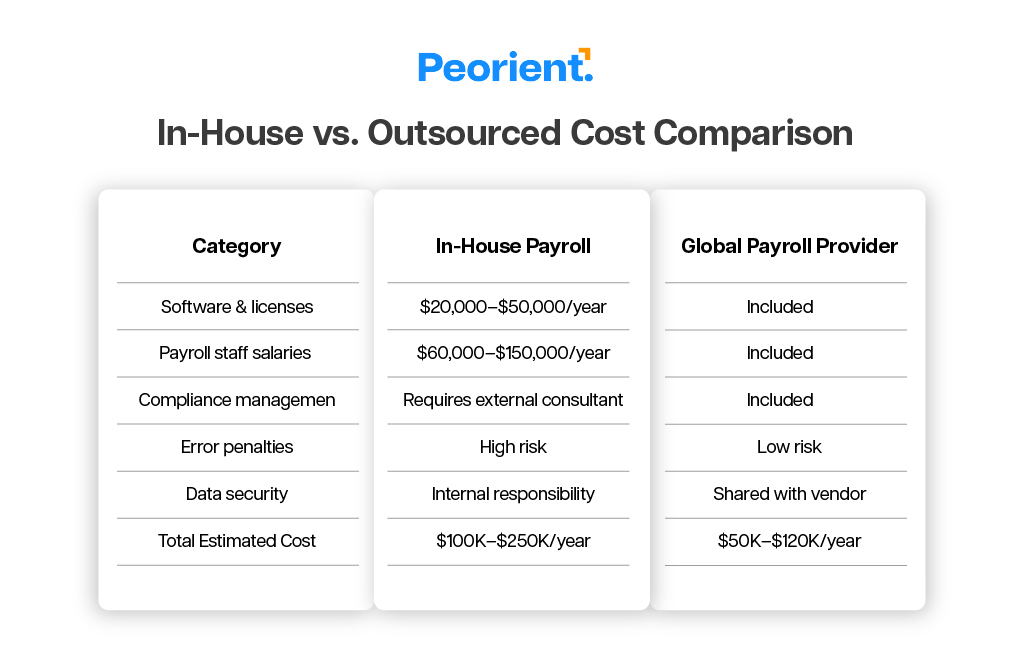
In-House vs. Outsourced Cost Comparison
Insight: Outsourcing global payroll can reduce administrative costs by 30–40% and improve compliance accuracy significantly. According to ADP, companies using global payroll platforms have achieved ROI up to 131% through reduced errors, automation, and time savings.
Additional Global Payroll Service Costs to Consider
Base pricing doesn’t reflect the full picture. The following are additional and hidden costs that most companies discover after signing a contract.
1. Implementation and Set-Up Fees
Vendors often charge setup fees for configuring and customising systems and onboarding employees and their HR information. Expect:
$1,000 – $10,000 for smaller firms
$25,000 and above for enterprises
Complications may also increase with multiple countries of employment, data migration, or if the payroll system integrates with an ERP system.
2. Country-Specific Fees
Some regions (e.g., France, Japan, or Brazil) have labour laws that are complicated, which may add to the vendor’s pricing to support compliance. In countries with significant regulation, the vendor may charge 5-15% per employee to support compliance.
3. Banking Fees and Currency Exchange
Paying an employee’s salary in local currency is considered a foreign exchange (FX) transaction that carries fees. The vendor or your bank may charge a fee between 0.5 and 3% of the gross salary for each payroll transaction. In addition, some payroll systems offer multi-currency wallets to limit the volatility associated with multiple currencies and leverage beneficial currency exchange rates.
4. Additional Runs for Payroll
Vendors tend to charge for off-cycle processing due to the added payroll run. If your business has resolution bonuses, commission add-ons, or monthly gross pay adjustments, you can expect to pay additional costs ranging from $2 to $10 per payslip processed.
5. Integration Cost
Multiple systems often need to integrate with the payroll function (e.g., HRIS, accounting software, timekeeping, etc.). APIs or middleware may be required for this task, which areas typically charge $2,000-$15,000 for, depending on your payroll and HR systems.
6. Compliance Costs
Filing local taxes, social contributions, and labour-required reports may be excluded from the base pricing. Some vendors charge between $100 and $500/month, per country, to support the recording or filing of government-required filings.
7. Maintenance Cost
Expenses may also be added on an incremental basis, as often countries are added to payroll, regulations change, or the system is upgraded. Such added costs are often charged quarterly or in advance as part of the vendor’s pricing schedule.
Hidden Cost Comparison Table
Cost Category
Typical Cost
Applies To
Description
Setup/Implementation
$1K–$25K
All
Onboarding, configuration, data migration
Currency Conversion
0.5–3% per transaction
Global payroll
FX & bank transfer fees
Country Surcharge
+5–15%
High-compliance markets
Added legal complexity
Integration
$2K–$15K
ERP/HRIS integration
Data sync, analytics
Compliance Filing
$100–$500/month
Per country
Tax, labor, or benefits filings
Additional Runs
$2–$10 per employee
Mid-cycle runs
Bonus or corrections
Tip: Always request a Total Cost of Ownership (TCO) breakdown from providers to avoid surprises.
For companies without a local entity, EOR payroll costs usually include gross salary, employer contributions, benefits, and the EOR service fee.
Questions to Ask Global Payroll Services Providers
Before signing a multi-year contract, your team must ask pointed financial and technical questions.
What pricing model do you use?
Is it PEPM, per payroll run, or base + variable?
Are setup and off-cycle runs included?
Which countries are included in your standard rate?
Are high-compliance countries billed separately?
What happens if we add a new country mid-year?
What exactly does the monthly fee cover?
Does it include tax filing, benefits, and employee self-service portals?
Do you provide Employer of Record (EOR) support?
What’s the incremental cost per employee?
Is the contract flexible for both full-time and contract workers?
What integrations are available?
Can it connect with our HRIS or ERP tools?
Are APIs free or billed separately?
How often do you update compliance rules?
Is compliance automatic or manually managed per country?
What penalties or guarantees exist for payroll errors?
Will the vendor absorb fines for incorrect filings?
How scalable is the pricing as we expand?
Does cost reduce with larger headcount?
Are there enterprise volume discounts?
Can you provide cost benchmarks from clients similar to us?
Benchmarking ensures you’re paying a fair market rate.
How transparent is your invoicing?
Can we see detailed billing by country, employee, or service?
Asking these questions upfront helps finance teams identify hidden costs, compliance gaps, and scalability challenges early.
The Bottom Line
Payroll has evolved to become more than a back-office function; it is a global compliance engine. As organisations scale globally, there is more to any payroll than pay cheques – for example, automation, compliance accuracy, multi-currency efforts, and jurisdictional expertise locally.
Here’s what organisations’ decision-makers need to consider:
The cost of a global payroll service ranges on average from $20 to $50 per employee/month, but the total cost of ownership depends on hidden costs, including setup, fugitive services (translation unknown), and compliance operational.
EOR models are best suited to organisations expanding their footprints in countries in which there is not yet an established local hire, but they will cost considerably more in the short term.
Outsourcing payroll takes time from decision-makers, reduces errors, and takes risk away from managing internal resources across borders.
The right vendor acts like a strategic partner for the organisation rather than just a processor, ensuring continuity, scalability, and efficiency for compliance in all aspects.
FAQs
1. What is the average cost of global payroll services?
The typical costs for ordinary global payroll vary from $20 to $50 per employee per month. For EOR services, the costs can be anywhere from $99 to $600, depending on the country and level of service.
2. What factors influence global payroll service pricing?
Key cost drivers include:
Number of employees and countries
Payroll frequency (monthly vs weekly)
Complexity of local compliance
Inclusion of EOR or entity management
Software integrations
Currency exchange and banking fees
Onboarding and setup complexity
3. Is outsourcing global payroll more cost-effective than in-house payroll?
Certainly. Outsourcing avoids the expense of software, staffing, and management of compliance. In-house software systems on a yearly basis can cost on average $100K–$250K. Outsourcing in HR typically can range from $50K to $120K. Additionally, outsourcing has fewer mistakes and fewer compliance issues. Outsourcing is the best choice financially for organisations with employee presence in many countries (5+) or organisations that have no HR and legal presence locally.
4. Are there hidden costs in global payroll services?
Yes. Here are some common hidden fees:
Setup and implementation fees
Country-specific compliance surcharges
FX conversion and transaction costs
Additional payroll runs for bonuses or corrections
Modules for integration and reporting
Make sure to always ask for a transparent breakdown of pricing before signing a contract.
5. Which promotes employee engagement better?
PEOs provide access to better benefits and HR support. HRIS platforms provide transparency and employee self-service, both of which develop engagement in their own unique ways.
Bottom Line
The real expense of global payroll services isn’t solely expressed in monthly per-employee fees. It is a combination of efficiency, compliance, and scalability. Once business owners, HR leaders, and finance teams get a better grip on all pricing factors and negotiate more straightforward contracts, they can make payroll a competitive differentiator, rather than just a cost.
US employee benefits are less about a long federal checklist and more about health insurance, state rules and competitive expectations. For a professional hire, budget roughly 25–35% above base salary before any EOR fee, then model family coverage and the employee’s work state separately.