Learn what an Employer of Record (EOR) is, how it works, and how much it costs. Includes EOR vs PEO comparison, country guides, legal liability breakdown, and expert provider picks for 2026.

An Employer of Record (EOR) is a third-party organisation that becomes the legal employer of a company's workforce in a foreign country, managing payroll, tax compliance, benefits, and employment contracts, while the client company retains full operational control of the employees.
Companies use EOR services to hire internationally without setting up a local legal entity, typically onboarding a fully compliant employee within 2–7 business days.
Hiring talent globally sounds straightforward until you discover that every country has a different employment framework, tax system, social insurance structure, and termination process. Setting up a legal entity in each market can take months and cost tens of thousands of dollars, before you have hired a single person.
An Employer of Record removes that barrier entirely. It provides the legal infrastructure your company needs to hire compliantly, quickly, and without the overhead of entity incorporation, in virtually any country in the world.
If you are hiring across several countries, read our full guide to what a Global Employer of Record is and how it works.
An Employer of Record (EOR) is a company that legally employs workers on behalf of another business. When you engage an EOR, it becomes the worker’s official employer under local law, handling all employment paperwork, payroll processing, statutory benefits, and tax filings while you direct the employee’s work, set their tasks, and manage their day-to-day performance.
Think of it as a legal wrapper around your international workforce. You get the talent; the EOR handles the legal complexity.
According to LinkedIn’s Global Talent Trends Report, over 70% of companies now consider access to global talent a top strategic priority, yet most lack the legal infrastructure to hire across borders quickly. EOR services fill that gap.
When a company partners with an EOR, the working relationship involves three parties: your company (client), the EOR provider, and the employee. Here is the standard operational flow:
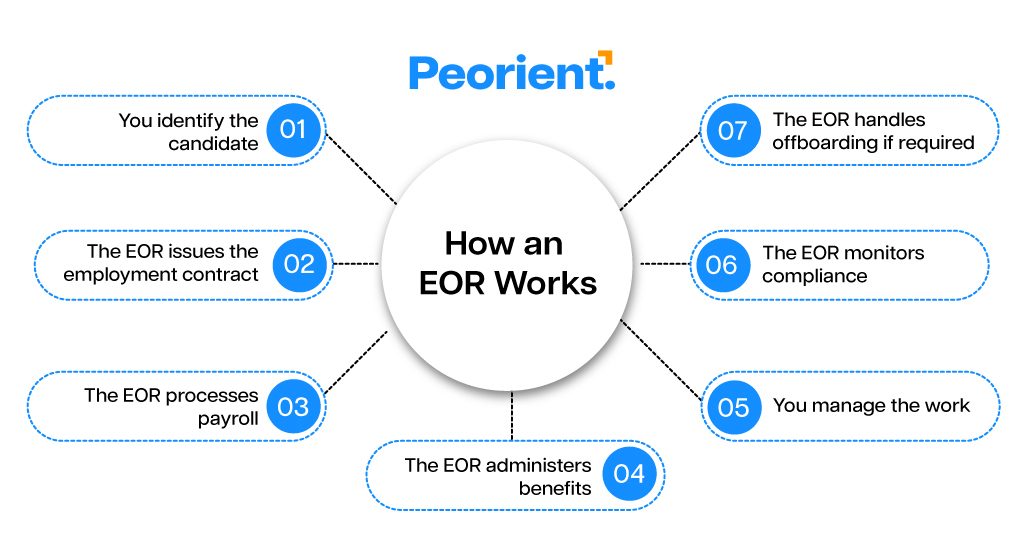
This division of responsibilities is fundamental. You control what work gets done. The EOR controls the legal employment relationship. Contracts, tax filings, benefits, and compliance are the EOR's domain. Projects, goals, and performance are yours. Clarity here prevents both operational confusion and legal risk.
The most common source of confusion in global HR is the difference between an EOR and a Professional Employer Organisation (PEO). Both involve outsourcing employment functions, but the legal structure is fundamentally different, and using the wrong model can create serious compliance exposure.
| Criteria | EOR (Employer of Record) | PEO (Professional Employer Org) |
|---|---|---|
| Legal employer | EOR is the sole legal employer | Co-employment: PEO and client company share employer status |
| Local entity required? | No: EOR provides its own entity | Yes: client must have a registered entity in-country |
| Best for | Hiring in new markets without entity setup | Enhancing HR in countries where you are already established |
| Compliance responsibility | Entirely with the EOR | Shared between PEO and client |
| Speed to hire | 2–7 days (typical) | Weeks to months (entity registration required first) |
| Cost model | Per-employee monthly flat fee | % of payroll or per-employee fee |
| Control over HR policies | Moderate: must follow EOR frameworks | High: client retains more HR autonomy |
| Ideal company size | Any: especially startups entering new markets | Mid-to-large companies already operating in a country |
| Employment risk | Lower: EOR bears employment liability | Shared risk between client and PEO |
If you don’t have a legal entity in the country where you want to hire, you need an EOR. If you already have an entity and want to outsource HR administration, a PEO may be more appropriate.
→ Relevant reading: What Is a PEO? Comprehensive Guide for Global Employers
Staffing agencies and EORs both involve third parties employing workers, but they serve fundamentally different purposes and suit different hiring scenarios.
| Criteria | Employer of Record (EOR) | Staffing Agency |
|---|---|---|
| Who finds the worker? | You (the client company) | The agency sources and supplies |
| Worker relationship | Long-term, full-time employment | Often temporary or contract-based |
| Compliance management | Full: EOR manages all local compliance | Partial: varies by agency |
| Strategic hire? | Yes: your chosen candidate | Not typically your direct hire |
| Payroll localisation | Fully localised to employee's country | Often standardised or centralised |
| Use case | Global expansion, remote teams, market entry | Temporary staffing, peak-load cover |
| Cost structure | Transparent monthly fee per employee | Markup on salary (typically 15–50%) |
Key distinction: A staffing agency finds and supplies workers. An EOR legally employs workers you have already found. If you’ve hired someone in a country where you have no entity, you need an EOR, not a staffing agency.
To get a detailed insight, also check our article covering employee vs contractor differences
EORs also support employee engagement by handling compliance onboarding and payroll
Setting up a foreign subsidiary can take 3–6 months and cost $15,000–$100,000+, depending on the country. An EOR allows you to onboard a fully compliant employee in as little as 48–72 hours. For companies testing new markets or responding to urgent talent needs, this speed advantage is decisive.
Employment law varies enormously by country. Germany’s Works Council co-determination rules, India’s Provident Fund contribution requirements, and Brazil’s CLT labour regime each demand specialised knowledge. An experienced EOR maintains in-country legal counsel and stays current with regulatory changes, removing compliance risk from your organisation.
→ Hiring in Germany specifically? Best Employer of Record Germany: Reviewed in 2026
Avoiding entity incorporation alone saves tens of thousands of dollars per market. Beyond setup costs, you eliminate ongoing costs of local accountants, HR consultants, registered offices, and compliance advisors. For most companies hiring fewer than 10 people in a new country, EOR is demonstrably cheaper than entity establishment.
Your HR team doesn’t need to become experts in 12 different labour law systems. The EOR absorbs contract drafting, multi-currency payroll, tax remittance across time zones, and benefits administration in local languages.
A reputable EOR understands local employment norms. Employees receive locally competitive benefits, onboarding in their own language, and HR support calibrated to their market. This reduces churn and strengthens your employer brand in new geographies.
In many countries, a long-term contractor who works exclusively for one company faces serious misclassification risk. An EOR converts that arrangement into a legitimate, fully compliant employment relationship, removing legal exposure from both your company and the worker.
→ See our full breakdown: Top 10 Benefits of Partnering with an Employer of Record
Don't settle for marketing materials. Let Peorient help you compare the top 10+ providers based on your specific hiring needs and compliance requirements.
Get a Free RecommendationEntering a new international market. You want to test demand in South Korea before committing to a full subsidiary. An EOR lets you hire a sales representative on the ground, legally and compliantly, in days, with no long-term entity commitment. If the market works, you scale. If not, you exit cleanly.
Building a remote-first global team. Distributed companies hiring engineers in Poland, designers in Colombia, and customer support staff in the Philippines face a patchwork of employment laws. An EOR with multi-country coverage handles each jurisdiction independently, giving you a single point of accountability.
Converting contractors to employees. Long-term freelancers working exclusively for your company are a misclassification liability in most jurisdictions. An EOR converts them to full-time employment status quickly, removing legal risk while preserving the working relationship.
Mergers, acquisitions, and restructuring. When acquiring a company with employees in countries where you have no entity, an EOR provides a temporary employment bridge — keeping staff legally employed while you complete entity registration or restructuring.
Startups and SMEs scaling globally. Early-stage companies can’t justify the overhead of entity setup in five countries. EOR services allow them to compete for global talent, offering locally compliant contracts and competitive benefits packages without the infrastructure.
→ Relevant reading: Top EOR Services for Startups in 2025
EOR pricing is rarely published transparently, but the industry follows a consistent structure. Understanding it helps you budget accurately and compare providers fairly.
| Pricing Model | What You Pay | Best For |
|---|---|---|
| Flat monthly fee | $199–$650 per employee | Most common; enables predictable budgeting |
| Percentage of salary | 10–15% of gross monthly salary | Less common; expensive at senior levels |
| Hybrid model | Base fee + country surcharge | Used in high-complexity jurisdictions |
| Complexity Tier | Example Countries | Typical Monthly Fee |
|---|---|---|
| Low complexity | UK, Australia, Canada, Netherlands | $199–$299 |
| Medium complexity | India, Germany, Singapore, Mexico | $299–$449 |
| High complexity | Brazil, China, Indonesia, Argentina | $449–$650+ |
| Usually Included in Monthly Fee | Often Charged Separately |
|---|---|
| Payroll processing and local bank transfers | Equity/stock option administration |
| Tax withholding and statutory filing | Background check coordination |
| Mandatory benefits enrolment | Private health insurance (above minimum) |
| Employment contract drafting | Termination support in complex jurisdictions |
| Onboarding and offboarding admin | Setup fee ($500–$2,000 per employee) |
EOR is almost always more cost-effective for fewer than 8–10 employees in a single market. Beyond that threshold, entity setup begins to offer better unit economics; particularly for long-term, committed market presence.
Not all EOR providers are equal. The right choice depends on your target markets, headcount, and how much specialist support your team needs. Evaluate providers against these six dimensions before signing any agreement.
| Evaluation Area | What to Look For | Red Flag |
|---|---|---|
| Geographic coverage | Owned legal entities in your target countries (not just partner networks) | Partner-only coverage: compliance quality varies |
| Compliance track record | In-country labour lawyers, proactive law change monitoring | Relies entirely on external counsel with no local team |
| Service scope | Contract drafting, benefits admin, HR support in employee's language | Payroll-only model with no HR advisory capacity |
| Technology | Real-time dashboard, payroll reports, HRIS integrations | No self-serve access; everything manual and ticket-based |
| Pricing transparency | All-in quotes including setup, termination, and surcharge fees | Headline rate only: hidden fees common |
| Employee experience | Local-language onboarding, fast HR response times | Offshored support with no local presence |
| Scalability | Dedicated account manager; can scale from 1 to 50+ employees | No account ownership; support degrades at scale |
→ See our independently reviewed shortlist: Best Employer of Record (EOR) Services in India
One of the most important, and least discussed, aspects of EOR arrangements is the allocation of legal liability. Understanding this protects both your company and your workers.
| Scenario | Liable Party |
|---|---|
| Payroll error or late payment | EOR (they are the employer of record and process payroll) |
| Wrongful termination claim | Shared: depends on who directed the termination decision |
| Workplace discrimination (day-to-day) | Client company (they control working conditions) |
| Non-payment of statutory benefits | EOR (responsible for benefits enrolment and administration) |
| Work-related injury (duty of care) | Shared: EOR provides insurance; client controls work environment |
| Immigration/work permit violations | EOR (employment authorisation); Client (if work scope changes) |
| Data privacy violations (GDPR) | EOR as data processor; Client as data controller |
Even though the EOR is the legal employer, courts in some jurisdictions have held the client company jointly liable when the client exercised excessive control over working conditions in ways that resembled direct employment. Maintain clear operational boundaries between your management role and employment decisions.
EOR complexity, and therefore cost and risk, varies dramatically by country. The following snapshots cover five of the most commonly targeted EOR markets.
India is the world’s fastest-growing EOR market. Key compliance requirements include Provident Fund (12% of basic salary), Professional Tax (state-specific), and Shops & Establishment Act registration. Termination requires 30–90 days’ notice, depending on tenure. EOR onboarding time: 5–10 business days.
→ In-depth guide: Best Employer of Record (EOR) Services in India
Germany has some of Europe’s most employee-protective labour laws, including Works Council consultation rights, strict termination protections, and mandatory social insurance contributions (~20% of gross salary per employer). Probationary periods can be up to six months. Collective bargaining agreements (Tarifverträge) may override individual contracts.
→ Full guide: Best Employer of Record Germany: Reviewed in 2026
The US has no single federal employment framework — state laws vary enormously. California, for example, has specific rules on pay transparency, meal breaks, and non-compete enforceability that differ significantly from Texas or Florida. An EOR must be state-registered, not just federally registered, and must monitor state-level law changes independently.
→ Full guide: Employer of Record USA: The Complete 2026 Guide to Hiring Without a US Entity
Brazil’s CLT (Consolidation of Labour Laws) is one of the most complex employment frameworks globally. Mandatory benefits include 13th-month salary, FGTS (8% of salary in a severance fund), vacation with 33% bonus, and extensive termination notice obligations. A specialist EOR with deep Brazil expertise is essential — this is not a market for generalist providers.
Singapore is a comparatively EOR-friendly environment with clear employment frameworks, low social contribution rates, and a straightforward Skills Development Levy. It is often used as a regional hub when building a Southeast Asia presence. EOR onboarding time: 3–5 business days.
Also Read:
→ In-depth guide: Best Employer of Record in Canada
Hiring requirements vary significantly by jurisdiction. Let Peorient help you compare the best-fit providers for your target markets: from Germany and the UK to India and Brazil.
Book a Free ConsultingThe table below compares leading EOR providers on key dimensions. Prices are estimates; always request a custom quote for your specific countries and headcount.
| Provider | Est. Price/Employee/Month | Entity Model | Compliance Depth | Best For |
|---|---|---|---|---|
| Deel | $499–$699 | Hybrid | ★★★★ | Multi-country speed, tech startups |
| Remote | $599 flat | Direct entity | ★★★★★ | Compliance-first distributed teams |
| Remunance | $99 | Direct entity (India) | ★★★★★ | Deep India expansion |
| Rippling | From $500 | Hybrid | ★★★★ | HRIS-integrated global teams |
| Gusto | From $199 | Direct (US) | ★★★★ | US-primary, limited international |
| WorkMotion | €349–€599 | Direct entity | ★★★★★ | Germany and EU hiring |
| Oyster | $399–$599 | Partner-led | ★★★ | Remote-first startups |
An Employer of Record removes the single biggest barrier to global hiring: the requirement to establish a local legal entity before you can employ anyone. For companies entering new markets, building distributed teams, or managing contractor relationships across borders, EOR services provide a legally sound, operationally efficient, and cost-effective alternative to full entity incorporation.
The right EOR partner acts as more than a compliance vendor — it becomes the legal and administrative backbone of your international workforce strategy, freeing your team to focus on finding the right people and helping them do their best work.
Whether you’re hiring one engineer in Berlin or building a thirty-person team across Southeast Asia, the EOR model gives you the legal infrastructure of a multinational without the overhead of becoming one.
Skip the sales calls. Let our independent advisors provide a side-by-side comparison of the best providers for your specific global expansion.
Get Your Free RecommendationAn EOR is the sole legal employer of your workers and does not require you to have a registered entity in the country. A PEO operates in a co-employment arrangement alongside your own registered entity. If you have no local entity, you need an EOR. If you already have an entity and want to outsource HR administration, a PEO may be more appropriate.
EOR services typically cost between $199 and $650 per employee per month, depending on the country and scope of services. High-complexity markets like Brazil, China, or Indonesia sit at the higher end. Most providers also charge a one-time setup or onboarding fee of $500–$2,000 per employee, and some charge separately for termination handling.
Yes. When using an EOR, the EOR entity is the legal employer named on the employment contract, responsible for payroll, tax filing, and statutory benefits. Your company retains full operational and day-to-day management control but is not the legal employer of record.
Yes. This is one of the most common EOR use cases. If you have long-term contractors working exclusively for your company in a country where you have no entity, an EOR can bring them on as fully compliant employees, eliminating misclassification risk.
In most markets, an EOR can onboard a new employee within 2–7 business days once the worker's details and compensation are confirmed. Compare this to 3–6 months for establishing a local entity from scratch.
Most major EOR providers cover 100–180+ countries. However, coverage quality varies — some providers use partner networks in smaller markets rather than owned entities, which can reduce compliance reliability. Always verify whether the EOR has its own legal entity in your specific target country.
The EOR is legally responsible for payroll accuracy. Any underpayment or late payment to employees is the EOR's liability. Ensure your agreement includes an indemnification clause covering payroll errors caused by the EOR's own processes, and verify the provider's SLA for error resolution.
Yes. EOR services are designed to be scalable in both directions. Most providers have no minimum headcount requirement, making them ideal for companies hiring a single employee in a new market. Many providers offer the same pricing and service quality regardless of headcount.

Written by
Director of Global Hiring Advisory · 6+ years experience
Arjun runs the global hiring advisory practice at Peorient. He previously led APAC operations at an EOR startup and advised at Singapore's EDB, overseeing workforce launches in 18 countries across EOR, PEO, and subsidiary models.
US Employee Benefits Guide 2026: Costs & Requirements
US employee benefits are less about a long federal checklist and more about health insurance, state rules and competitive expectations. For a professional hire, budget roughly 25–35% above base salary before any EOR fee, then model family coverage and the employee’s work state separately.