Global payroll enables businesses to pay international employees accurately across multiple countries while maintaining compliance with local tax laws, currency regulations, and labor requirements. It centralizes payroll processing and reduces administrative and compliance risks.
Expanding teams across countries is exciting, but the admin side is complex. Each country has its own rules for taxes, filings, benefits, and labour laws. Even small payroll errors can lead to delays or fines.
Global payroll services simplify this by handling pay, taxes, benefits, and compliance across different regions without requiring companies to learn every local rule.
If you’re considering global payroll services, this blog will guide you. It will cover the basics and common challenges. It will also explain the types of providers and what to consider when choosing one.
The Ultimate Guide to Managing Global Payroll Operations
Payroll processing in one country involves complex tasks. These include tax deductions, benefits, attendance tracking, statutory contributions, and year-end reporting.
Now, multiply that complexity 5 or 20 times by location, and the burden is exponential. Global payroll solutions make processes uniform. They blend local rules and keep each payroll cycle consistent.
But “consistency” doesn’t mean oversimplification. A solid global payroll platform must balance standardisation with local labour laws compliance. That balance sets apart solutions that work well from those that only add more tasks.
Let’s go through every part of that equation.
What Is the Definition of Global Payroll?
Global payroll means managing employee pay and taxes in many countries. It includes managing legal filings, benefits, and compliance requirements. It brings all payroll tasks together in one system. It still considers local employment laws and tax rules.
A global payroll system includes:
Salary processing based on country-specific compensation rules
Tax calculation and statutory deductions
Social security contributions
Leave and attendance integration
Benefits administration
Country-specific reporting and year-end documentation
Compliance management
Global payroll servicesaim to ensure international payroll is accurate, compliant, and smooth. This is true no matter how many countries a business operates in.
What Is the Difference Between “Global Payroll” and “Global Payroll Operations”?
Although the terms are often confused as one, they are not the same thing.
Global Payroll
This means handling payroll in various countries. It includes calculations, payments, taxes, filings, and documentation.
Global Payroll Operations
This refers to the entire ecosystem surrounding payroll, including:
Local entity setup or partnership
Data collection from different teams
Compliance tracking and updates
Reporting consolidation
Integration with HR systems
Governance and audit readiness
Vendor coordination
Payroll is the “WHAT.” Payroll operations is the “HOW.”
A company can use payroll software. However, weak global payroll operations cause delays, compliance problems, and more admin work.
If you do not have a local entity, compare global payroll v/s EOR payroll before choosing a model.
How Does Global Payroll Work?
Many organisations use a hybrid approach. It combines technology, local knowledge, and structured processes. Let’s see how this process functions:
1. Global payroll starts with collecting employee information. HR or People Ops shares basic employee details and contracts. They also provide attendance records and other payroll information.
2. Next, the system applies the rules of each country. Tax slabs, social security deductions, benefits, and other statutory components follow local regulations.
3. Once this is set, payroll is calculated. The platform works out gross-to-net pay for every employee in every location.
4. Before salaries go out, the payroll is reviewed. Finance or HR checks and approves the numbers.
5. After approval, payments are released. Employees receive their salaries in their local currencies.
6. Statutory filings follow the payment cycle. Taxes, contributions, and mandatory reports are submitted to local authorities on time.
7. Finally, records are organised and maintained. Clear reports, reconciliations, and compliance files ensure the organisation is always audit-ready.
To do this, a global payroll platform should automate these steps as much as it can. But it should also allow for manual review when needed.
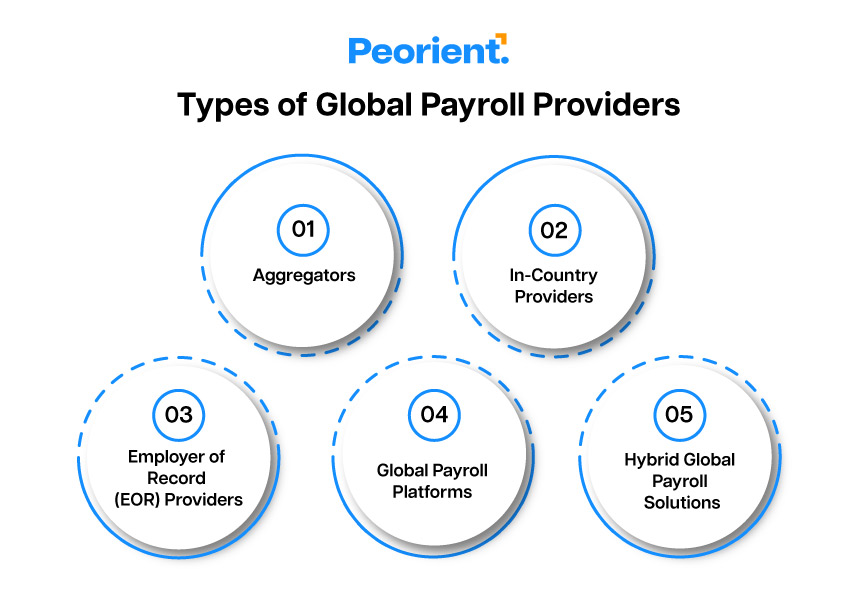
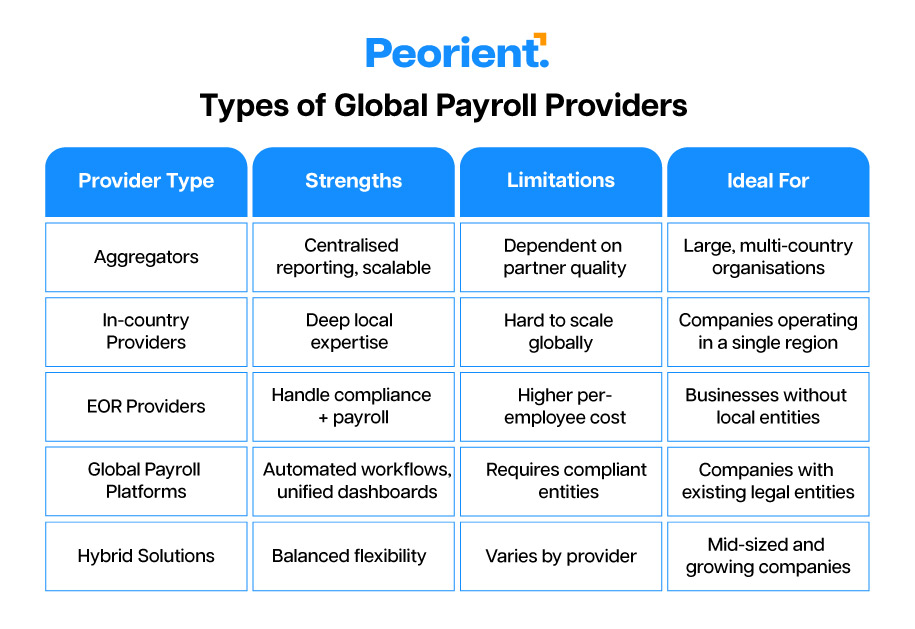
Types of Global Payroll Providers
Not every provider functions in the same manner. The majority of solutions can be classified into one of these categories:
1. Aggregators
These providers use a global network of local payroll companies. They combine all information into one integrated system. Best suited for larger companies operating in many countries.
2. In-country providers
Local firms that handle payroll for a single country. Valuable when local expertise is needed. It can be tough to scale for teams in different countries.
3. Employer of Record (EOR) providers
They act as the legal employer for a client. They handle payroll, compliance, contracts, and onboarding. Ideal for companies hiring without setting up entities.
4. Global payroll platforms
Cloud-based platforms that merge data, manage multi-national computations, and offer unified dashboards. Well-suited for companies with established entities in each country.
5. Hybrid global payroll solutions
A mix of technology + local partners + optional EOR services. Best for businesses that want both scalability and on-ground compliance strength.
What Are the Challenges of Global Payroll Operations?
Managing global hr payroll comes with several inherent hurdles:
Regulatory variability
Every country has its own rules on employment, tax codes, and payroll cycles. Even small changes, like a revised tax slab, can affect payroll if tracking is inaccurate.
Data fragmentation
Often, information comes from various systems and teams, which makes consistency difficult.
Currency fluctuations
Exchange rates affect net compensation, cross-border remittances, and budgeting.
Multiple systems
Without a central payroll system, businesses use different tools in various areas.
Compliance risks
Even small payroll mistakes like late filings or incorrect deductions can lead to fines. This is especially possible in countries with strict regulations.
Scaling challenges
Payroll infrastructure setup becomes complicated as companies expand into newer markets.
These challenges highlight the need for global payroll solutions. They should blend automation with local expertise.
What Are the Benefits of Global Payroll Providers?
Partnering with top global payroll providers brings several advantages:
Centralised reporting: A single dashboard for all markets.
Reduced administrative load: Coordination with various local suppliers is unnecessary.
Compliance assurance: Real-time notifications about modifications in employment laws.
Cost predictability: Clear pricing rather than disjointed local invoicing.
Better employee experience: Timely salaries, understandable payslips, and consistency of processes.
Global payroll companies make payroll easier. They also enhance the whole global employment system.
What Are the Responsibilities of Global Payroll Providers?
While the level of practice varies among providers, most are accountable for these:
Accurate gross-to-net calculations: Making sure wages follow local rules. Rules on earnings, benefits, variable pay, and overtime.
Mandatory deductions and contributions: Properly apply social security, provident fund, and pension rules. Also, ensure that each relevant area follows health insurance regulations.
End-to-end tax compliance: Oversee withholding regulations and tax brackets. Manage employee classifications and specific filing requirements for each jurisdiction.
On-time legal payments: Pay what’s due on time to avoid problems.
Benefits and entitlement administration: This concerns the management of national benefits. It includes overseeing employee leave accumulations, parental leave rights, reimbursements, and required benefits.
Payslip creation and distribution: Create payslips that meet local rules. Use the correct format and language for each country.
Payroll reporting and audit readiness: Set up documentation in an organised way. Include all variance reports and audit trails that can handle any regulatory review.
Onboarding support: Check documents and set up employees correctly in the payroll system. Add their details properly into the payroll system.
Year-end processes: Handle yearly filings, income statements, and tax documents. Make sure records are correct across all countries.
Modern global payroll providers offer more than basic services. They also deliver higher-value features, such as:
HRIS and ERP integrations minimise manual data input and remove discrepancies.
Cost allocation and project-based payroll reporting for organisations with multi-entity or shared-service structures.
Real-time reports help track payroll costs, taxes, and risks. They also show trends by country.
How Do You Ensure Payroll Compliance With Local Labour Laws?
Compliance is the cornerstone of global payroll operations. Without oversight, companies may enter new markets. They often ignore rules on minimum wages, notice periods, or social contributions. This can lead to fines or legal issues.
Best practices include:
Staying updated on rule changes: Work with partners who are current on tax and labour law changes. They adjust payroll processes as the rules change.
Regular internal and external audits: Assess payroll calculations and the timeliness of contributions. Review additional records to spot discrepancies before regulators do.
Thorough record-keeping for every cycle: Keep consistent and verifiable records. Clearly show how each payment amount is calculated and authorized.
Auto-updating system: These platforms refresh tax slabs, thresholds, and contribution rates by themselves. This cuts down on manual checks.
Correct employment contracts: Ensure offer letters, benefits, and policies follow local rules. Do not base them on your home country’s rules.
Compliance should not be viewed as optional. It protects an organisation’s reputation and ensures continuity of operations.
When Should You Outsource Global Payroll Operations?
Outsourcing becomes essential when:
Cross-country coordination drains internal bandwidth. Managing several calendars, tax cycles, and legal documents takes up too much time.
You’re entering countries where you lack a legal entity. Building compliance from scratch can be expensive. But specialised providers know the regulatory landscape well.
Your workforce spans several jurisdictions with different rules. Remote hiring gets easier when a partner centralises calculation logic and statutory tasks.
Compliance risks feel harder to control. If the team is unsure about tax or contribution deadlines, it means the model needs more controls.
Payroll accuracy becomes inconsistent. Frequent corrections or reconciliation issues reveal gaps in structure. A dedicated provider can fix these gaps.
Legacy systems can’t handle multi-country data. When tools can’t support unified reporting or meet different local needs, scaling fails.
Global payroll outsourcing provides you with operational help and strategic adaptability.
Salary levels and statutory deductions vary enormously between markets — compare, for instance, average salaries in India versus Australia, where EPF and superannuation shape take-home pay in completely different ways.
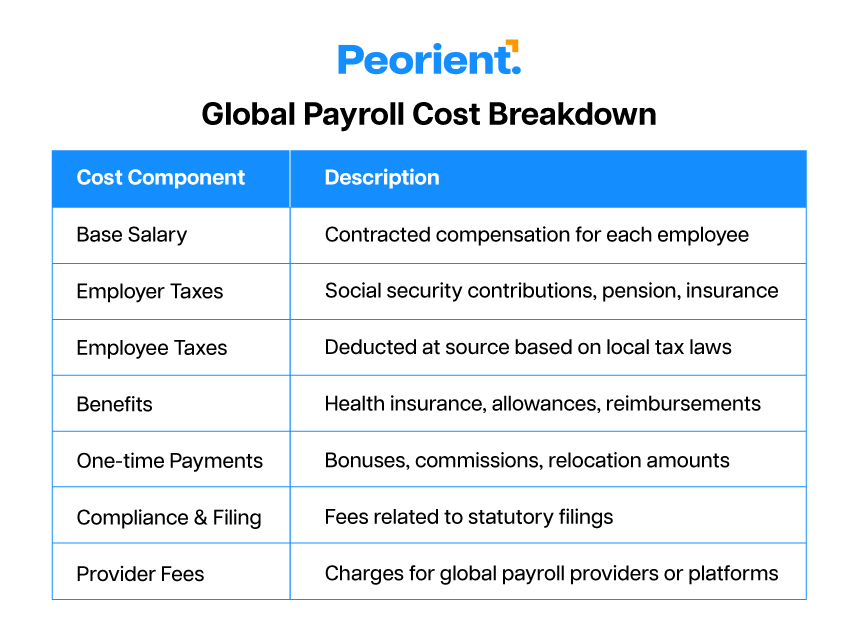
How Should You Track Your Global Payroll Costs?
Many companies find it hard to see their costs. This is because different entities, vendors, and local offices scatter expenses.
Centralise all payroll data in a single dashboard. Combine each country’s payroll cycle, employee numbers, and costs into one dashboard. This removes uncertainty and reduces reconciliation work.
Break down employer-side costs clearly. Track taxation, statutory contributions, and benefits at the separate cost level. This shows how spending varies across regions.
Monitor projected vs. actual salary outflow. Causes for discrepancies include unexpected hires, irregular overtime, or mistakes in regional calculations.
Assess currency movements regularly. Changes can greatly affect payroll budgets, especially in volatile markets.
Classify recurring and exceptional payments. Bonuses, benefits, and commissions are part of the main workforce costs. One-off adjustments help show these costs more clearly.
A well-designed global payroll platform can automate most of this.
5 Tips When Choosing Your International Payroll Provider
Selecting the right global payroll providerrequires more than looking at software features. The best global payroll options for HR departments are easier to choose with clear goals. It helps make the decision straightforward.
1. Depth of local expertise
A provider needs to manage local tax laws, labour codes, and reporting guidelines. It’s not enough to automate calculations.
2. Scalability across multiple countries
Choose partners who can help you grow in new markets with fewer changes.
3. Transparency in pricing and processes
Hidden charges in payroll services can significantly affect budgets.
4. Integration capabilities
Make sure the global payroll solutions fit well with your HR, accounting, or ERP system.
5. Quality of support and compliance updates
Top-rated global payroll platforms for HR offer real-time updates on local rules. This helps you stay compliant and informed.
Conclusion
Global payroll isn’t about monthly salaries. It’s the backbone that helps international teams operate smoothly and stay compliant.
A well-organised global payroll system reduces admin stress and lowers compliance risks. It also provides clear insights across different regions.
If you are hiring abroad, the right partner can help avoid mistakes when expanding to new regions.
About Peorient
Peorient is an advisory platform for global employment. It helps companies evaluate the global payroll landscape. You can compare providers and find solutions that fit your expansion plans.
Its expertise helps businesses handle payroll services confidently. This support comes from real operational insights, not features listed on a page.
Ready to simplify your international payroll? Find the solution that works best for your business.