Global expansion brings great opportunities but adds operational challenges, especially in payroll. Hiring abroad without a local entity can be tricky. Businesses must understand foreign tax laws, labor rules, and multi-currency payments. An Employer of Record (EOR) payroll system addresses these issues.
This guide explains EOR payroll. It covers everything from onboarding to payday. You’ll see your responsibilities and those of the EOR provider. With this knowledge, companies can manage global teams confidently and comply fully.
What is EOR Payroll? (And How It Differs from Traditional Methods)
EOR payroll is a payroll model where an Employer of Record legally employs and pays workers on behalf of another company. The EOR signs the local employment contract, adds the employee to its payroll, calculates gross-to-net salary, withholds income tax, manages statutory contributions, pays benefits, issues payslips, and files payroll-related compliance documents.
The client company does not need to open a local entity. It still manages the employee’s day-to-day work, role, reporting structure, performance, salary approvals, bonus decisions, and team integration.
In simple terms: the EOR owns the legal employment and payroll layer. You own the work relationship.
The EOR Payroll Process: A Step-by-Step Breakdown
To understand EOR payroll efficiency, you need to see it from the client’s view. This structured process ensures accuracy, compliance, and timely payments for your global team.
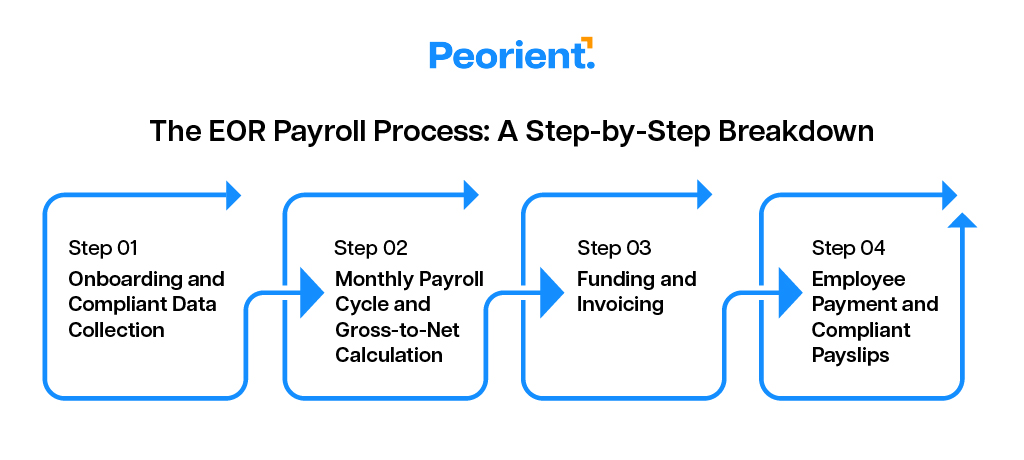
Step 1: Onboarding and Compliant Data Collection
The client shares the employee’s name, role, salary, start date, work location, benefits expectations, and reporting structure. The EOR checks whether the proposed salary, contract type, working hours, probation period, and benefits meet local employment rules.
Step 2: Monthly Payroll Cycle and Gross-to-Net Calculation
The EOR issues a locally compliant employment contract. This contract should cover job title, compensation, pay cycle, leave, benefits, confidentiality, IP assignment, termination rules, and local statutory clauses.
Step 3: Funding and Invoicing
The EOR registers the employee with the required tax, social security, pension, insurance, or labour authorities depending on the country. In India, this may include TDS, PF, ESI where applicable, professional tax, gratuity treatment, and state-level labour compliance.
Step 4: Employee Payment and Compliant Payslips
The EOR calculates the employee’s gross pay, statutory deductions, employer contributions, reimbursements, bonuses, commissions, leave adjustments, and net salary. This is where accuracy matters most because each country has different tax slabs, contribution caps, benefit rules, and payslip requirements.
Step 5: Monthly invoice to the client
The client receives one consolidated invoice. It usually includes gross salary, employer statutory contributions, benefits cost, approved expenses, FX charges if applicable, and the EOR management fee
Step 6: Employee salary payment
The EOR pays the employee in local currency on the local pay date and issues a compliant payslip showing earnings, deductions, reimbursements, and net pay.
Step 7: Payroll filings and records
After payroll is run, the EOR remits taxes and contributions to the relevant authorities and maintains payroll records for audits, employee queries, and compliance checks
Key Responsibilities: Your Role vs. The EOR's Role
A successful EOR partnership requires a clear division of responsibilities. This model helps your company focus on core goals. The EOR takes care of admin and legal tasks.
What the Employer of Record Manages
The EOR takes on all legal and administrative tasks, including:
- Ensuring compliance with local laws and taxes.
- Calculating and withholding all statutory deductions.
- Filing and remitting employer taxes to authorities.
- Administering mandatory and supplemental benefits.
- Managing onboarding and offboarding processes.
What Your Company Continues to Manage
While the EOR handles legal aspects, your company maintains control over:
- Defining job roles and performance objectives.
- Setting gross salaries and determining bonuses.
- Conducting performance reviews and career development.
- Approving expenses and managing paid time off (PTO).
- Integrating employees into your company culture.
EOR Payroll vs Global Payroll vs Payroll Outsourcing
Choose EOR payroll when you need a legal employment solution, not just salary processing. Choose global payroll or payroll outsourcing when you already have a local entity and only need help running payroll.
A Global Employer of Record can simplify payroll across multiple countries by consolidating contracts, local payroll, statutory filings, and reporting.
What does EOR payroll cost include?
A monthly EOR payroll invoice usually includes:
Gross salary: the agreed monthly salary before deductions.
Employer statutory contributions: pension, social security, insurance, provident fund, gratuity, or country-specific employer costs.
Employee deductions: income tax, social security, professional tax, or other mandatory deductions withheld from salary.
Benefits cost: mandatory and optional benefits such as health insurance, paid leave accruals, retirement contributions, and local allowances. Effective statutory benefits administration ensures employees receive all legally mandated benefits alongside accurate payroll.
Approved expenses: reimbursements, bonuses, commissions, or one-time payouts approved by the client.
FX or currency conversion charges: added when the client pays in one currency and the employee is paid in another.
EOR service fee: the provider’s monthly fee for legal employment, payroll, HR administration, and compliance support.
When should a company use EOR payroll?
EOR payroll works best when a company wants to hire employees in a new country before setting up a local entity. It is useful for hiring the first employee in a market, testing a new region, building a remote team, employing workers during entity setup, or switching from risky contractor arrangements to compliant employment.
EOR payroll is a good fit if
- You are hiring 1–30 employees in a country.
- You do not have a local legal entity.
- You need payroll, tax, benefits, and compliance handled together.
- You want employees paid in local currency.
- You need faster onboarding than entity setup.
- You want one invoice instead of managing local payroll vendors.
EOR payroll may not be the right fit if
- You already have a local entity.
- You are hiring a large team in one country.
- The employee must legally represent your company.
- You need direct local payroll control.
- You want to run all employment contracts under your own entity.
Choosing the Right EOR Payroll Partner
Do not compare EOR payroll providers only by monthly fee. A cheaper provider can become expensive if statutory benefits, FX markup, offboarding, payslip corrections, or local support are billed separately.
EOR providers vary in quality and reliability. Not all offer the same expertise or support. When choosing a partner, check their legal presence. Look for clear pricing and assess the quality of their customer support.
Choosing solely based on low fees can lead to hidden costs and compliance gaps. A solid vetting process helps you find a partner for your global expansion goals. Expert guidance can also help. You can get free advice to compare the best EOR providers in India for your needs.
Frequently Asked Questions