Compare Deel vs Remote in 2026. See pricing, country coverage, compliance, owned entities, onboarding speed, hidden fees, and which EOR fits your hiring plan.

Deel: $599/employee/month for EOR, 150+ countries served through a mix of owned and partner entities, strongest contractor tooling in the category, currently fighting a federal RICO lawsuit filed by Rippling alleging corporate espionage.
Remote: $699/employee/month list price, $599 with annual billing, 80 to 95 wholly owned entities, cleaner compliance posture, narrower country coverage.
The honest answer for most teams: it depends on where you're hiring and how much your legal team trusts hybrid-entity models.
Hiring globally sounds exciting until payroll starts. A developer in Lisbon needs to be paid under Portuguese rules. An ops manager in São Paulo must be handled under Brazilian employment laws. A junior designer in Bangalore has just signed her offer letter and expects a smooth onboarding experience.
Now the real challenge begins: paying all three legally and on time, without opening entities in three different countries.
Two names will land in your shortlist within ten minutes of Googling: Deel and Remote. Both are massive. Both promise the same thing on the homepage. Both will quote you something close to $599 a month per employee.
And yet the choice between them isn’t a coin flip. The wrong pick can cost you tens of thousands in hidden FX fees, drag your onboarding past a candidate’s notice period, or land your IP in a country where one of these vendors has no owned entity to enforce it.
This guide walks through every variable that actually matters. Pricing, country footprints, the legal model behind each platform, the recent ugliness involving Deel and a corporate spy, and the question almost no comparison post asks: is either of them even the right pick for your specific countries? For the foundational concepts behind any of this, we lean on our complete guide to Employer of Record services
If you’re new to the category, here’s the short version. An Employer of Record (EOR) is a third-party company that legally employs workers on your behalf in a country where you don’t have a registered legal entity. The EOR signs the local employment contract, runs payroll, withholds taxes, files statutory reports, and administers benefits. You manage the day-to-day work.
The cost comparison usually goes like this. Setting up your own legal entity in a new country runs $25,000 to $100,000 upfront and three to six months of paperwork. An EOR onboards your first hire in that country in a week, for $599 a month. The math gets more complicated once you’ve got fifteen plus people in one country, at which point owning the entity often becomes cheaper. Our complete EOR primer goes deeper if you need the foundations.
Both Deel and Remote operate as EORs. They also operate as global payroll providers (for cases where you already own the entity) and contractor management platforms. The product overlap is intentional. Most teams need a mix of all three over time, and consolidation is the pitch.
Deel and Remote both compete in EOR, global payroll, and contractor management. PEO services are available from both but stronger from US specialists like ADP and TriNet. If you’ve conflated EOR and PEO in past conversations, you’re not alone, but the distinction matters when comparing pricing and compliance models.
Before comparing Deel and Remote, understand the main Global EOR provider models: owned entity, aggregator, hybrid, and self-service.
Skim this if you have ninety seconds. The rest of the article fills in why each row reads the way it does.
Pricing, coverage, compliance posture, and best-fit scenarios in one clean view.
| Factor | Deel | Remote |
|---|---|---|
| EOR list price | $599/employee/month | $699/month list, $599 annual |
| Contractor pricing | $49/contractor/month | $29/contractor/month |
| Country coverage | 150+ countries using hybrid model | 80 to 95 countries with owned entities |
| Onboarding speed | 5 to 7 days, often faster | 3 to 7 days, slower in complex markets |
| Compliance posture | Mixed in some partner-led markets | Strong with fully owned structure |
| Pending legal exposure | DOJ criminal probe reported Jan 2026 | None notable |
| Best for | Breadth, contractors, global scale | Compliance certainty, EU and NA depth |
| Ratings | G2 / Capterra 4.7 to 4.9 | G2 / Capterra 4.6 to 4.8 |
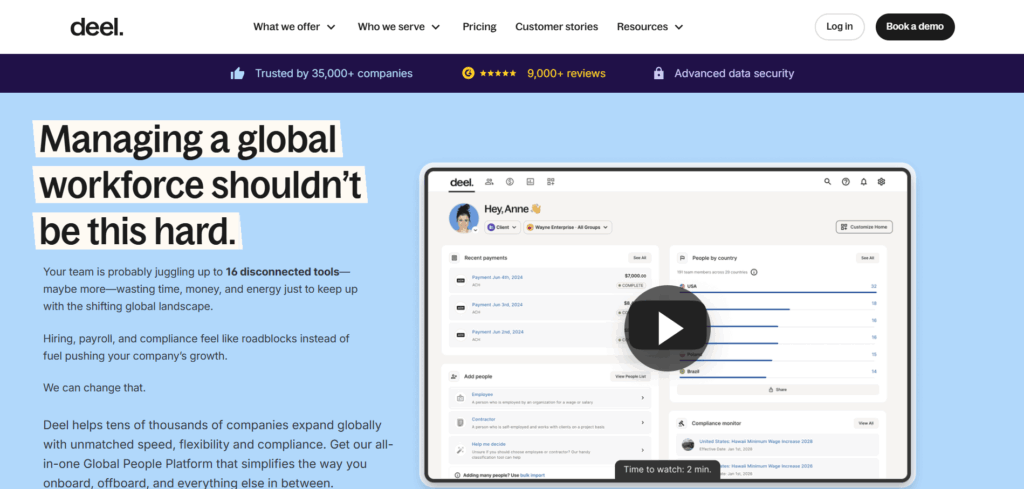
Deel started in 2018 as a tool for paying contractors. It has since become something else entirely. By the end of 2025, the company had completed roughly thirteen acquisitions according to Wikipedia’s running record, absorbing payroll engines, an IT device platform (Hofy), an HR software company (Roots), an Australian payroll firm (PayGroup), the African payroll engine PaySpace, and Safeguard Global’s payroll division.
The strategy is obvious. Deel wants to be your one HR vendor. Hire, pay, equip, classify, file taxes, all in one tab. As of October 2025, the company hit a $17.3 billion valuation after a $300 million Series E led by Ribbit Capital and Andreessen Horowitz. Joe Kauffman, formerly of Intuit, joined as CFO in November 2025, and Deel has been telegraphing an IPO.
The pace is the story, and also the problem. We’ll come back to that.
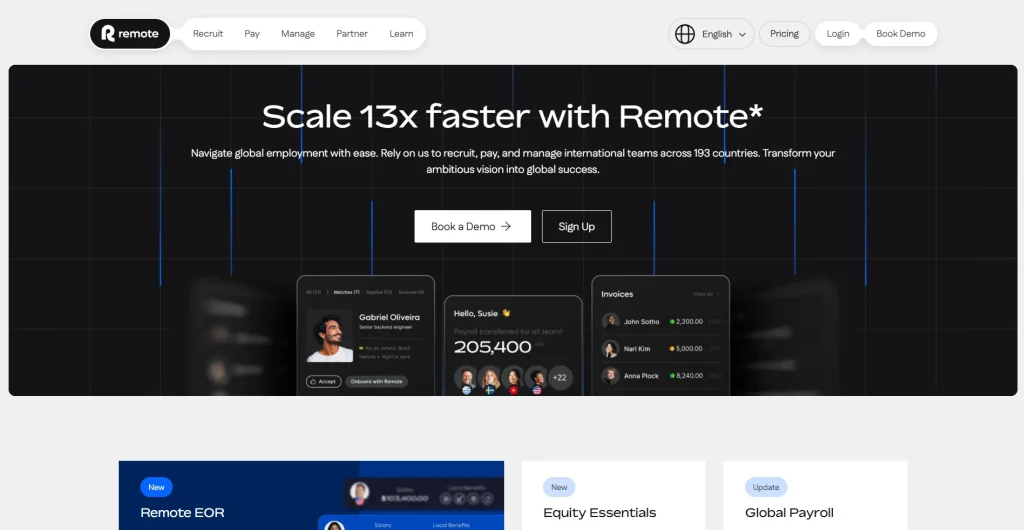
Remote launched in 2019. The founders, Job van der Voort and Marcelo Lebre, are both former GitLab executives, which probably explains the platform’s distributed-team DNA. The company has raised over $500 million and now supports hiring in 190+ countries on the contractor side, with somewhere between 80 and 95 wholly owned EOR entities depending on which 2026 source you trust.
The pitch is different from Deel’s. Remote leans into compliance depth, IP protection (its proprietary IP Guard system covers contracts that hold up under local legal scrutiny), and direct ownership of every entity it operates through. There are no third-party partners holding the employment relationship, no intermediaries, no ambiguity about who’s on the hook when something goes wrong.
Remote is smaller than Deel. That’s intentional, mostly.
The list prices are easy to find. What they cost you in practice is harder.
Deel’s published EOR rate is $599 per employee per month. Contractor management runs $49 per contractor per month. Global payroll, used when you already own the local entity, is $29 per employee per month. Independent breakdowns from Pin’s pricing analysis confirm those numbers as of Q1 2026.
Here’s what that price doesn’t include. Deel applies an FX markup of roughly 0.6% to 2% above the mid-market rate when your funding currency differs from the payroll currency. On $1 million in annual cross-border payroll, that’s $5,000 to $10,000 a year that never appears as a line item.
Some markets carry country-specific surcharges. Brazil, France, India, and several others can add $50 to $150 per month above the base rate. Deel doesn’t publish those publicly. You’ll need a sales call.
Volume discounts exist. They’re not on the website. Independent analyses suggest the effective EOR rate drops to around $315 to $400 per month at fifty plus employees with a multi-year commitment.
Remote’s list rate is $699 per employee per month, dropping to $599 with annual billing. Contractor management is $29 per contractor per month, comfortably cheaper than Deel. Global payroll is $29 per employee per month, identical to Deel.
What’s actually included at $599 is broader than most buyers initially realize. According to WhichPayroll’s April 2026 pricing teardown, the fee covers legal employment through Remote’s owned entity, the local employment contract, payroll processing, employer tax filings, statutory benefits, statutory leave, termination protections, offboarding, severance administration, a dedicated onboarding specialist, basic HRIS access, and Zapier-based integrations.
Remote doesn’t charge separate termination fees for standard offboarding. That’s a real differentiator, especially in markets like France and Germany where competitors can quote $500 to $2,000 per termination.
Remote’s volume discount floor sits around $450 to $500. Deel’s negotiates lower. For a fifty-person team, the gap can run between $60,000 and $300,000 a year per eorHQ’s modelling.
Take a hypothetical SaaS company hiring four people in the UK, three in Germany, and three in Brazil. Average salary $90,000. Here’s roughly what the math looks like at list pricing, before negotiation.
| Cost line | Deel | Remote |
|---|---|---|
| Platform fee (10 × 12 months) | $71,880 | $71,880 (annual rate) |
| Salary deposit / float | ~$75,000 upfront | Typically waived |
| FX markup (estimated) | $8,000 to $12,000/year | Comparable, varies |
| Termination buffer (1 exit) | Included | Included |
| Country surcharges (Brazil) | $600 to $1,800/year | Generally none |
| Annual platform spend (est.) | $80,000 to $86,000 | $72,000 to $76,000 |
Numbers shift considerably with volume discounts and contractual negotiation. We’ve seen Deel drop closer to $400 effective at scale and Remote settle around $480. The point isn’t the exact figure. It’s that list pricing rarely tells the real story.
Pricing pages don't tell you what you'll actually pay. Peorient's advisors model your full annual cost across providers, including FX exposure, statutory pass-throughs, and onboarding fees, before you sign anything.
Get a free quote comparisonBoth vendors lead with country counts. The numbers don’t mean what you probably think they mean.
Deel claims service in 150+ countries. The detail buried under that number is that Deel runs on a hybrid entity model. Some markets have Deel-owned entities. Others run through in-country partners (ICPs), where a third-party local provider holds the actual employment relationship and Deel handles the interface.
The hybrid model is how Deel covers Sub-Saharan Africa, parts of Central Asia, and several smaller Latin American markets so quickly. It also means service quality and compliance oversight can vary across the footprint, as Atlas HXM’s 2026 comparison lays out in detail.
Direct or partner is an important question to ask Deel sales for any country you care about. The answer matters when something goes wrong.
Remote runs roughly 80 to 95 wholly owned entities for its EOR service. Contractor management extends across 190+ countries because contractor payments don’t require local entities. Standalone payroll service covers about 40 markets.
Remote owns its entities across North America, Europe, Asia Pacific, Latin America, and parts of Africa. Coverage gets thin in Southeast Asia, Sub-Saharan Africa, and Central Asia. If you’re hiring engineers in Vietnam, Indonesia, Nigeria, or Kazakhstan, verify Remote can serve that market through an owned entity before assuming yes.
A SaaS company we advised wanted to hire a senior PM in Nigeria, two engineers in Vietnam, and a designer in Argentina. Deel could onboard all three within seven days. Remote could onboard the Argentine hire through its owned LATAM entity but had no path for Nigeria or Vietnam at the time.
The team picked Deel for breadth, with an explicit acknowledgement of the partner-entity tradeoff in the two markets they couldn't get through Remote. That tradeoff is exactly the conversation most buyers skip.
This is the question most comparison posts skip. It’s also the one that determines whether you’ll sleep well at 2 AM when a labor inspection lands.
When an EOR uses a wholly owned entity, the EOR itself is the legal employer. There’s a single party responsible for compliance, contract enforcement, tax filings, and termination procedure. Audit trails are clean. IP assignment clauses hold up in local courts because the employer that signed them is the same entity that exists in that country.
When an EOR uses a partner entity, a third-party local firm becomes the actual employer. The EOR provides the platform and the customer relationship. Compliance work, payroll execution, and labor risk sit with the partner. If the partner has a bad month, gets acquired, fails an audit, or loses its registrations, your employee’s employment relationship is the one in question.
Why provider operating structure changes accountability, speed, and risk.
| Dimension | Owned entity (Remote default) | Partner entity (some Deel markets) |
|---|---|---|
| Legal employer | EOR itself | Local third-party firm |
| Compliance accountability | Single party | Shared, sometimes unclear |
| IP enforcement | Direct | Depends on partner contract terms |
| Termination handling | EOR's in-house legal team | Partner's legal team, with EOR coordination |
| Onboarding speed | Slightly slower | Often faster |
| Cost to provider | Higher | Lower |
| Risk if partner fails | N/A | Material |
The right answer depends on your industry and risk profile. A fintech company hiring engineers with access to financial systems benefits significantly from owned entities. A marketing agency hiring content writers in Indonesia probably doesn’t need to pay for that compliance certainty. Worth reading: our breakdown of payroll compliance in India for what regulatory complexity actually looks like in a single market.
Compliance is where this comparison gets uncomfortable.
In March 2025, Rippling filed a federal lawsuit alleging that Deel cultivated a corporate spy inside Rippling’s Dublin office. According to the complaint detailed by TechCrunch, the spy, a Rippling employee named Keith O’Brien, searched the term “Deel” in internal Rippling systems an average of twenty-three times a day over four months, exfiltrating sales pipelines, customer account info, and product roadmaps. O’Brien was caught in a sting operation involving a fictional Slack channel and provided a sworn affidavit confessing to the arrangement.
The case has escalated. In February 2026, a federal judge in San Francisco allowed Rippling’s RICO and trade-secret claims to advance. In January 2026, the Wall Street Journal reported the U.S. Department of Justice opened a criminal investigation into Deel over the espionage allegations. Deel has denied wrongdoing, filed a countersuit in Delaware, and continues to operate normally.
This matters less than you might think for day-to-day platform reliability. Deel’s product still works. Customers still get paid. But it matters for vendor selection at risk-averse companies, especially in regulated industries.
The Deel-Rippling litigation doesn't affect employment compliance for Deel customers. It does affect how comfortable some general counsels are signing a multi-year contract.
If your legal team has veto power over vendor selection, this is a conversation you'll need to have proactively, not reactively. Document the question and the answer on the record before signing.
Remote leans into the compliance angle as core marketing. Its IP Guard feature, included in every EOR contract, adds an IP assignment layer that holds up in local courts. The platform holds SOC 1, 2, 3, GDPR, and ISO 27001 certifications. Remote Watchtower, the platform’s compliance monitoring tool, sends proactive alerts when local labor laws change.
The owned-entity model itself is the compliance pitch. Every Remote employee is employed by a Remote entity, period. There’s no question of partner accountability.
Remote isn’t immune to issues. Some users on G2 report inconsistent support escalation paths and request more direct phone access for urgent issues. But there’s no pending criminal investigation. That’s a real factor in 2026 vendor selection.
Deel onboards EOR employees in five to seven business days in established markets. Contractors can go live in under twenty-four hours. The platform’s automation does most of the work. Localized contract generation, document collection, benefits enrollment, and tax form completion run in parallel rather than sequentially.
Deel’s speed is real, and it’s a meaningful advantage when you’re racing a candidate’s competing offer. Where it slips is in markets running on partner entities. Communication between your HR team and the actual local employer goes through an extra layer, adding one to three days in some cases.
Remote quotes three to seven days. In practice, complex markets like Brazil and Germany run seven to ten days according to eorHQ’s country-by-country breakdown. Onboarding specialists are real humans, which is helpful when contracts need adjusting for local norms but slower than fully automated flows.
For markets where Remote owns the entity, onboarding quality is consistently strong. Salaries credit on time, payslips meet local audit standards, and statutory deductions run cleanly. Where Remote shines is in execution reliability, not raw speed.
Quick comparison of expected hiring timelines across key expansion markets.
| Market | Deel typical timeline | Remote typical timeline |
|---|---|---|
| United Kingdom | 3 to 5 days | 3 to 5 days |
| Germany | 5 to 7 days | 7 to 10 days |
| Brazil | 5 to 7 days | 8 to 10 days |
| India | 5 to 7 days (partner entity) | 7 days where covered |
| Argentina | 5 to 7 days | 5 to 7 days |
| Vietnam | 7 to 10 days (partner) | Not currently available |
| Nigeria | 7 to 14 days (partner) | Not currently available |
Both platforms work. Both have intuitive dashboards. Both let you manage employees, contractors, payroll, and benefits in one place.
The differences are less in the screens and more in what’s behind them.
Deel offers 100+ native integrations, including Xero, NetSuite, QuickBooks, BambooHR, Workday, Slack, and most major ATS platforms. The API is mature, and the company runs an open developer ecosystem. Mobile app reviews on Capterra average 4.9 out of 5.
Remote integrates natively with about forty platforms and exposes Zapier as the universal escape hatch. The API is functional but less documented. Mobile experience is solid but lighter on power-user features than Deel’s.
For HR teams running a tight integrated stack, Deel’s depth wins. For teams that prefer fewer integrations done well, Remote’s approach is fine.
We've watched teams pick Deel for the integration breadth, then discover six months in that they only actually use three of those integrations.
Integration count rarely correlates with operational outcome. Pick based on the two or three connections you actually need to work flawlessly, not the marketing logo grid.
If contractors make up a meaningful portion of your team, this is where the gap opens up between the two platforms.
Deel built its original product around contractor payments. The contractor experience reflects that history. Cross-border payouts in 120+ currencies, multiple withdrawal methods (bank transfer, PayPal, crypto, Deel Card), localized invoicing, automatic 1099s and equivalent tax forms in dozens of countries, and free Deel HR access for the contractor’s own records. Capterra reviewers frequently call out the payment flexibility as the headline feature.
Remote’s contractor product is functional. It handles compliant contracts, invoicing, and payouts. It’s not as polished. The $29 per month price is genuinely cheaper than Deel’s $49, but if you’re managing fifty plus contractors, the cost gap is the smaller problem. The user-experience gap is the bigger one.
For teams running twenty plus contractors, Deel is the more obvious pick. For teams with mostly full-time hires and a handful of contractors, either platform works.
Best-fit view for pricing, payout flexibility, tax forms, and contractor-heavy teams.
| Contractor feature | Deel | Remote |
|---|---|---|
| Monthly fee per contractor | $49 | $29 |
| Currency support | 120+ currencies | 70+ currencies |
| Withdrawal methods | Bank, PayPal, Wise, crypto, card | Bank, PayPal |
| Auto-generated tax forms | 1099, W-8, country equivalents | 1099, basic equivalents |
| Free trial | Limited | 30-day trial available |
| Best for | Heavy contractor mix | Mostly EOR with few contractors |
Both platforms administer locally compliant benefits. Health insurance, pension, paid leave, statutory contributions, all of it. The platform layer handles enrollment and payroll integration.
Where they diverge is in benefits curation.
Remote tends to offer stronger supplemental benefits in European markets. Reviewers consistently note that Remote’s German and French benefits packages exceed what Deel offers at the same price point. Remote’s 8% holiday allowance handling in the Netherlands is a small but real differentiator.
Deel offers broader benefits choice in more markets, partly because of its larger footprint. Quality varies. In markets where Deel runs on partner entities, benefits administration runs through the partner, and the consistency drops.
Both platforms offer 24/7 support. Both have dedicated account managers for larger accounts. Both have chat, ticketing, and knowledge bases.
Deel’s support is generally fast at the front line, with 4.7 to 4.9 ratings across Capterra and Trustpilot. The common complaint: AI-driven first responses that often function as a Google search wrapper, leading to three-to-five day delays for complex issues that need human attention.
Remote’s support is slower at first response but tends to resolve issues more thoroughly. Reviewers describe the experience as “personal” and call out partnership-style support more often than transactional support. Some users want clearer phone escalation paths for urgent compliance incidents.
For teams that prefer fast first response, Deel wins. For teams that want fewer hops to resolution, Remote wins. Different priorities, both valid.
Before you pick either platform, run your situation through five questions. The answers usually point clearly to one or the other (or to a different category entirely).
If the answer is one to three established markets like the UK, Germany, US, or Australia, both platforms are functionally equivalent. Pick on price and platform preference. If the answer is ten plus, including markets in Southeast Asia, Sub-Saharan Africa, or Central Asia, Deel’s breadth becomes a real advantage even with the partner-entity caveat.
If contractors make up 60% or more of your global workforce, Deel’s contractor tooling and pricing pulls ahead. If contractors are an afterthought (under 20%), Remote’s lower contractor fee saves you negligible money and the EOR experience matters more.
Fintech, healthcare, defense, and any industry handling sensitive personal data should default to Remote unless there’s a strong country-coverage reason otherwise. Owned-entity compliance matters when regulators show up. For B2B SaaS, marketing services, or media companies, the partner-entity tradeoff is usually fine.
This is the uncomfortable question, and it’s the one most procurement teams skip. Deel is in active federal court fighting a RICO and trade-secret case from Rippling, with a reported DOJ criminal probe in the background. Some legal teams won’t sign a multi-year contract with a vendor in that posture. Others see it as commercial drama with no operational impact. Both views are defensible. Decide explicitly.
At ten employees, list pricing is what you’ll pay. At fifty plus, both platforms negotiate aggressively. Deel typically discounts further than Remote at scale. If you’re at fifty plus, get quotes from both, request volume terms in writing, and run a side-by-side TCO model. The savings often pay for an outside advisor like Peorient several times over.
We've built a fifteen-question evaluation framework based on these five categories, expanded into a structured scorecard.
Email us through the Peorient contact form if you'd like a copy. No gate, no follow-up sequence, just the framework.
Both platforms ship continuously. Here’s what’s actually changed in the last twelve months that affects the buying decision.
Deel completed its acquisition of London-based Omnipresent in 2024, absorbing additional EOR coverage. Through 2025, the company integrated Safeguard Global’s payroll division and Zavvy’s people-development platform. Compliance Hub launched in 2024 and added AI-powered worker classification in 2025. Deel HR (the free HRIS tier) now supports up to two hundred employees at no cost, which is a real benefit for early-stage companies.
The acquisition pace has flattened in early 2026, partly because of the litigation distraction and partly because the company is preparing for an IPO. Internal sources cited in trade press suggest a 2026 or 2027 listing depending on market conditions.
Remote shipped its Workflow Canvas in February 2026, a drag-and-drop visual builder for HR automations. AI-driven approval summaries on mobile arrived the same month, alongside real-time time tracking improvements per Remote’s official changelog. The platform also expanded its IP Guard coverage to additional emerging markets through 2025.
Remote’s strategic posture in 2026 is steady-state. The company is profitable, growing, and not visibly distracted by acquisitions or legal turbulence. If you value vendor stability over feature velocity, that’s a meaningful signal.
If you’re hiring in regulated jurisdictions or handling sensitive employee data, the security posture of your EOR matters. Most comparison articles skip this entirely.
Both platforms hold SOC 2 Type II certification. Both are GDPR-compliant for EU operations. Both maintain ISO 27001. The differences show up in the depth of their security teams, breach disclosure history, and data residency options.
Deel runs its own data infrastructure, with regional data centers in the US, EU, and Asia Pacific. The company has disclosed no major breaches as of April 2026. The Rippling lawsuit alleges that internal Rippling employee data was exfiltrated by a Deel-paid spy, but that’s a different category of incident than a customer data breach.
Remote also runs its own infrastructure with similar regional residency options. The IP Guard product layers additional contractual protection on top of the technical security stack, which matters for engineering teams whose work product is the company’s core IP.
For most buyers, the security posture is functionally equivalent and shouldn’t tip the decision. For regulated buyers, request both vendors’ SOC 2 reports during procurement and have your security team review them directly.
Here’s where we cut through the comparison to specific situations.
Cost is the primary constraint and Multiplier at $400 flat or Remofirst at $199 fits the requirement
Vendor selection without a structured comparison is how teams end up with $80,000 in annual overpayment they didn't realize was negotiable. Peorient has helped over two hundred teams model their actual EOR cost across providers.
Book a free advisory callHere’s the part most Deel vs Remote articles don’t tell you. If a meaningful slice of your hiring is in India, there’s a third path most teams overlook.
Both Deel and Remote charge $599 to $699 per employee per month for India hiring. India-specialist EORs like Wisemonk start at $99 per employee per month. Remunance, which has been operating in India for twenty-one plus years, sits in similar territory.
For a ten-person Indian engineering team, the annual cost gap between Deel/Remote and an India specialist runs between $36,000 and $60,000. That’s enough to fund another headcount.
The tradeoff is global breadth. Wisemonk and Remunance only do India. If you’re hiring across eight countries, you’d use a global EOR and accept the premium for India coverage. If 70% of your team is in India, the math points another direction entirely.
Several teams we advise run a split: Deel or Remote for global breadth across small headcounts, plus an India specialist for the bulk of their engineering team.
Two contracts, two dashboards, but a substantially lower blended cost. The added admin overhead is real but usually worth it once your India footprint exceeds five people.
We covered the broader landscape in our review of EOR providers for India expansion.
If you’re already on one platform and considering a move, here’s what to expect. We’ve helped a dozen teams through these transitions, and the pattern is consistent.
Switching EOR providers means terminating the existing employment relationship in each country and creating a new one with the new EOR. In most jurisdictions, this is treated legally as a termination and a fresh hire. That has implications: continuous service dates reset (which affects severance entitlements down the line), accrued leave needs to be paid out or transferred (varies by country), and benefits enrollment starts over.
Some countries allow assignment transfers under TUPE-style frameworks (UK, EU primarily), which preserve continuous service and avoid the severance reset. Both Deel and Remote handle this where possible, but the legal mechanics depend on local law more than on the EOR’s preference.
Plan four to eight weeks for a clean transition. Two weeks for new contract preparation and signature, two weeks for payroll cycle alignment, two to four weeks of overlap to validate that the new EOR is running cleanly before you fully cut over from the old one. Trying to compress this into a single payroll cycle is how mistakes get made.
Direct costs: any termination fees from your outgoing provider (Remote rarely charges these, Deel’s terms vary by contract), one-time onboarding setup fees with the new provider (often waived during sales negotiation), and the legal review of new employment contracts in each country.
Indirect costs: HR team time (typically 40 to 80 hours for a transition across three countries), employee anxiety during the change (real and worth managing), and the risk of compliance gaps if anything falls through the cracks. Budget $5,000 to $15,000 in soft costs for a ten-person, three-country switch.
Switching purely to save 10% on platform fees usually isn't worth the disruption. Price alone rarely offsets migration effort, process resets, and internal distraction.
Switching because your current provider has serious compliance gaps in target markets, lost a key entity, or because your legal team has lost confidence in the vendor relationship — those are real reasons.
We've talked teams out of switching about as often as we've helped them switch. Sometimes the better answer is renegotiating the existing contract.
After running structured comparisons for hundreds of buyers, we’ve collected a list of things that don’t show up in sales decks but matter once you’ve signed.
The salary deposit requirement is real and often surprises CFOs in month one. Ask about it explicitly. Confirm whether it’s refundable and on what timeline.
Deel’s volume discount tiers aren’t published. The first quote is rarely the best quote. If you’re hiring more than ten employees, ask for tiered pricing in writing and benchmark against at least one other provider.
Country surcharges in Brazil, France, and India are real. They’re disclosed in the contract but not on the pricing page. Get a country-by-country quote before signing.
Deel’s free HR tier (Deel HR) is genuinely useful and a real differentiator at small scale. It’s also a customer-acquisition lever, designed to make leaving the platform harder. That’s not bad, just worth knowing.
The annual billing discount that drops list price from $699 to $599 requires a year-long commitment. Month-to-month is technically available but priced at full list. If your hiring plan is uncertain, the pricing flexibility is real but expensive.
Remote’s coverage map is more conservative than Deel’s. Sales reps may say “we can hire there” when the answer is “we can hire there through a partner.” Ask specifically: is this an owned entity? When was it established? How many employees does Remote have on your books in that country today?
Remote’s contractor product is genuinely lighter than Deel’s. If contractors are 30% or more of your workforce, this isn’t an apples-to-apples comparison.
Termination handling is included in Remote’s monthly fee. That’s a real saving versus competitors, but it doesn’t apply to complex terminations involving litigation or labor board filings, where Remote will scope additional fees on a case-by-case basis.
Both Deel and Remote will discount harder if they're competing for the deal. Telling each rep that you're seriously evaluating the other, truthfully, generally drops list pricing 10% to 20% in the first round.
Coming back with a better quote from the competitor often drops it another 10% to 15%. Total negotiable savings on a fifty-person, multi-year deal are routinely six figures.
We've seen it happen on calls we've sat in on.
Deel and Remote both work. Both can run your global team without you setting up a single foreign entity. The difference between them isn’t a winner and a loser. It’s two different companies optimizing for two different things.
Deel optimizes for breadth, speed, and product depth. The trade is a hybrid entity model and ongoing legal turbulence.
Remote optimizes for compliance certainty and execution reliability. The trade is narrower country coverage and a higher price tag at list.
The right answer for your team depends on where you’re hiring, how regulated your industry is, what your contractor mix looks like, and how much risk your legal team will tolerate. There’s no universal right answer. There’s just the right answer for you.
If you’re not sure which way to go, that’s exactly when an independent advisor saves you the most money. Peorient has reviewed dozens of providers, including the India specialists most global comparisons miss. We’ll model your actual cost, audit the partner-entity risk in your target markets, and tell you straight what we’d pick if we were you.
Independent advisory. Vetted partner panel. Side-by-side comparison reports. 30-minute consultation with no charge, no obligation, and no pressure to sign.
On contractor management and at scale, yes. Deel's contractor pricing is $49 per month versus Remote's $29 per month, but Deel typically negotiates volume discounts to lower effective EOR rates than Remote. On the published EOR list price, Remote's $699 is higher than Deel's $599, but Remote's $599 annual rate matches Deel.
Honestly, neither is the most cost-efficient option. India-specialist providers offer equivalent compliance at roughly one-sixth the price. If you must use a global EOR for India, Deel and Remote are both adequate, with Deel running on a partner entity and Remote operating through partner relationships in past configurations. Verify owned-entity status during the sales conversation.
For day-to-day employment compliance, yes. The litigation is between Deel and Rippling, not between Deel and its EOR customers. For risk-averse legal teams, the pending DOJ investigation is a factor worth weighing. Document the question and answer it on the record before signing.
In countries where Deel owns the entity, there's no functional difference. In countries where Deel runs on a partner, a third-party firm holds the employment relationship, and Deel is effectively reselling that firm's services. Remote owns every entity it operates, with no intermediaries. The practical impact shows up in audits, terminations, and compliance disputes, not in the daily payroll run.
Yes, but it's not trivial. Each switch requires re-onboarding every employee, transitioning payroll cycles, and handling termination and re-hire (or assignment transfer, depending on the country). Plan four to eight weeks for transitions and verify continuity of statutory benefits to avoid gaps. Severance protections, accrued leave, and continuous service dates are the three places switches usually break.
Both do, with caveats. Deel offers global equity support and visa sponsorship. Remote handles stock option administration for international employees but with a lighter feature set. Equity in EOR setups is genuinely complicated because tax treatment varies wildly by country. Get a tax advisor involved, regardless of which platform you pick.
Peorient is an independent EOR advisor. We don't sell Deel, Remote, or any specific platform. We model your actual annual cost across providers, audit your country requirements, evaluate your HRIS stack against the EOR you're considering, and help you negotiate. Most teams save more than the cost of our advisory engagement on the first year of EOR fees alone.
For a single hire, both platforms work fine, and the platform fee is a small fraction of your fully-burdened cost (salary plus statutory contributions). At one employee, you're paying $599 per month for compliance and convenience. That's worth it. The procurement decision becomes much more interesting once headcount in any single country crosses ten or fifteen people, when entity setup starts to break even.
Both offer US payroll services, but they're not the strongest pick for US-only operations. Specialist US providers like Gusto, Rippling, or ADP typically deliver better US-specific compliance handling and integrations. If your team is mostly US plus a handful of international hires, consider a domestic payroll specialist plus an EOR for the international hires. We've covered US-friendly HRIS options for small businesses separately.
Yes. Ask about: salary deposits, country surcharges, FX markups, off-cycle payroll fees, expense reimbursement processing fees, year-end tax form generation fees, employee equity administration fees, immigration support fees (if relevant), and termination fees. Get all of these in writing before signing. Both vendors will quote them on request, but neither leads with them in the standard sales conversation.
It's a real risk worth understanding. If your EOR's local entity dissolves, your employees in that country are technically working for an employer that no longer exists. In practice, both Deel and Remote are well-capitalized with multiple funding rounds and significant revenue, so the immediate risk is low. But mid-tier EORs have failed before, and the cleanup is messy. For long-term plans, vendor financial health matters more than people realize.
Both offer visa and immigration support, with caveats. Deel's immigration support is custom-priced per case and handled through its Legalpad acquisition. Remote provides relocation assistance in twenty plus countries with visa sponsorship. Neither is a substitute for an immigration law firm in complex cases (executive transfers, blocked nationalities, edge cases). Treat their immigration tooling as a coordination layer, not a complete legal service.
US Employee Benefits Guide 2026: Costs & Requirements
US employee benefits are less about a long federal checklist and more about health insurance, state rules and competitive expectations. For a professional hire, budget roughly 25–35% above base salary before any EOR fee, then model family coverage and the employee’s work state separately.