
Compare the top 10 international PEO providers in India for 2026. Side-by-side pricing, compliance capabilities, and India-specific features for Velocity Global, Deel, Remunance, Remote, and more.
Velocity Global (PEO) — Best for enterprise-scale global expansion across 185+ countries
Remunance — Best India-centric PEO/EOR with 21 years of local HR expertise
Deel — Best tech-forward platform with free contractor management
Remote — Best for IP protection with 100% owned entities
G-P (Globalization Partners) — Best for enterprise compliance with owned infrastructure
Rippling — Best unified HR + IT + Finance platform
Papaya Global — Best for global payroll at scale
Multiplier — Best budget-friendly option for APAC-focused hiring
Skuad — Best low-cost entry point for startups and SMEs
Oyster HR — Best for remote-first companies focused on employee experience
PEO/EOR pricing in India ranges from $199 to $699 per employee per month. Most providers charge $400–$599 per month for full EOR services. Choosing between PEO and EOR depends on whether there is an Indian entity.
Peorient is an independent workforce advisory platform. We evaluated these 10 PEO/EOR providers using six weighted criteria designed specifically for India-focused hiring decisions.
We cross-verified G2, Capterra, and Trustpilot reviews as of Q1 2026, validated pricing through official sources and third-party audits, and assessed India-specific compliance capabilities including EPF, ESI, Professional Tax, Gratuity, and Shop & Establishment Act handling.
The table below compares all 10 providers across the factors that matter most when hiring in India through a PEO or EOR arrangement.
Velocity Global rebranded to Pebl in September 2025 and launched an AI-first global hiring platform. With EOR and PEO services spanning 185+ countries, it remains one of the broadest-coverage providers available. The platform now features an AI-powered assistant for instant cost estimates, automated contract generation, and integrated HRIS connections with Oracle HCM and BambooHR. Velocity Global holds more employment licenses than any other provider and is rated #1 for compliance on G2.
Key Features:
Pricing:
Standard EOR: $599/employee/month. Promotional rates from $399/mo (time-limited). Custom quotes for enterprise and global payroll. Pricing is quote-based and varies by country complexity and headcount.
India Compliance:
Uses partner entities in India rather than an owned subsidiary. Handles EPF, ESI, TDS, Professional Tax, and Gratuity through local partners. Strong global compliance but India-specific depth depends on partner quality.
Best For:
Enterprise companies expanding across 10+ countries simultaneously who need the widest possible geographic coverage and premium support.
Pros: Widest country coverage (185+) | AI-powered platform | #1 compliance rating on G2 | Strong immigration support
Cons: Premium pricing | Partner-dependent in India (not owned entity) | Less automated than competitors | Opaque pricing structure
Peorient provides free, unbiased consultations to match your business with the right PEO/EOR provider.
Get Free ConsultationRemunance is an India-headquartered PEO and EOR provider with 21 years of hands-on HR expertise in the Indian market. Unlike global platforms that treat India as one of 150+ countries, Remunance specializes in India-first compliance, making it the go-to choice for companies whose primary expansion target is the Indian market. They operate their own legal entity in India and support hiring across 22 additional countries.

Key Features:
Pricing:
Custom quote-based pricing. Generally competitive for India-focused hiring compared to global platforms charging $599/mo. Contact Remunance directly for current rates.
India Compliance:
Strongest India compliance depth among all providers listed. Owned entity in India with direct management of EPF, ESI, Professional Tax, Gratuity, LWF, TDS, and Shop & Establishment Act registrations across all Indian states. Handles state-specific variations in labor law directly.
Best For:
Companies whose primary or sole expansion target is India. Ideal for startups testing the Indian market, mid-size firms building Indian teams of 5–50+, and enterprises needing India-specific statutory expertise.
Pros: 21 years India HR expertise | Owned entity in India | Deepest India compliance knowledge | Subsidiary formation support | Competitive India-focused pricing
Cons: Smaller global footprint (22 countries vs. 150+) | Less brand recognition globally | Platform less feature-rich than Deel/Rippling
Read the full review: Remunance Review: Best EOR Services for India Expansion
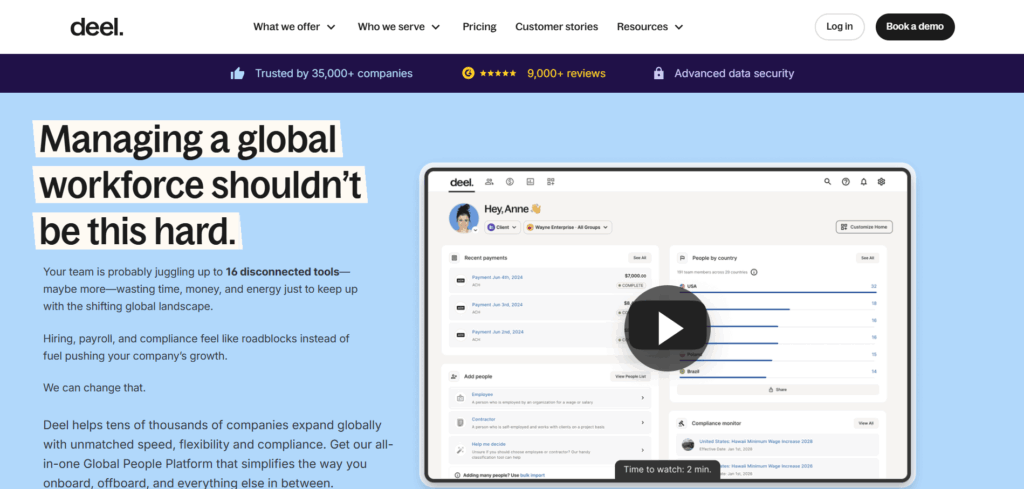
Deel has grown into the most widely adopted EOR platform globally, serving 35,000+ companies across 150+ countries. Its standout feature is free contractor management (most competitors charge $29–$49/mo per contractor), making it especially cost-effective for companies running hybrid teams of employees and contractors. Deel holds a 4.9/5 rating on Capterra across 4,200+ reviews, the highest satisfaction score in the EOR category.
Key Features:
Pricing:
EOR: $599/employee/month (platform fee). Contractors: Free. Global Payroll: $29/employee/month. US PEO: Custom quote. Volume discounts available: $475–$549/mo at 5–20 employees, $350–$400/mo at 50+ with multi-year commitment.
India Compliance:
Uses partner entities in India (not owned). Handles EPF, ESI, TDS, and statutory benefits through local partners. Onboarding in India typically takes 3–5 business days. APAC support responsiveness is reported as slower (8–12 hour waits during India business hours).
Best For:
Tech-forward companies managing hybrid teams (employees + contractors) across multiple countries who value platform speed and a modern UI.
Pros: Free contractor management | Highest user satisfaction ratings | Fast onboarding | Free HRIS tier | Strong integrations
Cons: Partner entities in India (not owned) | APAC support slower than competitors | One-month salary deposit required | FX markup 0.6–2%
Read the full review: Top Deel Competitors & Alternatives Reviewed
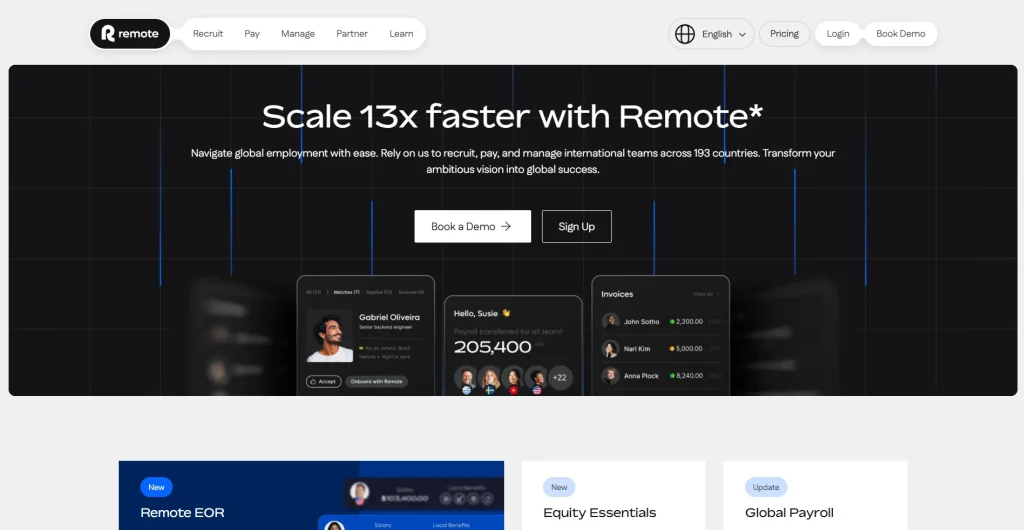
Remote differentiates itself by owning 100% of its legal entities in every country where it operates — no third-party partners. This full-stack approach gives Remote stronger IP protection, compliance control, and data security than partner-dependent competitors. For companies with sensitive IP (software, biotech, fintech), this is a significant advantage.
Key Features:
Pricing:
Monthly: $699/employee/month. Annual billing: $599/employee/month. Contractors: $29/contractor/month.
India Compliance:
Owns its legal entity in India. Direct management of EPF, ESI, TDS, Professional Tax, and Gratuity. No dependency on third-party partners for Indian compliance, which reduces risk of compliance gaps.
Best For:
Companies with sensitive IP (tech, biotech, fintech) who need the strongest possible compliance and data security guarantees, and prefer owned entities over partner networks.
Pros: 100% owned entities | Strongest IP protection | No partner dependency | Own entity in India
Cons: Smaller country coverage (100+ vs. 185+) | Higher monthly pricing | Less feature-rich platform than Deel | No free contractor tier
Read the full review: Remote.com In-Depth Review, Pricing & Competitor Comparison
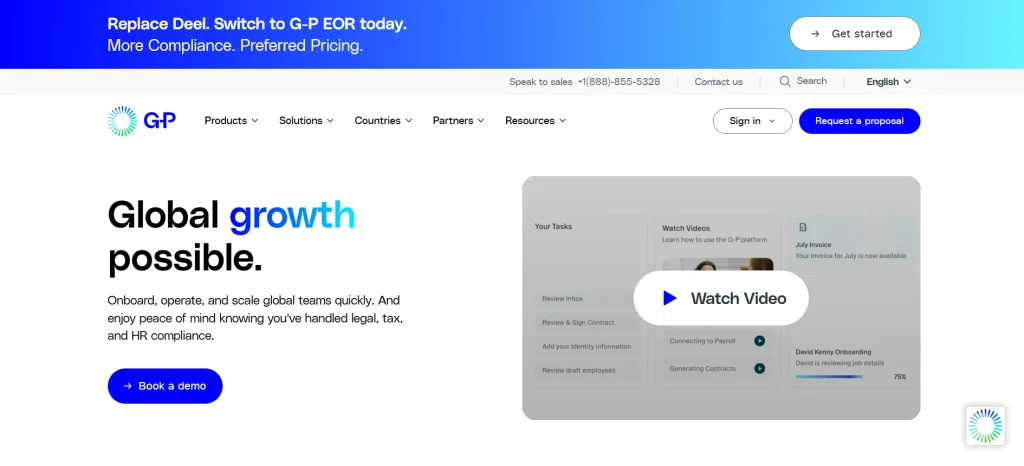
Globalization Partners (now branded as G-P) is one of the original EOR providers, founded in 2012 with a 14-year track record. G-P operates owned entities in key markets and serves primarily enterprise clients who prioritize compliance certainty over cost optimization. Their platform is more conservative and less flashy than Deel or Remote, but the compliance infrastructure is battle-tested.
Key Features:
Pricing:
Custom quote-based only. Enterprise-level pricing, generally higher than Deel and Remote. Volume discounts and multi-year agreements available.
India Compliance:
Operates owned entity infrastructure in India. Manages all statutory requirements including EPF, ESI, TDS, Gratuity, and state-specific labor laws. Enterprise-grade compliance reporting.
Best For:
Large enterprises (500+ employees globally) who need proven compliance infrastructure and are less price-sensitive.
Pros: 14-year track record | Enterprise-grade compliance | Owned entities in key markets | Strong advisory services
Cons: Premium enterprise pricing | Slower platform than competitors | Less transparent pricing | Over-engineered for SMEs
Tell us your hiring goals, team size, and budget. Our advisory team will shortlist the right providers for you — no obligation.
Schedule Free ConsultationRippling offers a unified HR, IT, and Finance platform with EOR capabilities in 50+ countries. Its standout feature is the ability to manage employee devices, app access, and payroll from a single dashboard. EOR pricing is custom-quoted. Rippling is the strongest choice for companies already using it for domestic HR who want to extend internationally without adding another vendor. India operations use partner entities. Rated 4.8/5 on G2.
Related: Rippling Review: All-in-One HR & Payroll Platform
Papaya Global specializes in global payroll processing and workforce payments across 160+ countries. Its workforce intelligence features provide analytics on labor costs, compliance risks, and headcount trends. EOR pricing starts from $599/employee/month. Best suited for finance-oriented teams who need robust payroll reporting and multi-country payment processing. Uses partner entities in India. Rated 4.5/5 on G2.
Multiplier is headquartered in Singapore and offers EOR services from $400/employee/month — the most competitive published pricing among major providers. The platform focuses on APAC markets and offers fast onboarding (typically 2–3 business days in India). Multiplier is the best choice for cost-conscious companies focused on APAC hiring who don’t need the feature depth of Deel or Remote. Uses partner entities in India. Rated 4.7/5 on G2.
Skuad offers one of the lowest entry-point prices in the EOR market at $199/employee/month. Based in Singapore, Skuad targets startups and SMEs expanding into India and other APAC markets. The platform is thinner than Deel or Remote but covers core EOR functions: contracts, payroll, compliance, and benefits. Uses partner entities in India. Rated 4.5/5 on G2. Best for startups hiring their first 1–5 employees in India who need to minimize costs.
Oyster HR positions itself as the EOR for remote-first companies, with strong employee experience features including compensation benchmarking, total rewards tools, and team engagement analytics. EOR pricing starts at $599/employee/month across 180+ countries. Oyster’s platform is optimized for distributed teams who want to offer location-agnostic compensation. Uses partner entities in India. Rated 4.4/5 on G2.
Before choosing a provider, you need to understand the structural difference between a PEO and an EOR — because it determines whether you need an Indian entity or not.
A PEO (Professional Employer Organization) operates as a co-employer alongside your existing Indian entity. You retain the legal employment relationship, and the PEO handles HR, payroll, and compliance administration. This model requires you to already have a registered business entity in India.
An EOR (Employer of Record) becomes the legal employer of your Indian workers on your behalf. The EOR uses its own Indian entity to hire, pay, and manage compliance. You make all day-to-day work decisions, but the EOR holds the employment contract. This model does NOT require you to have an Indian entity, making it the faster and more common choice for first-time India expansion.
| Factor | PEO (Co-Employment) | EOR (Full Legal Employer) |
|---|---|---|
| Legal Employer | Your company (PEO co-employs) | The EOR provider |
| Entity Required? | Yes — you need a local entity | No — EOR uses theirs |
| Compliance Liability | Shared between you and PEO | Primarily on the EOR |
| Best For | Companies with an Indian entity wanting HR support | Companies with no Indian entity wanting to hire quickly |
| Typical Cost (India) | $150–$400 per employee per month | $300–$699 per employee per month |
| Setup Time | 2–4 weeks | 2–5 business days |
| Control Over Employees | High — direct employment relationship | Moderate — EOR handles legal employment |
India’s statutory compliance landscape is complex, with multiple overlapping central and state-level obligations. Any PEO or EOR operating in India must handle all of the following on your behalf. This section helps you evaluate whether a provider truly has India-depth or is just offering surface-level coverage.
The Supreme Court of India has directed the government to finalize a decision on increasing the EPF wage ceiling from ₹15,000 to ₹21,000–₹25,000 by mid-2026.
This will increase employer contribution obligations. Ask your PEO provider how they plan to handle this change.
The Social Security Code (notified November 2025) consolidates 29 labor laws into one framework.
This introduces universal social security for gig workers and a national floor wage. Providers must be tracking these changes proactively.
| Obligation | Applicability | Contribution Rate | Due Date |
|---|---|---|---|
| EPF (Provident Fund) | 20+ employees | 12% employer + 12% employee on Basic + DA (capped at ₹15,000/month for EPS component) | 15th of following month |
| ESI (Employee State Insurance) | 10+ employees (some states 20+); wages ≤ ₹21,000/month | 3.25% employer + 0.75% employee on gross wages | 15th of following month |
| Professional Tax | State-specific (Maharashtra, Karnataka, etc.) | ₹150–₹200/month (varies by state & salary slab) | Monthly or as per state rules |
| Gratuity | 10+ employees; 5+ years service | 4.81% of basic salary per month (approx.) | On separation / retirement |
| Labour Welfare Fund | State-specific | ₹6–₹50/employee (varies) | Half-yearly / annually |
| TDS (Income Tax) | All employers paying salary | Per applicable income tax slabs | 7th of following month |
India’s compliance requirements vary significantly by state. Professional Tax applies in Maharashtra, Karnataka, Tamil Nadu, Telangana, Gujarat, West Bengal, and Andhra Pradesh — but NOT in Delhi, Haryana, Uttar Pradesh, or Rajasthan. Labour Welfare Fund rates and frequency also vary by state. The Shop & Establishment Act requires separate registration in each state where employees are located. A strong PEO provider must handle multi-state compliance if your team is distributed across Indian cities.
Related: Everything You Need to Know About PEO Services in India
PEO and EOR pricing in India varies widely based on provider, service model, and team size. Here is what you can expect in 2026:
$199–$400/employee/month (Skuad, Multiplier)
$400–$599/employee/month (Deel, Remote annual, Papaya Global)
$599–$699+/employee/month (Velocity Global, Remote monthly, G-P)
Custom quotes, typically $150–$400/employee/month (Remunance)
Beyond the per-employee monthly fee, watch for these additional costs that impact total spend: salary deposits (Deel requires one month’s gross salary upfront per employee), FX markups (typically 0.6–2% on currency conversion), country surcharges ($50–$150/month for complex jurisdictions), visa and immigration fees (if relocating employees), and termination costs (local severance and notice period obligations under Indian labor law).
Deep dive: How Much Does a PEO Cost? Pricing, Fees & ROI Breakdown
Use this decision framework based on your company’s situation:
A practical way to decide whether a PEO, EOR, or India-specialist model fits the hiring situation best.
Before selecting a PEO or EOR partner for India, these are the questions that reveal real capability, hidden risk, and total cost.
Share a few details. Peorient will map your hiring needs to the right PEO/EOR options, clearly and without bias.
A PEO (Professional Employer Organization) co-employs workers alongside your existing Indian entity. An EOR (Employer of Record) becomes the legal employer using its own entity, so you do not need to set up a company in India. If you have no Indian entity, you need an EOR. If you already have one, a PEO can handle HR administration.
PEO/EOR platform fees in India range from $199 to $699 per employee per month in 2026. Budget options like Skuad start at $199/mo, mid-market providers like Deel charge $599/mo, and premium services like Remote monthly cost $699/mo. India-specialist providers like Remunance offer custom quotes that are typically competitive for India-only hiring. Total cost includes salary + statutory contributions (~15–20% of gross) + platform fee.
Yes, through an Employer of Record (EOR). The EOR uses its own Indian legal entity to employ workers on your behalf, handling payroll, compliance, tax filings, and statutory contributions. This is the most common method for foreign companies hiring their first employees in India.
Key obligations include EPF (12% employer contribution on Basic + DA), ESI (3.25% employer contribution on gross wages for employees earning up to ₹21,000/month), Professional Tax (state-specific, ₹150–₹200/month), Gratuity (approximately 4.81% of basic salary), Labour Welfare Fund (state-specific), and TDS (income tax withholding per applicable slabs). A competent PEO/EOR handles all of these.
Most EOR providers can onboard an employee in India within 2–5 business days. Deel and Multiplier are among the fastest at 2–3 days. The process involves signing the EOR agreement, collecting employee documents (PAN, Aadhaar, bank details), generating a compliant employment contract, and registering for statutory benefits.
Remunance is the strongest India-specialist with 21 years of local HR expertise and an owned entity in India. For companies that also need multi-country coverage, Deel and Remote offer strong India support with broader geographic reach. The best choice depends on whether India is your sole focus or part of a multi-country expansion.
Employees are typically terminated by the outgoing EOR and re-hired by the incoming EOR or your own entity. This requires careful management to ensure continuity of benefits, no gaps in statutory contributions, and compliance with notice period requirements under Indian labor law. Most providers offer transition support.
For teams of 1–15 employees, an EOR is almost always more cost-effective than entity setup (which costs $15,000–$50,000 upfront plus $3,000–$8,000/month in ongoing admin). At 15–50+ employees, the math shifts toward entity setup with PEO support. Some providers like Remunance offer subsidiary formation services to help companies transition from EOR to owned entity as they scale.
M.Sc. Taxation, LSE · Chartered Tax Adviser (CTA) · ACCA · CEBS
Claire has 14+ years in international tax planning and cross-border benefits structuring. Previously at PwC Global Mobility Tax and Mercer, she specializes in employer tax obligations, permanent establishment risk, and co-employment tax implications.
Employer of Record Netherlands (2026): Complete EOR Guide
Hire in the Netherlands without a Dutch entity. EOR costs, 2026 employment law, CAO rules, taxes, 30% ruling, top providers & step-by-step.