...
Workforce Expansion Advisory

Why Global Hiring Needs a Smarter Guide

Global expansion brings exciting opportunities, but also complex hurdles. From employment laws to multi-country payroll, even experienced HR teams can struggle.

review blogs page

Peorient’s Rating

150+ Countries

Price $499

Peorient’s Rating

150+ Countries

Price $199

Peorient’s Rating

180+ Countries

Price $499

Peorient’s Rating

90+ Countries

Price $699

Peorient’s Rating

150+ Countries

Price $499

Peorient’s Rating

150+ Countries

Price $199

Peorient’s Rating

180+ Countries

Price $499

Peorient’s Rating

90+ Countries

Price $699

Peorient’s Rating

12+ Countries

Price $599

Peorient’s Rating

150+ Countries

Price $199

Peorient’s Rating

12+ Countries

Price $599

Peorient’s Rating

150+ Countries

Price $199

The Definitive Framework

Choosing the Right Employer of Record (EOR) in India

India has reached a point where hiring here is no longer a “cost-advantage experiment.” It’s a core strategy. Global companies now look at India for deep technical talent, stable operations, and access to a workforce that understands global standards. 

And while the opportunity is massive, the compliance landscape is not simple. India runs on layered regulations, state-wise variations, social security obligations, and employment rules that shift often.

This is where the right Employer of Record (EOR) becomes a differentiator.

A high-quality EOR lets organisations hire in India immediately, without setting up an entity, without navigating compliance blind spots, and without risking statutory penalties. But the gap between a good EOR and an average EOR is huge. One protects the business. The other creates invisible compliance debt that surfaces only when it’s too late.

This framework cuts through that noise. It explains exactly how to review, compare, and select the right EOR for India using depth, structure, and clarity that support real decision-making.

Understanding EOR for India: What It Actually Means

An Employer of Record in India legally employs your workforce while you manage the day-to-day work. The EOR becomes responsible for:

    • Payroll compliance
    • Employee taxation
    • Statutory benefits
    • HR documentation
    • Labour-law adherence
    • Onboarding and exits

You maintain complete operational control. The EOR manages the legal, administrative, and statutory foundation required to employ talent in India.

For global organisations, the real value lies in speed, compliance certainty, and cost efficiency. An EOR removes the burden of entity formation, ongoing statutory filings, local HR management, and labor-law complexities, allowing companies to scale without friction.

However, that value becomes apparent only if the provider has a deep understanding of India.
Not at the surface level.

Quote


What Sets the Best India-Focused EORs Apart

India is not an easy employment environment. The best EOR partners stand out through very specific strengths that directly influence compliance safety and employee experience.

1. Real Regulatory Expertise, Not Generic Compliance Claims

India has central laws, state rules, draft codes, old rules still in effect, and compliance that changes frequently. A strong EOR maps this complexity with:

    • state-wise statutory clarity
    • internal legal and payroll specialists
    • proactive regulatory monitoring
    • PF, ESIC, PT, LWF, and gratuity accuracy
    • clear guidance on local variations

Providers who offer “we’ll take care of compliance” without explaining India’s specifics are red flags. Real experts speak the language of PF rates, wage ceilings, state adoption timelines, and region-specific employment requirements.

2. Actual On-Ground India Presence

This is non-negotiable.

EORs operating from foreign hubs without real Indian infrastructure cannot handle statutory filings or tax compliance, employee issues, or documentation that requires local authority interaction.

A strong EOR has:

    • offices in major Indian cities
    • dedicated India HR and compliance teams
    • direct relationships with authorities
    • operational capacity for quick resolutions

Local presence directly correlates with reliability.

3. Transparent, Predictable Pricing

India’s payroll components are layered. Hidden charges around statutory filings, reimbursements, benefits, or onboarding can distort actual cost.

The best EORs provide:

    • clear per-employee pricing
    • itemised fee breakdowns
    • clarity on currency, FX, and billing cycles
    • transparency on what qualifies as “extra”

Low-cost providers often balance cheap pricing with poor compliance depth, creating far bigger long-term risks.

4. Service Breadth Beyond “Just Compliance”

Compliance is a minimum requirement, not a differentiator.

Strong EORs support:

    • employee onboarding
    • health insurance and India-competitive benefits
    • HR support
    • leave and attendance management
    • reimbursement workflows
    • equipment procurement
    • employee query handling

This directly affects retention, morale, and brand reputation.

5. A Mature Technology Platform

In India, payroll and compliance involve high paperwork volume. A robust platform reduces friction.

The best systems offer:

    • employee portals
    • payroll and compliance dashboards
    • automated documentation
    • secure storage
    • mobile access
    • integration with HRIS tools

Heavy manual work is a sign of an outdated EOR model.

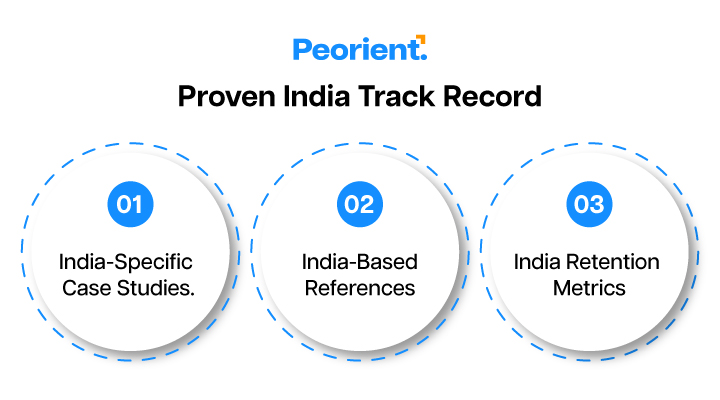
6. Proven India Track Record

Experience matters more here than in many other countries.

Proven India Track Record


7. Responsive Account Management

  • Time zones should not reduce speed.
  • Employee issues should never wait.
  • Compliance clarifications should be timely.

The best providers show responsiveness during the evaluation itself.
If they’re slow now, they’ll be slower later.

How to Evaluate and Review EOR Providers Systematically

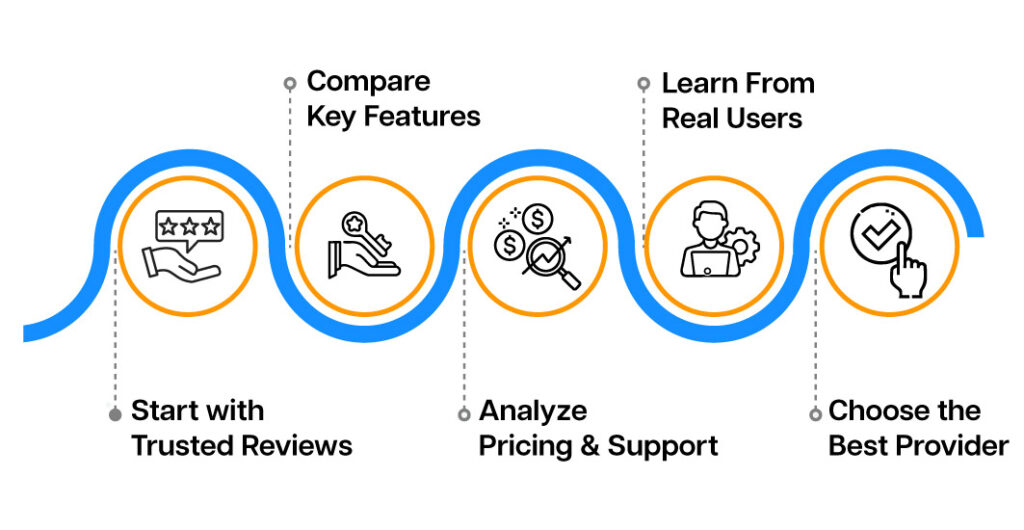
A structured evaluation prevents surprises. Here’s the recommended approach.

1. Initial Screening and Shortlisting

Start by identifying providers that actively understand India. Indicators include:

    • India-focused articles or guides
    • regulatory explainers
    • India-specific service pages
    • proof of local presence

Eliminate providers that treat India as an afterthought.

2. Deep-Dive Service Capability Review

Request detailed information on:

    • India office locations
    • size of India HR/compliance teams
    • number of India employees they currently manage
    • industries they support
    • onboarding and offboarding workflows
    • benefits administration
    • payroll timelines
    • statutory filing accuracy

Any hesitation or vague answers indicate weak internal capability.

3. Compliance Verification

Ask India-specific questions:

    • PF eligibility criteria
    • ESIC thresholds
    • state-wise professional tax differences
    • timelines for Form 16
    • gratuity applicability
    • statutory remittance cycles
    • labour code adoption status

A strong provider answers instantly and confidently, because they live these rules daily.

Also confirm:

    • their Indian entity registrations
    • insurance coverage (EPLI, PI)
    • internal audit processes

4. Technology Demonstration

Evaluate:

    • payroll dashboards
    • India-specific statutory workflows
    • employee portals
    • reporting formats
    • document management
    • mobile access

The platform must simplify India, not complicate it.

5. Reference Calls

Speak to clients using the provider specifically for India.

Ask about:

    • payroll accuracy
    • responsiveness
    • hidden charges
    • employee experience
    • dispute handling
    • compliance reliability

Real stories reveal more than polished pitches.

6. Financial Stability Review

EORs handle salaries, statutory payments, and reimbursements.
Financial instability puts your employees at risk.

Check:

    • years of operation
    • client base
    • funding background
    • audit history

Long-term reliability is essential.

7. Contract and Legal Review

Look for clarity on:

    • services included
    • liability distribution
    • termination terms
    • data protection
    • IP ownership
    • confidentiality provisions
    • employee transition support

Ambiguity here becomes expensive later.

Critical Factors Before Final Selection

These considerations ensure long-term fit, not just initial compatibility.

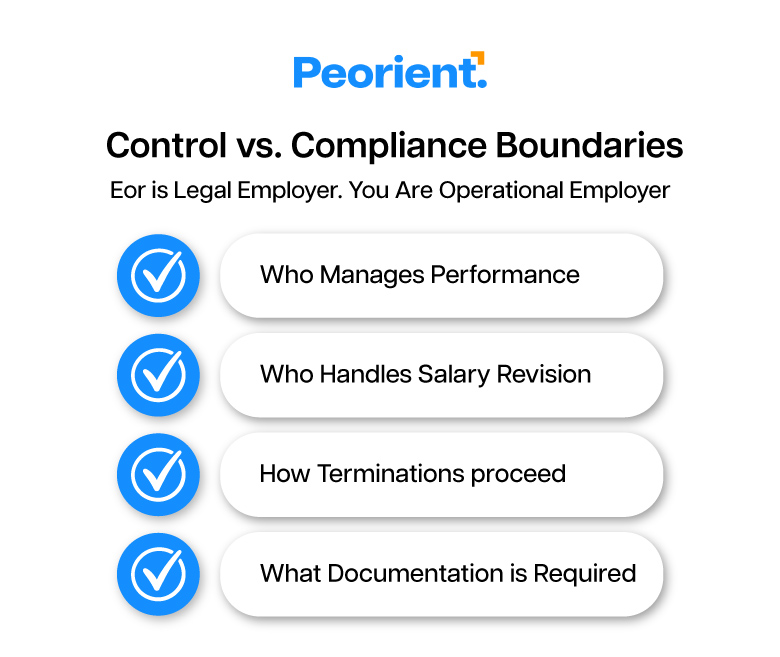
1. Control vs. Compliance Boundaries

EOR is a legal employer.
You are an operational employer.

Both sides must understand:

Control vs Compliance Boundaries

Clear boundaries prevent conflict.

2. Cultural and Operational Fit

Ask yourself:

    • Does the provider communicate clearly?
    • Do they operate with discipline?
    • Do their processes work with our systems?
    • Does their support model match how we work?

Partnership fit is often the deciding factor.

3. Employee Experience Impact

Employees judge your brand through the EOR.

Check:

    • payroll accuracy
    • timeliness
    • benefits quality
    • query handling
    • professionalism
    • onboarding efficiency

A strong EOR improves retention.
A weak one damages credibility.

4. Scalability Alignment

Will the provider support:

    • multi-state hiring?
    • 50 → 200+ employee growth?
    • new benefits?
    • remote/on-site mix?

Some EORs excel at small teams but break under scale.

5. Exit and Transition Path

If you later:

    • build your own India entity
    • migrate to another provider
    • scale down operations

The transition must be clean and compliant.

Understand:

    • notice periods
    • employee transfer processes
    • data handover
    • cooperation levels

EOR transitions in India are documentation-heavy, you want a partner who supports the process, not obstructs it.

6. Data Security and IP Ownership

Confirm:

    • ISO certifications
    • breach protocols
    • storage locations
    • employee data policies
    • assignment agreements making IP yours

This protects long-term business value.

7. Long-Term Strategic Alignment

Is EOR a bridge or a permanent model?
Does the provider support both pathways?

Strong EORs adjust to long-term strategy, not restrict it.

India-Specific Factors You Must Consider

India’s HR compliance landscape is unique. These areas require heightened scrutiny.

1. Labour Code Transition Management

States are adopting the new labour codes at different speeds.

Your EOR must track:

    • state-wise adoption
    • wage definition changes
    • leave policy changes
    • gratuity implications

Weak monitoring = high compliance risk.

2. Provident Fund and Social Security Accuracy

Check:

    • PF calculation accuracy
    • ESIC applicability
    • remittance timelines
    • UAN management
    • employee documentation
    • statutory audit readiness

This is one of the most failure-prone areas for inexperienced EORs.

3. State-Level Variations

Professional tax, shops & establishment registrations, leave rules, all vary by state.

Your EOR must handle:

    • multi-state onboarding
    • region-wise compliance
    • state-specific filings

Not every provider has this capacity.

4. Notice Periods and Exit Compliance

India’s exit process requires:

    • documented reasons
    • notice period adherence
    • settlement timelines
    • statutory calculations

A good EOR protects both compliance and dignity during exits.

5. Benefits Competitive to Indian Market

Employees expect:

    • family health insurance
    • accidental coverage
    • term life insurance
    • fair leave
    • reimbursement support

This shapes employer brand perception in India.

6. Billing, FX, and Invoicing

Confirm:

    • invoicing currency
    • FX handling
    • cycle timelines
    • statutory breakup visibility
    • adjustment processes

Poor billing clarity becomes an operational burden.

Red Flags That Signal a Risky EOR

Watch for:

    • vague compliance explanations
    • no India office
    • suspiciously low pricing
    • unwillingness to share references
    • inconsistent communication
    • overpromising
    • outdated tech
    • no India-specific content

Any of these weaken trust immediately.

Making the Final Decision

You weigh:

    • compliance depth
    • service breadth
    • responsiveness
    • pricing clarity
    • technology
    • employee impact
    • cultural fit

No EOR is perfect. But the right one fits your priorities and protects your India operations without hidden risks.

Conclusion: EOR Selection as a Strategic Advantage

Choosing an EOR for India is not an administrative task, it’s a strategic decision that influences compliance stability, talent quality, employee experience, and operational continuity.

A structured framework ensures you:

    • avoid compliance risk
    • build scalable India teams
    • deliver competitive employee experience
    • align long-term with India’s regulatory realities

Done right, EOR selection becomes a competitive advantage, unlocking India’s deep talent market with confidence, speed, and precision.