Compare 12 of the best EOR providers in India for 2026 by pricing, compliance, legal entity, support and fit. See which EOR suits your India hiring.

Choosing the best Employer of Record in India should not begin with the provider that supports the most countries.
It should begin with a simpler question:
What exactly do you need an EOR to handle in India?
A company hiring five software engineers in Bengaluru has very different requirements from an enterprise employing 80 people across Maharashtra, Karnataka, Telangana and Delhi. And a business hiring only in India should evaluate providers differently from one expanding into India alongside ten other countries.
If the model itself is new to you, Peorient’s complete Employer of Record guide explains how an EOR becomes the legal employer while the client company retains control over the employee’s day-to-day work.
For this comparison, Peorient reviewed 12 Employer of Record providers operating in India using India payroll and compliance capability, legal entity structure, pricing transparency, support, onboarding, platform capabilities and verified customer information.
Our conclusion is straightforward.
Remunance is our strongest overall choice for companies primarily hiring in India.
Asanify and Wisemonk remain strong alternatives at the low-price end.
Deel, Remote and Multiplier become more attractive when India is one part of a wider international workforce.
And Rippling deserves consideration when HR, payroll, devices and workforce management matter more than getting the lowest possible India EOR fee.
There is no provider that wins every situation.
That is why this comparison ranks providers by fit rather than simply declaring one company the winner for every buyer.
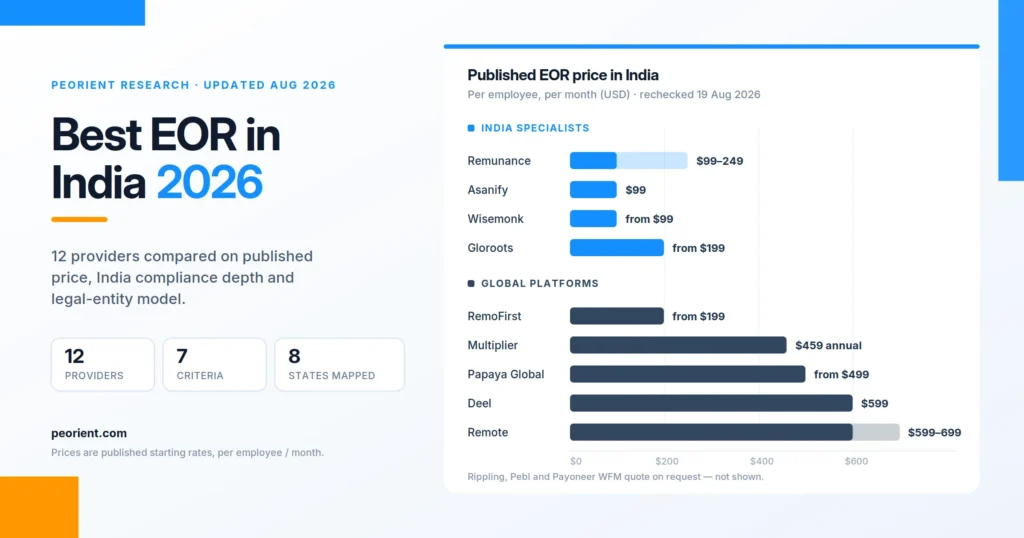
For most companies primarily building teams in India, this is our 2026 shortlist.
Compare leading EOR providers by their strongest use case and published pricing.
| Rank | Provider | Best suited for | Published EOR price |
|---|---|---|---|
| 1 | Remunance | India-focused hiring with local HR support | $99–$249 per employee/month |
| 2 | Asanify | Low-cost India EOR plus HRMS | From $99 |
| 3 | Wisemonk | Engineering and technology teams | From $99 |
| 4 | Gloroots | Recruitment plus EOR | From $199 |
| 5 | Deel | International hiring across many countries | $599 |
| 6 | Remote | Global hiring with owned entities | $599 annual / $699 monthly |
| 7 | Multiplier | APAC and multi-country teams | $459 annual / $499 monthly |
| 8 | RemoFirst | Lower-cost international EOR | From $199 |
| 9 | Rippling | HR, IT, payroll and workforce operations | Custom |
| 10 | Papaya Global | Enterprise payroll and EOR | From $499 |
| 11 | Pebl | Complex enterprise expansion | Custom |
| 12 | Payoneer Workforce Management | International workforce management | Custom |
Published EOR prices are service fees. They are not your full employment cost.
Salary, employer statutory contributions, benefits, deposits, payroll funding, foreign exchange charges and other employment expenses sit on top.
That distinction matters enough that buyers should model the real employer cost of hiring in India before comparing providers on their monthly service fee.
Remunance is our strongest India-first option for companies whose main hiring market is India.
Unlike a global platform where India is one country in a very large network, Remunance focuses its services around building and managing Indian teams.
Its official Employer of Record service page describes coverage across hiring, payroll, compliance, onboarding, employee benefits and offboarding.
Its current EOR pricing guide says local Remunance EOR fees generally fall between $99 and $249 per employee per month. See Remunance’s current EOR cost breakdown.
Peorient has also independently evaluated the provider in our 2026 Remunance review, including pricing, India compliance, onboarding and its limitations compared with global EOR platforms.
Remunance makes the most sense when:
Its main limitation is equally clear.
It is not the best single-platform answer when you need to hire employees across a large number of countries.
All three sit around the lowest published India EOR pricing tier.
But you should not choose between them based only on the monthly headline fee.
A $99 platform can cost more than a $199 platform if it adds expensive FX margins, insurance, deposits, off-cycle payroll charges or termination fees.
Ask each provider for a 12-month model that includes:
The correct comparison is total annual cost, not monthly software price.
Peorient’s EOR payroll guide explains the individual components that normally appear on an Employer of Record invoice.
Deel becomes more attractive when India is one part of a larger international workforce.
Its value comes from combining international EOR, contractor management, payroll, integrations and workforce administration within one global platform.
That can justify paying more than an India specialist when your HR team would otherwise need separate providers across several countries.
Before choosing it for India specifically, read Peorient’s independent Deel review, which looks at its $599 list price, international coverage and India-specific trade-offs.
Remote is a strong comparison when your legal or procurement team places high value on owned local entities and direct employment infrastructure.
Its current positioning is particularly relevant to companies handling sensitive IP or operating in multiple markets where a consistent employment model matters.
Peorient’s Remote review for 2026 examines its entity model, pricing, coverage and India suitability in more detail.
Multiplier deserves a place on the shortlist when India sits inside a broader Asia-Pacific hiring strategy.
The question here is not whether Multiplier knows India better than an India specialist.
The question is whether having India, Singapore, Australia and other APAC hires under one operational structure creates enough value to justify the higher fee.
RemoFirst is worth comparing when you need international EOR coverage but cannot justify the cost of platforms charging around $599 per employee per month.
The trade-off is that buyers need to scrutinise the legal employer structure, local partner involvement and support escalation more carefully.
Rippling should be evaluated differently from a pure EOR.
Its attraction lies in combining employment with HR systems, payroll, identity, device management and other workforce operations.
If your company already wants that wider infrastructure, the combined system can matter more than getting the lowest India-specific EOR fee.
Each provider was assessed against the factors that matter most when hiring and managing employees in India.
India payroll and compliance receives the highest weighting deliberately.
A strong dashboard cannot correct an inaccurate payroll filing.
Likewise, a low EOR fee becomes meaningless if Provident Fund, Professional Tax, salary TDS or state registrations are managed incorrectly.
Buyers who want to use the same framework themselves can follow Peorient’s guide to choosing an Employer of Record before creating a final shortlist.
Foreign employers often treat India as one employment market.
From a compliance perspective, it combines national employment rules with obligations that can vary by state.
Depending on the employee and location, an EOR may need to deal with:
Peorient’s payroll compliance in India guide covers these obligations in more detail.
And India’s employment framework changed materially before 2026.
The Ministry of Labour and Employment announced the implementation of India’s four Labour Codes on 21 November 2025. See the Ministry of Labour announcement.
These four codes consolidate 29 central labour laws into:
That creates a useful EOR due-diligence question:
Ask the provider what actually changed in its payroll configuration, employment agreements and compliance workflows after 21 November 2025.
A salesperson knowing that the Labour Codes exist is not enough.
You want evidence that regulatory changes reach the payroll operation responsible for your employees.
At minimum, an EOR should manage the formal employment layer.
The EOR becomes the legal employer and issues the employment agreement.
The contract should correctly reflect the employee’s location, compensation, working conditions, confidentiality requirements and applicable employment obligations.
For companies unfamiliar with the underlying structure, Peorient explains the allocation of employer and client responsibilities in its complete EOR services guide.
The EOR calculates gross-to-net salary, deductions, reimbursements, statutory items and payslips.
If you want to understand what happens between payroll funding and employee payday, read Peorient’s EOR payroll process guide.
The Employees’ Provident Fund Organisation states that employees generally contribute 12% of basic wages, dearness allowance and retaining allowance, while employers also contribute 12%, subject to the applicable rules and wage ceiling. See the official EPFO contribution FAQ.
Your EOR should know:
The official EPFO employer portal and resources provide the underlying filing information.
ESI does not apply identically to every employee.
Where applicable, the contribution structure includes an employer contribution of 3.25% and employee contribution of 0.75%. See ESIC’s official employer guidance.
The important question when reviewing an EOR quotation is not simply whether “ESI is included.”
Ask how the provider determines eligibility for each employee.
Payroll systems also need to reflect India’s new Income Tax Act framework.
The Income Tax Department states that salary payments from April 2026 onward fall under the salary TDS provisions of the Income Tax Act, 2025, with employers resetting the salary TDS computation for Tax Year 2026–27. See the Income Tax Department’s 2026 TDS transition guidance.
An EOR using an outdated payroll setup creates a direct operational risk.
Professional Tax is state-specific.
That makes the employee’s work location relevant.
A provider employing ten employees in one state has a simpler compliance footprint than a provider employing workers across Maharashtra, Karnataka, Telangana, West Bengal and several other states.
Ask which state registrations the employing entity currently maintains.
Labour Welfare Fund requirements also vary by state.
Although the monetary amount may be small, this is a useful test of whether the provider truly understands state-level payroll.
Gratuity creates an employer liability that should be included when modelling employment cost.
Ask whether the provider:
Do not assume the monthly EOR fee includes gratuity.
Health insurance and supplemental employee benefits can sit outside the advertised EOR service fee.
Compare:
rather than simply asking whether insurance is provided.
Onboarding gets most of the sales-demo attention.
Offboarding deserves just as much.
Ask the provider to explain:
before signing the agreement.
Entity structure matters because the EOR becomes the formal employer.
Peorient independently checks provider entity information rather than relying only on marketing claims.
For providers you shortlist, ask for:
You can then verify the company through the Ministry of Corporate Affairs. The MCA provides public company master-data functionality for registered companies and LLPs. See MCA guidance on Company Master Data.
For Remunance specifically, its India EOR operation is presented through Remunance Services Pvt. Ltd., and its official India EOR service information describes its employment, payroll, tax and HR responsibilities.
Peorient’s own Remunance review independently evaluates the same provider from the buyer’s side.
Neither model is automatically better.
The important issue is transparency and accountability.
An owned-entity model can reduce the number of parties between the client and the legal employer.
A partner model can give a global EOR wider country coverage without requiring it to establish an entity in every jurisdiction.
Instead of asking only:
“Do you own your entity?”
Ask:
“Which legal entity will employ my worker in India, and who is accountable when payroll or a statutory filing is incorrect?”
That answer is more useful.
Peorient’s Global Employer of Record guide explains the difference between owned-entity, partner and other EOR operating models in more detail.
Current published EOR fees range widely.
Several India-focused providers begin around $99 per employee per month, while major global platforms can charge several hundred dollars per employee per month.
Remunance’s current pricing analysis places its India EOR model around $99–$249 per employee per month. See Remunance’s 2026 EOR cost guide.
But the EOR fee is only one cost line.
The better formula is:
Gross employee compensation
Peorient’s India employer-cost guide explains why the gross salary and headline EOR fee are not enough to create an accurate hiring budget.
Based on currently published starting prices, Remunance, Asanify and Wisemonk sit around the lowest end of the market.
But “cheapest EOR” should mean lowest total cost for the same employment scenario.
It should not mean lowest number displayed on a pricing page.
Give every shortlisted provider the same employee profile:
Then ask for the full 12-month cost.
This creates an apples-to-apples comparison.
For a small India team, our first shortlist is:
At this stage, prioritize:
Peorient maintains a separate comparison of the best EOR services for startups for companies that want to compare India with global startup-focused EOR platforms.
A startup hiring six people only in India usually does not need to pay extra merely because a provider can employ workers in 150 other countries.
But the answer changes if the company plans to hire simultaneously in India, Germany, Singapore and the UK.
For software and technology teams, our India shortlist starts with Remunance and Wisemonk.
Global platforms such as Deel, Remote and Multiplier become more compelling when the engineering team is distributed across several countries.
Software companies should add four questions to a normal EOR review:
Do not accept a generic promise that “IP is protected.”
Ask to review the India employment agreement.
Peorient’s Best EOR for SaaS Companies guide goes deeper into IP assignment, equity, source-code security and engineering-specific EOR risks.
For US companies mainly hiring in India, start with:
For US companies expanding into several markets simultaneously, add:
US buyers should specifically review:
An EOR does not automatically eliminate permanent-establishment risk.
It solves the employment structure.
Your corporate-tax position still depends on what the Indian workforce actually does for the foreign company.
For India-only employment, India-specialist EORs remain attractive.
When the company also has workers across Europe and Asia, Deel, Remote and Multiplier become stronger comparisons.
UK buyers should review:
Australian companies hiring only in India should compare local specialists first.
Multiplier deserves extra consideration when India forms part of a wider APAC expansion.
Australian employers should compare:
Timezone overlap can make India-based operational support particularly valuable.
At larger headcounts, the decision changes.
Instead of asking only which EOR is best, ask whether an EOR is still the right structure.
Compare:
As headcount grows, a per-employee EOR fee compounds.
But your own subsidiary also introduces:
The break-even point differs by company.
Peorient’s guide to building a workforce in India without a local entity compares EOR, PEO, outsourcing and entity-based employment routes.
An EOR generally makes more sense when:
An Indian subsidiary becomes more attractive when:
Many companies use the two models sequentially.
EOR first.
Entity later.
A capable India EOR should therefore be able to explain how employees can eventually move from the EOR onto your own entity.
An EOR becomes the legal employer.
A PEO usually supports HR and payroll alongside an employer that already has its own local legal structure.
This distinction is frequently blurred in global hiring marketing.
Peorient’s comparison of international PEO providers in India explains where EOR and PEO structures differ.
The underlying choice is simple:
No Indian entity and need to employ workers quickly? Consider an EOR.
Already have an Indian entity and mainly need outsourced HR, payroll and compliance administration? A PEO may be more appropriate.
The monthly fee is only one part of the decision. Peorient compares pricing, fee structures, India-specific operating capability and your actual hiring requirements to help you build a better shortlist.
Get a transparent comparison built around your India team.
Tell us what you are hiring for. We will help narrow the options.
Do not choose contractor status simply because it costs less.
The actual working relationship matters.
A person who:
may create worker-classification concerns even if an agreement calls that person an independent contractor.
Contractors are appropriate for genuine independent relationships.
Employment is appropriate where the relationship is employment in substance.
Remunance’s current Contractor of Record guide also notes that a COR can reduce and contractually allocate some classification and payment risk but does not automatically remove every risk where the client controls the contractor like an employee.
Use the same questions for every shortlisted provider.
For a broader selection framework, Peorient’s EOR buyer’s guide provides a structured process for moving from a longlist to a final provider.
“We operate in India” is not enough.
Ask for the exact company that will sign your employee’s contract.
India’s four Labour Codes were implemented on 21 November 2025.
If a provider’s current sales material still calls them future legislation, ask when its payroll processes were last updated.
A provider can legitimately have additional fees.
The problem is not additional cost.
The problem is discovering it after the contract is signed.
India is not a single payroll jurisdiction in practice.
Ask how Professional Tax, Labour Welfare Fund and other state requirements are managed for your actual employee locations.
Any EOR can explain onboarding.
Ask the harder question:
“What happens if we need to exit an employee six months from now?”
Country coverage is useful for global hiring.
It is not evidence of India payroll depth.
Choose an India-focused EOR when:
Choose a global EOR when:
Do not pay for 150-country coverage when you only need India.
But do not create a fragmented international HR stack merely to save money in one country when your organization is operating in fifteen.
Context decides the winner.
Peorient ranks Remunance first for India-focused hiring because the provider combines India specialization, an India-based operating model, local HR support and competitive India pricing.
Its own Employer of Record in India guide describes how the provider handles contracts, payroll, social-security contributions, onboarding and HR administration for foreign companies.
Its current EOR pricing guide places local Remunance fees between $99 and $249 per employee per month.
And Peorient’s independent Remunance review examines those strengths alongside the provider’s principal limitation: it does not replace a broad global EOR platform when a business needs significant multi-country hiring.
That limitation matters.
A company already employing people across 20 countries through Deel may sensibly keep India within Deel.
A SaaS company prioritising a global owned-entity model may prefer Remote.
An APAC-focused company might prefer Multiplier.
A company hiring only in India has a different decision.
A useful provider comparison should be able to recommend different answers for different buyers.
Our 2026 recommendations are:
Remunance for companies primarily building teams in India.
Asanify for low-cost EOR combined with an India HRMS proposition.
Wisemonk for India-focused technology and engineering teams.
Gloroots where recruitment and EOR need to work together.
Deel when India is one part of a wider global workforce.
Remote when owned global employment infrastructure is particularly important.
Multiplier for APAC and multi-country expansion.
RemoFirst when lower-cost international coverage matters.
Rippling when HR and IT consolidation matters more than India EOR price.
But do not select an EOR from a ranking table alone.
Take the final three providers and give each one the same hiring scenario.
Request:
Then compare the responses side by side.
If you do not want to run that process yourself, Peorient’s EOR and PEO provider matching process can be used to shortlist providers by country, headcount, budget and hiring requirements.
An Employer of Record is a local legal employer that hires employees on behalf of another company. The client manages the person's work while the EOR handles employment contracts, payroll, tax withholding, applicable statutory benefits and employment administration.
For a complete explanation, read Peorient's Employer of Record guide.
Yes.
A foreign company can hire employees through an Employer of Record without first incorporating its own Indian entity.
Peorient explains the available structures in its guide to hiring in India without a local company.
India-focused EOR fees can begin around $99 per employee per month, while large global providers can charge several hundred dollars per employee each month.
Remunance's current cost guide places its local India EOR model between $99 and $249 per employee per month. See the Remunance EOR pricing breakdown.
Salary, statutory obligations, benefits, deposits and other employment costs are additional.
India-focused EOR fees can begin around $99 per employee per month, while large global providers can charge several hundred dollars per employee each month.
Remunance's current cost guide places its local India EOR model between $99 and $249 per employee per month. See the Remunance EOR pricing breakdown.
Salary, statutory obligations, benefits, deposits and other employment costs are additional.
Remunance, Asanify and Wisemonk currently compete near the lowest published end of India EOR pricing.
But compare the full annual cost before declaring one provider cheapest.
For India-focused startups, Peorient's shortlist starts with Remunance, Asanify and Wisemonk.
Companies hiring across several markets should also compare global providers.
See Peorient's EOR comparison specifically for startups.
Remunance and Wisemonk are strong India-focused candidates.
Deel, Remote and Multiplier become stronger options when engineering hiring extends across several countries.
Software companies should pay particular attention to IP assignment, confidentiality, device management and data security. Peorient covers these factors in its SaaS EOR buyer's guide.
A compliant EOR acting as the legal employer should manage applicable Provident Fund obligations.
EPFO states that both the employee and employer generally contribute 12% of applicable pay under the standard contribution framework. See the official EPFO FAQ
Where ESI applies to the employee and establishment, the EOR should calculate, deduct and remit the applicable contribution.
Current ESIC guidance states an employer contribution of 3.25% and employee contribution of 0.75%. See ESIC employer guidance.
A capable India EOR should determine the applicable Professional Tax obligations based on the employee's state and handle the required payroll deduction and employer filings.
No.
An EOR provides employment infrastructure.
Permanent-establishment and corporate-tax exposure depends on the activities performed by the foreign company's India team and should be evaluated separately.
An EOR usually makes more sense for fast entry, smaller teams and market testing.
A subsidiary becomes increasingly worth evaluating when India becomes a long-term market and headcount grows.
Onboarding times vary by provider, employee documentation, background checks and role.
Some EORs advertise onboarding within a few business days.
Treat published onboarding speed as a target rather than a guarantee and ask the provider for the actual median onboarding time for India hires completed during the previous quarter.
Compare:
The lowest monthly EOR fee is rarely enough information to make the right decision.
Choose an India specialist when India is your main hiring market and India-specific service, cost and compliance depth matter most.
Choose a global EOR when centralized management across multiple countries creates more value than maximizing India-specific efficiency.

Written by
Lead India Employment and Payroll Specialist · 13+ years experience
Priya is Peorient's resident expert on hiring in India. Former senior HR Tax consultant at a Big 4 firm in Bengaluru and Head of Payroll Operations at a Pune-based EOR. Advocate enrolled with the Bar Council of Maharashtra and Goa. Has run state-level registrations in 14 Indian states.

US Employee Benefits Guide 2026: Costs & Requirements
US employee benefits are less about a long federal checklist and more about health insurance, state rules and competitive expectations. For a professional hire, budget roughly 25–35% above base salary before any EOR fee, then model family coverage and the employee’s work state separately.