Learn Global Workforce Management essentials—benefits, challenges & strategies to manage international teams while ensuring compliance & productivity.
Key Components of Global Workforce Management
1. Global Talent Acquisition
Globally acquiring talent is locating, drawing in, and appointing people from different nations to fulfill organizational demands. This approach calls for thorough knowledge of local labor markets, cultural subtleties, and legal obligations. Standardizing recruitment practices and enabling regional adjustments guarantees consistency and compliance throughout all hiring operations.
2. Workforce Planning
Strategic workforce planning is the evaluation of present labor capacity and future talent demand in line with corporate goals. To predict skill needs and actively fill possible skills shortages, this entails examining population changes, technology developments, and market trends. Data-driven insights help companies to make wise decisions, therefore enabling efficient use of resources and preservation of their competitive edge.
3. International Mobility and Expatriate Management
Managing employee moves for permanent transfers or overseas projects calls for handling logistics, immigration processes, and cultural adaption help. Good expatriate management guarantees seamless transitions, advances knowledge transfer, and produces global leaders all of which help to assure operational consistency throughout many sites.
4. Cross-Cultural Management
Encouragement of cooperation and cohesiveness in diverse teams depends on navigating cultural barriers. Development of techniques to close cultural barriers, improve communication, and use many points of view is the main emphasis of cross-cultural managers. Encouragement of cultural intelligence inside the company helps to minimize misinterpretation and maximize the advantages of a staff from many backgrounds.
5. Compliance with Global Labor Laws
Reducing legal risks requires ensuring adherence to labor laws, tax rules, and employment standards across several nations. This entails keeping current with local employment laws, handling payroll in line with area rules, and following international immigration restrictions. Strong compliance systems protect the company against any liabilities and support moral corporate behavior.
Global workforce management increasingly includes employees who move between countries by choice — the digital nomad workforce, each of whom triggers visa and tax-residency questions.
6. Performance Management
Using uniform performance evaluation tools across many nations and cultures guarantees that employee assessments complement organizational objectives. This covers clearly defined expectations, frequent criticism, and celebration of successes. Customizing performance management strategies to honor cultural standards improves employee output and involvement.
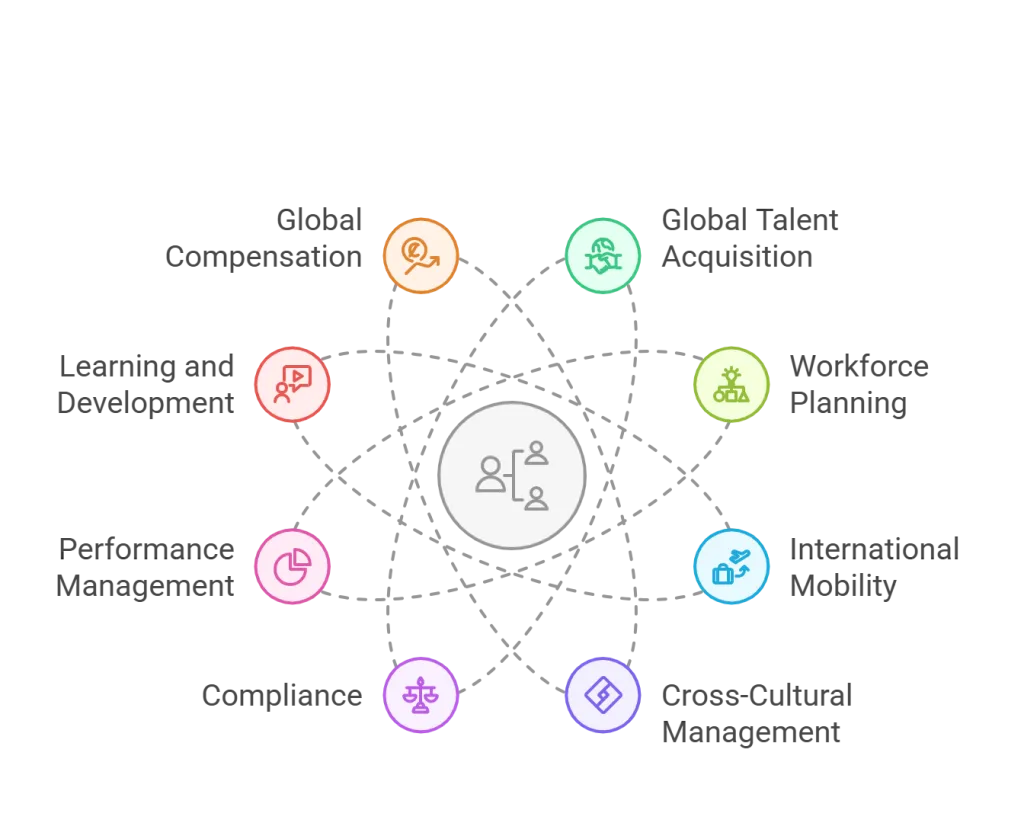
7. Learning and Development
Offering chances for training and development that fit a worldwide workforce means designing initiatives sensitive to global trends and fit for local needs. Constant skill development, encouragement of innovation, and support of career advancement made possible by ongoing education help to promote general organizational growth.
8. Global Compensation and Benefits
Attracting and keeping talent depends on developing competitive remuneration schemes fit for local market conditions, cost of living, and cultural expectations. This covers negotiating complexity connected to several payment systems, benefits arrangements, and guaranteeing equity worldwide among the workforce.
9. Technology Integration
Using technology solutions including collaboration tools and Human Resource Information Systems (HRIS) simplifies procedures and improves connection across scattered teams. By means of efficient communication, data administration, and remote work arrangements supported by integrating sophisticated technology, one can improve general staff management.
10. Risk Management
Crucially is the identification and reduction of hazards connected to worldwide operations including geopolitical conflicts, economic changes, data security issues. In a complicated worldwide scene, proactive risk management techniques guarantee organizational assets and commercial continuity.
11. Diversity, Equity, and Inclusion (DEI)
Encouragement of a workplace that celebrates diversity, guarantees fair treatment, and promotes inclusivity throughout worldwide operations improves organizational culture. By supporting equal chances and using the assets of a diverse workforce, DEI programs help to inspire innovation and employee satisfaction.
Benefits of Hiring and Managing a Global Workforce
Access to a Diverse Talent Pool
A worldwide workforce offers a wide spectrum of viewpoints, knowledge, and abilities. Using foreign talent pools helps companies to identify top-notch applicants, therefore promoting creativity and flexibility.
Enhanced Cultural Competence and Insight
Managing a worldwide workforce increases the cultural competency of a company by enabling staff members to properly negotiate several cultural conventions and business practices. Understanding local consumer preferences and customizing goods or services to fit regional demands depend on this cultural sensitivity.
Cost Savings and Increased Productivity
Strategic worldwide hiring can maximize operational efficiencies and obtain trained staff at competitive rates, hence lowering costs. A distributed workforce lets for continuous operations across time zones, thereby improving productivity; remote work arrangements can help to lower overhead costs.
Flexibility and Scalability
A worldwide workforce provides the adaptability to scale activities in response to customer needs. Companies might change the way their employees are distributed to seize new prospects or solve problems in particular areas.
Risk Mitigation
Globally distributing activities and expertise helps to lessen dependency on a single market and improve resilience against local political unrest, natural calamities, or economic downturns. This diversification helps to foster sustainable development by lowering risk.
Innovation and Problem-Solving
Different points of view and methodologies for problem-solving brought by diverse teams inspire invention and creativity. Working across cultures improves competitive advantage and helps to create original answers.

Challenges of Hiring and Managing a Global Workforce
Global Financial Instability
Variations in the economy and exchange values of currencies might affect financial planning and pay policies. Companies have to negotiate exchange rate concerns and modify their budgets to keep financial stability throughout different areas.
Legal and Regulatory Compliance
Negotiating several labor laws and tax rules calls for diligence to guarantee adherence. Legal consequences and financial fines resulting from mistakes make it necessary to keep educated and apply strong compliance systems.
Cultural Differences and Clashes
Different cultural standards can cause misinterpretation that disturbs decision-making and communication. Different ideals and work ethics could impede team harmony. Companies have to face these variations head-on by encouraging cultural awareness and training aimed at mutual respect.
Global Remote Work Challenges
Remote work might cause isolation and communication problems. Setting up across several time zones makes real-time cooperation difficult. Companies must have consistent check-ins and dependable communication methods to mitigate these problems so that every voice is heard and in line with corporate objectives.
Data Security and Privacy Concerns
Operating across borders exposes one to several data security rules. Organizations have to follow local data privacy rules and implement strong cybersecurity policies to guard private data. By being proactive, one reduces risk and provides defense against possible data leaks.
Global Benefits and Compensation Management
Establishing fair pay systems is difficult when local market factors, cost-of-living variances, and different expectations all factor. To draw and keep top personnel, companies must strike a mix between internal equity and competitive local offers. It is absolutely vital to customize benefits packages to reflect regional needs while preserving general fairness.
Cross-Border Talent Acquisition and Retention
Globally recruiting has difficulties like confirming credentials and assuring fit with local cultural standards. Excellent competition for top-notch talent calls for a calculated retention approach. Businesses should create strong career development plans and onboarding systems that fit the particular requirements of a diverse workforce.
Global Team Building
Creating team cohesiveness over scattered sites calls for intentional planning. Disjointed efforts and a lack of togetherness might follow from physical distances and cultural differences. Creating strong, driven teams with a common goal depends mostly on funding virtual team-building events and supporting an inclusive atmosphere.
Strategies for Overcoming Global Workforce Management Challenges
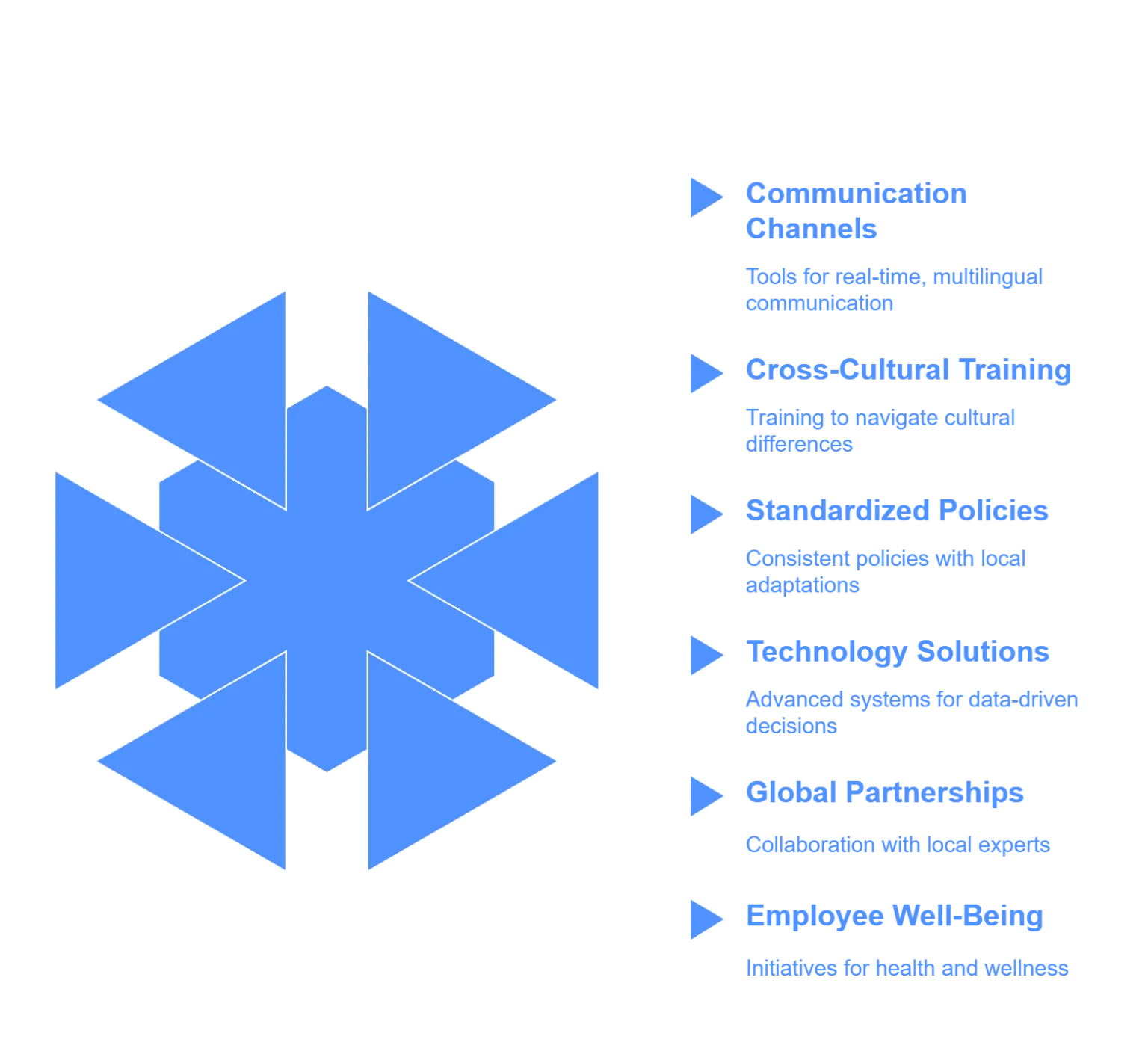
Implement Effective Communication Channels
We make investments in strong, multilingual communication tools to enable real-time conversation and guarantee consistency all throughout the company. Consolidated communication hubs and frequent virtual meetings help to close the distance produced by geography.
Leverage Cross-Cultural Training
One must cultivate cultural intelligence. We offer specifically designed training courses that enable staff members and managers to negotiate cultural quirks. This kind of training improves cooperation among several teams and helps to avoid misunderstandings.
Standardize Policies with Local Adaptations
We use consistent worldwide rules considering local labor laws and cultural customs. This equilibrium guarantees compliance and fairness, therefore lowering legal risks and raising general efficiency.
Integrate Advanced Technology Solutions
Our technology approach centers on using data analytics and thorough HRIS technologies. From recruitment to performance management, these solutions simplify procedures to allow real-time tracking and predictive planning for worldwide operations.
Partner with Global Experts
Working with local HR and legal professionals guarantees flawless navigation of difficult regulatory terrain. By outsourcing some tasks, we can use specialized knowledge and keep close adherence to local compliance standards.
Prioritize Employee Well-Being
Global labor management transcends mere operational effectiveness. Our initiatives for health and well-being honor cultural diversity and assist both physical and psychological wellness. Higher engagement and production follow from a significant emphasis on employee welfare.
Conclusion
From negotiating cultural diversity and legal complexity to preserving strong channels of communication, we understand that running a worldwide workforce has special challenges. Our all-encompassing strategy uses strategic planning, cutting-edge technology, and professional alliances to meet these obstacles.
We make sure that our worldwide workforce stays adaptable and competitive by encouraging an inclusive workplace, lifelong learning, and proactive risk management, therefore promoting sustainable business growth in an always changing international scene.