Free EOR, PEO and payroll shortlists for companies. We reply within 1 business day.Free provider shortlists
Start your brief
Get free shortlist
Free for companies. Reply within 1 business day. Or email hello@peorient.com
Free EOR, PEO and payroll shortlists for companies. We reply within 1 business day.Free provider shortlists
Start your briefFree for companies. Reply within 1 business day. Or email hello@peorient.com

Understand maternity leave in India for private companies: 26-week eligibility, salary, ESIC, adoption rules and employer duties under the Social Security Code.

Maternity leave in India for private companies generally provides eligible women employees with up to 26 weeks of paid leave when they have fewer than two surviving children. The employer-paid route normally requires at least 80 qualifying days with the employer in the 12 months before the expected delivery date. Employees who qualify for ESIC maternity benefits follow a separate contribution-based route.
For employers, the difficult questions usually come after that headline. Does probation affect eligibility? Can salary be held until the employee returns? What happens when a contract expires? And who pays when the employee works through an employer of record?
This guide explains the rules for Indian private companies and for US, UK, Australian and New Zealand businesses employing people in India. It covers the current Social Security Code, the 2026 adoption ruling, payment deadlines and practical decisions that HR and payroll teams need to make.
Eligible employees can receive 26 weeks or 12 weeks of paid maternity benefit, depending on their circumstances. The current framework is Chapter VI of the Code on Social Security, 2020, read with applicable rules and court decisions.
| Situation | Statutory entitlement | When it applies |
|---|---|---|
| Pregnancy with fewer than two surviving children | Statutory entitlementUp to 26 weeks | When it appliesNo more than eight weeks before the expected delivery date |
| Pregnancy with two or more surviving children | Statutory entitlementUp to 12 weeks | When it appliesNo more than six weeks before the expected delivery date |
| Legal adoption | Statutory entitlement12 weeks | When it appliesFrom the date the child is handed over, without the former three-month age restriction |
| Commissioning mother | Statutory entitlement12 weeks | When it appliesFrom handover, subject to the statutory definition |
| Miscarriage or medical termination of pregnancy | Statutory entitlementSix weeks | When it appliesImmediately after the event, with prescribed proof |
| Tubectomy operation | Statutory entitlementTwo weeks | When it appliesImmediately after the operation, with prescribed proof |
| Specified illness arising from pregnancy or childbirth | Statutory entitlementUp to one additional month | When it appliesWith prescribed medical evidence under Section 65 |
The pregnancy and medical-event entitlements above come from Sections 59–65 of the Social Security Code. Adoption eligibility must also reflect the Supreme Court decision explained below. This table summarises the employer-paid framework. ESIC eligibility and claims require a separate check.
For a current policy, employers should cite the Social Security Code rather than present the Maternity Benefit Act, 1961 as the sole governing law. The government brought the four labour codes into effect on 21 November 2025.
The 1961 Act and its 2017 amendment remain useful historical references. Many familiar entitlements, including 26 weeks of leave, carried into the Code. But a policy updated only by changing its year to “2026” can miss new rules, current section numbers and court decisions.
The Social Security Central Rules, 2026, notified on 8 May 2026, also contain maternity claim procedures and forms. Employers should identify the relevant authority and applicable central or state requirements before administering a case.
No. An internal policy or employment contract cannot remove an applicable statutory entitlement. Section 161 of the Code also preserves more favourable benefits under an agreement or contract.
A company can offer longer leave, broader eligibility or enhanced pay. It should record those additions clearly so employees can distinguish statutory maternity benefit from an extra company benefit. A handbook that requires one year of service cannot replace the statutory 80-day test for an otherwise eligible employer-paid claim.
The maternity chapter covers factories, mines and plantations, and shops or establishments employing ten or more employees, including those that reached that number on any day in the preceding 12 months. Other notified establishments can also be covered.
The First Schedule to the Code sets out these categories. “Private company” is therefore not the complete legal test. Establishment type, headcount, employment status and the relevant benefit route all matter.
No. The threshold for shops and establishments counts employees overall, not women alone. A covered office with two women and eight men does not escape the rule because it employs fewer than ten women.
Nor does a later reduction in headcount automatically end coverage. Section 1(8) preserves the application of a chapter after coverage first attaches, even if numbers subsequently fall below the threshold.
For a business that has always employed fewer than ten people, check its establishment category and any applicable notification before concluding that Chapter VI is inapplicable. Contractual benefits can also exist independently of that coverage question.
Probation or a temporary contract does not, by itself, exclude an employee. The employer must assess the actual employment relationship and the relevant eligibility conditions.
An employee supplied through an agency is different from a genuinely self-employed consultant. Calling someone a “freelancer” does not settle the issue if the working relationship is actually employment. Peorient’s employee versus contractor guide explains why that classification matters.
Likewise, the Code’s provisions for gig-worker social security do not automatically give every independent contractor 26 weeks of employer-funded leave. Eligibility under a notified scheme and eligibility as an employee are different questions.
For the employer-paid childbirth benefit, the employee must have at least 80 qualifying days in the employer’s establishment during the 12 months immediately before her expected delivery date. This is not a requirement to complete 12 months of service.
Section 60(2) also includes specified lay-off days and holidays declared under law as holidays with wages when calculating qualifying service.
The Code does not require 80 consecutive days. HR should count qualifying days across the relevant 12-month period, using attendance and legally countable paid-holiday records.
Do not substitute “three months on payroll” or “80 calendar days since joining” for that calculation. Those shortcuts can produce the wrong answer. Record the expected delivery date, the look-back period, actual days worked and each additional category counted.
For example, an employee with 76 actual workdays and six qualifying paid holidays has 82 qualifying days. If establishment coverage and the other conditions are satisfied, an unfinished six-month probation period does not cancel that eligibility.
Service with an unrelated previous employer does not automatically carry into the new employer’s 80-day calculation. The statutory wording refers to the establishment of the employer from whom the benefit is claimed.
Before moving, the employee and new employer should check qualifying service against the expected delivery date and confirm any more generous company policy. ESIC-insured employees need a separate review of contribution history and benefit periods.
Transfers within a group, business transfers and changes of EOR can raise continuity questions. Obtain a written assessment of the actual transfer rather than assuming either that all past service survives or that every transfer resets it.
Calculate maternity leave in weeks and calendar dates. Twenty-six weeks equals 182 days, while 12 weeks equals 84 days. Neither is always identical to six or three calendar months.
The eight-week prenatal limit is a maximum for the 26-week category. It does not require every employee to stop working eight weeks before delivery.
Yes. An eligible employee can use less of the entitlement before delivery and more afterward, subject to her circumstances and the statutory framework. The law prohibits employment during the six weeks immediately following delivery, miscarriage or medical termination of pregnancy.
Here is an illustrative schedule for an employee entitled to 26 weeks, assuming delivery occurs on the expected date:
| Milestone | Example date or period |
|---|---|
| Expected delivery | Example date or period1 December 2026 |
| First day of maternity leave | Example date or period3 November 2026 |
| Leave before delivery | Example date or periodFour weeks |
| Leave from delivery onward | Example date or period22 weeks |
| Final day of 182-day leave period | Example date or period3 May 2027 |
| Planned return | Example date or period4 May 2027, or the next scheduled working day |
An earlier or later delivery requires HR to recheck the actual absence and payment calculation. The table illustrates date arithmetic, not a guarantee that every birth follows the planned schedule.
Weekends and public holidays within a continuous maternity leave period count toward that period. They do not automatically extend 26 weeks into additional working weeks.
Twins do not create two separate 26-week entitlements. The Code provides a maximum period for the qualifying maternity event and distinguishes women who already have two or more surviving children. If the family circumstances are unusual, assess the statutory wording rather than simply counting pregnancies.
Do not use “18 weeks after delivery” as an unconditional standalone rule. It is the remainder of 26 weeks when eight weeks are taken beforehand and delivery matches the expected date.
The employer pays under Chapter VI where that route applies. ESIC pays the statutory cash benefit for an insured woman who qualifies under its contribution rules. A company’s maternity health insurance is separate from both routes.
Resolve the payment route before leave begins. An ESIC registration number alone does not establish that the employee qualifies for the maternity cash benefit.
The main difference is the eligibility test and the payer. The employer-paid route uses qualifying employment with the employer, while ESIC uses insured status, contributions and benefit periods.
| Question | Employer-paid route | ESIC route |
|---|---|---|
| Who pays the statutory cash benefit? | Employer-paid routeEmployer | ESIC routeESIC |
| What is the core childbirth eligibility test? | Employer-paid route80 qualifying days in the preceding 12 months | ESIC routeContributions payable for at least 70 days in the immediately preceding two consecutive contribution periods, linked to the relevant benefit period |
| What determines the amount? | Employer-paid routeStatutory average daily wage and any more favourable entitlement | ESIC routeApplicable ESIC average daily wage calculation |
| What should HR verify? | Employer-paid routeCoverage, service, wage base, evidence and payment deadlines | ESIC routeInsured status, contribution record, benefit period and claim documents |
The 70-day requirement appears in the 2026 Central Rules governing ESIC maternity benefits. ESIC’s maternity benefits guidance describes the benefit at 100% of average daily wages.
Section 61 also protects continuity for a woman entitled under Chapter VI until she qualifies for the ESIC maternity benefit. Do not reject an employer-paid claim merely because the establishment has entered ESIC coverage. For the wider payroll context, see Peorient’s EPF and ESIC employer contribution guide.
The statutory calculation uses wages as defined under the Code and the average daily wage rule in Section 60. It is not automatically basic salary alone, and it is not the employee’s entire CTC.
The reference period is the three calendar months immediately before maternity absence starts. The minimum wage floor also matters. Payroll must apply Section 2(88), including relevant inclusions, exclusions and the rule that adds back excluded amounts above the prescribed proportion.
Employer contributions and other CTC items should not simply be converted into cash salary. Equally, a company should not cut an existing, more favourable contractual maternity-pay entitlement by relabelling it as “statutory pay.”
For a simple illustration, assume payroll has correctly established a statutory average daily wage of ₹2,000:
| Calculation | Amount |
|---|---|
| Daily maternity benefit | Amount₹2,000 |
| Eligible absence for 26 weeks | Amount182 days |
| Total maternity benefit | Amount₹2,000 × 182 = ₹3,64,000 |
For the employer-paid route, the amount for the period before expected delivery is payable in advance after the prescribed pregnancy proof. The amount for the subsequent period is payable within 48 hours of receiving the prescribed proof of delivery.
These are the deadlines in Section 62(5). A monthly payroll habit should not be treated as permission to override them. ESIC claims follow the scheme’s process rather than this employer-payment timetable.
An employer cannot make payment of statutory maternity benefit conditional on returning to work. A “50% now, 50% after rejoining” arrangement conflicts with the statutory payment timetable where it withholds benefit already due.
Separate a genuine additional retention bonus from statutory pay. The former may have contractual conditions that need their own review. The latter is an entitlement, not a reward for completing a return-to-work period.
HR should confirm the amount, supporting documents, payer and payment dates in writing. An employee should not have to discover a holdback after her regular salary stops.
No. Hospital-bill reimbursement and income during maternity absence are different benefits. A group insurance policy does not, by itself, settle the employer’s obligation to pay maternity benefit.
Section 64 provides a ₹3,500 medical bonus, or another centrally notified amount, where the employer does not provide the specified prenatal, confinement and postnatal care free of charge. The 2026 rules retain the ₹3,500 amount and this condition.
Assess what the employer actually provides. A policy with a waiting period, exclusions or unreimbursed costs is not automatically equivalent to free care. And do not add unrelated government maternity assistance to every employee’s payroll entitlement without checking that scheme’s eligibility.
The major 2026 change is that adoptive mothers can no longer be excluded merely because the adopted child is three months old or older. Separate provisions continue to govern commissioning mothers and medical events.
These categories should appear separately in a company policy. Grouping them together as “other maternity cases” makes eligibility and documentation harder to administer.
Yes. On 17 March 2026, the Supreme Court struck down the three-month age restriction in Section 60(4). The entitlement is 12 weeks from handover for a woman who legally adopts a child.
The Court’s decision in Hamsaanandini Nanduri v Union of India means employers should remove the old age restriction from policy documents, application forms and HR software. The ruling did not increase adoption leave to 26 weeks.
A commissioning mother also has a 12-week entitlement from handover. The Code defines her as a biological mother whose egg is used to create an embryo implanted in another woman. This is different from the woman carrying and delivering the child, whose own maternity claim should be assessed under the childbirth provisions if she qualifies.
Miscarriage or medical termination of pregnancy attracts six weeks of paid leave on the required proof. A tubectomy attracts two weeks. Specified illness arising from pregnancy, delivery, premature birth, miscarriage or medical termination can attract up to one additional month under Section 65.
A stillborn child is expressly included in the Code’s maternity provisions. Employers should not automatically treat a stillbirth as a miscarriage or reduce the claim to six weeks without checking the applicable definitions and medical evidence.
An extension for general childcare is different from medically supported additional leave. Beyond the statutory entitlement, extra leave depends on applicable rights, available leave balances and the employer’s policy or agreement.
The employee should submit written notice with the intended leave start date and prescribed supporting evidence. HR should acknowledge the request and confirm eligibility, the payment route, dates and any further documents required.
The 2026 Central Rules, including Forms X and XI, provide for medical evidence and notice of claim. They also state that a claim is not invalid merely because the specified application form was not used.
Collect what is needed for the relevant claim and restrict access to medical information. A practical record should cover:
For an adoption claim, obtain the relevant legal adoption and handover evidence. For medical leave, use evidence appropriate to that event. A manager generally needs the leave schedule and handover plan, not unrestricted access to the employee’s medical file.
There is no blanket rule in Section 62 requiring every employee to notify the employer eight weeks before delivery. The eight-week provision concerns how early leave can start in the 26-week category.
Early notice helps workforce planning, but Section 62 permits notice as soon as possible after delivery if it was not given during pregnancy. Failure to give notice does not, by itself, remove an otherwise valid entitlement.
A useful HR process therefore asks for timely notice while providing a route for emergencies, premature delivery and late documentation. It does not turn an administrative delay into automatic forfeiture.
Section 68 prohibits dismissal during or because of protected maternity absence and changes to service conditions that disadvantage the employee during that absence. It also protects maternity benefit against certain dismissals during pregnancy.
The Code contains a specific exception relating to prescribed gross misconduct, with written communication and appeal rights. That is not a general permission to label maternity absence as poor performance.
Expiry does not automatically extinguish an accrued maternity benefit. In Kavita Yadav v Secretary, Ministry of Health and Family Welfare, the Supreme Court held in 2023 that a qualifying employee’s benefit could extend beyond her contract term.
That judgment concerned the earlier Act. It remains an important authority when assessing an expiry under the current framework, alongside the Code’s protections. Continuing maternity benefit and an unlimited renewal of employment are different issues.
Employers should obtain a case-specific review before stopping payment at the contract end date. Employees should retain the contract, qualifying-service records, leave application and any written refusal.
The statutory maternity provisions do not impose a universal six-month return-to-work requirement. A company cannot turn statutory maternity benefit into a recoverable loan simply by adding that wording to its handbook.
Resignation can still raise separate questions about notice, an additional contractual benefit or work undertaken during the benefit period. Section 70 excludes maternity benefit for periods during which the woman works for remuneration. Starting another paid job while receiving maternity benefit therefore needs particular care.
Where an employee chooses to resign, calculate valid exit dues separately and examine any proposed recovery on its own legal basis. Peorient’s full and final settlement guide for India explains the wider exit process.
The maternity framework includes nursing breaks, crèche requirements for covered establishments meeting the threshold, and possible work-from-home arrangements. These are separate provisions with different conditions.
Agree the return plan before the leave ends. It should explain working hours, reporting arrangements, available facilities and who will resolve a problem.
No. Section 60(5) allows work from home where the nature of the work permits it, for a period and on conditions mutually agreed by the employer and employee. It does not create an automatic right to unlimited remote work.
A useful agreement specifies its duration, work expectations and review date. It should also distinguish normal working time from protected breaks. Remote work should not be used to make an employee perform her normal role while recording the same period as maternity leave.
A woman returning after delivery is entitled to two nursing breaks, in addition to ordinary rest intervals, until the child reaches 15 months. Under the 2026 Central Rules, each nursing break is 15 minutes, with provision for additional travel time within the prescribed limit.
Covered establishments with 50 or more employees must provide the required crèche facility, which may be a permitted common facility. The threshold counts employees, not only women. Section 67 provides for four daily visits, including rest intervals.
The government’s employer compliance handbook summarises nursing breaks and common crèche arrangements. Facility requirements and implementation should be checked against the applicable rules. A remote workforce should not be assumed to create an automatic exemption.
For employees hired in India through an Indian entity or EOR, build the policy around the applicable Indian entitlement. A global handbook cannot reduce that entitlement merely because headquarters follows a different leave system.
Keep the India supplement clear about the legal employer, benefit payer and any additional global benefit. This avoids confusion between the client’s parental-leave policy and the Indian employer’s statutory duties.
The EOR, as legal employer, ordinarily administers the Indian employment entitlement and payroll or ESIC process. The client’s service agreement determines how costs are funded between the businesses. That commercial arrangement does not cancel the employee’s rights.
Before choosing a provider, ask:
Use these questions alongside Peorient’s EOR provider due-diligence checklist and comparison of EOR providers in India.
Budget separately for the employee’s entitlement, any applicable continuing employment costs, and temporary work coverage. Do not assume an EOR’s monthly administration fee includes maternity wages or replacement staff.
For planning, use the verified statutory calculation or the more favourable contractual pay obligation. Add the actual cost of a temporary replacement, handover time, applicable benefits and agreed provider fees. Keep statutory amounts separate from optional enhancements.
Peorient’s India employee cost calculator provides a starting point for ordinary employment costs. Maternity absence and temporary coverage should be modelled as separate scenarios, using the provider’s written assumptions.
First, establish the disputed point in writing: coverage, qualifying service, wage calculation, payment timing or dismissal. If the matter remains unresolved, the Code provides complaint and appeal routes through the relevant labour authorities.
Keep the claim factual. Dates, payslips, attendance records, contribution statements and written policy terms are more useful than a general statement that the company is being unfair.
Section 72 allows a complaint to the Inspector-cum-Facilitator concerning improperly withheld maternity payments or dismissal during or because of protected absence. Section 68 provides a separate appeal route with a 60-day period from communication of the relevant deprivation or dismissal order. Appeals against an inspector’s order have a different, 30-day period.
Identify the authority with jurisdiction over the establishment and act promptly. The 2026 rules include maternity complaint and appeal forms. An internal grievance should not be assumed to pause a statutory deadline.
For an ESIC payment problem, use the relevant ESIC branch or its official contact channels to establish whether the issue is eligibility, documentation, contribution records or claim processing.
A workable policy should answer the employee’s questions without requiring several rounds of clarification. Check that it:
For an overseas business building an India team, the provider’s handling of these cases is a useful test of its local employment support. Speak with Peorient about comparing India EOR providers and include maternity administration in the comparison before you sign.
This article explains the general private-sector framework as checked on 23 September 2026. An individual dispute, unusual employment arrangement or state-specific requirement needs review against its facts and applicable law.

Written by
Head of Cross-Border Tax and Compliance · 14+ years experience
Claire leads cross-border tax and compliance at Peorient. Previously at PwC Global Mobility Tax and Mercer, she specialises in permanent establishment risk, employer tax obligations, and co-employment tax implications. CTA, ACCA, CEBS, M.Sc. Taxation (LSE).
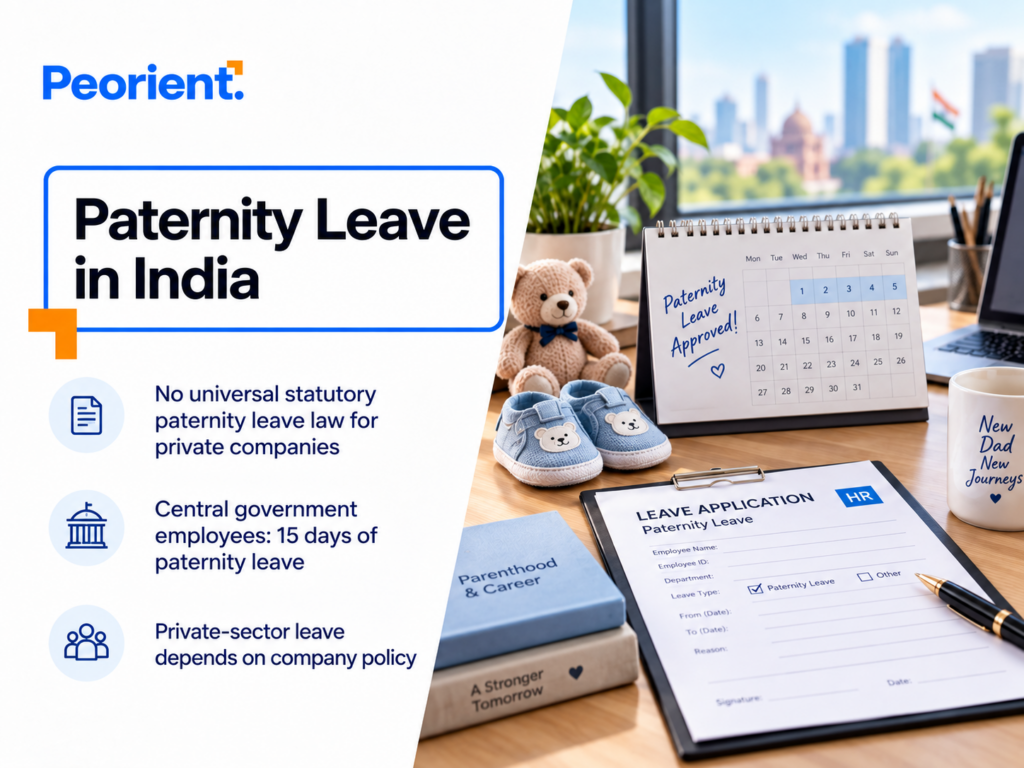
Paternity Leave in India 2026: What the Law Actually Says
Paternity leave in India depends on who employs you. This guide explains the 15-day government rule, private-company policies, the Supreme Court’s 2026 judgment, adoption, surrogacy and practical questions about pay, approval and hiring through EORs. It also covers probation and notice-period rules.