Free EOR, PEO and payroll shortlists for companies. We reply within 1 business day.Free provider shortlists
Start your brief
Get free shortlist
Free for companies. Reply within 1 business day. Or email hello@peorient.com
Free EOR, PEO and payroll shortlists for companies. We reply within 1 business day.Free provider shortlists
Start your briefFree for companies. Reply within 1 business day. Or email hello@peorient.com
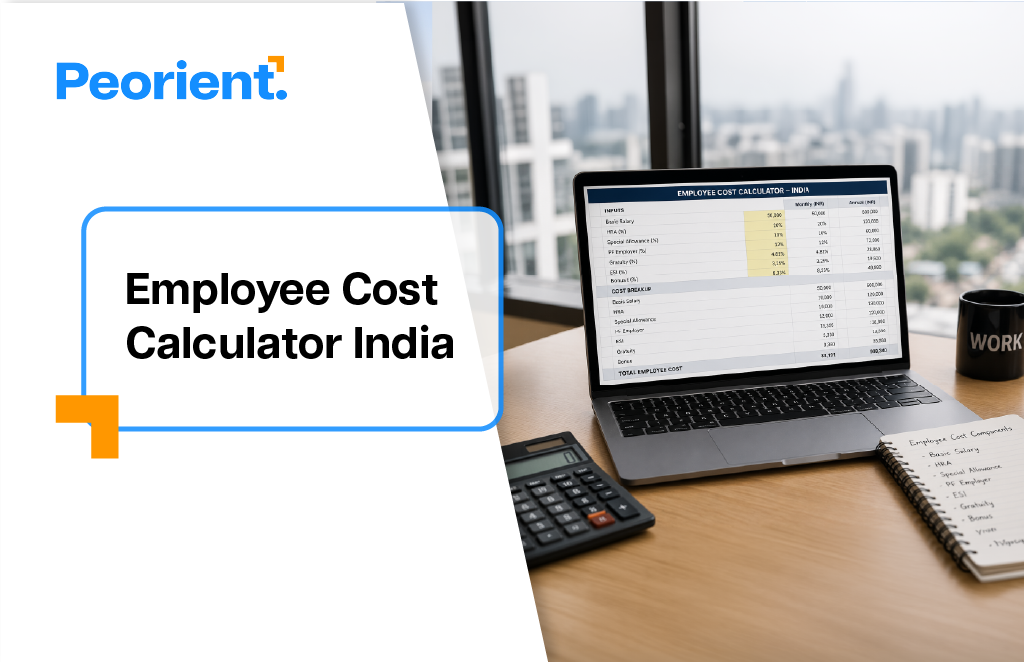
Calculate the true cost of hiring in India in 2026, including PF, ESI, gratuity, bonus, and hidden employer expenses. Learn how salary structure, labour codes, and EOR models impact total employee cost.

The salary you offer is rarely the cheque you write. In India a hire who signs for twelve lakh a year can cost your business anywhere from twelve and a half to thirteen and a half lakh once provident fund, gratuity, insurance, bonus and state levies are stacked on top. This guide breaks every layer apart, gives you the 2026 statutory rates straight from EPFO and ESIC, walks through worked examples across five salary bands, and hands you a free calculator you can use in under a minute.
KEY TAKEAWAY · The 30-second answer
True employer cost in India = gross salary + employer PF (about 13% of basic, capped at ₹15,000) + ESI (3.25% if gross ≤ ₹21,000) + gratuity provision (4.81% of basic) + statutory bonus (8.33% to 20% for eligible staff) + nominal state levies.
For most professional salaries that lands 3% to 16% above gross. Lower salaries carry the higher percentage because statutory caps bite the hardest at the bottom.
Ask three people in an Indian office what an employee “costs” and you will get three answers. The recruiter quotes the CTC. The employee quotes their take-home. Finance quotes something higher than both. None of them is wrong, because each is measuring a different layer of the same package. Before any calculator is useful, you need to know which number you are actually solving for.
There are four numbers worth separating, and they sit inside one another like a set of measuring cups.
| Layer | What it is | Who sees it | Typical position |
|---|---|---|---|
| Net take-home | Cash that lands in the bank after PF, professional tax, ESI and TDS are deducted | The employee | Smallest |
| Gross salary | Fixed cash package: basic, HRA and allowances, before the employee’s own deductions | The employee, on the offer letter | Middle |
| CTC | Gross plus the employer’s PF and gratuity, the way most Indian offers are framed | The recruiter and candidate | Larger |
| True employer cost | CTC plus ESI, statutory bonus, state levies, admin charges and indirect costs | Finance and the founder | Largest |
The gap most foreign employers miss is between CTC and true cost. Indian CTC conventionally bundles employer provident fund and the gratuity provision, so a well-built offer letter already absorbs two of the big statutory items. What it usually leaves out are the Employees’ State Insurance contribution for lower-paid staff, the statutory bonus, the labour welfare fund, EPFO administration charges, and every indirect cost from laptops to recruitment fees. Those are the line items that turn a tidy budget into a variance.
If you are hiring from outside India and want the full mechanics of how money moves from your account to the employee, our explainer on how EOR payroll works walks through the gross-to-net flow invoice by invoice.
A common error: adding professional tax (PT) to the employer side. PT is deducted from the employee and merely remitted by the employer to the state. It lowers take-home, it does not raise your cost.
The same is true of the employee’s 12% PF and their 0.75% ESI share. Keep the employee-borne and employer-borne columns strictly separate or your model will double-count.
Every rupee an Indian employer spends on a salaried hire falls into one of seven buckets. Five are statutory and largely non-negotiable. Two are structural choices you make. Here is the full anatomy, with the rates in force as of 2026.
| Component | Borne by | Rate (2026) | Calculated on | Cap / note |
|---|---|---|---|---|
| Gross salary | Employer | Negotiated | n/a | Basic, HRA, allowances |
| Employer PF | Employer | 13% effective | Basic + DA | Capped at ₹15,000 basis |
| Employer ESI | Employer | 3.25% | Gross wages | Only if gross ≤ ₹21,000 |
| Gratuity provision | Employer | 4.81% | Basic + DA | No cap; vests at 5 yrs, 1 yr fixed-term |
| Statutory bonus | Employer | 8.33% to 20% | Lower of basic or ₹7,000 | Eligible if wage ≤ ₹21,000 |
| Labour Welfare Fund | Employer | Nominal | Per head | State-specific, often under ₹100/yr |
| EPFO admin charges | Employer | 0.5% + 0.5% | Basic + DA | EDLI + admin, inside the 13% |
The Employees’ Provident Fund is the single largest statutory item for most hires. The employer contributes 12% of basic plus dearness allowance, but that 12% does not land in one place. It splits into 3.67% to the EPF account and 8.33% to the Employees’ Pension Scheme, where the pension portion is capped at 8.33% of ₹15,000, or ₹1,250 a month. On top of the 12% the employer pays roughly 0.5% towards EDLI life insurance and 0.5% in administration charges. Add it up and the real employer outflow is about 13% of the provident fund wage. You can confirm the official split on the EPFO contribution rate chart.
PF is mandatory only on basic plus DA up to ₹15,000 a month. Above that, most employers cap their contribution at 13% of ₹15,000, which is ₹1,950 a month, no matter how high the salary climbs.
This single rule is why a ₹48 lakh hire and a ₹6 lakh hire can carry almost the same rupee PF cost. The EPFO does allow voluntary contribution on full basic, and many foreign employers choose it as a benefit, which roughly triples the PF line.
ESI funds medical and disability cover for lower-paid workers. The employer pays 3.25% of gross wages and the employee pays 0.75%, rates unchanged since July 2019 and confirmed on the ESIC contribution page. The catch is the ceiling: ESI applies only when gross monthly wages are ₹21,000 or less, or ₹25,000 for an employee with a disability. Cross that line and the contribution stops entirely. So ESI is a meaningful cost for support, operations and junior roles, and a non-event for most engineering or managerial salaries.
Gratuity is a lump sum paid on exit, calculated as 15 days of last-drawn basic for every completed year of service. Expressed as a monthly accrual that works out to 4.81% of basic plus DA, and unlike PF it is not capped at ₹15,000, so it scales with the full salary. Legally the benefit vests only after five years of continuous service for permanent staff, and after just one year for fixed-term employees under the new labour codes. Prudent finance teams provision it every month regardless, because the liability is building whether or not you set the money aside.
The Payment of Bonus framework, now folded into the Code on Wages, entitles employees earning ₹21,000 a month or less to an annual bonus of at least 8.33% and up to 20%, calculated on the lower of their basic or ₹7,000. For a qualifying employee that is roughly ₹7,000 a year at the floor rate. Above the ₹21,000 wage line the statutory bonus disappears, though many companies pay a discretionary performance bonus that has nothing to do with the Act. Layer on the state Labour Welfare Fund, a token amount that varies by state and is often under ₹100 a year for the employer, and the EPFO administration and EDLI charges already counted inside the 13%, and you have the complete statutory picture.
Skip the spreadsheet. Peorient’s advisors model your full employer cost across every statutory line and compare it against EOR and entity routes, free and with zero obligation.
➜ Get your free India cost modelA reliable employee cost calculator does only one thing well: it starts from a number you actually know and adds the statutory layers in the right order, applying every cap and threshold. The formula underneath is simple enough to run on paper.
The salary is only the start. See what an Indian hire truly costs your business once provident fund, ESI, gratuity, bonus and state levies are stacked on top, and what the employee actually banks.
Statutory rates current to 2026 · before income tax (TDS)An Employer of Record carries every line above on one monthly invoice, with no PF, ESI or professional-tax registrations of your own.
A rough estimate for planning, not payroll advice. Income tax (TDS) varies by regime and declarations and is excluded. Built by Peorient.
The three inputs that move the answer are the gross salary, the basic-to-gross ratio (now legally at least 50% under the wage code, more on that below), and the state, which sets professional tax and welfare fund rates. Everything else is a fixed national rate.
We built a free, no-login calculator that applies every cap and threshold automatically and shows the net, gross, CTC and true-cost layers side by side.
It pairs with this guide and runs entirely in your browser. Drop it on the same page as this article, or embed it on your tools hub.
A cost calculator is only as good as the gross salary you feed it, and in India that figure swings hard by city and role. Pay the wrong base and every downstream contribution is wrong too. So before you calculate cost, anchor the salary against the market.
Location is the first lever. By Peorient’s own market data, Bangalore commands 20% to 40% higher salaries than Pune, Hyderabad or Chennai for comparable technology roles, while tier-2 cities such as Jaipur, Coimbatore and Indore deliver 30% to 50% savings on the same skill set. A mid-level software engineer runs roughly ₹12 lakh to ₹18 lakh a year in a tier-1 city, which is a fraction of the ₹80 lakh-plus an equivalent US hire would cost. That arbitrage is the entire reason global teams build in India, and it is also why getting the base right matters: a 30% city premium applied to the wrong city can blow a headcount budget before a single statutory rupee is added.
Role and seniority are the second lever. Support, operations and junior roles often sit below the ₹21,000 monthly ESI line, which pulls them into ESI and statutory bonus and lifts the percentage uplift. Engineering, product and leadership roles clear the ceilings, so their statutory uplift is small but their indirect costs, from equipment to equity, are large. The third lever is the annual increment. With Indian salary increments averaging around 9.5% to 10%, the base you budget today compounds quickly, so any multi-year cost model should build in raises rather than freeze the salary.
For a fuller picture of where Indian pay sits and how it stacks up internationally, our analysis of how the average Indian salary compares with global income levels gives the benchmarks you need to set a defensible base before you cost it.
Set the gross from a real benchmark for the role and city, decide your basic-to-gross split at the 50% floor, pick the state, and only then run the cost build-up.
Reversing that order, starting from a budget and back-solving the salary, is how teams end up making offers that cannot attract the candidate.
Take a customer-support associate in Pune on a gross of ₹18,000 a month, structured with basic at 50%, so ₹9,000. Because gross is under ₹21,000, this employee is inside both the ESI and statutory bonus nets, which makes the example a useful upper bound on the percentage uplift.
| Line item | Basis | Rate | Monthly (₹) |
|---|---|---|---|
| Gross salary | — | — | 18,000 |
| Employer PF | Basic ₹9,000 | 13% | 1,170 |
| Employer ESI | Gross ₹18,000 | 3.25% | 585 |
| Gratuity provision | Basic ₹9,000 | 4.81% | 433 |
| Statutory bonus | Lower of basic / ₹7,000 | 8.33% | 583 |
| Labour Welfare Fund | Maharashtra | Nominal | 13 |
| True employer cost | — | — | 20,784 |
Annualised, the gross of ₹2,16,000 becomes a true employer cost of about ₹2,49,400. The employee, meanwhile, sees a take-home nearer ₹16,600 after their own 12% PF, 0.75% ESI and roughly ₹200 of professional tax. Three different numbers, one hire: a take-home of ₹16,600, a gross of ₹18,000, and a real cost of ₹20,784. That 25% spread between what the employee banks and what you spend is exactly the gap an employee cost calculator exists to expose.
Now a software engineer in Bengaluru on a gross of ₹1,50,000 a month, basic at 50%, so ₹75,000. Gross is well above ₹21,000, so ESI and statutory bonus both fall away, and the employer caps PF at the ₹15,000 basis. Watch how much smaller the percentage uplift becomes.
| Line item | Basis | Rate | Monthly (₹) |
|---|---|---|---|
| Gross salary | — | — | 1,50,000 |
| Employer PF (capped) | Basis ₹15,000 | 13% | 1,950 |
| Employer ESI | Gross above ceiling | n/a | 0 |
| Gratuity provision | Basic ₹75,000 | 4.81% | 3,608 |
| Statutory bonus | Wage above ₹21,000 | n/a | 0 |
| Labour Welfare Fund | Karnataka | Nominal | 3 |
| True employer cost | — | — | 1,55,561 |
The statutory uplift has collapsed from 15.5% to 3.7%. The reason is structural: PF is frozen at ₹1,950 by the ceiling, ESI and bonus do not apply, and only gratuity scales with the salary. If this employer instead contributes PF on full basic as a benefit, the PF line jumps to ₹9,750 and the uplift rises to about 8.9%. Either way, the lesson is the same. For senior salaries the statutory burden is modest, and the real cost of the hire moves elsewhere, into the indirect items we cover later.
Statutory cost as a percentage of salary falls as salary rises. Caps on PF, the ₹21,000 ESI and bonus thresholds, and a fixed gratuity rate mean a ₹2.4 lakh hire can carry a 15% uplift while a ₹48 lakh hire carries under 3%.
Budget the percentage by band, never with a single blanket figure.
Cost flows in one direction for the employer and the opposite direction for the employee. While you add contributions on top of gross, the employee has deductions taken out of it. Understanding both sides in the same model prevents the most common offer-stage confusion, where a candidate hears “twelve lakh” and pictures a take-home that the deductions never deliver.
Four items come out of an employee’s gross before the money reaches their account.
Return to the ₹18,000 support associate. After a 12% PF deduction of ₹1,080, a 0.75% ESI share of ₹135, and roughly ₹200 of Maharashtra professional tax, with no TDS at that income, the take-home settles near ₹16,585 a month. Set that beside the ₹20,784 the employer spends and the full arc is visible: the business pays ₹20,784, the offer says ₹18,000, and the employee banks ₹16,585. The ₹4,199 spread between the top and bottom figures is split between the employee’s retirement and insurance pots and the employer’s statutory contributions. None of it is waste, but all of it has to be budgeted and explained.
Candidates churn when a take-home turns out lower than the CTC implied. The fix is transparency: show the gross, the deductions, the net, and the employer add-ons in one table on the offer letter.
It costs nothing and prevents the most common first-month grievance.
The fourth deduction, TDS, is the one that moves most between two otherwise identical employees, because India now runs two parallel income-tax regimes and the employee chooses. The new regime, which is the default, offers lower slab rates and a higher rebate threshold but strips out most exemptions, so an employee who claims little can keep more cash. The old regime keeps the familiar deductions for provident fund, HRA, section 80C investments and the like, and tends to win for someone who rents a home in a metro and invests heavily. The same gross can therefore produce two different take-home figures, set entirely by a declaration the employee makes at the start of the year.
This matters to a cost model in a specific way. The regime choice does not change the employer cost at all, because PF, ESI, gratuity and bonus are computed on wage, not on tax. What it changes is the take-home the candidate compares against a rival offer, which is why two firms quoting the same CTC can lose or win a hire on a structuring decision that costs the business nothing. Build the take-home line for both regimes when you draft an offer, and let the candidate see which one suits them. It is a five-minute exercise that materially improves acceptance rates.
To make the pattern concrete, here is the annual employer cost across five common bands, using the capped PF model, basic at 50% of gross, and a representative state. ESI applies only to the first band; statutory bonus only where the wage qualifies.
| Gross / yr | Employer PF | ESI | Gratuity | Bonus | True cost / yr | Uplift |
|---|---|---|---|---|---|---|
| ₹2,40,000 | 15,600 | 7,800 | 5,772 | 7,000 | 2,76,300 | 15.1% |
| ₹6,00,000 | 23,400 | 0 | 14,430 | 0 | 6,37,900 | 6.3% |
| ₹12,00,000 | 23,400 | 0 | 28,860 | 0 | 12,52,300 | 4.4% |
| ₹24,00,000 | 23,400 | 0 | 57,720 | 0 | 24,81,100 | 3.4% |
| ₹48,00,000 | 23,400 | 0 | 1,15,440 | 0 | 49,38,800 | 2.9% |
Plot the uplift column and you get a clean downward curve from roughly 15% to under 3%. This single chart is the most useful thing a hiring manager can keep on a wall, because it kills the lazy habit of applying a flat “add 20%” rule to every offer. The 20% rule overstates senior costs badly and can understate the indirect costs of junior ones.
The biggest change to Indian employer cost in three decades arrived in late 2025. India’s four new labour codes were notified into force on 21 November 2025, repealing 29 older central statutes, with the Ministry of Labour and Employment rolling out the supporting rules through 2026. For anyone calculating employee cost, one provision matters above all others: the universal definition of wages and the 50% rule.
Under the Code on Wages, “wages” now means basic plus dearness allowance plus retaining allowance, and these must make up at least 50% of total remuneration. If your allowances exceed half the package, the excess is reclassified as wages and pulled back into the base on which PF, gratuity, ESI and bonus are all calculated. The old trick of keeping basic artificially low at 30% to shrink statutory contributions no longer works.
Here is what the shift does to a single hire on a gross of ₹1,00,000 a month, comparing an old 30% basic structure with the new 50% floor.
| Item | Old structure (30% basic) | New structure (50% basic) |
|---|---|---|
| Basic + DA | ₹30,000 | ₹50,000 |
| Gratuity provision (4.81%) | ₹1,443/mo | ₹2,405/mo |
| Employer PF if on full basic | ₹3,900/mo | ₹6,500/mo |
| Employee take-home | Higher | Slightly lower |
| Retirement corpus + gratuity | Lower | Higher |
For foreign employers the practical takeaway is that salary structures designed before November 2025 may now be non-compliant, and the fix is to rebuild the basic-to-allowance split before your first inspection rather than after. A competent Employer of Record restructures the package to the 50% rule, recalculates the statutory base, and absorbs the compliance risk on your behalf. If your provider has not raised this with you already, that silence is itself a red flag.
India’s central rates are uniform, but two employee-facing levies are set by states and will shift your net-pay math from city to city. Professional tax is capped nationally at ₹2,500 a year and is deducted from the employee, not paid by the employer. Several large states levy none at all, which is why the same gross delivers a higher take-home in Delhi than in Mumbai.
| State | Professional tax (top slab) | Annual max | Notes |
|---|---|---|---|
| Maharashtra | ₹200/mo (₹300 in Feb) | ₹2,500 | Employee-borne |
| Karnataka | ₹200/mo | ₹2,400 | Employee-borne |
| West Bengal | ₹200/mo | ₹2,500 | Slab-based |
| Tamil Nadu | Half-yearly slabs | ₹2,500 | Levied by local body |
| Telangana | ₹200/mo | ₹2,500 | Employee-borne |
| Gujarat | ₹200/mo | ₹2,400 | Employee-borne |
| Delhi, Haryana, UP | No professional tax | ₹0 | Higher net pay |
The Labour Welfare Fund is the other state variable, but it is small enough that it rarely moves a budget. Employer shares typically run from a few rupees to under a hundred rupees per employee per half-year, collected once or twice a year. Where it matters is multi-state compliance: a company hiring across six states must register and file separately in each, and that administrative load, not the rupee amount, is the real cost. Our breakdown of global payroll service costs covers how this multiplies once you operate across borders.
Two offers with the same headline CTC can deliver very different take-home and very different employer cost, depending on how the package is split. Within the bounds of the 50% wage rule there is still room to design a structure that is tax-efficient for the employee and predictable for the employer. Done well, structuring is a retention tool that costs the business little.
The discipline is to design the structure once, at the 50% basic floor, then add tax-efficient allowances and benefits on top rather than padding basic. Padding basic raises gratuity and any uncapped PF for no take-home benefit, while thoughtful allowances raise net pay for the same employer outlay. The new wage code narrows the room for aggressive structuring, but it does not close it.
Designs built before November 2025 that pushed basic down to 30% to shave contributions are now non-compliant.
If the excess of allowances over 50% gets reclassified as wages, you inherit back-dated PF, gratuity and ESI liabilities.
Rebuild the split to the floor first, optimise within it second.
Statutory contributions are the part of employer cost that is easy to compute, which is exactly why they get all the attention. The larger and lumpier costs are the indirect ones, and for a senior hire they often dwarf the statutory uplift. A complete employee cost view should reserve a line for each of these.
For a junior role the statutory uplift may be the biggest single add-on. For a senior engineer earning ₹24 lakh, a 3% statutory uplift of ₹81,000 can be smaller than the laptop, benefits and recruitment bill combined. Any honest total-cost-of-employment exercise has to size both. Our guide on how to build a workforce in India without a local entity lays out where each of these costs sits under the different hiring models.
A useful rule of thumb for budgeting is the total cost of employment ratio, the full annual cost of a hire divided by their gross salary. For a junior, ESI-eligible role in a low-overhead setup the ratio often sits around 1.2 to 1.3 once statutory and basic indirect costs are counted. For a senior knowledge worker with a laptop, premium health cover, a learning budget and an allocated seat, the statutory uplift is tiny but the indirect block can still push the ratio to 1.15 to 1.25. The numbers converge from opposite directions, which is the quiet reason a single blanket multiplier feels roughly right yet is wrong in the detail every time.
Build the ratio bottom-up for each role family rather than borrowing an industry average. Count the statutory lines from the calculator, add a realistic recruitment cost amortised over expected tenure, a year-one equipment figure, the annual benefit spend, and a provision for attrition based on your real churn. The output is a defensible loaded cost you can carry straight into a hiring plan or an investor model
An EOR rolls salary, every statutory contribution, benefits and compliance into one monthly invoice, with no PF, ESI or professional tax registrations of your own.
See which providers fit your headcount and budget.
➜ Compare the best EOR providers in IndiaIf you have no Indian entity, the question is not only what an employee costs but who carries the cost of being the employer. Setting up a subsidiary to run payroll yourself means incorporation, PF and ESI registration codes, a compliance officer, audits and ongoing filings, with upfront costs that frequently run ₹8 lakh to ₹20 lakh and a timeline of three to six months before a single salary is paid.
An Employer of Record replaces all of that with a per-employee monthly fee. The EOR is the legal employer through its own Indian entity, so it handles every statutory contribution in this guide, restructures salaries to the 50% rule, runs payroll, files taxes and issues Form 16, while you keep full day-to-day control of the work. Fees for India-focused providers typically run ₹100 to ₹550 per employee per month, and you still pay the salary and the statutory contributions on top, so the EOR fee is the cost of compliance and infrastructure, not a replacement for the cost of employment.
The trap to avoid is comparing an EOR fee against a salary and concluding it is expensive. The honest comparison is against the fully loaded cost of running your own entity, including the people, the registrations and the risk. For a team of one to roughly twenty-five, the EOR route is almost always cheaper and far faster. Beyond that headcount, an entity may start to pay for itself, which is the point our PEO services in India guide and the broader international PEO playbook help you model. If you are weighing specific platforms, our independent Deel review and Deel versus Remote comparison break down where the global names fit against India specialists.
One cash-flow nuance is easy to miss. Some global EOR platforms require a salary deposit, often around one month of pay per employee, held in advance before payroll runs. For a small team that is a meaningful sum sitting in escrow, and it belongs in your model alongside the monthly fee. Currency is the other quiet cost: paying salaries in rupees from a foreign account carries an exchange spread, so an honest comparison prices in FX as well as the headline per-employee fee. India specialists that bill and pay domestically tend to avoid both frictions.
| Cost line | Own entity | Employer of Record |
|---|---|---|
| Setup cost | ₹8L to ₹20L upfront | ₹0 |
| Time to first hire | 3 to 6 months | 1 to 2 weeks |
| Statutory contributions | You compute and file | Handled for you |
| Compliance staff | You hire them | Included |
| Per-employee fee | ₹0 (internal cost instead) | ₹100 to ₹550/mo |
| Best for | 25+ in one country, long term | 1 to 25, speed, testing |
A tempting way to dodge the statutory stack is to engage a worker as an independent contractor rather than an employee. On paper the cost looks lower: no employer PF, no ESI, no gratuity, no bonus, no professional tax to administer. You pay an agreed fee, deduct tax at source, and the worker handles their own taxes. For a genuinely independent specialist on a defined project, this can be the right and cheaper structure.
The catch is that the saving is real only if the relationship is genuinely a contractor relationship. If the worker keeps fixed hours, uses your equipment, reports to a manager and looks like an employee in everything but name, Indian authorities can reclassify them, and the bill arrives with interest. Reclassification exposes you to back contributions for PF, ESI and gratuity, penalties, and for a foreign company the far larger risk of creating a permanent establishment that drags your global profits into the Indian tax net. The fee you saved is dwarfed by the liability you created.
| Factor | Employee | Independent contractor |
|---|---|---|
| Employer PF, ESI, gratuity, bonus | Payable | None |
| Tax handling | TDS on salary, Form 16 | TDS on fee, self-assessed |
| Headline cost | Higher | Lower |
| Misclassification risk | None | High if treated like staff |
| PE risk for a foreign company | Removed via EOR | Elevated |
| Best for | Ongoing, core roles | Defined projects, true freelancers |
Put numbers on the risk and the temptation fades. Suppose you engage a worker as a contractor on ₹1,00,000 a month for two years to avoid roughly ₹13,000 a month of employer PF, gratuity and bonus, a headline saving near ₹3.1 lakh over the period. If the engagement is later reclassified as employment, the authorities can recover the unpaid provident fund for the full term, and PF arrears carry interest under section 7Q plus a damages charge under section 14B that scales with the length of the default and can reach 100% of the amount due for delays beyond six months.
On those facts the recoverable PF alone, with interest and damages, can comfortably exceed ₹5 lakh, before you count gratuity, any ESI that applied, the cost of the assessment itself and professional fees. For a foreign parent the figure is the smaller worry: a contractor who functions as staff can be treated as a dependent agent, creating a permanent establishment that exposes a share of global profit to Indian corporate tax and turns a payroll question into a cross-border tax dispute. The arithmetic is unforgiving. A saving measured in lakhs is routinely overtaken by a liability measured in tens of lakhs, which is why mature teams reserve the contractor structure for genuine project specialists and put anyone who looks like staff on a compliant payroll.
The clean way to get statutory simplicity without the misclassification risk is to employ the worker properly through an Employer of Record, which gives you a compliant full employee on one invoice and no permanent establishment exposure. That is the structure most global teams settle on once they understand what reclassification actually costs.
The fix for all eight is the same. Maintain one calculator that takes gross, basic ratio and state as inputs, applies every cap automatically, and reports the four cost layers plus a separate indirect-cost block.
Run it per salary band, not per company average, and revisit it whenever a rule changes.
An employee cost calculator for India is only as honest as the layers it counts. Start from gross, add the five statutory items with their caps and thresholds, separate the employee-borne deductions from the employer-borne contributions, and then reserve real budget for the indirect costs that a rate card never shows. Do that and you replace the lazy “add 20%” habit with a number you can defend to finance, band by band, state by state.
The 2026 labour codes have raised the stakes by lifting the statutory base, and they reward employers who restructure salaries proactively. Whether you run payroll through your own entity or hand the whole burden to an Employer of Record, the first step is the same: know the true cost before you make the offer. For context on where Indian pay sits globally, our look at how the average Indian salary compares with global income levels is a useful companion to this guide.
Tell us the role, salary and state. Peorient’s advisors return a fully itemised cost model and a side-by-side EOR comparison, with no obligation and no sales pressure.
➜ Talk to a Peorient advisorFor most professional salaries the employer pays 3% to 16% above gross in statutory contributions, with the higher percentage at lower salaries. On top of that sit indirect costs such as equipment, benefits and recruitment, which for senior hires can exceed the statutory uplift.
CTC typically bundles the gross salary, the employer’s provident fund contribution and the gratuity provision. It usually excludes ESI, statutory bonus, labour welfare fund, EPFO admin charges and all indirect costs, which is why true cost runs above CTC.
Professional tax is deducted from the employee’s salary and remitted by the employer to the state. It reduces take-home pay but is not an employer cost. It is capped nationally at ₹2,500 a year and is not levied at all in states such as Delhi, Haryana and Uttar Pradesh.
The employer contributes 12% of basic plus dearness allowance, split into 3.67% to EPF and 8.33% to the pension scheme, plus about 0.5% EDLI and 0.5% admin charges, for an effective 13%. It is mandatory only on basic up to ₹15,000 a month, so most employers cap the contribution at ₹1,950 for higher earners.
ESI applies when an employee’s gross monthly wage is ₹21,000 or less, or ₹25,000 for an employee with a disability. The employer pays 3.25% and the employee pays 0.75% of gross wages. Above the ceiling, neither side contributes.
It can. By forcing basic plus DA to at least 50% of the package, the rule raises the base on which gratuity and uncapped PF are calculated, so those provisions rise. Employee take-home dips slightly while long-term retirement and gratuity benefits grow.
Gratuity legally vests after five years for permanent staff and after one year for fixed-term staff under the new codes. The liability accrues from the start, so prudent employers provision 4.81% of basic every month rather than waiting for it to fall due.
An India EOR fee of roughly ₹100 to ₹550 per employee per month sits on top of salary and statutory contributions, not in place of them. It buys away entity setup, registrations and compliance staffing, so the fair comparison is against the loaded cost of running your own entity, where the EOR is usually cheaper for teams under about twenty-five.
Only if the relationship is genuinely independent. A contractor carries no employer PF, ESI or gratuity, but if they work like an employee, fixed hours, your equipment, a reporting line, Indian authorities can reclassify them, triggering back contributions, penalties and permanent establishment risk for a foreign company. For ongoing core roles, a compliant employee, often via an EOR, is safer.
There is no single number. Junior, ESI-eligible roles often land near 1.2 to 1.3 times gross once statutory and basic indirect costs are counted, while senior roles carry a small statutory uplift but a large indirect block. Build the ratio bottom-up per role rather than applying one blanket multiplier.
Start with gross annual salary, then set basic plus DA at 50% of gross to satisfy the wage rule. Add employer PF at 13% of basic, capped at ₹1,950 a month unless you contribute on full wages. Add ESI at 3.25% of gross only if gross is ₹21,000 or less a month. Add a gratuity provision of 4.81% of basic, and statutory bonus where the employee qualifies. Sum those onto gross for the statutory true cost, then layer in equipment, benefits, recruitment and attrition for the fully loaded figure.
Both are calculated on basic plus dearness allowance rather than on gross, which is why the basic ratio drives so much of employer cost. The key difference is the ceiling: employer PF is mandatory only on basic up to ₹15,000 a month, while gratuity at 4.81% has no statutory ceiling and rises with the full basic. Raising basic therefore lifts gratuity for every employee but lifts PF only for those still under the ceiling.

Written by
Lead India Employment and Payroll Specialist · 13+ years experience
Priya is Peorient's resident expert on hiring in India. Former senior HR Tax consultant at a Big 4 firm in Bengaluru and Head of Payroll Operations at a Pune-based EOR. Advocate enrolled with the Bar Council of Maharashtra and Goa. Has run state-level registrations in 14 Indian states.

Paternity Leave in India 2026: What the Law Actually Says
Paternity leave in India depends on who employs you. This guide explains the 15-day government rule, private-company policies, the Supreme Court’s 2026 judgment, adoption, surrogacy and practical questions about pay, approval and hiring through EORs. It also covers probation and notice-period rules.