Free EOR, PEO and payroll shortlists for companies. We reply within 1 business day.Free provider shortlists
Start your brief
Get free shortlist
Free for companies. Reply within 1 business day. Or email hello@peorient.com
Free EOR, PEO and payroll shortlists for companies. We reply within 1 business day.Free provider shortlists
Start your briefFree for companies. Reply within 1 business day. Or email hello@peorient.com
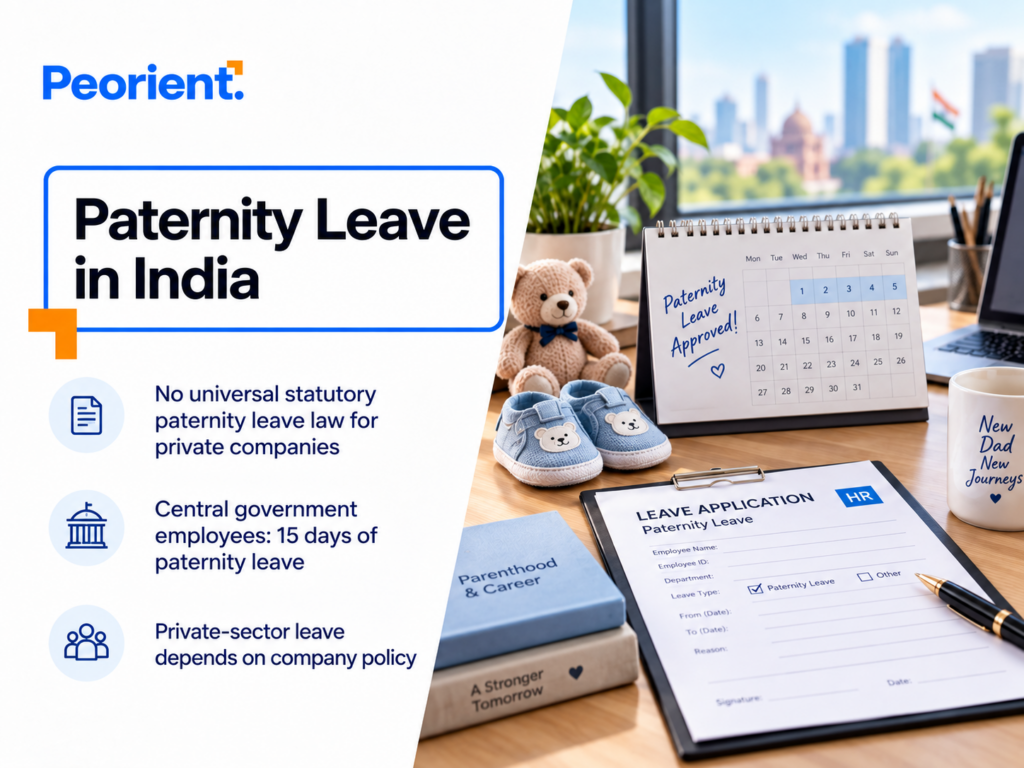
Paternity leave in India depends on who employs you. This guide explains the 15-day government rule, private-company policies, the Supreme Court’s 2026 judgment, adoption, surrogacy and practical questions about pay, approval and hiring through EORs. It also covers probation and notice-period rules.

India does not have a nationwide law requiring every private company to provide paternity leave. Eligible central government employees covered by the Central Civil Services (Leave) Rules receive 15 days. For private-sector employees, the starting point is the applicable employment agreement, leave policy and any other binding service terms.
That distinction matters when a new father asks for time off. A government service rule, a company benefit and a proposed bill can all appear in search results as “paternity leave in India”. They do not create the same rights.
For employers in the US, UK, Australia and New Zealand hiring in India, the practical question is also broader than the number of days. Who qualifies? What salary continues? Can a manager change the dates? And who handles approval if an Employer of Record employs the person?
This guide separates the current rules from proposals and explains what employees and employers should put in writing.
There is no general nationwide statutory paternity-leave entitlement covering all private-sector employees. But an employer may have obligations under the benefit it has committed to provide.
The government’s parliamentary response on private-sector paternity leave documents the historical position. The later Supreme Court judgment of 17 March 2026 calls for legislation, rather than announcing an existing universal private-sector entitlement.
No. The widely quoted 15-day rule belongs to a particular government service framework.
Use the employee’s actual employment category to identify the relevant document:
| Employment category | Where to check the entitlement |
|---|---|
| Central government employee covered by CCS leave rules | Where to check the entitlement CCS Rules 43-A and 43-AA, relevant amendments and departmental instructions |
| State government employee | Where to check the entitlement The state’s service rules and applicable departmental orders |
| Railway, All India Services, public-sector undertaking or bank employee | Where to check the entitlement The applicable service rules, settlement or adopted policy |
| Private-company employee | Where to check the entitlement Employment agreement, handbook, parental-leave policy and other binding terms |
| Employee hired through an EOR | Where to check the entitlement EOR employment terms and any agreed client-funded enhancement |
| Genuine independent contractor | Where to check the entitlement The services agreement and any agreed payment during an absence |
A government-owned organisation is not enough, by itself, to establish that CCS rules apply. Likewise, an employee working for a private business in Bengaluru does not acquire central government leave rights because the business follows some government holiday dates.
A benefit can be voluntary to introduce but still create obligations once it forms part of the applicable employment terms.
Whether a particular promise is enforceable depends on its wording, how the policy applies, any lawful amendment provisions and the employee’s circumstances. “Indian law does not mandate it” does not, on its own, resolve a dispute over promised leave.
Read the contract and policy together. If they conflict, ask HR to explain which provision governs and why. Keep the policy version and written approval that applied when the request was made.
Rule 43-A provides a defined paid-leave benefit for eligible male government servants covered by the CCS framework.
The government training summary of CCS leave rules sets out the core childbirth provisions:
| Point | Rule for eligible employees |
|---|---|
| Duration | Rule for eligible employees 15 days |
| Child-related eligibility | Rule for eligible employees Fewer than two surviving children |
| Timing | Rule for eligible employees Up to 15 days before delivery or up to six months after delivery |
| Payment | Rule for eligible employees Leave salary equal to the pay drawn immediately before leave |
| Leave balance | Rule for eligible employees Not deducted from the ordinary leave account |
| Other leave | Rule for eligible employees May be combined with admissible leave, subject to applicable rules |
The rule says it “shall not normally be refused”. It also says leave not taken within the specified window lapses.
That wording should not be rewritten as either unrestricted managerial discretion or an absolute guarantee that no refusal is ever possible. Submit the request to the competent authority and obtain the sanctioned dates.
This is an event-linked benefit. It is not an annual balance that keeps accumulating.
No. Rule 43-A itself does not prescribe an 80-day qualifying period.
The consolidated CCS rules reproduced in this government compilation should be checked directly, including the provisions relevant to the employee’s appointment status. Do not add an 80-day condition merely because another article lists it for temporary employees.
An 80-day condition appears in proposed paternity legislation, but a bill’s eligibility test is not an operative service rule. Private companies should identify any service requirement as their own policy condition, subject to applicable law.
The March 2026 Supreme Court judgment did not grant every private-sector father a fixed period of paid leave. Nor does the introduction of the labour codes, by itself, establish such a benefit.
In Hamsaanandini Nanduri v. Union of India, 2026 INSC 246, the Court removed the three-month age restriction affecting adoptive mothers’ maternity benefit under Section 60(4) of the Code on Social Security, 2020.
Its separate discussion of fathers culminated in paragraph 169, urging the Union to recognise paternity leave as a social security benefit. The judgment’s conclusion did not prescribe a universal number of paternity-leave days.
Employers should distinguish the operative maternity ruling from the call for paternity reform. “The Supreme Court supports legislation” and “every employer must now provide eight weeks” are different claims.
They should not be presented as enacted entitlements. The Parliament record for the Paternity Benefit Bill, 2017 records its introduction, not the creation of a nationwide benefit.
The Paternity and Parental Benefit Bill, 2025, as introduced proposes up to eight weeks of paternity benefit, subject to its conditions. It also contains an 80-day work requirement and separate parental-benefit provisions.
These proposals explain some numbers circulating online. They do not establish an employer’s current payroll obligation. A proposed commencement clause is not evidence that commencement has happened.
No. Maternity benefit and paternity leave are separate legal questions.
The government’s explanation of the Code on Social Security describes maternity benefits. Those provisions do not create an equivalent general leave entitlement for fathers.
For eligibility, payment and the maternity rules affecting private employers, read our guide to maternity leave in India for private companies. Keep the two benefits distinct when drafting a parental-leave policy.
The employee should expect the duration stated in the policy that covers them. There is no single private-sector number that can safely be applied across employers.
Ask for the current India policy before accepting an offer or planning leave. A global careers page may describe a different country, employee group or version of the benefit.
The policy must say. Fifteen working days and fifteen calendar days can produce different return dates.
Consider an illustrative Monday-to-Friday employee with no public holidays:
| Policy wording | Leave starts | Last leave day | Return to work |
|---|---|---|---|
| 15 calendar days | Leave starts Monday, 5 October 2026 | Last leave day Monday, 19 October | Return to work Tuesday, 20 October |
| 15 working days | Leave starts Monday, 5 October 2026 | Last leave day Friday, 23 October | Return to work Monday, 26 October |
These examples explain counting methods, not a statutory entitlement. Under government service rules, do not relabel the prescribed days as working days without checking the applicable treatment of holidays.
For a private policy, specify weekly offs, public holidays, shifts and any “sandwich” rule. Record the return date in the approval email so payroll and the employee use the same calculation.
Only where the applicable rules or policy permit it. The number of days and the period in which they can be used are separate conditions.
A policy might allow one continuous block, two blocks or individual working days. It might require leave around delivery or allow a later caregiving period.
The employer should define both the first permitted date and the final permitted date. Also state whether leave must start or finish before the deadline. “Use within six months” can otherwise create a dispute at the end of the window.
Combining paternity leave with annual leave is another question. Approval for one category should not be assumed to approve the other.
The answer depends on the route to parenthood and the rules covering the employee. A childbirth-only policy can leave other parents without a clear process.
Under Rule 43-AA, eligible employees with fewer than two surviving children can receive 15 days for qualifying pre-adoption foster care or valid adoption of a child below one year, within the prescribed six-month window.
If the foster placement is not followed by valid adoption, the leave already used is adjusted against another available leave category. These details appear in the updated CCS adoption provisions.
The same compilation includes the June 2024 addition to Rule 43-A. It provides 15 days within six months of delivery for an eligible commissioning father with fewer than two surviving children who is a government servant.
The 2026 judgment about adoptive mothers should not be treated as automatically rewriting the separate CCS eligibility rule for fathers.
They should address these situations expressly, rather than making employees negotiate exceptions after a child arrives.
We recommend stating:
These are policy-design recommendations, not a claim that every category already has an identical statutory right. An emergency process should accept prompt notice and allow supporting documents to follow when reasonably available.
Apply through the required HR process and get written confirmation of eligibility, dates and pay. Early planning helps, but a due date should not be treated as a guaranteed delivery date.
Provide the information required by the applicable policy, using the least sensitive evidence sufficient to confirm eligibility.
A practical request includes the expected or actual arrival date, requested leave dates, the relevant policy provision and a proposed handover. Depending on the circumstances, HR may ask for confirmation of the expected delivery date, birth documentation or adoption documentation.
Ask whether a hospital confirmation can be accepted while a birth certificate is pending. Do not assume a marriage certificate or a complete medical record is universally required by law.
Before leave begins, confirm:
It should make the dates, policy basis and required confirmation clear. This example can be adapted to the employee’s situation:
Paternity leave email template
Replace the details in square brackets before sending.
Start by identifying the exact entitlement and asking for the reason in writing. The appropriate response differs between a policy dispute, an eligibility issue and a request for leave the employer has never offered.
Employee discussions show why this detail matters. One Reddit account of being asked to work during paternity leave describes work pressure after a premature birth. Another discussion about retrospective policy changes raises concerns about changed terms and management pressure. These are individual accounts, not verified findings against the employers or evidence of national prevalence.
Check the written policy and approval, then ask HR to resolve the conflict. A verbal instruction should not leave the employee guessing whether they are on leave or expected to work.
Ask HR to confirm whether the approved absence is being changed, who authorised the change and how any work performed will be recorded. Where a policy promises a continuous block, ask which clause permits a manager to split it.
For employers, establish a backup and escalation contact before leave begins. If an exceptional recall occurs, record the work and decide how leave will be restored under the applicable terms. An employee should not discover at month-end that a day of work was also deducted as leave.
Preserve both versions and ask which effective-date and transition provisions the employer is applying.
Useful evidence includes the employment agreement, policy, approval emails, HR portal record and relevant payroll entries. A retrospective reduction can raise contractual questions, but the result depends on the facts and governing terms.
Escalate through HR or the formal grievance process. If pay is withheld, employment is threatened or an agreed benefit is withdrawn, obtain advice on the appropriate labour or civil route for that employee and establishment. A proposed paternity bill does not create a functioning complaint mechanism.
Private-sector employees should check these situations separately. A leave benefit does not answer every question about service eligibility, resignation or transfer.
That depends on the applicable policy and employment terms, subject to law. There is no universal private-sector rule granting or excluding all probationers.
Ask whether eligibility is tested on the birth date, application date or first leave day. For someone close to completing a service requirement, those dates can produce different outcomes.
During a notice period, obtain separate confirmation of leave approval, the final employment date and any claimed notice extension. Do not assume paternity leave automatically extends notice or automatically cancels a resignation obligation.
Our guide to full and final settlement in India explains the wider exit-payment process. A paternity-leave balance should not be confused with an earned-leave balance that may qualify for encashment.
Do not assume either. Private-policy carryover, encashment and recognition of prior service need express terms.
Before changing employers near a child’s arrival, ask the new employer whether its policy covers a birth or adoption that occurred before joining. If an EOR or employing entity changes, document whether the agreed benefit and eligibility service will continue.
The useful question is specific: “Will my approved [number]-day entitlement for this birth remain available after the transfer, and until what date?”
Start with the employment arrangement in India, then define any additional company benefit. A headquarters policy should not be assumed to apply unchanged to every overseas hire.
No automatic entitlement follows simply from the employer’s headquarters. Overseas coverage can require a separate legal assessment, particularly for international assignments.
These distinctions help global HR teams avoid mixing different benefits:
| Headquarters | Distinction to check |
|---|---|
| United States | Distinction to check The US Department of Labor’s FMLA coverage guidance excludes employees employed outside the covered US jurisdictions. A company can separately offer an India benefit. |
| United Kingdom | Distinction to check UK paternity leave and pay have separate eligibility rules. Do not describe a voluntary India salary payment as UK statutory paternity pay. |
| Australia | Distinction to check The Fair Work Ombudsman separates parental-leave payments from leave entitlements. Identify the funding and eligibility for any India benefit separately. |
| New Zealand | Distinction to check Partner’s leave is distinct from primary-carer leave and parental-leave payments. Avoid treating the terms as interchangeable. |
Instead of copying statutory labels, describe the promised outcome in the India policy: time away, continued pay, eligibility, benefit coverage and return arrangements.
The EOR and client should agree the process before the employee needs leave, with the commitment reflected in the employment documents.
An Employer of Record provides the local employment arrangement. The client may fund an enhanced benefit, while the EOR administers the documented policy and payroll. The precise allocation depends on the agreements.
We recommend confirming who:
Do not tell the employee that the client offers six weeks while leaving an inconsistent entitlement in the EOR paperwork. Our India EOR comparison and shortlisting tool can help identify providers to question about these requirements.
A genuine contractor’s paid absence depends on the services agreement and any additional agreement with the client. Calling someone a contractor does not settle whether that classification is legally correct.
Before setting benefits, review the difference between an employee and an independent contractor. A contractor label should not be used to avoid obligations arising from the actual working relationship.
It should let an employee work out their entitlement without negotiating every detail with a manager. It should also give payroll enough information to process the absence correctly.
At minimum, define who qualifies, what is provided, when it can be used and how requests are handled.
| Policy field | Decision to document |
|---|---|
| Coverage | Decision to document Employing entities, employee groups and routes to parenthood |
| Eligibility | Decision to document Service requirements, probation treatment and assessment date |
| Duration | Decision to document Number of days or weeks and working-day or calendar-day basis |
| Pay | Decision to document Salary components that continue and treatment of variable pay |
| Timing | Decision to document Permitted start dates, completion deadline and split-leave rules |
| Evidence | Decision to document Required documents and alternatives where records are delayed |
| Emergencies | Decision to document Early birth, hospitalisation, pregnancy loss and extensions |
| Approval | Decision to document Decision-maker, response timeline and escalation route |
| During leave | Decision to document Work-contact expectations and recording of any work performed |
| Return and exit | Decision to document Return arrangements, notice-period treatment and policy changes |
These are recommended drafting decisions. They are not statutory minimums for every private employer.
Separate salary already included in annual payroll from additional cover costs.
For illustration, assume monthly fixed salary is ₹1,00,000, the policy provides 15 paid working days, and the business uses 22 working days for internal capacity planning. The salary value of the time away is approximately ₹68,182: ₹1,00,000 × 15 ÷ 22.
That is a planning allocation, not an additional payment owed on top of the employee’s salary or a statutory payroll formula. Incremental costs may include temporary cover, overtime or extra administration.
Ask payroll to confirm the treatment of normal deductions, contributions, benefits and any unpaid extension. Do not infer take-home pay or contribution exemptions from the leave label alone.
Measure approvals and interruptions, not just the number of weeks advertised.
Review how many eligible employees apply, how long approvals take, how often managers request changes and whether employees work during approved leave. Use aggregated information rather than circulating personal family details.
A policy is easier to use when the backup plan is settled before the employee leaves. Managers should know that workload planning sits with the business, and employees should know where to raise an unresolved request.
If you are building an India team, speak with Peorient about your hiring requirements. Include parental leave in the provider brief so the shortlist reflects the employment support your team needs.

Written by
Head of Cross-Border Tax and Compliance · 14+ years experience
Claire leads cross-border tax and compliance at Peorient. Previously at PwC Global Mobility Tax and Mercer, she specialises in permanent establishment risk, employer tax obligations, and co-employment tax implications. CTA, ACCA, CEBS, M.Sc. Taxation (LSE).
Paternity Leave in India 2026: What the Law Actually Says
Paternity leave in India depends on who employs you. This guide explains the 15-day government rule, private-company policies, the Supreme Court’s 2026 judgment, adoption, surrogacy and practical questions about pay, approval and hiring through EORs. It also covers probation and notice-period rules.