Best Employer of Record Singapore: Reviewed in 2026
An Employer of Record (EOR) in Singapore allows companies to hire and pay employees without establishing a local entity. EOR services handle payroll, taxes, benefits, employment contracts, and Singapore compliance, enabling fast and legally secure workforce expansion.
- August 6, 2026
Best Employer of Record Singapore: Reviewed in 2026
An Employer of Record (EOR) in Singapore allows companies to hire and pay employees without establishing a local entity. EOR services handle payroll, taxes, benefits, employment contracts, and Singapore compliance, enabling fast and legally secure workforce expansion.
- August 6, 2026

Many companies approach Singapore hiring with confidence. The market feels transparent. Contracts are in English, and the country ranks high on global business indexes.
That confidence usually fades during the first real hire. Employment terms trigger statutory obligations that cannot be simplified. Payroll accuracy, CPF rules, and visa eligibility demand precision from day one.
Singapore rewards companies that respect its systems and penalises those who assume flexibility where none exists.
The Employer of Record Singapore has emerged as a deliberate expansion strategy. It allows companies to hire legally, move quickly, and avoid structural mistakes that are costly to reverse.
What Is an Employer of Record in Singapore?
An Employer of Record in Singapore is a legally registered local entity. It hires employees on behalf of a foreign company. The EOR becomes the official employer under Singapore law.
The employee will work for your business. All your daily tasks and duties will still be your responsibility. Legal employment responsibility rests with the EOR.
This includes issuing compliant contracts and running payroll. Statutory contributions and employment records are also managed. The EOR Singapore also handles regulatory interactions with local authorities.
This allows companies to operate in Singapore without setting up a local entity. It is commonly used for market entry, regional teams, and controlled expansion phases.
How an Employer of Record Singapore Model Works
The Employer of Record model separates control from liability. Your company defines the role, compensation, and expectations. The EOR executes employment within the legal framework.
Once a candidate is selected, the EOR drafts a Singapore-compliant employment contract. This includes notice periods, leave entitlements, and termination clauses.
Payroll is processed locally in Singapore dollars. Statutory deductions, tax reporting, and CPF contributions are calculated accurately. Payments are issued on time.
The EOR maintains employment documentation and audit trails. Your company receives consolidated reports for visibility. This creates operational clarity without compliance exposure.
Why Companies Use an Employer of Record in Singapore
Expanding into Singapore presents operational and regulatory challenges. Many companies use an EOR to reduce friction and speed up hiring.
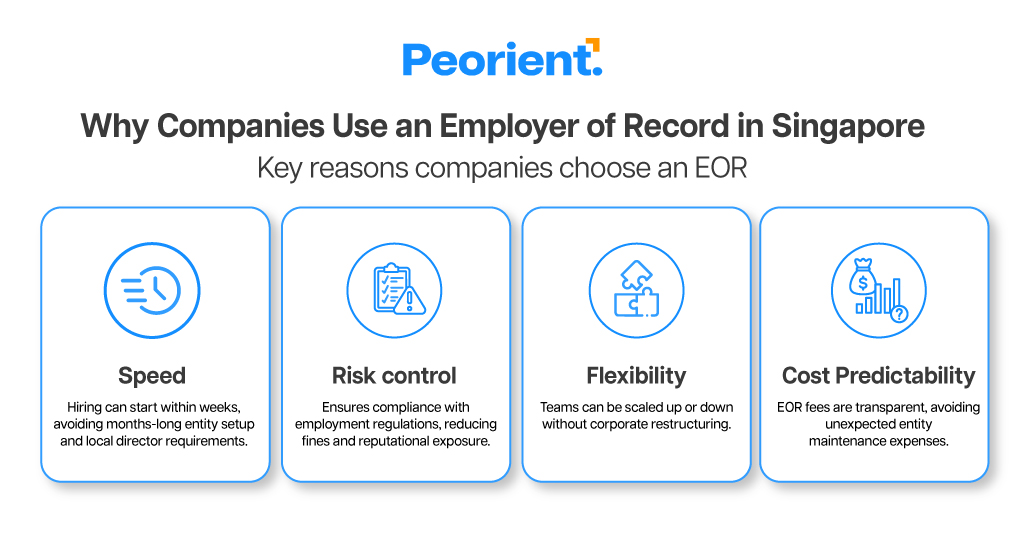
Key reasons companies choose an EOR
- Speed: Hiring can start within weeks, avoiding months-long entity setup and local director requirements.
- Risk control: Ensures compliance with employment regulations, reducing fines and reputational exposure.
- Flexibility: Teams can be scaled up or down without corporate restructuring.
- Cost predictability: EOR fees are transparent, avoiding unexpected entity maintenance expenses.
Employer of Record Singapore vs Setting Up a Local Entity
Quick comparison. EOR offers speed and flexibility, while a local entity suits long-term, large-scale operations.
Factor | Employer of Record (EOR) | Local Entity Setup |
Setup Time | 2–4 weeks | 2–4 months |
Upfront Cost | Minimal | High (legal, registration, capital) |
Ongoing Fixed Costs | Predictable monthly fee | Accounting, audits, compliance overhead |
Compliance Responsibility | Managed by EOR | Fully owned by the company |
Payroll & Tax Complexity | Handled locally by EOR | Managed internally or via vendors |
Work Pass & Visa Handling | Included | Separate process |
Exit Flexibility | High | Low |
Best Use Case | Early-stage, pilot, or flexible hiring | Long-term, large-scale operations |
Key Employer of Record Services in Singapore
Employer of Record services in Singapore extend beyond payroll. The scope determines whether compliance risk is truly transferred.
Below is a comparative overview of leading Employer of Record companies in Singapore.
Provider | Indicative Monthly Cost (SGD) | Payroll & Tax Handling | Compliance & Benefits Coverage | Key Strength | Best Fit |
Deel | $500–$700 | Centralised payroll | Standard to strong | Speed and platform usability | Companies are hiring across multiple regions quickly |
Remote | $600–$800 | Local payroll execution | Advanced compliance focus | Legal accuracy and documentation | Risk-sensitive and regulated teams |
Papaya Global | $650–$900 | Aggregated multi-country payroll | Advanced | Global payroll consolidation | Large organisations managing scale |
Oyster | $400–$600 | Partner-led payroll | Moderate | Simplicity and startup friendliness | Early-stage companies |
Velocity Global | $700–$900 | Local partner model | Advanced | Regulated industry expertise | Healthcare, finance, and industrial sectors |
Globalization Partners | $800–$1,200 | Direct entity ownership | Enterprise-grade | Compliance depth and control | Large enterprise expansion |
Safeguard Global | $600–$900 | Hybrid payroll model | Advanced | Complex payroll and benefits handling | Companies with diverse workforce models |
Boundless | $400–$550 | Partner-led payroll | Moderate | Straightforward execution | Small teams entering Singapore |
Horizons | $500–$700 | Local partner payroll | Strong | Asia-Pacific regional expertise | APAC-focused expansion strategies |
Multiplier | $450–$650 | Local payroll execution | Strong | Cost efficiency with compliance | Budget-controlled scaling |
Note: Costs are indicative and vary by benefits, visa support, and service scope.
- Deel – Works well for fast, standardised hiring. Flexibility drops when contracts, benefits, or visa cases fall outside preset workflows.
- Remote – Prioritises compliance accuracy over speed. It suits teams that prefer conservative legal interpretation in Singapore.
- Papaya Global – Best when Singapore payroll feeds into multi-country reporting. Less ideal for teams treating Singapore as a standalone market.
- Oyster – Fits early-stage teams with simple hiring needs. It becomes restrictive as roles or compliance requirements grow more complex.
- Velocity Global – Chosen in regulated or high-liability sectors. Cost sensitivity often comes second to deeper local oversight.
- Globalization Partners – Offers strong control and audit readiness. Pricing reflects the depth of compliance assurance.
- Safeguard Global – Handles mixed payroll, benefits, and workforce models well. Coordination matters more than speed in its approach.
- Boundless – Provides straightforward EOR services in Singapore. Focuses on clarity and straightforward execution. It suits short-term or validation hiring rather than scale.
- Horizons – Designed for Asia-Pacific expansion strategies. Less relevant for companies hiring only in Singapore.
- Multiplier – Appeals to cost-conscious teams. Compliance coverage remains strong within defined limits.
Hiring in Singapore Stressing You Out?
Peorient helps you pick the right EOR and stay compliant effortlessly.
Singapore Employment Laws an Employer of Record Manages
Singapore’s employment framework is precise and tightly enforced. Rules are clear, but flexibility is limited. This makes early compliance decisions critical.
What the EOR manages
- Employment Act compliance covering hours, overtime, leave, and termination
- Statutory contract clauses that cannot be overridden by agreement
- Notice periods and leave entitlements aligned with legal minimums
- Ongoing tracking of Ministry of Manpower guideline updates
- Documentation readiness for audits or regulatory checks
Payroll Processing and Tax Compliance Through an EOR in Singapore
Payroll in Singapore operates on fixed timelines. Accuracy and timing are equally important, and errors are rarely overlooked.
What the EOR manages
- Salary payments issued within seven days after each pay period
- Monthly income tax calculations and accurate deductions
- IRAS filings across ongoing cycles and annual submissions
- Year-end tax form preparation and submission
- Standardised payroll workflows to reduce manual errors
Insight: Most payroll-related penalties in Singapore stem from timing errors—not incorrect calculations.
CPF Contributions and Statutory Benefits Covered by an EOR
CPF compliance is one of the most sensitive areas for foreign employers. Contribution rules vary by age and income level.
What the EOR manages
- Employer and employee CPF contribution calculations
- Timely CPF submissions within statutory deadlines
- Age-based contribution rate adjustments
- Statutory benefits, including annual leave and sick leave
- Accurate benefit records for audits or employee queries
Tip: CPF errors are among the most common compliance issues faced by foreign employers entering Singapore.
Employment Contracts and Worker Classification in Singapore
Employment contracts in Singapore must reflect labour standards clearly. Vague or copied clauses increase legal exposure. Precision matters.
Worker classification is closely monitored by authorities. Misclassifying employees as contractors can lead to retroactive penalties. This risk increases with long-term roles.
An Employer of Record ensures correct classification from the start. It aligns contract structure with actual working conditions. This prevents disputes later. Clear contracts also improve employee confidence. Compliance supports trust and long-term retention.
Hiring Local and Foreign Employees Using an Employer of Record Singapore
Employer of Record providers can hire both local and foreign employees. Each category involves distinct compliance steps. Mixing them requires coordination.
Local hires require CPF registration and statutory benefits compliance. Foreign hires must meet work pass eligibility thresholds. Salary and role classification matter.
The EOR manages both processes under one framework. This prevents fragmented administration. HR operations remain centralised.
Companies avoid maintaining parallel compliance workflows. This reduces internal complexity and risk.
Work Pass and Visa Support Through an Employer of Record
Employing foreign workers in Singapore requires various work passes. The three most popular passes are the Employment Pass, S Pass, and Work Permit, depending on the nature of the job. It is essential to keep up to date with the required criteria.
- EORs manage applications, renewals, and cancellations end-to-end.
- Documentation is prepared to meet the Ministry of Manpower requirements.
- Salary, role seniority, and qualifications are verified for compliance.
- EOR support mitigates risks of delays that could disrupt onboarding.
Risks of Hiring in Singapore Without an Employer of Record
Hiring without an EOR exposes companies to compliance and operational risks.
- Fines and enforcement actions can be issued for non-compliance.
- Unregistered employment or documentation gaps are treated seriously by authorities.
- Hiring approvals may be paused, and contracts could be invalidated.
- Operational disruption may occur due to audits or regulatory interventions.
An Employer of Record provides a compliance buffer, allowing companies to hire confidently and focus on growth.
Cost of Employer of Record Services in Singapore
EOR costs in Singapore typically range from $400 to $800 per employee per month. Pricing varies based on service scope and provider model.
Additional costs may include benefits administration or visa processing. These should be disclosed upfront. Transparency is critical.
Lower pricing often signals limited coverage. Compliance gaps surface later and cost more to fix.
Evaluating the total cost of ownership is more reliable than comparing headline fees.
Planning India Hiring next?
Get hands-on guidance with Peorient’s EOR support starting at $199.
Factors to Consider When Choosing an Employer of Record in Singapore
Partnering with the right EOR is essential. Consider the following factors:
- Compliance depth should be the primary evaluation factor. Singapore law allows little flexibility. Mistakes have consequences.
- Local payroll execution matters. Some providers rely heavily on third-party processors. This can affect response times.
- Reporting clarity is critical for decision-makers. Visibility into costs and compliance status supports planning.
- Support responsiveness also matters. Delays can affect employee experience and onboarding timelines.
Best Employer of Record Singapore Providers Compared
No provider fits every business model. The right choice depends on hiring objectives and internal capabilities.
Startups often prioritise speed and simplicity. Enterprises focus on audit readiness and risk control.
Structured comparison reduces decision risk. Context matters more than marketing claims.
When an Employer of Record Is the Right Choice for Singapore Expansion
Choosing the right hiring model depends on team size, project scope, and growth plans.
Key scenarios for using an EOR
- Early expansion: Ideal for teams with limited headcount entering Singapore.
- Project-based hiring: Supports short-term initiatives or pilot projects without committing to a full entity.
- Uncertain timelines: Allows companies to adjust hiring speed and team size as plans evolve.
- Transition to entity setup: Provides operational control until establishing a local entity becomes practical.
Final Thoughts
Singapore rewards companies that respect its laws. The rules are clear, enforcement is consistent, and expectations are well documented. This clarity benefits companies that prepare properly.
The Singapore Employer of Record model provides that preparation layer. For many businesses, it enables growth without forcing premature legal commitments.
Choosing the right provider is less about brand recognition and more about fit. Hiring volume, risk tolerance, and plans all matter. Clear alignment leads to smoother operations and fewer surprises.
How Peorient Helps You Choose the Right Employer of Record
Choosing an Employer of Record is rarely straightforward. Providers differ in compliance depth, local execution, and support quality. These differences only become visible once hiring begins.
Peorient brings clarity to that decision. We help businesses compare employer of record services in Singapore with clarity. Our focus is on practical factors, not surface claims. Our platform focuses on real-world suitability rather than generic rankings.
We guide you through provider shortlisting, trade-off evaluation, and expectation setting. This reduces guesswork. It lowers the risk of choosing an EOR that does not match your hiring reality. For businesses ready to move forward, Peorient’s EOR support starts at $199. It includes hands-on guidance throughout the process.
If you are planning to hire in Singapore and want to make a trusted choice, Get Free Recommendations from Peorient.
FAQs
-
Is using an Employer of Record legal in Singapore?
Yes. EORs are legal when they comply with the Employment Act, CPF rules, and MOM requirements.
-
Can an Employer of Record sponsor work visas?
Yes. Most EORs manage Employment Pass and S Pass applications, subject to eligibility and policy rules.
-
Is an Employer of Record suitable for long-term hiring?
It works best for early or mid-stage expansion. Many companies shift to an entity as teams grow.
-
Do Employer of Record providers handle CPF contributions?
Yes. They calculate, submit, and maintain CPF contributions for both employer and employee.
-
How quickly can hiring start with an Employer of Record?
Usually within two to four weeks, depending on role and visa needs.

Written by
Arjun Mehta
Director of Global Hiring Advisory · 6+ years experience
Arjun runs the global hiring advisory practice at Peorient. He previously led APAC operations at an EOR startup and advised at Singapore's EDB, overseeing workforce launches in 18 countries across EOR, PEO, and subsidiary models.
US Employee Benefits Guide 2026: Costs & Requirements
US employee benefits are less about a long federal checklist and more about health insurance, state rules and competitive expectations. For a professional hire, budget roughly 25–35% above base salary before any EOR fee, then model family coverage and the employee’s work state separately.
-
How to Hire Employees in the US: Foreign Company Guide
September 7, 2026 -

Notice Period Buyout India 2026: Rules, Tax & Formula
September 4, 2026 -
Best EOR in India 2026: 12 Providers Compared
September 3, 2026 -
Gratuity in India 2026: Rules, Formula & Tax Treatment
September 2, 2026