For companies hoping to extend operations, reach new markets, and increase their talent pool, global expansion is an exciting but difficult task. This procedure does, however, present many difficulties, like managing international payroll systems, guaranteeing continuous legal compliance across borders, and comprehending and following complicated local employment rules.
Particularly for small to medium-sized businesses (SMEs) with little resources or knowledge in worldwide HR management, these challenges can represent major financial, legal, and operational concerns.
By means of this article, we further explore the function of Professional employer organizations, their many advantages, and the reasons for their growing preference among companies trying to effectively negotiate the complexity of worldwide expansion.
Understanding the strategic value PEOs provide helps companies to position themselves to attain sustainable development while reducing risks and staying compliant in a fast-changing worldwide environment.
What Is a Professional Employer Organization (PEO)?
A Professional Employer Organization (PEO) is a co-employment partner handling company regulatory compliance, payroll, benefits administration, and human resource chores. Companies can concentrate on core operations by working with a PEO and using their administrative task management experience.
PEOs, who operate as co-employers, handle important administrative tasks such as payroll processing, tax compliance, employee benefits management, and HR support while ensuring companies satisfy national employment laws.
Outsourcing these heavy and time-consuming tasks helps businesses free more resources and attention for their main operations, creativity, and strategic goals.
Key Functions of a PEO:
- Payroll processing and tax administration
- Employee benefits management
- Compliance with local and international employment laws
- HR support, training, and recruitment assistance
- Workers’ compensation and risk management
Why Use a PEO for Your Business?
1. Global Expansion Made Easy
Usually involving building up local businesses, entering new markets may be expensive and time-consuming. Acting as your Employer of Record (EOR), a PEO lets you employ talent anywhere without creating a legal presence in the target nation.
Benefits:
- Faster market entry
- Cost savings of up to 60% compared to entity establishment
- Compliance with local laws and tax regulations
2. Access to Global Talent
A PEO lets companies engage top-notch personnel anywhere in the world. Eliminating hiring restrictions will help you to access a larger talent pool, therefore lowering skills gaps and enhancing organizational performance.
Advantages:
- Overcome local labor shortages
- Build diverse, high-performing teams
- Retain top employees with flexible, remote opportunities
3. Compliance and Risk Mitigation
Employment regulations change often and differ between nations. PEOs specialize in handling compliance, making sure your company follows local tax laws, labor rules, and employee rights.
Compliance Services Include:
- Accurate payroll tax filings
- Employee contracts aligned with local laws
- Management of workplace safety standards
How Does a PEO Work?
Under a co-employment model—a cooperative arrangement whereby the PEO and the client company share in managing employee responsibilities—a Professional Employer Organization (PEO) functions. While outsourcing the frequently difficult and time-consuming administrative HR chores to the PEO, this arrangement lets companies keep control over their daily operations and strategic decisions.
Here is a detailed breakdown of how a PEO operates:
1. Contract Agreement
The procedure starts with a formal contract between the PEO and the client’s business. This agreement details the parameters of the cooperation and the particular HR tasks the PEO will be performing. It defines the roles and obligations of both sides and therefore creates the co-employment link.
- PEO’s Role: Handing important HR tasks such as payroll processing, benefits administration, regulatory compliance, and tax filings, the PEO takes on the administrative employer role.
- Client Company’s Role: The client keeps complete operational control, including team management, recruiting, firing, performance monitoring, and daily business activity decision-making.
The contract provides a clear structure to guarantee that there is no ambiguity about responsibility, legal duties, and the extent of PEO services given.
2. Administrative Employer Role
The PEO serves as the administrative employer under the co-employment arrangement for designated employment-related purposes. Although employees still answer directly to the client company, the PEO handles:
- Payroll Management: Guaranteeing accurate and timely payroll processing, tax withholdings, and statutory deductions compliant with local laws.
- Employee Benefits Administration: Thanks in great part to the PEO’s collective bargaining strength, offering competitive benefit packages—including health insurance, retirement plans, and wellness programs—often at more reasonable rates.
- Compliance and Risk Management: Managing labor law compliance, occupational safety standards, and risk reduction across borders helps companies avoid expensive legal penalties and conflicts.
- Workers’ Compensation: Managing insurance coverage, claims, and workplace safety initiatives to guarantee legal compliance and staff welfare.
The PEO greatly lessens administrative tasks for the client company by centralizing these duties, optimizing procedures, and guaranteeing correctness and legal compliance.
3. Operational Oversight
A PEO offers one of the main advantages in that it lets companies have complete operational control. Unlike staffing companies or outsourcing companies, a PEO does not meddle with client business operations or decision-making processes. The client company keeps control over its personnel and owns them.
- Businesses can still recruit the required skills locally or internationally; the PEO guarantees that the employment procedure follows local rules.
- The client organization still controls daily duties, KPIs, performance reviews, promotions, and termination policies.
- Vision for the business and leadership remains the same. The PEO basically helps the company by handling non-core HR tasks.
Designed to empower companies, the co-employment arrangement frees time and resources to concentrate on expansion, innovation, and basic operations free from administrative distractions.
How the PEO-Co-Employment Relationship Works
The PEO and the client company have a simpler co-employment relationship, shown here:
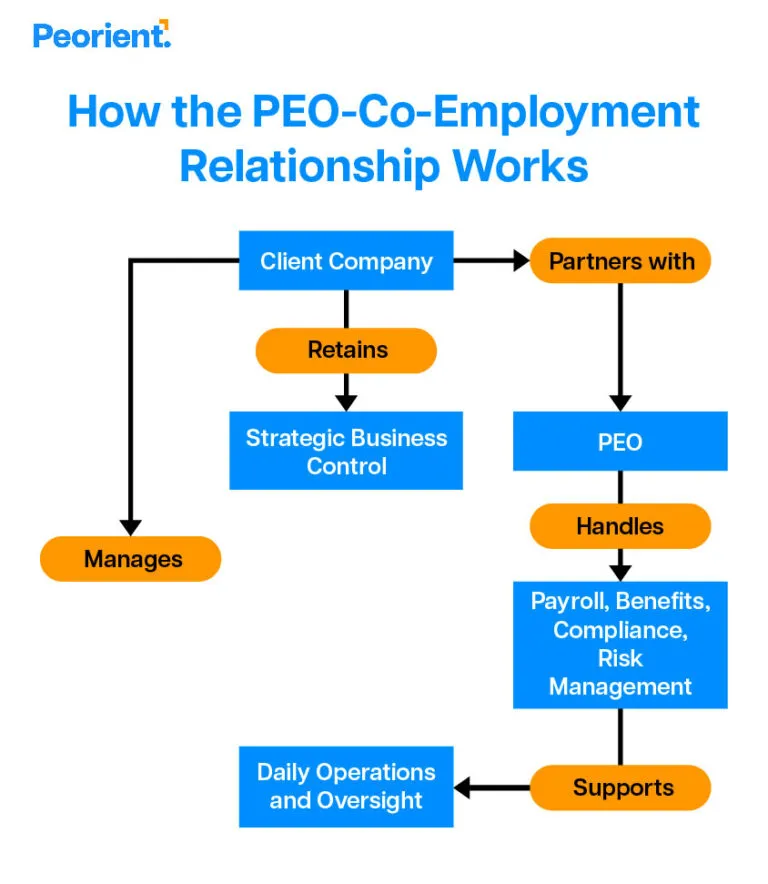
- It focuses on staff management, business operations driving, and the expansion of the client company.
- Acting as an administrative partner, PEO guarantees compliance and handles HR responsibilities.
The End Result
By means of this shared employment model, companies can accomplish:
- A reduction in administrative burden, therefore allowing internal resources to concentrate on strategic objectives.
- Better control of HR chores, including legal compliance, benefits, and payroll.
- Improved scalability will help companies to easily and legally hire personnel wherever.
Although it acts as an extension of your HR team, the PEO does not replace it; rather, it guarantees that the company runs legally, stays compliant, and provides a better employee experience. This cooperative strategy lowers employment administration-related risks and costs while driving operational efficiency.
What Kinds of Businesses Benefit from PEOs?
PEOs are particularly advantageous for:
- Small to Mid-Sized Businesses (SMBs) sometimes lack the means to handle difficult HR operations within their own companies. A PEO offers access to HR knowledge and services that are otherwise costly.
- Companies wishing to enter new markets can gain from a PEO’s familiarity of local labor laws and regulations, therefore enabling more seamless and compliance expansion.
- PEOs help sectors including manufacturing, construction, and healthcare—which must comply strictly—manage their regulatory complexity.
For companies of all kinds without internal knowledge of worldwide employment practices, working with a PEO is very helpful. PEOs offer a turnkey solution for companies entering foreign markets since they control regulatory complexity and reduce the non-compliance risks. By allowing companies to hire top-notch people across borders without creating a legal organization in every nation, they also save a lot of time and major expenses.
Why and How a PEO Helps Small Businesses to a Great Extent
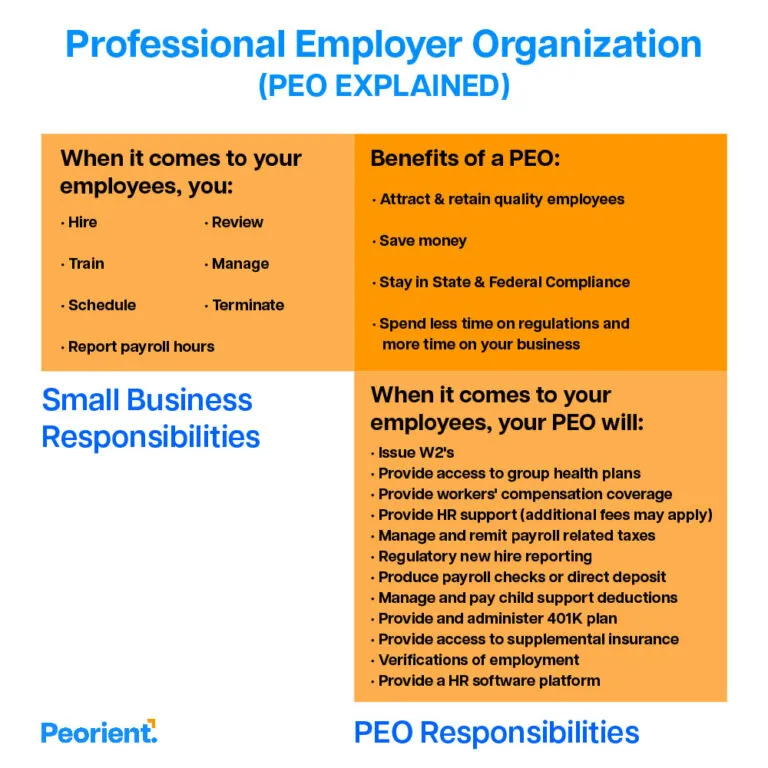
Small companies trying to expand sometimes struggle to balance administrative tasks with personnel management. Acting as an extension of the company, a Professional Employer Organization (PEO) handles challenging HR responsibilities and compliance while letting business owners keep control of their employees. PEOs effectively split tasks as seen in the picture, allowing small companies to save time, lower expenses, and remain compliant.
Why Small Businesses Need a PEO
1. Focus on Core Employee Management
Small companies keep control over important personnel-related choices, including:
- Hiring and onboarding: Choose the correct candidates who fit the vision and culture of the company.
- Training and Development: Give staff members the tools they will need to flourish.
- Management and scheduling help to guarantee teams stay effective and in line with business objectives.
- Manage staff performance, promotions, and departures to maximize results.
This operational control guarantees small enterprises keep their vision and corporate culture while the PEO manages background administrative tasks.
2. Cost Savings and Access to Better Benefits
Limited resources cause small enterprises to find it difficult to provide competitive perks. Working with a PEO addresses this by offering:
- Access to Group Health Plans: reasonably priced, excellent employee health benefits.
- 401k Retirement Plans: Designed to draw in and keep elite talent.
- Extra coverage choices that boost employee happiness constitute supplemental insurance.
Usually reserved for bigger organizations, these advantages are only available to small enterprises once they use a PEO to allow for talent acquisition without going broke.
3. Simplified Payroll and Tax Administration
Tax mismanagement and payroll mistakes can cost expensive fines and unhappy workers. PEO guarantees:
- Exact payroll processing covering direct deposits and payroll checks.
- Tax reporting, withholding, and following federal and state rules.
- Simple child support deductions and other payroll-related chores.
This guarantees legal compliance, reduces administrative complications, and lets business owners save valuable time.
4. Compliance and Risk Management
Navigating labor laws is difficult, particularly when rules differ depending on the state or sector. A PEO reduces hazards by:
- Responsible for federal and state compliance, including reporting obligations.
- Managing programs for occupational safety and worker compensation.
- Giving HR help to professionally address employee problems or conflicts.
Small businesses stay compliant and avoid penalties, knowing experts manage their HR processes.
How a PEO Empowers Small Businesses
Small companies working with PEOs produce a healthy allocation of tasks, as the picture shows:
Small Business Responsibilities:
These remain focused on driving employee engagement, growth, and performance:
- Employ and educate staff members.
- Plan events and handle chores.
- Analyze performance and decide about terminations.
- Track and document your payroll hours.
PEO Responsibilities:
The PEO manages time-consuming administrative and HR functions, such as:
- Take care of the W-2 forms that need to be issued.
- Handling tax payments and payroll.
- Giving group health insurance, a 401k, and extra perks access.
- Managing labor law compliance and worker compensation claims.
- Providing HR systems for simplified worker control.
While PEOs handle administrative complexity, the balanced collaboration guarantees that companies remain nimble and profitable.
Benefits of a PEO for Small Businesses
The picture emphasizes the main advantages that support small company expansion:
- Attract and retain outstanding Employees. Provide competitive advantages together with professional support.
- Cut HR expenses and stay free from compliance penalties.
- Stay in line with always shifting employment rules, both state-wise and federally.
- Spend less time handling HR and more time inventing and scaling if you give business growth a top priority.
How Much Does a PEO Cost?
Employing a PEO will cost differently depending on the size of the company, the breadth of services needed, and the pricing policy of the PEO. Typical pricing strategies consist of:
- Percentage of Payroll: Usually ranging from 2% to 12%, the PEO levies a fee based on a percentage of the company’s overall payroll.
- Per Employee Per Month (PEPM): Every employee pays a set price; rates depend on the services rendered.
Businesses need to assess their specific needs and compare PEO offerings to determine the most cost-effective option.
Benefits for Employers and Employees
For Employers:
- Faster and compliant market entry
- Streamlined recruitment and onboarding
- Reduced HR costs and workload
- Access to HR expertise and global market knowledge
For Employees:
- Secure employment with competitive benefits
- Opportunities to work for global organizations
- Improved work-life balance and flexible arrangements
- Exposure to diverse teams and professional growth
PEO vs. Employee Leasing
Feature | PEO | Employee Leasing |
Employment Relationship | Co-employment with existing employees | Temporary workforce supplied |
Scope of Services | HR, payroll, benefits, compliance | Short-term labor supply |
Duration | Long-term partnership | Project-specific or temporary |
Focus | Administrative and HR management | Staffing and workforce provision |
How Do You Choose the Right PEO?
You can read a comprehensive guide on choosing the right PEO here, or to get brief information, you can continue reading through the blog:
- Evaluating your company’s needs can help you decide which HR tasks you want to outsource and find PEOs focused on those domains.
- Search for PEOs who satisfy industry standards by being approved by the IRS or accredited by reputable companies like the Employer Services Assurance Corporation (ESAC).
- Review the co-employment agreement’s contents very carefully, including the distribution of duties and any related expenses.
- Ask other companies that have teamed with the PEO about performance and satisfaction.
Grow Your Business Today with Peorient
At Peorient, we are dedicated to empowering businesses by providing comprehensive insights and reviews in the HR, Payroll, Recruitment, Employer of Record (EOR), and International Professional Employer Organization (PEO) sectors. Our mission is to fill the knowledge void and tackle misinformation in these domains, enabling you to make informed decisions that drive your business forward.
Our Expertise
Our team comprises seasoned professionals with extensive experience in HR, payroll, and recruitment. We pride ourselves on delivering excellence through:
- Data-Focused Reviews: Our assessments are shaped by extensive user feedback aggregated from leading platforms such as TrustPilot, G2, LinkedIn, and Capterra.
- Customer-Centric Approach: We prioritize delivering essential information that matters most to our users, ensuring they make well-informed decisions.
Why Choose Peorient?
- Unbiased Information: We offer informed and unbiased reviews based on our industry experience, publicly available data, and direct engagement with the companies we assess. Our reviews reflect our independent opinions.
- Free Access: Beyond our commitment to transparency and unbiased reporting, we believe in empowering businesses and individuals with reliable information without any cost. Our dedication to supporting informed decisions is our way of contributing positively to the community we serve.
Our Services
- Professional Employer Organization (PEO) Insights: Gain a comprehensive understanding of PEO services to determine the best fit for your business needs.
- Employer of Record (EOR) Guidance: Navigate the complexities of international employment with our expert analyses and recommendations.
- HR and Recruitment Resources: Access valuable information to enhance your HR strategies and recruitment processes.
Book a call with our expert to explore our insights and take the next step toward business growth.
Frequently Asked Questions