

This PEO vs HRIS guide highlights how a PEO manages HR tasks through co-employment, while an HRIS empowers internal teams with automated tools. It covers benefits, drawbacks, costs, data control, and decision factors to help businesses choose the right HR model.
This PEO vs HRIS guide highlights how a PEO manages HR tasks through co-employment, while an HRIS empowers internal teams with automated tools. It covers benefits, drawbacks, costs, data control, and decision factors to help businesses choose the right HR model.

When the administration of employees grows to be intricate, corporations usually have to make a very important choice:
In which case, either teaming up with a PEO (Professional Employer Organisation) or going for an HRIS (Human Resource Information System) will bring you more advantages?
The two choices aim at the same purpose of simplifying the human resource operation. Nevertheless, their approaches are different.
A PEO serves as your outsourced HR department—taking care of payroll, legal matters, benefits, and taxes through a shared employment technique.
An HRIS, conversely, is a computerised method that accompanies your in-house HR department to carry out such practices as payroll, absenteeism monitoring, and employee information management automatically.
The selection of the most suitable one is based on your organisation’s size, HR maturity, compliance requirements, and long-term objectives.
At Peorient—your reliable HR consultant and comparison site—we assist companies in assessing the situation, comparing, and contacting the most suitable PEO or EOR providers. Regardless of whether you are increasing your presence locally or worldwide, we will make your HR selection not only easier but also more intelligent.
A Professional Employer Organisation (PEO) is a service provider that takes over an organisation’s HR functions completely. It accepts the HR duties on a co-employment basis, where both your organisation and the PEO are transferred the employer’s responsibilities.
Let us explain:
The PEO is the employer of record for all the administrative aspects, such as payroll, taxes, benefits, and compliance issues.
Your company reverses the control of the operations, decisions about work, and the company culture.
This combination of forces assists smaller and mid-sized firms to divert their attention from HR compliance and smooth execution, and to concentrate on growth, innovation, and operation instead.
👉 Check out the top-notch PEO partners that have been verified by Peorient’s expert advisors.
Globally, PEOs such as ADP TotalSource, Insperity, and TriNet are the most common and widely recognised examples. The companies deliver extensive human resources services through this joint responsibility model.
PEOs suit businesses that don’t mind letting HR go and fully concentrate on the operations, but are not good for those that need complete internal control.
A Human Resource Information System (HRIS) can be defined as a software solution that not only automates but also organises HR operations in one place.
In contrast to a PEO, this system does not take HR work and move it to the external HR provider but rather gives the in-house HR staff the power to carry out the work more effectively.
It collects employee information, supervises payment, monitors presence, and supplies data and graphs for better evaluation and decision-making.
To put it differently, HRIS is the virtual skeleton of your HR team. As stated by SHRM, HRIS systems are the core of the current HR departments and the source of great data-based management.
Feature | Functionality |
Centralized Database | Stores all employee records securely in one place. |
Payroll Automation | Simplifies salary calculation and tax deduction. |
Time & Attendance Tracking | Monitors shifts, attendance, and leave requests. |
Benefits Administration | Manages health, insurance, and retirement plans. |
Recruitment & Onboarding | Streamlines hiring and candidate management. |
Performance Management | Tracks employee goals, KPIs, and reviews. |
Analytics & Reports | Provides data insights for better HR decisions. |
Popular HRIS software examples include BambooHR, Zoho People, and Workday.
The present HRIS systems are capable of integrating with finance, hiring, and performance measurement tools, which assures smooth inter-departmental cooperation.
However, for companies that are expanding, an HRIS will become a long-term strategic asset delivering visibility, control, and scalability.
Here’s how both solutions compare in functionality, cost, and control:
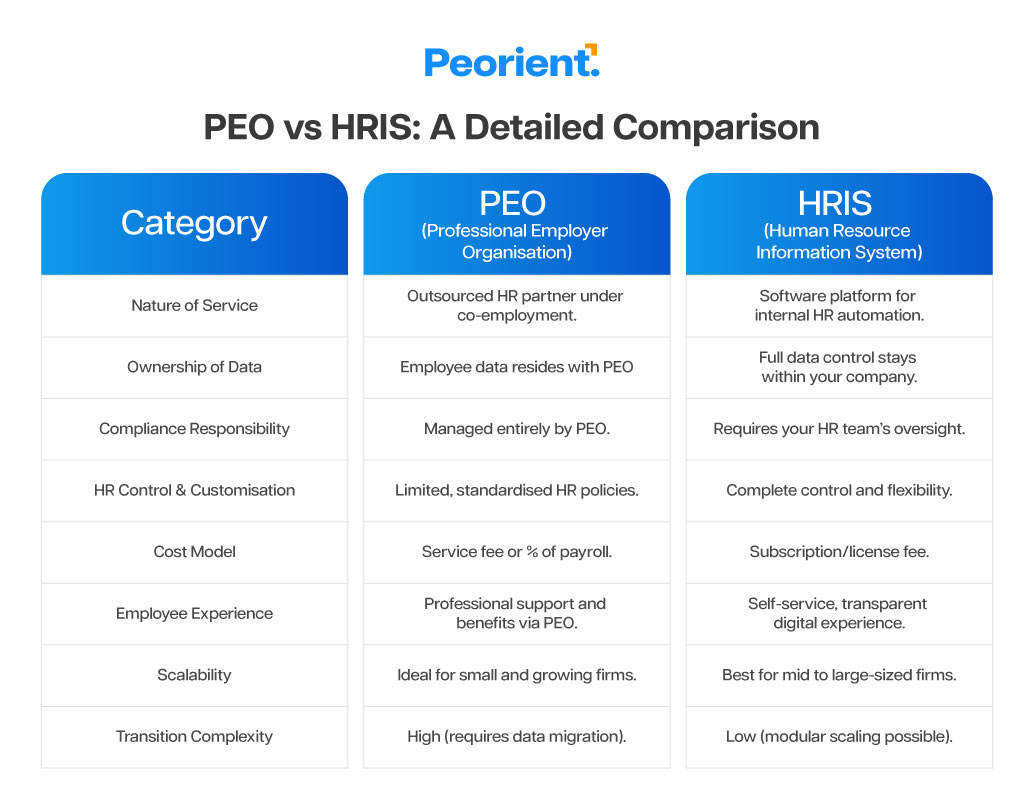
If you’re unsure which suits your stage best, you can use Peorient’s comparison tool to analyse both options based on your company profile.
There are really differences among PEOs. The Certified Professional Employer Organisation (CPEO) has to go through a detailed IRS audit for its financial strength and compliance with standards.
The association with a CPEO reduces the risk of tax liability, and at the same time, it gives better trust and transparency.
This accreditation is a major plus for U.S.-based businesses regarding continuity of HR services over the long term.
Check out certification standards on IRS.gov for further information.
When companies grow, a lot of them use a PEO at first for convenience and later switch to an HRIS for control. Check out the following transition steps for a smooth process:
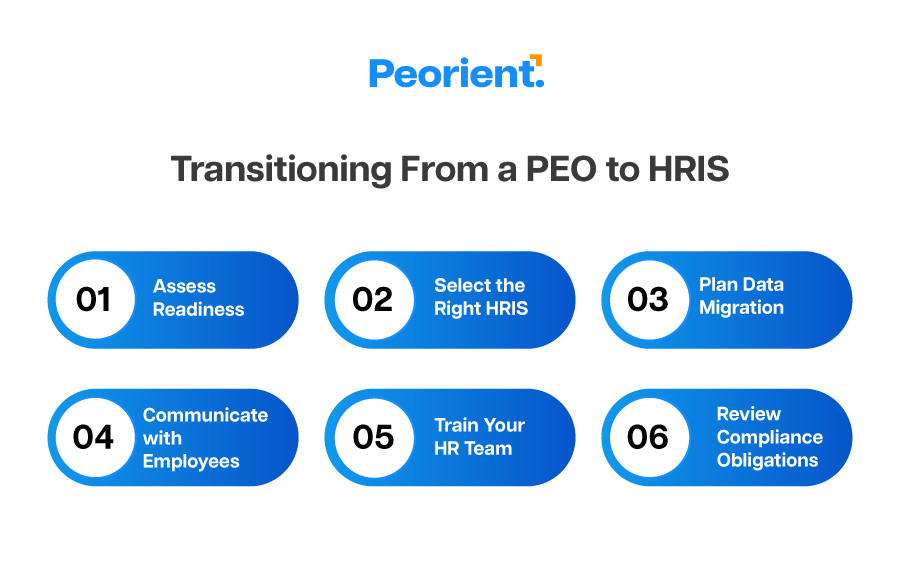
Internal HR capacity, processes, and systems are to be evaluated.
If your team is up to the task of doing payroll and compliance, you’re ready for the move.
Pick software with integration capability, scalability, and price as your main criteria.
Find platforms that are in line with your HR objectives.
Invite both suppliers to transport employees’ files, payroll details, and insurance data for you.
Make the transition procedure clear.
Allow employees to know that there will be no changes in benefits and pay schedules.
Put in place training sessions to enable your HR team to get the most out of the new system.
Check that all legal and tax duties that the PEO used to take care of are now done internally.
If transition is properly managed, it will not only interrupt the operations less but also create a self-reliant HR function.
When choosing between a PEO and an HRIS, evaluate these factors:
Factor | Best Choice | Reason |
Business Size | PEO for startups; HRIS for mid-to-large firms. | PEOs handle complex HR tasks for small teams. HRIS offers scalability. |
HR Expertise | PEO if you lack an HR team. HRIS, if you have one. | PEOs fill HR gaps; HRIS enhances team productivity. |
Compliance | PEO | PEOs handle legal filings, taxes, and risk management. |
Cost Efficiency | HRIS (long-term) | Lower operational costs over time. |
Control Over HR | HRIS | Enable customisation and internal management. |
Employee Experience | Both in different ways. | PEO ensures benefits and compliance; HRIS provides transparency and engagement. |
Data Ownership | HRIS | You control all data and analytics. |
👉 Want a tailored comparison? Use Peorient’s HR Solution Finder to see which option suits your business goals.
A PEO appears to be a budget-friendly option at first sight. However, if your business gets larger, the monthly or payroll-based charges can escalate in no time.
An HRIS, for its part, although having a high initial cost due to installation and training, is going to be a lot cheaper over time because of its capabilities of automation and being able to grow with the company.
In case your concern is heavy data processing and you want to be in control, HRIS is going to be the cheaper option. For small firms that put compliance and ease of use first, PEO is still a viable option.
To have a clearer understanding of the pricing structures, check out Investopedia’s guide on PEO costs.
Both models enhance the employee experience but in their own unique ways.
Another factor that greatly distinguishes the two is data security. Your data with PEOs is kept in the provider’s system.
With an HRIS, you are the owner of your data, which guarantees adherence to privacy laws such as the GDPR and ISO standards.
In the event that the highest concern is data ownership and transparency, HRIS is the clear winner.
PEO and HRIS, both technologies, are the key ingredients of seamless HR management, but their importance varies according to the company’s growth stage.
Next Steps
Still unsure which HR model fits your company?
👉 Compare top PEO and HRIS providers on Peorient — your go-to hub for smart HR decisions.
👉 Or, visit Remunance to explore customised PEO and EOR solutions designed for global growth.
A PEO is an external HR resource which takes care of important tasks such as payroll, compliance, and benefits, whereas HRIS is a system that supports your HR staff to perform these processes in-house through automation and management.
Yes. When first purchasing HRIS, there is an initial cost involved. Nonetheless, in the long run, it will be more economical because there will not be so much dependence on invoice submissions from third parties.
When the firm forms an internal HR team and demands more access to their data, only then would they be able to take compliance on their own, rather than depending on the PEO services.
PEOs take on the full, legal, and responsible ownership of compliance. HRIS provides tools to track compliance, but the company remains responsible for compliance as an HR function.
PEOs provide access to better benefits and HR support. HRIS platforms provide transparency and employee self-service, both of which develop engagement in their own unique ways.
Wisemonk Review 2026: Pricing, Features & Honest User Feedback
Independent Wisemonk review covering pricing ($99/mo), features, G2 ratings (4.8/5, 241 reviews), pros, cons & competitor comparison. Find out if Wisemonk is the right India EOR for your team.


![International PEO Services: Complete Guide to Global Hiring [2026]](https://peorient.com/wp-content/uploads/2025/08/what-is-international-peo-150x150.webp)
![Top 10 International PEO Providers in India [2026 Comparison]](https://peorient.com/wp-content/uploads/2025/08/Top-10-PEO-Service-Providers-in-India-150x150.webp)
![7 Signs Your Business Needs a PEO Partnership [2026 Guide]](https://peorient.com/wp-content/uploads/2025/08/5-Signs-Your-Business-Should-Consider-a-PEO-Partnership-150x150.webp)