Finding talented individuals abroad is relatively straightforward. The challenge starts after you decide to hire them. When you employ someone in Germany, you’ll have to follow German employment law. You’ll pay German taxes. You’ll deal with German paperwork, even if your company has never opened an office there and has no plans to do so. A lot of companies learn this lesson the hard way after they hire someone overseas, then discover they have to handle regulations in a foreign country.
So companies at this stage use one of two solutions: an Employer of Record (EOR) or a staffing agency. Yes, there are other choices. You could create a legal business entity in the other country. Or you could hire people as contractors instead of employees. But for most growing companies, these two options make the most sense. However, they solve completely different problems in unique ways.
Picking the wrong one means you’ll waste money or end up with a solution that doesn’t actually work for your organization. This guide breaks down what each option actually does, what it costs, and when it makes sense, so you can make a confident decision.
What is an Employer of Record?
An Employer of Record (EOR) is a company that becomes the legal employer of your workers in countries where you don’t have your own business set up. Think of them as your legal stand-in. They handle all the official employer responsibilities in that country, so you don’t have to create your own company there first.
For example, assume you find the perfect candidate in Singapore, but your company is only registered in the United States. You won’t need to spend months and tens of thousands of dollars setting up a Singapore subsidiary if you partner with an EOR. They put your chosen candidate on their local payroll, manage all taxes, and administer benefits according to Singapore law.
Your company’s relationship with the employee will remain purely job-related. They’ll use your systems, work on your projects, report to your managers, attend your meetings, and integrate fully into your team. For all practical purposes, they’re your employee. But on paper, on tax forms, employment contracts, and government filings, they’re employed by the EOR.
What is a Staffing Agency?
A staffing agency or recruitment/employment/ temp agency finds and supplies workers for your company temporarily. Their job is to quickly match available workers with demand companies like yours. The agency usually maintains a pool of candidates who are sometimes people registered with them. Sometimes, they also recruit passive candidates through their networks. When you need labor, you’ll need to tell the agency what skills and experience you’re looking for, and they’ll source and screen candidates. Once you select someone, the agency will employ that worker on its payroll and then contract that worker’s services out to you. In return, you’ll have to pay the agency a rate that includes both the workers’ compensation and the agency’s markup.
Key Differences Between EORs and Staffing Agencies
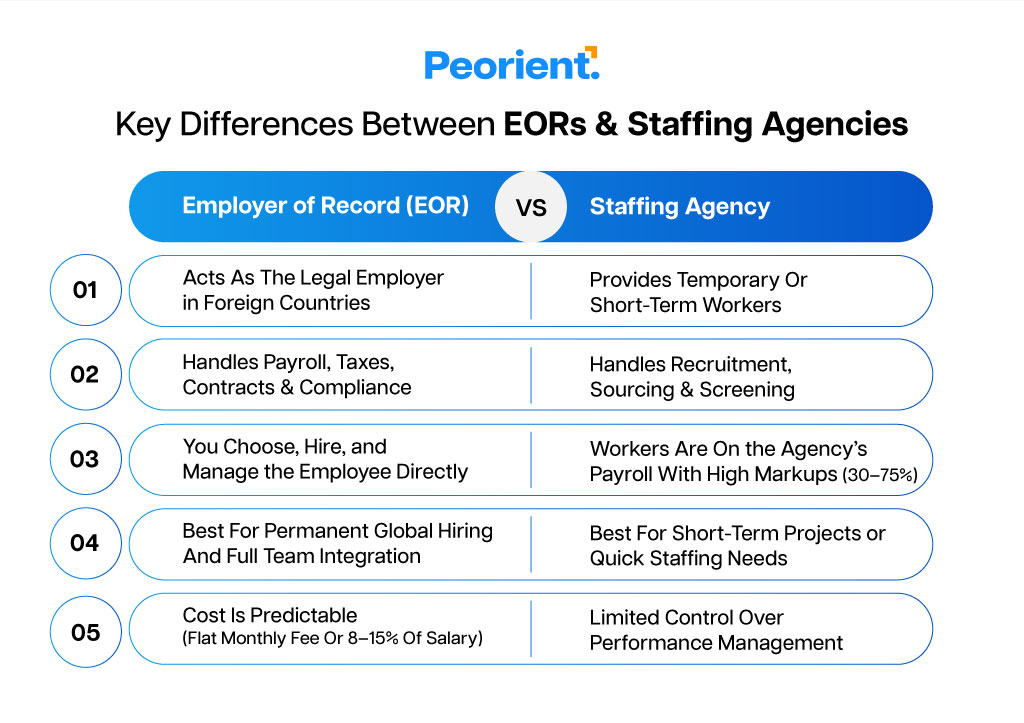
Both models offer international employment services but come with different practical implications:
Hiring Process
With an EOR, you control everything, including:
- Writing job descriptions
- Sourcing candidates through recruiters, job boards, LinkedIn, or referrals
- Conducting all interviews and evaluating cultural fit
- Negotiating compensation and making final hiring decisions
The EOR only gets involved after you’ve chosen who to hire.[1]
Whereas with a staffing agency, you’re outsourcing recruitment:
- You provide job requirements and hiring criteria
- The agency searches its database, posts on its channels, and conducts initial screening
- They present 2-5 shortlisted candidates
- You conduct final interviews from that list
For specialized agencies with strong networks, this works out well. With general agencies, it means you’re handing hiring over to people who may not really get your culture or exact needs.
Employee Management
An EOR offers complete day-to-day control because:
- Employees report directly to your managers
- They use your tools, processes, and systems
- They attend your meetings and planning sessions
- You conduct performance reviews, set objectives, and assign work
- You decide on raises, bonuses, promotions, and terminations
- Employees have your email, business cards, and a place in your org chart
The EOR remains invisible in daily operations. They’re the backend, not part of the management relationship.
A staffing agency comes with a split management structure because:
- You direct day-to-day tasks (what to work on, priorities)
- Limited ability for formal performance management
- The agency technically supervises as a legal employer
- Raises, performance issues, and terminations flow through the agency
- Temporary workers may focus on pleasing the agency (their next assignment source) over deeply serving your goals
Compliance and Paperwork
An EOR carries the primary compliance responsibility. They handle:
- Employment contracts complying with local law
- Income tax calculations and withholdings
- Social security contributions
- Mandatory benefits like statutory leave, health coverage, pensions, parental leave, and sick pay
- Proper termination procedures with notice periods and severance
You’re still responsible for workplace safety, DEI laws, data privacy, etc.
Staffing agencies have a narrower scope: They manage:
- Payroll taxes
- Workers’ compensation insurance
- Unemployment insurance
- Their obligations as an employer
- Basic requirements like work authorization and certification
Legal Implications
EOR:
- When disputes arise, both your company and the EOR can be named. Employee denied mandated leave? That likely falls on the EOR. But a workplace discrimination or harassment claim likely falls on you.
- Employment laws in many countries assign work product to the legal employer. Reputable EORs take care of this in their service agreements with clear assignment of all IP to your company. Most established EORs have standardized this, but you’ll still need to verify it independently.
- Some countries have joint employment rules leading to shared responsibility between companies and staffing providers. While EOR arrangements are generally structured to comply with these rules, you need to ensure your provider understands the nuances in your specific locations.
- EOR-employed workers have proper employee status with full benefits and protections. This is a major advantage compared to hiring people as contractors in countries where you lack an entity.
Staffing Agency:
- With an agency, you’re a client receiving services, not a co-employer. This can provide some liability insulation since employment claims typically flow to the agency.
- Courts and regulatory agencies sometimes look at the practical reality: Who directs and controls the workers’ day-to-day activities? Who determines their schedules? Who provides their tools and equipment? Who supervises their performance? If the answer is “you,” joint employment might exist even if the formal structure says otherwise.
- Many countries have laws preventing companies from using temporary workers to avoid permanent employment obligations. If someone works for you long enough doing regular business functions, they may be entitled to permanent employee status regardless of what your contract with the staffing agency says.
- Many countries limit how long someone can remain a temp worker before they’re entitled to permanent employee benefits. Using staffing agencies to avoid permanent employment obligations can backfire legally if you’re not careful about duration limits.
Cost Analysis for EOR Vs. Staffing Agency
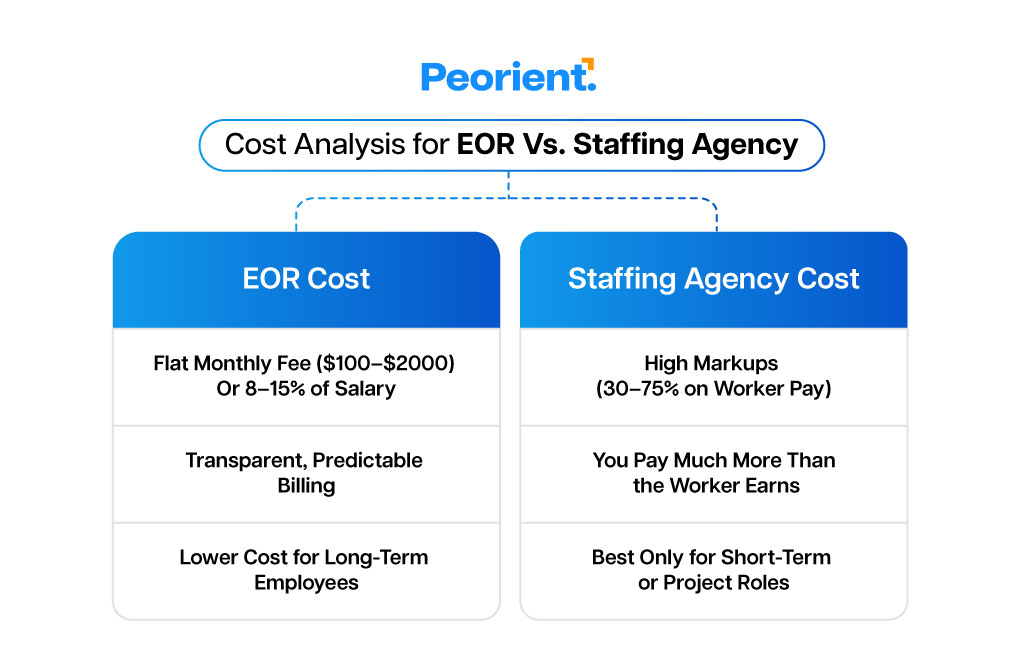
EOR pricing models typically follow one of two structures. Most charge a flat monthly fee per employee, ranging from $100 to $2000 depending on the country.[2] The fee gets higher in countries with complex labor laws or higher regulatory burden. It also depends on the service level you select (premium support, dedicated account management, or self-service options), and the provider’s positioning in the market. Some EORs charge a percentage of salary instead, usually 8-15%, particularly for higher-earning employees.
Beyond the service fee, you pay the employee’s gross salary plus all employer-side costs that would exist in any employment relationship. Employer social security contributions might be 15% of salary in one country and 40% in another. Mandatory benefits, required insurance policies, pension contributions, and other statutory obligations all vary by location as well.
Let’s go over a hypothetical scenario of hiring a mid-level software engineer in France:
- Base salary: €60,000 annually (competitive for mid-level in a smaller French city)
- EOR monthly service fee: €500
- Employer social contribution: 40-45% of gross salary, so €24,000-27,000 annually
- Mandatory benefits, supplemental health insurance, and other requirements: approximately €3,000 annually
- Total annual employment cost: approximately €93,000 ($102,300)
The EOR’s service fee of €6,000 annually represents about 6.5% of your total employment cost. For 1-15 employees in France, this is almost certainly cheaper than establishing your own French entity, which would involve:
- Initial registration and setup
- Annual accounting and legal compliance
- Ongoing corporate tax obligations and regulatory filings
- HR administrative overhead for managing French-specific payroll and compliance
- Potential need for local office space to establish legitimate presence
The breaking point typically comes around 20-30 employees in a single country, where the accumulated EOR fees ($120,000-240,000 annually) exceed the fixed costs of maintaining your own entity.
Staffing agency pricing works entirely differently. Agencies charge a markup on the contractor’s compensation, structured as:
- Bill rate: What you pay per hour (or annually for full-time contractors)
- Pay rate: What the worker actually receives
- Markup/margin: The difference, typically 30-75% of the pay rate
The markup percentage covers the agency’s costs plus their profit margin. More specialized or scarce skills command higher markups because the agency can. High-volume, lower-skill positions typically have lower markups. The agency’s goal is to maximize the spread while remaining competitive enough that you don’t go direct.
For example, the cost breakdown for hiring a specialized IT contractor in the US would be:
- Pay rate to worker: $80/hour ($166,400 annually for full-time equivalent)
- Agency markup: 50% (typical for in-demand technical skills)
- Bill rate to you: $120/hour ($249,600 annually)
The agency’s annual margin is $83,200, far exceeding what you’d pay an EOR for the same worker as a permanent employee. And remember, the contractor is only receiving $166,400 while you’re spending $249,600.
Making the Choice Between EOR and Staffing Agency
So which model actually fits your situation? There’s no universal answer, but there are clear patterns about when each makes sense.
Choose an EOR when you’re:
- Building permanent international teams
- Hiring in countries where you lack legal entities and don’t plan to establish one soon
- Prioritizing compliance and risk mitigation over cost optimization
- Needing full management control and team integration
- Seeking predictable, transparent costs for budgeting
Choose a staffing agency when you’re:
- Filling temporary, short-term, or seasonal roles
- Testing roles or markets before permanent hiring commitments
- Requiring specialized recruitment expertise you lack internally
- Needing to scale capacity up and down rapidly without employment law complications
- Lacking internal HR infrastructure for recruiting and initial vetting
- Covering short-term gaps or emergency situations[3]
Hybrid approaches often work well too. Some companies use EORs for their permanent international employees and staffing agencies for temporary capacity, specialized skills, or seasonal demand.
The most important thing to keep in mind is that you’re building an international presence. Get the employment infrastructure right, and everything else becomes easier. Get it wrong, and you’ll spend months untangling compliance issues, burning budget on inefficient arrangements, or rebuilding team structures that didn’t work.
You now have the framework to make that choice confidently. That’s enough to have informed conversations with providers and select the approach that best fits your company’s growth.
Now go build that global team.
FAQs