Whenever global teams decide to expand in India, they envision a great supply of talent, sectors showing growth, and an improving digital infrastructure. What is not immediately visible is the complex web of documentation, legal procedures, and tiered authorisations that makes hiring or moving talent in India a task requiring both precision and persistence.
To the HR leaders and global mobility directors, India offers a mix of promise and complication. Right from the selection of the right visa to the verification of the right salary grade, to coping with Foreigners Regional Registration Office (FRRO) related requirements, even a single misstep delays onboarding or puts an organisation at risk of compliance problems.
Therefore, understanding the Indian work permit and visa procedure is extremely important. Whether it is hiring a global specialist for a certain position or moving top executives to an Indian branch, doing it right lays the foundation for a compliant and assured entry into one of the fastest-growing markets in the world.
This guide will explore everything an employer should know, right from the different types of work visas and eligibility criteria to application procedures, and how an Employer of Record (EOR) can make the process easier.
Work Visas vs Work Permits in India
One of the first things to clarify is terminology. While many countries issue “work permits” as separate legal documents, India does not work that way.
While a work visa is the document that permits entry into and work in India, a work permit refers more broadly to all permissions—visa, registration, and adherence to regulations—that demonstrate the legality of employment.
In practice, both terms are often used interchangeably, although employers should be aware that there is no separate work permit scheme in India. This distinction helps clarify what is work permit in India is, which refers to the combination of visa, FRRO registration, and employment authorisation that enables lawful work.
Under the Foreigners Act (1946), the punishment for working without proper work authorisation may be serious, including the imposition of fines and imprisonment. Both the employer and the employee are liable in case of failure to have proper paperwork before the work commences.
Types of Work Permit and Visas in India
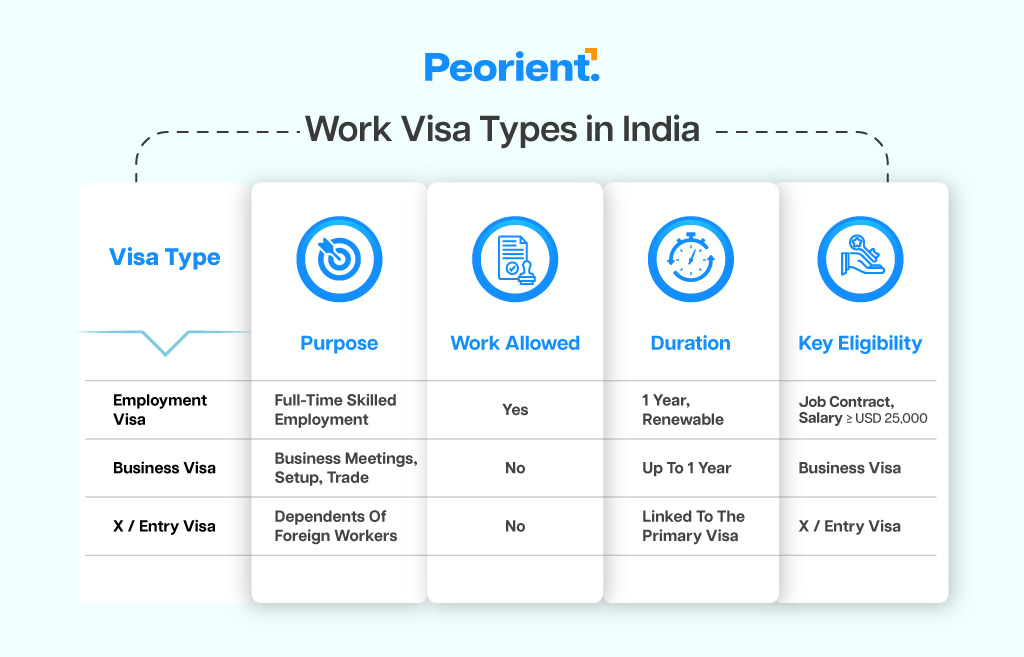
Employers should understand the different work permit types in India to identify which authorisation applies to their employees. The types of work permits in India generally align with visa categories such as Employment, Business, and Entry (X) visas.
This is the predominant category for employing or relocating international professionals to India. It is relevant when a foreign citizen is employed by an organisation or subsidiary that is registered in India.
Key points:
- Have a formal employment contract with a company based in India.
- Issued for one year initially; renewable annually.
- The minimum salary requirement per year is USD 25,000, with the exceptions of certain categories, including teachers and NGO employees.
- Intended for occupations that are specialised or highly skilled and cannot be found locally.
This visa allows entry for visits regarding short-term business, meetings, exploring partnerships, and the establishment of entities, and not for full-time employment.
Key points:
- Requires evidence of a legitimate business purpose.
- Holders cannot receive remuneration from an Indian company.
- Typically issued for up to six months or one year, with multiple entries allowed.
Dependents—spouse, children, or parents—of Employment or Business Visa holders can apply for an X or Entry Visa.
Key points:
- Grants residence rights but not work authorisation.
- Valid for the same duration as the primary visa holder’s stay.
- Requires proof of relationship and sufficient financial support documentation.
Work permits authorise local employment; they differ from digital nomad visas, which allow remote work for a foreign employer — a distinction we unpack in our digital nomad guide.
What are the Eligibility Requirements for Work Visas in India?
Although eligibility does vary slightly depending on the visa category, one common theme of all is that the foreign employment will support the labour and economic objectives of India.
Employment Visa Requirements
- Hold a formal employment contract with an Indian-based company.
- Display specialised skills or professional qualifications.
- Unless there are excluded categories, the annual salary must be at least USD 25,000.
- Hold a passport that is valid for a minimum of six months.
- Provide legitimate documentation with your application, such as your recent photos, evidence of experience, and school credentials.
Business Visa Requirements
Applicants must show:
- Proof of a valid business purpose can be in the form of meeting schedules or trade documents.
- Financial means to support their stay in India.
- A letter of invitation from an Indian entity and proof of business registration.
- A valid passport with a minimum of six months left before expiration.
X or Entry Visa Requirements
Dependents must provide:
- Evidence of a relationship to the primary visa holder.
- A copy of the primary visa and employment documents.
- Proof of financial support for their stay.
- A valid passport with at least six months of remaining validity.
How to Apply for a Work Visa in India
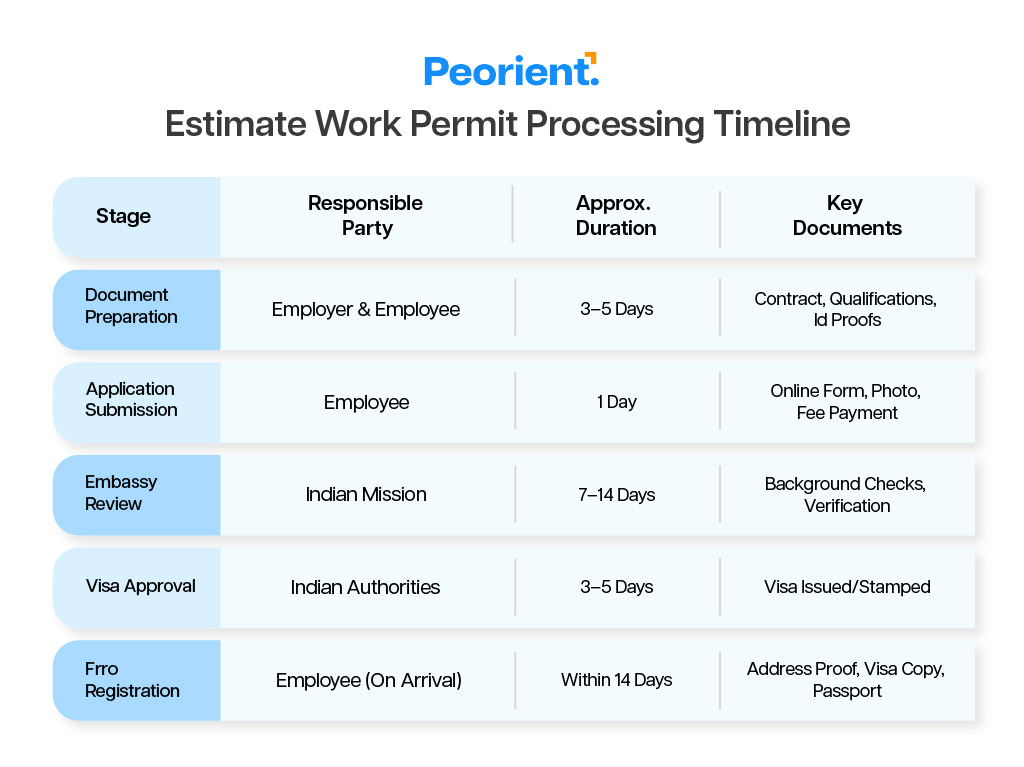
The process and duration for obtaining a work visa in India are influenced by the applicant’s nationality and the Indian consulate handling the application. Typically, it requires two to four weeks.
Step-by-step outline:
- Determine the appropriate visa. Visa for Employment, Business, or Entry, depending on the purpose of the visit.
- Gather required documents. Include contract letters, educational qualifications, and proof of financial means.
- Complete the online application. Fill out the online application. Use the Indian e-Visa platform or the official Government of India portal to submit.
- Include employer documentation. Include business credentials, evidence of registration, and sponsorship letters.
- Pay the application costs and complete the application. The typical fees range from USD 100 to 1000, though this can change based on a person’s country.
- Participate in an interview (if asked). Be prepared to describe the nature of the job or the goal of the company.
- Await visa approval. Notifications are sent via email or are available on the portal.
- Travel to India and register. For long-term visa holders, registration with FRRO must be completed within 14 days of arrival.
Along with guaranteeing compliance, proper execution is crucial for a smooth onboarding experience and speeding up project initiation schedules.
How Can a Company Sponsor a Work Visa Application in India?
Foreign nationals cannot self-sponsor their own employment in India. It is important that the sponsoring company is the EOR and accepts responsibility for accuracy and compliance.
Requirements for Sponsoring Companies
To qualify as an employer sponsoring a foreign worker, a company must:
- Be legally registered in India with active corporate filings.
- A thorough employment contract that includes specifics on tenure, pay, and designation.
- Demonstrate that the position requires skills that are not accessible locally.
- Adhere to all legal obligations, including labour regulations and tax deductions.
- Maintain records of financial stability and company registration certificates.
Sponsorship Process
- Identify eligible roles. Ensure the position justifies hiring foreign expertise.
- Verify candidate qualifications. Cross-check academic background and experience.
- Prepare sponsorship documents. Prepare letters confirming employment terms and company information.
- Coordinate with the employee. Assist with the visa application and ensure document completeness.
- Tracking and management of renewals. Sponsorship obligations will continue throughout the period of your employment.
Precise record keeping by employers and timely renewals helps avoid penalties or blacklisting.
Using an EOR to Avoid Immigration Compliance Stress
For many organisations around the world, navigating India’s complex visa framework internally can be very daunting. By partnering with an EOR, much of this administrative burden is removed.
An EOR serves as the lawful employer for an organisation in India. They manage the complete compliance process—from securing work permits and handling payroll to guaranteeing ongoing compliance with Indian labour and immigration laws.
Services Provided by an EOR
- Visa and Work Permit Management:
Handles the entire visa cycle, from the selection of the right visa type, preparation of documentation, liaison with embassies, to coordination of FRRO registration and renewals.
- Local Sponsorship and Representation:
Sponsors foreign staff and ensures that foreign employees are legally employed and maintain their visa conditions during the period of their employment.
- Payroll and Tax Administration:
Processes salaries in INR, manages income tax, provident fund, and statutory contributions — preventing errors and double taxation.
- HR and Legal Compliance:
Oversees local labour laws, insurance, leaves, and employment contracts. Guarantees each employee’s complete compliance and uniformity.
- Onboarding and Employee Support:
Helps with orientation, arrival procedures, and continuing HR assistance, such as visa extensions, renewals, and terminations.
Benefits of Using an EOR
- Assured Compliance:
EORs remain current with evolving immigration and labour laws, ensuring your workforce stays compliant.
- Faster Market Entry:
Bypassing entity setup allows foreign employees to begin work in weeks instead of months.
- Cost and Time Efficiency:
By centrally managing legal and HR processes, penalties, delays, and administrative burdens are prevented.
- Reduced Risk:
The EOR assumes legal responsibility for employment compliance, protecting companies from visa or misclassification violations.
- Operational Clarity:
A single local partner manages payroll, taxation, and immigration, streamlining all cross-border employment processes.
An employer leveraging the expertise of an EOR can focus on strategy and performance, not paperwork.
Why Visa Compliance in India Matters
Immigration is a serious matter in India. Breach of conditions attached to a work visa might attract fines, deportation, and even imprisonment of the worker and the sponsoring organisation.
Key risks of non-compliance:
- Working when in the wrong visa category, such as on a tourist visa.
- Failure to register with FRRO within the prescribed timeframe.
- Failure to renew visas or staying beyond the period for which visitors are approved.
- Non-compliance with minimum wage and tax legislation.
Beyond exposure to fines, this can cause reputational damage to the employer and scrutiny by the government of future applications.
Who Can Legally Work in India?
Only Indian nationals and foreign nationals holding valid employment or business visas are issued work permits. Tourist visas do not allow the holder to undertake any paid or unpaid work. Similarly, working as a digital nomad on a tourist visa may inadvertently be illegal in India. Right to work must always be verified through valid visa documents, passports, and PAN or Aadhaar, where applicable, by employers.
The Bottom Line
Bringing in or moving foreign experts to India offers opportunities for knowledge and creativity, though it involves complex regulatory frameworks. Compliant and flexible teams can be set up only if one understands the types of work permits available in India, the application process, and the sponsoring obligations.
Businesses that approach compliance the right way from the first day have smoother processes, faster onboarding, and greater local trust.
For the companies that would want to avoid the complexities, EOR provides a reliable connection; from visa sponsorship down to local payroll, it handles everything and allows an organisation to focus on business growth rather than administrative tasks.
FAQs