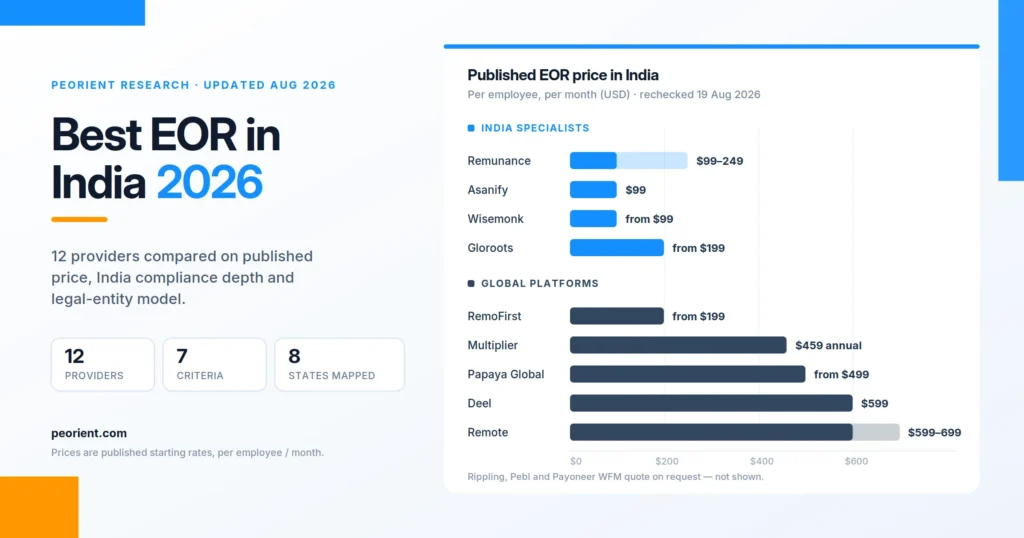
For an India-focused team, start by comparing Remunance and Wisemonk. For hiring across several countries, add Deel, Remote and Multiplier. Consider Rippling when connecting employment with your existing HR and IT systems is a priority. The remaining providers offer useful alternatives for different budgets and operating needs.
An Employer of Record becomes the local legal employer. It administers employment contracts, payroll and applicable employment obligations, while your company directs the employee’s work. Peorient’s guide to how an Employer of Record works explains the arrangement in more detail.
Choose against a written India quote and service agreement. A low advertised fee does not tell you who will resolve a payroll error, how much cash you must fund before joining, or what happens when an employee leaves.
Which EOR should you shortlist for hiring in India?
Use the existing five-question shortlisting tool to narrow the comparison, then check each result against the provider profiles and buying checklist below. Its recommendations are a starting point for due diligence.
How do the best EOR providers in India compare?
India-focused providers and global platforms solve different operating problems. This table compares their published commercial starting points and the situations in which we would include them in a shortlist.
All figures are service fees per employee per month, not salary-inclusive employment costs. Global starting prices are not guaranteed India quotes. Annual commitments, plan scope and country adjustments can change the amount payable.
The source links and qualifications for each price appear in the profiles below. A “from” price is an entry point, not evidence that every employee qualifies for that rate.
How did we assess these providers?
We reviewed public provider pages, current pricing information, the competing guides and buyer discussions available during this research. Our recommendations are editorial assessments of fit, not results from a paid deployment or a measured service-quality test.
We considered six questions: Does the provider support the hiring model? Is the commercial structure clear? Can it explain India employment administration? What support does it describe? How does it fit the buyer’s systems? What needs checking at onboarding and exit?
Published features do not prove delivery quality. Where a contract, sample payroll run or customer reference is needed, we say what to request rather than assigning an unsupported score. This is a selected comparison, not an exhaustive directory of every India EOR.
Should you choose an India specialist or a global platform?
Choose based on the work you need the provider to perform. An India specialist deserves a place on the shortlist when most hires are in India and you need help with local employee questions, recruitment coordination or physical equipment. A global platform deserves consideration when one workflow across countries reduces your HR team’s workload.
Neither model guarantees better compliance or faster support. Ask both types to demonstrate the same India payroll scenario. A specialist that cannot meet your security requirements can be unsuitable. A global provider with a responsive India team can be a good fit even for a small operation.
Which EOR service providers deserve a closer look?
The 12 providers below cover a range of service models and budgets. The order groups buying needs and should not be read as a universal ranking from best to worst.
When is Remunance a good fit for India hiring?
Remunance belongs on the shortlist when India employment requires ongoing local HR and operational support. Its India EOR services cover employment administration, with recruitment and IT support also presented across its service offering.
Its EOR cost guide describes a $99–$249 monthly fee range for its local model. Use that as a budgeting reference and request the exact charge for each employee’s compensation and service needs.
The main fit question is whether you want an India-focused service relationship. If you need one platform to employ people across many countries, compare that requirement separately.
Before signing, request an itemised scope for recruitment, insurance, equipment, deposit terms and any later move to your own Indian entity. Do not assume an available service is included in the monthly fee. For further context, read Peorient’s Remunance review.
When should you consider Wisemonk?
Wisemonk is worth comparing when your main requirement is employment in India with an assigned HR contact. Its published EOR plan starts at $99 and describes payroll, statutory administration, an HR business partner, benefits and equipment setup support.
That combination makes it relevant to teams that want help with employee operations as well as payroll. Buyers should distinguish equipment coordination from the cost of buying, shipping and recovering devices.
The low entry price needs a salary-specific quote. Ask how the fee changes with compensation, headcount and additional services, and request the insurance schedule rather than a general benefits description.
Its India focus is useful when India is the core requirement. If you also need employment elsewhere, confirm the complete operating model. Peorient’s Wisemonk review provides a separate provider overview.
When does Deel make sense for an India team?
Deel is a relevant option when India sits within a workforce spread across several countries. Its pricing page lists EOR from $599 per employee per month and distinguishes employment from contractor and payroll products.
The benefit to evaluate is operational consolidation: whether your team can manage different worker types and countries without maintaining several disconnected processes. That value depends on the products and integrations you actually use.
For India, request the local employing entity’s name, a sample employment agreement, payroll funding dates and a complete invoice illustration. Do not infer the entity structure from a competitor’s comparison.
Deel can be harder to justify on fee alone for an India-only team. Compare the time saved by its workflows against the total annual cost. Use Peorient’s Deel versus Remote comparison for a more focused shortlist.
When should you choose Remote for India employment?
Remote deserves consideration when provider-owned employment entities are a procurement priority. Its current pricing page states that it owns its EOR entities and lists a standard EOR fee of $699 per employee per month.
The same page explains that its FX rate is applied when billing and employment currencies differ. That makes the conversion method an explicit part of the comparison, even when the monthly service fee looks predictable.
Ask for the India employing entity, the proposed intellectual-property terms, a sample currency conversion and the price of optional services. Older comparisons can show different annual offers. Use the current order form for the rate you will pay.
Remote fits buyers who value its employment model and platform enough to support the higher published entry cost. A simpler India-only requirement still warrants a like-for-like quote from a specialist.
When is Multiplier worth shortlisting?
Multiplier is worth assessing when you want EOR, payroll, leave and workforce administration within a shared international platform. Its current pricing lists Core EOR from $459 monthly on annual contracts or $499 on monthly contracts.
This matters because older roundups commonly repeat a $400 starting fee. The current page also identifies implementation fees where applicable, compliance-mandated add-ons and country-level pricing variations.
Ask which plan supports the integrations, reports and workflows your team needs. A lower tier is not the cheapest choice if necessary features require an upgrade.
For an India proposal, obtain the full salary-to-invoice calculation and written confirmation of the applicable country rate. Multiplier is a useful global comparison, but its published starting fee should not be treated as a complete India employment budget.
When is RemoFirst a useful lower-cost alternative?
RemoFirst is relevant when you want international EOR coverage at a lower advertised entry fee. Its EOR offering starts at $199 per employee per month.
Its company website describes a partner-based employment model. That makes the India delivery relationship a central diligence question, rather than a reason to automatically include or exclude it.
Ask who signs the employment agreement, who files payroll obligations, who holds funds and which organisation resolves employee disputes. Request an escalation process that works across the platform and local employer.
The published model can suit a budget-conscious buyer. The trade-off to assess is whether the coordination between parties meets your needs. Confirm the India quote and distinguish any provider administration fee from statutory or contractual costs payable when employment ends.
When does Rippling offer more value than a standalone EOR?
Rippling is worth comparing when employment needs to connect with your HR, access and device workflows. Its India EOR guide describes hiring through an EOR, while its pricing page directs buyers to a tailored quote.
The useful demonstration is an employee joining and leaving: an offer becomes a payroll record, the right systems become available, and access is removed at the right time. Ask the vendor to show the actual products required for that workflow.
Request one commercial proposal covering the EOR service, underlying platform, relevant modules, implementation and support. A low price for one software component is not the price of employing someone in India.
Rippling is most relevant when those connected processes solve a real operating need. For buyers looking only for local payroll and HR support, the wider platform may add little value.
When should a distributed team consider Oyster?
Oyster is relevant to teams that want global employment administration with onboarding, offboarding and local support. Its pricing page lists EOR at $699 per employee per month, with annual discounts available.
The page also identifies a refundable deposit and separately presented services, including benefits packages and people advisory support. Ask for the complete commercial schedule before comparing it with another provider’s headline rate.
Oyster’s published billing currency list includes USD, EUR, GBP and CAD. Australian and New Zealand buyers should specifically confirm their funding route and currency costs.
Evaluate the employee-facing experience: how a new hire asks a payroll question, changes benefit details and gets help at exit. The provider is a useful comparison for distributed teams, but the value depends on the support and workflows included in your agreement.
When is G-P a suitable option?
G-P, also known as Globalization Partners, deserves consideration for international hiring programmes that need structured support and system integrations. Its EOR solution page lists a starting fee of $599 per employee per month.
The published offering includes payroll administration, benefits management and integrations. It also distinguishes add-ons such as background checks, visa support, equity payroll management, office space and IT equipment.
Ask which of those services are available for the proposed India roles and how each is priced. Enterprise buyers should also request the account structure, reporting permissions and process for resolving an urgent payroll exception.
For a single straightforward hire, compare whether the broader operating model is useful. For a larger international programme, evaluate the consistency of contracts and service delivery across the countries you actually plan to use.
When is Papaya Global worth comparing?
Papaya Global is relevant when employment is part of a wider payroll and payments requirement. Its published pricing lists EOR from $499 per employee per month and presents payroll, benefits and payments within its offering.
The practical question is whether finance can reconcile what was approved, what was funded, what employees received and what was remitted to authorities. Ask for a demonstration using an India employee with variable pay and reimbursable expenses.
Confirm the legal employing entity, responsibility for local filings and who handles employee queries. A single interface does not itself explain the legal relationships behind a service.
Papaya deserves a place on the shortlist when the broader payment workflow matters. If you mainly need hands-on local HR for a small India team, compare that requirement directly rather than assuming a payroll platform provides the same service model.
When should you assess Pebl?
Pebl, formerly Velocity Global, is worth assessing when India hiring forms part of a wider international expansion. Its EOR pricing page publishes an entry fee of $399 per employee per month.
Its service overview describes employment, payroll, benefits and wider support for global teams. That makes it relevant when several employment needs must be coordinated across markets.
Request a written India scope and ask what changes when the case involves relocation, an acquisition or a transfer from another employer. A global service description is not confirmation that every complex case is supported at the entry price.
Also confirm the current contracting entity and service terms if your procurement records still refer to Velocity Global. Compare the actual India delivery team and commercial offer, rather than treating the former and current brand names as two separate providers.
When should you consider Payoneer Workforce Management?
Payoneer Workforce Management, formerly Skuad, is relevant when you want employment and contractor administration within one platform. The current Skuad pricing page uses the Payoneer Workforce Management name and lists EOR from $199 per employee per month.
Its offering describes local employment agreements, onboarding assistance, payroll, benefits administration and account management. The page separately prices contractor products, which is an important distinction for buyers converting a contractor into an employee.
Ask for the India legal employer’s name, applicable service agreement, currency rules and employee support process. An existing payment relationship does not establish that someone has been hired as an employee.
This is a useful option to compare on budget and workflow. Confirm the current product and contract rather than relying on older Skuad reviews or assuming that all Payoneer payment services include EOR employment.
How much does an EOR in India actually cost?
Your budget needs the employee’s compensation, employer obligations, benefits and provider charges. Published starting fees in this comparison run from $99 to $699, but your exact quote can fall outside that range.
Which costs belong in the monthly budget?
Separate recurring employment costs from provider fees, refundable funds and one-off expenses. That prevents a cheap-looking service fee from hiding a more expensive overall arrangement.
CTC, gross salary and take-home pay are different numbers. Cost to company can already include employer contributions or benefit costs. Adding them again overstates the budget. Take-home pay reflects employee deductions and tax withholding, so it should be illustrated separately.
Use Peorient’s employee cost calculator for India to organise an estimate, then replace assumptions with the provider’s written calculation.
How much difference can the fee and FX method make?
For ten employees, a hypothetical $200 monthly fee costs $24,000 a year. A hypothetical $600 fee costs $72,000. The annual difference is $48,000 before employment costs, discounts or additional services.
FX can change that comparison. If the amount converted over a year is $300,000, a hypothetical 2% conversion charge adds $6,000. These are arithmetic examples, not quotes or claims about a named provider.
Ask every shortlisted provider to price the same workforce in the same billing currency. Include normal payroll, a bonus month and an employee exit. Compare the annual cost and the largest cash outflow month.
A refundable deposit is primarily a cash commitment, not automatically a consumed service expense. But the refund timetable, deductions and contractual protection still matter to your finance team.
What should an India EOR prove about compliance?
It should explain the applicable rules for your employees and show how it administers them. A general promise to handle compliance is not a substitute for a named legal employer, a payroll calculation and evidence of filings.
Which documents should you request before signing?
Request a sample India employment agreement, the legal employer’s details, a payroll illustration, a benefits schedule and the registrations relevant to the proposed work locations. Ask how you will receive filing evidence without exposing other clients’ employee data.
Use a practical review checklist:
- EPF and ESI applicability, including the employee’s status and the contribution base.
- Salary tax withholding, payslips and the applicable annual tax certificate.
- State-specific leave, holidays, professional tax and labour welfare obligations where applicable.
- Gratuity, statutory bonus and maternity-related obligations where the eligibility conditions apply.
- Workplace policies, grievance handling and sexual-harassment prevention responsibilities.
- Employment changes, lawful termination, final pay and record retention.
The Ministry of Labour’s employer compliance handbook provides a primary source for checking the provider’s explanation of the labour-code framework. Do not assume every statutory contribution applies to every employee in the same way.
What should you ask about the labour codes in 2026?
Ask which current rules and notifications the provider uses and how they affect your employment package. The government’s 2025 labour ministry review records the four labour codes taking effect on 21 November 2025. The ministry’s March 2026 FAQs address implementation questions, including wages and gratuity.
Request a written explanation of the wage definition, contribution bases, gratuity treatment and any relevant central or state rules for the proposed roles. A copied pre-2025 checklist is not enough, and neither is a claim that every rule is now uniform across India.
For employees in different states, ask for the policy applicable to each location. Peorient’s India leave policy guide helps frame the questions about earned, casual and sick leave.
Does using an EOR remove every legal or tax risk?
No. An EOR provides employment infrastructure, but your company still needs to assess its business activities, contractual responsibilities, data handling and intellectual-property arrangements.
Permanent-establishment exposure is a separate corporate-tax question. Review the employee’s authority, work location, activities and the relevant treaty with a qualified adviser. For example, the US–India tax treaty contains its own permanent-establishment rules. An EOR agreement cannot replace that analysis.
Ask who bears which losses under the service agreement, what the indemnity excludes and whether liability is capped. For product and engineering roles, have counsel check the chain of IP assignment from the employee through the employing entity to your business.
Which provider fits your hiring situation?
Build the shortlist around your operating needs before comparing brands. Start with three providers that can demonstrate the required service and price the same scenario.
Which EOR should a startup or first-time India employer compare?
For an India-focused first hire, compare Remunance and Wisemonk with a third provider selected for your budget or systems needs. RemoFirst or Payoneer Workforce Management can provide a lower-entry-price global comparison. Deel or Remote can be useful if you already use their wider platform.
Prioritise a clear employment package, manageable funding requirements and an accessible escalation contact. An early-stage company gains little from a feature-rich platform if nobody can explain the candidate’s take-home pay before offer acceptance.
Peorient’s EOR guide for startups explores the decisions that change as the team grows.
Which EOR should you compare for an engineering team?
Compare providers on IP terms, employee support, device handling and security requirements. Remunance and Wisemonk are relevant India-focused candidates. Deel, Remote and Rippling warrant consideration when international workflows or connected systems matter.
Ask for the process for delivering a configured laptop, handling repairs, removing access and recovering the device at exit. Also check who approves expenses, how bonuses enter payroll and whether the proposed equity arrangement needs specialist support.
Provider size alone does not establish whether the service fits your engineering team. A documented workflow and an employee-facing demonstration provide better evidence.
When should an existing Indian company use payroll services instead?
If your Indian entity can employ the team directly, compare payroll and HR administration before buying EOR services. The legal employer and the problem you are outsourcing are different.
The terminology can be confusing because international PEO is sometimes used to describe EOR arrangements. Ask who will sign the employment agreement and hold the employer registrations. Peorient’s EOR versus PEO comparison explains the distinction.
EOR can still be useful during a transition or while an entity becomes operational. It should have a defined purpose rather than becoming the default because a vendor uses the term broadly.
What should US UK Australian and New Zealand buyers check?
The same India employment package can have different funding and coordination requirements depending on where your company is based. Your headquarters location does not, by itself, determine the best provider.
What matters for US companies hiring in India?
US buyers should request USD funding terms, an INR salary calculation and a support schedule that overlaps with the relevant US time zone. Separate service fees from currency conversion and bank charges.
For engineering or customer-facing roles, review IP assignment, data access and the employee’s authority to negotiate or conclude business. If the offer includes equity, confirm who handles the required payroll inputs and specialist advice.
An India specialist can fit an India-only team. A global platform becomes more useful when the company wants the same approval process for employees in several countries.
What matters for UK companies hiring in India?
UK buyers should confirm GBP funding options, conversion rules and the responsibilities attached to sharing employee or customer data with organisations in India.
The ICO’s international-transfer guidance includes a UK business using an Indian service provider as an example. Check whether your arrangement involves a restricted transfer and which safeguards apply. A provider’s general privacy statement does not complete that review.
Also agree support overlap, local employment terms and the process for applying company-wide benefits to the India team.
What matters for Australian and New Zealand companies?
Australian and New Zealand buyers should confirm AUD or NZD funding, the receiving bank route, currency conversion and payroll cut-offs. Do not assume every EOR accepts both currencies directly.
Check support overlap with your city and season, because daylight-saving changes can alter the working window. Ask who will handle an urgent India payroll issue after your local office has closed.
Compare the provider’s proposed India employment package with any additional benefits your company wants to offer. For employees relocating between countries, obtain separate advice on work rights, tax and home-country obligations rather than treating the move as a routine payroll change.
What do employees ask about EOR jobs in India?
Employees want clarity about who employs them, what they will receive and whether the arrangement will complicate a later job move. Answering those questions before joining can reduce offer-stage confusion.
Recent Reddit discussions about EOR employment stability ask about PF, background verification and a future move to the client’s own entity. A separate discussion about missing employment documents shows why workers need to distinguish contractor payment arrangements from employment. These threads identify questions, not verified provider-performance rankings.
Will the employee receive payslips and employment records?
The offer process should clearly identify the legal employer and the documents the worker will receive. Ask the EOR to demonstrate access to the employment agreement, payslips, relevant tax documents, benefits information and employment confirmation.
For future background checks, agree how the employer name, client assignment and job title will be described. Explain the arrangement to the candidate before they resign from their existing job.
Do not use the payment platform’s brand as proof of employee status. Confirm which agreement the individual is signing and whether it establishes employment or a contractor relationship.
Will the employee’s take-home pay or benefits change?
They can change when the compensation structure or worker status changes. Compare the employee’s proposed gross pay, deductions, insurance and leave before presenting the offer as equivalent to their previous arrangement.
If compensation is discussed in USD but payroll runs in INR, specify whether the salary is fixed in INR or adjusted using an agreed conversion method. Questions about USD-pegged pay through an EOR show why that distinction needs to be settled in writing.
Request the insurer’s schedule for family coverage, exclusions, waiting periods and cover dates. “Health insurance included” does not answer those questions.
Does an EOR job guarantee long-term stability?
No. The EOR arrangement does not guarantee the client company’s funding, business performance or continued need for a role. Employees need clear employment terms and an explanation of what happens if the client assignment ends.
Ask who communicates performance decisions, approves salary changes and handles grievances. Request the termination process and relevant notice terms before joining.
For employers, this is a reason to include the employee experience in provider selection. The provider should be able to explain the relationship plainly without making job-security promises it cannot control.
How should you compare proposals and plan a provider switch?
Send the same hiring brief to each shortlisted provider and compare written answers. A useful brief includes the company’s country, employee work locations, roles, compensation, benefits, hiring date and expected growth.
What should every EOR proposal contain?
Ask each provider to supply the following before you approve the engagement:
- The India legal employer and any delivery partner’s role.
- A sample employment agreement and salary-to-take-home illustration.
- An itemised first invoice and a normal recurring invoice.
- Deposit, prefunding, FX, renewal and refund terms.
- The benefits schedule and applicable leave policy.
- A joining plan with dependencies and responsible contacts.
- Employee and employer support hours with escalation commitments.
- Filing evidence, reporting access and data-handling terms.
- A worked exit example covering final pay and charges.
- A transfer plan for moving to another EOR or your own entity.
Demonstrate a difficult situation during the sales process: an incorrect payslip just before payday, a new work location, or an employee leaving mid-month. The specificity of the answer is useful evidence. A polished demo alone is not.
For a deeper review, use Peorient’s checklist for vetting EOR providers.
How do you switch EORs without creating avoidable gaps?
Agree the employment, payroll and benefits transition before setting a switch date. A provider change can involve a change of legal employer, so continuity should be documented rather than assumed.
Map the old employer’s final payroll, the new employer’s joining date, PF administration, leave balances, benefit cover and treatment of recognised service. Ask both providers who is responsible for each handover item and whether employee consent or new agreements are required.
Also confirm deposit recovery, access to historic documents, equipment ownership and any outstanding reimbursements. Do not release the old arrangement until the new one is ready to perform its obligations.
Use Peorient’s final-settlement guide to prepare the exit questions, and check the applicable facts with the providers handling the move.
When should you move from an EOR to your own Indian entity?
Compare the full operating cost and business requirements, not a universal headcount threshold. Per-employee EOR fees rise with team size, while an entity adds setup, accounting, tax, legal, payroll and management obligations.
How should you calculate the financial crossover?
Compare both models over the same period with the same salary and benefits assumptions. Add the EOR’s service and additional charges on one side. Add entity setup, recurring administration, internal staff time and transition costs on the other.
Salary and employment costs that exist under both models should not be counted as savings merely because you stop using an EOR. Deposit recovery can improve cash flow without becoming an operating-cost saving.
Run the comparison at your expected headcount after 12 and 24 months. Also consider whether local contracts, revenue, licences or operational control require a different structure regardless of the fee calculation.
What should the transfer agreement protect?
It should define the new employer, transfer date and treatment of employment rights and records. Ask counsel and both employers to document service recognition, leave, gratuity treatment, benefits, payroll balances and IP arrangements.
Ask whether the EOR charges an administration fee for the move and when it returns remaining funds. Ensure the employee can retain historic payslips and tax records after platform access ends.
An EOR-to-entity plan is easier to negotiate before the relationship begins. Include it in the original comparison if an Indian entity is already part of your expansion plan.
What other questions should you ask before choosing an India EOR?
The following answers address common points that can otherwise delay a first hire or create a mismatch between the offer and the service purchased.
Can you hire one employee in India without opening a company?
Yes, an EOR can provide local employment without your company first establishing its own Indian entity. Confirm that the provider accepts a single employee and check minimum fees, deposits and contract commitments. Corporate-tax and business-activity questions still need separate consideration.
What is the cheapest EOR in India?
There is no universal cheapest provider for every employee. Remunance’s published cost guide and Wisemonk’s pricing advertise entry points of $99. Confirm eligibility for that rate, then compare annual costs, currency charges, benefits and exits. A starting fee alone cannot establish the cheapest complete proposal.
How quickly can an EOR onboard an employee?
The timetable depends on contract approval, employee documents, funding, checks and the employee’s availability. Ask for dated milestones covering the signed agreement, approved start date, benefit activation, equipment and first salary payment. A fast contract-generation claim is not a complete joining timetable.
Can you convert an existing contractor into an EOR employee?
Yes, if the provider accepts the role and the parties complete the required employment transition. Review the working arrangement, compensation, benefits, IP and termination of the contractor agreement. The change does not automatically resolve historic classification issues. Peorient’s employee versus contractor guide explains the distinction.
Does EOR service include finding candidates?
Not necessarily. Employment administration and recruitment are different services. Ask whether sourcing, screening, interviews and replacement support are available, and obtain separate pricing and terms where relevant. If you have already selected the candidate, compare the employment service without adding unnecessary recruitment scope.
Can an EOR employ people in different Indian states?
A provider may support several states, but it should confirm the specific work locations and applicable registrations and policies. Ask what happens if an employee moves. A national coverage claim should lead to a location-specific explanation, not a single undifferentiated leave and compliance template.
Can you offer equity to an EOR employee?
It can be possible, but the proposed plan needs legal, tax and payroll review. Confirm eligibility under the plan, required approvals, reporting, valuation inputs and payroll responsibilities. Ask whether the provider supports that particular arrangement and whether specialist services cost extra.
Can you end an India EOR employment relationship immediately?
Do not assume you can. Applicable law, the employee’s category, the contract and the circumstances determine the process and payments. Obtain an exit calculation and legal review before communicating a termination. Peorient’s notice-period buyout guide provides related context, but a buyout clause does not settle every termination question.
How can you turn this comparison into a useful shortlist?
Choose three providers that fit the work you need done, give them the same hiring brief and compare their complete written proposals. Select the provider that can explain and deliver the arrangement your company and employees need.
For an India-focused team, begin with Remunance and Wisemonk and add a third provider based on budget or systems. For hiring across countries, compare Deel, Remote and Multiplier. Add Rippling when connected HR and IT workflows are central, or the other providers above when their commercial and service models fit your requirements.
Need help narrowing the options? Ask Peorient for an India EOR shortlist and share your company’s country, planned headcount, employee locations, salary ranges and target start date. Include whether you need recruitment or already have candidates, so the comparison addresses the service you actually need.
Frequently Asked Questions