The short answer
The average salary in Canada in 2026 is CAD 69,300 a year, based on Statistics Canada’s Survey of Employment, Payrolls and Hours reading of CAD 1,333 in average weekly earnings for March 2026. The average salary for an urban professional in India is Rs 7 to 9 lakh a year, or roughly Rs 55,000 to Rs 75,000 a month, which converts to about CAD 10,400 to CAD 13,400 at mid-July 2026 rates. That makes a Canadian average salary roughly 5.8 times an Indian urban professional’s salary in pure exchange-rate terms, and about 16 times India’s all-India regular-salaried average of Rs 24,217 a month for men.
Those multiples are real, and they are the reason cross-border hiring into India works economically. They are also misleading on their own. India costs roughly one third of Canada to live in, so once you adjust for what each salary actually buys where it is spent, the gap collapses from about 5.8x to about 1.8x. A CAD 3,000 monthly lifestyle in Canada is matched by roughly CAD 960 of spending in Bengaluru.
Canada still wins on absolute purchasing power and on the ability to save in a hard currency. India wins on cost, on speed of pay growth (9.1% projected against 3% to 4.5%), and on lifestyle per rupee earned. The rest of this guide shows the working.
India vs Canada salary: the headline numbers
If you read one table, read this one. It sets the anchor figures for 2026 and shows why “which country pays more” has a more interesting answer than the raw rupees and dollars suggest.
Why compare salaries in India and Canada at all?
Three very different readers land on this comparison, and each needs a different number.
The first is a founder or HR leader sizing a hiring budget. Should the next five engineers sit in Bengaluru or Toronto, and what will each actually cost once statutory contributions are stacked on top? The second is a professional weighing relocation or a remote offer, working out whether a Canadian salary is genuinely better once rent and groceries are paid. The third is simply curious and wants the comparison done properly rather than as a headline that divides two big numbers and stops.
This guide serves all three. It uses the most recent official data available in 2026, separates the average from the median so neither country is flattered, converts at a dated rate, and then does the part most comparisons skip. It adjusts for cost of living, because a rupee in Pune and a dollar in Vancouver do very different amounts of work. Where a figure moves, we say so and link the live source.
Average salary in India in 2026
India does not have one average salary so much as several, depending on which slice of a very wide labour market you look at. Getting the Canada comparison right means being honest about that spread rather than picking the flattering number.
The official baseline: what the government data says
The most authoritative source is the Periodic Labour Force Survey, published by India’s Ministry of Statistics and Programme Implementation. The PLFS Annual Report 2025, covering January to December 2025 and released in March 2026, puts average monthly earnings for a regular wage or salaried worker at Rs 24,217 for men and Rs 18,353 for women. That is roughly Rs 2.9 lakh and Rs 2.2 lakh a year, or about CAD 4,340 and CAD 3,290 at mid-July 2026 rates.
Those numbers feel low to anyone working in a metro tech office, and they should, because of how India’s workforce is composed. The same release splits employment into 56.2% self-employed, 23.6% regular salaried and 20.2% casual labour. The regular-salaried bucket is the one global employers hire from, and within it the metro, technology and corporate segment sits well above the all-India figure.
One trend worth noting for anyone modelling multi-year costs: those PLFS earnings are rising. Male regular-salaried earnings grew 5.8% between 2024 and 2025 (from Rs 22,891), and female earnings grew faster at 7.2% (from Rs 17,126). The salaried share of employment also rose from 22.4% to 23.6%, which is slow formalisation of exactly the workforce an international employer wants to reach.
The number that matters for global hiring: urban professionals
For corporate, IT, financial-services and mid-to-senior white-collar roles, current 2026 benchmarks put gross monthly pay at Rs 55,000 to Rs 75,000, or about Rs 7 to 9 lakh a year (roughly CAD 10,400 to 13,400). This is the band to use when sizing a hiring budget for India, and it is the figure most comparable to a Canadian professional salary.
The median sits lower again at roughly Rs 5 to 6 lakh a year. The gap between average and median is the clearest signal of how unequal Indian incomes are. A relatively small number of senior technology, finance and leadership roles pull the mean upward, so the typical professional earns less than the average implies.
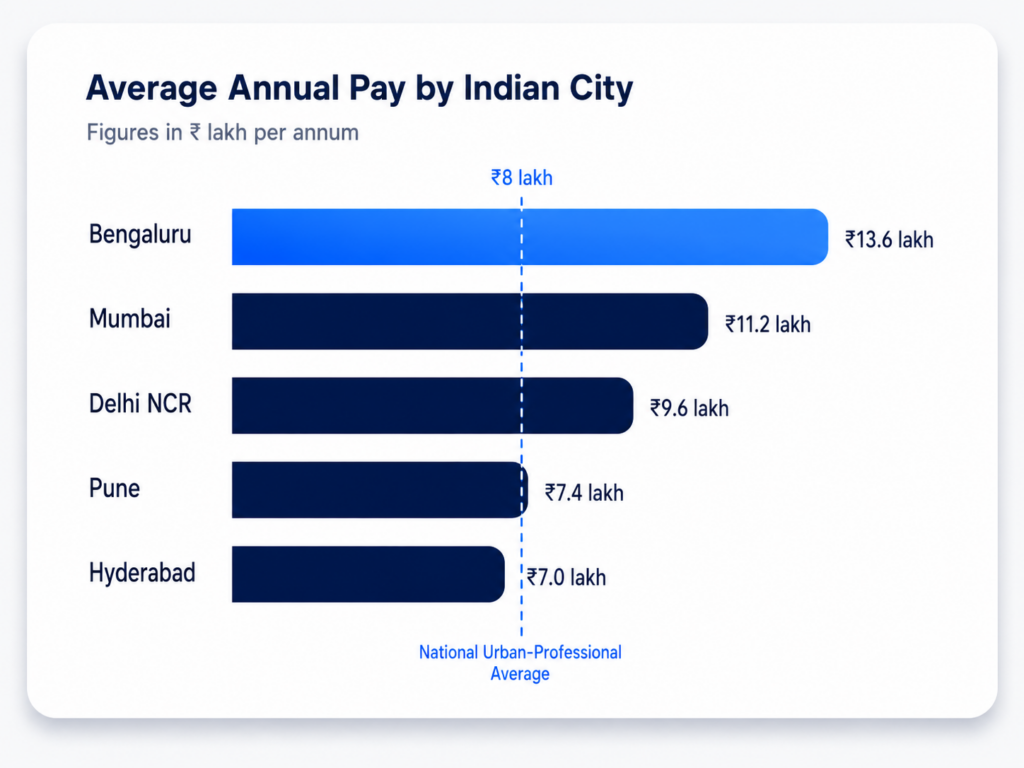
Average salary in India by city
Location is one of the strongest determinants of pay in India. The technology and finance hubs command a 15% to 30% premium over tier-2 cities for comparable corporate roles, driven by the concentration of multinationals and a higher cost base.
Read this table carefully. These are averages across all urban white-collar professionals in each city, spanning every corporate function from operations to engineering. They are not technology salaries. A Bengaluru software engineer earns roughly double these figures, and the role table further down is where you should look for that.
A useful real-world anchor: Peorient’s guide to the best Employer of Record providers in India notes that a mid-level software engineer in Pune earns roughly Rs 12 to 18 lakh a year, which is well above the Rs 7.4 lakh all-professional average for the same city. That is not a contradiction. It is the point. Specific skills and seniority move the number more than geography does.
Average salary in India by industry
Industry shapes pay as sharply as location. Technology, financial services and specialist analytical roles sit consistently above the urban average, while retail, hospitality and administrative roles sit below it.
- Highest paying: information technology, AI and machine learning, data science, cloud and cybersecurity, investment banking, management consulting, specialist medicine.
- Mid band: financial analysis, marketing management, engineering, product roles, chartered accountancy.
- Lower band: customer support, retail, administration, education, entry-level operations. These often carry allowances on top of base pay.
For 2026, Aon projects an average salary increase of 9.1% across India, up from the 8.9% actually delivered in 2025. The projection comes from the 32nd edition of its Annual Salary Increase and Turnover Survey, which analyses more than 1,400 organisations across 45 industries. Real estate and infrastructure and non-banking financial companies are expected to lead. Technology and IT services lag the national average. Aon also reports overall attrition falling to 16.2% in 2025, close to pre-COVID levels, which matters for anyone budgeting replacement cost alongside salary.
The gender pay gap in India
PLFS 2025 shows male regular-salaried workers earning Rs 24,217 a month against Rs 18,353 for women, a gap of roughly 24%. The gap is wider in self-employment and narrower in formal corporate roles. Women’s nominal wage growth is currently outpacing men’s in regular-salaried jobs (7.2% against 5.8%), which slowly closes it. At that differential, and holding everything else constant, the gap would take well over a decade to close.
Average salary in Canada by city
City matters as much as province, because housing cost and industry mix vary sharply within the same jurisdiction. The largest technology and finance markets pay the most, but they also carry the highest rents, which is why a higher Toronto or Vancouver salary does not always translate into a higher saving rate.
The pattern rhymes with India: the headline-leading cities (Toronto, Vancouver in Canada; Mumbai, Bengaluru in India) are not always the best places to actually keep money, because rent claws back much of the premium. For both countries, the smarter comparison is pay net of housing, not pay alone.
Minimum wage in Canada
Canada has no single national minimum wage for most workers. The federal rate, which applies only to federally regulated private-sector workers, is CAD 18.10 an hour in 2026. Each province and territory sets its own floor for everyone else, ranging from about CAD 15.00 in Alberta to CAD 19.75 in Nunavut, with several provinces indexing increases to inflation each year. At minimum wage, a full-time worker earns roughly CAD 3,100 a month, about 55% of the average gross salary. For a country-by-country view of statutory floors, see Peorient’s guide to minimum wage by country.
Average salary in Canada by industry
The highest average weekly earnings cluster in capital-intensive and specialist sectors:
- Utilities: over CAD 2,000 a week, roughly CAD 104,000 a year.
- Mining, quarrying, oil and gas: about CAD 88,000 to 120,000 a year.
- Professional, scientific and technical services: about CAD 83,000 a year.
- Finance and insurance, public administration, and company management: above the national average.
- Retail, hospitality and administration: below the national average, with raises driven largely by minimum-wage adjustments.
Wage growth in 2026 is projected at 3% to 4.5% across most industries, with technology, healthcare and skilled trades running higher (5% to 7%) on the back of persistent labour shortages. That is a far gentler curve than India’s, and it matters for any multi-year budget.
The gender pay gap in Canada
Canada’s gap is narrower than India’s but still present. Across the broad averages, men earn roughly 8% to 11% more than women for comparable work, with the gap narrowing in unionised and public-sector roles and widening in commission-heavy and senior private-sector roles.
Average salary in Canada in 2026
Canada’s wage data is more centralised than India’s, but it has the same average-versus-median trap plus a strong provincial dimension. Here is what the official sources say for 2026.
The official baseline
Statistics Canada publishes wages mainly through the Survey of Employment, Payrolls and Hours. In its March 2026 release, average weekly earnings across all employees were CAD 1,333, up 3.5% from March 2025. Annualised over 52 weeks that is CAD 69,300, or about CAD 5,775 a month. We use CAD 69,300 as the working national average throughout this guide. At mid-July 2026 rates that is roughly Rs 46.4 lakh, or about USD 48,200.
SEPH is built from a census of roughly one million payroll deduction records held by the Canada Revenue Agency, plus a survey of 15,000 establishments and public-sector administrative records. It is the most commonly cited “average Canadian salary” figure and the one behind most international media coverage of Canadian wages.
As in India, the median sits well below the mean. The Canadian Income Survey puts the median individual salary near CAD 56,000, while the Labour Force Survey’s median for full-time workers is about CAD 63,000. The mean is pulled up by high earners in finance, technology, oil and gas, and senior management. When a headline says the average Canadian earns CAD 69,000, it is technically true and it overstates what a typical worker takes home.
Average salary in Canada by province
Provincial economies drive real differences. Alberta leads on the strength of energy and resource extraction, while the territories post high averages that mostly reflect isolation premiums rather than a broad labour market. Nunavut sits nearly CAD 700 a week above Prince Edward Island at the two ends of the range.
Average salary in Canada by city
City matters as much as province, because housing cost and industry mix vary sharply within the same jurisdiction. The largest technology and finance markets pay the most, but they also carry the highest rents, which is why a higher Toronto or Vancouver salary does not always translate into a higher saving rate.
The pattern rhymes with India. The headline-leading cities (Toronto and Vancouver in Canada, Mumbai and Bengaluru in India) are not always the best places to actually keep money, because rent claws back much of the premium. For both countries, the smarter comparison is pay net of housing, not pay alone.
Minimum wage in Canada
Canada has no single national minimum wage for most workers. The federal rate, which applies only to federally regulated private-sector workers, is CAD 18.10 an hour in 2026. Each province and territory sets its own floor for everyone else, ranging from about CAD 15.00 in Alberta to CAD 19.75 in Nunavut, with several provinces indexing increases to inflation each year. At minimum wage, a full-time worker earns roughly CAD 3,140 a month, about 54% of the average gross salary. For a country-by-country view of statutory floors, see Peorient’s guide to minimum wage by country.
Average salary in Canada by industry
The highest average weekly earnings cluster in capital-intensive and specialist sectors:
- Utilities: over CAD 2,000 a week, roughly CAD 104,000 a year.
- Mining, quarrying, oil and gas: about CAD 88,000 to 120,000 a year.
- Professional, scientific and technical services: about CAD 83,000 a year.
- Finance and insurance, public administration, company management: above the national average.
- Retail, hospitality and administration: below the national average, with raises driven largely by minimum-wage adjustments.
Wage growth in 2026 is projected at 3% to 4.5% across most industries, with technology, healthcare and skilled trades running higher (5% to 7%) on the back of persistent labour shortages. The actual SEPH reading of 3.5% for the year to March 2026 sits squarely in that band. It is a far gentler curve than India’s, and it matters for any multi-year budget.
The gender pay gap in Canada
Canada’s gap is narrower than India’s but still present. Across the broad averages, men earn roughly 8% to 11% more than women for comparable work, with the gap narrowing in unionised and public-sector roles and widening in commission-heavy and senior private-sector roles. Against India’s 24%, it is less than half the size.
India vs Canada: the head-to-head comparison
Now we put the two countries on the same axis. First in raw converted numbers, then role by role, then by seniority, and then the important part, adjusted for what the money actually buys.
Nominal comparison: converting like for like
At mid-July 2026 rates (1 CAD is about Rs 67), Canada’s average salary of CAD 69,300 equals about Rs 46.4 lakh. India’s urban-professional average of Rs 7 to 9 lakh equals about CAD 10,400 to 13,400. So in pure exchange-rate terms, a Canadian average salary is roughly 5.8 times an Indian urban professional’s, and about 16 times the all-India regular-salaried average for men.
Those multiples are real, and they are exactly why cross-border hiring into India is so cost-effective for Western companies. They are also only half the story, because they ignore the cost of turning that salary into a life.
Average salary in India vs Canada by role
Aggregate averages hide the roles you actually hire for. The table below gives indicative 2026 ranges for common roles in local currency, with India also shown in Canadian dollars so you can read across the row.
Two patterns stand out. Healthcare shows the widest divide: a Canadian physician can earn ten to twenty times an Indian counterpart, because Canada’s public system pays medical specialists at the top of its wage scale. Technology shows the narrowest, especially once you reach senior or specialist engineering, where a strong Bengaluru or Pune package starts to approach an entry-to-mid Canadian one in nominal terms and matches or beats it on purchasing power.
Average salary in India vs Canada by experience level
Seniority moves pay more than almost any other factor in both countries, but it moves it differently. India’s curve is steeper in percentage terms, so a senior earns a large multiple of a fresher. Canada’s is flatter but starts from a much higher floor.
Two practical implications follow. For Indian professionals, the fastest route to a Canadian-comparable salary is seniority plus a specialist skill (AI, cloud, security, quantitative finance), because the top of the Indian market has risen quickly. For employers, an Indian senior or lead hire can deliver close to Western output at a fraction of a Western senior’s cost, which is the core economic case behind the growth of Global Capability Centres in Pune, Bengaluru and Hyderabad.
The twist: cost of living and real purchasing power
This is the section that turns a one-line headline into an honest comparison. A salary is only as good as what it buys where you spend it, and on that measure the gap between India and Canada is far smaller than the converted numbers suggest.
On Numbeo’s index (New York City = 100), India scores about 22 against Canada’s 66. In plain terms, India is roughly 67% cheaper to live in. Rent drives most of that, and rent is also where this comparison has changed most in the last two years.
The rent story nobody is telling
Canada’s national average asking rent was CAD 2,033 in June 2026, according to the Rentals.ca and Urbanation National Rent Report. That is down 4.3% year on year and marks the 21st consecutive month of annual decline. Rents have now fallen 6.9% over two years to their lowest June level in four years.
This matters more than it sounds. Most India-versus-Canada comparisons still price Canadian housing at 2023 peaks. They are working from a number that has been falling for nearly two years. Canada is getting cheaper to live in, slowly, at the same time as Indian salaries are rising at 9%. Both forces push in the same direction: the real gap is narrowing from both ends.
The honest caveat is that Canadian rents remain out of step with Canadian renter budgets. Rentals.ca’s own Spring 2026 survey found 72% of renters looking for places at CAD 2,000 or less, which is below the national average, and 70% naming high rent as their single biggest challenge. Falling is not the same as affordable.
What this does to the salary gap
Take the nominal multiple of about 5.8 times (Canada average against India urban professional) and deflate it by the cost-of-living ratio. On a like-for-like basket, Canada runs about 3.2 times more expensive than India. The real, purchasing-power gap collapses to roughly 1.8 times.
Put differently: a CAD 3,000 a month lifestyle in Canada is matched by about CAD 960 a month of spending in Bengaluru. The Canadian still comes out ahead on absolute purchasing power and on the ability to save in a hard currency, but the chasm implied by the raw conversion is largely an illusion created by rent and the exchange rate.
The same basket, priced in both countries
Here is the arithmetic behind that 3.2x, using a comparable monthly basket for a single professional. Indian figures are Bengaluru. Canadian figures are the national average.
Canada pays far more on paper and somewhat more in real terms, while India pays far less on paper but offers strong local purchasing power, which is why the comparison rewards employers who hire in India and professionals who weigh take-home lifestyle rather than headline salary.
Software engineer in Bengaluru vs Toronto
Abstract averages only get you so far. Here is one role, end to end, in both markets, so you can see how gross pay, conversion and cost of living interact in a real decision.
Take a mid-level software engineer with about five years of experience. In Bengaluru, a competitive package is around Rs 18 lakh a year. In Toronto, the equivalent runs around CAD 95,000. On paper the Toronto role pays more than three and a half times the Bengaluru one once you convert (Rs 18 lakh is about CAD 26,900). The interesting part is what happens next.
The Toronto engineer still earns and saves more in absolute, hard-currency terms, and has access to Canadian public services and immigration pathways. But the Bengaluru engineer, paying a fraction of the rent and a lighter tax bill, often saves a higher share of income and enjoys a comparable day-to-day standard of living. This is precisely why the question which pays more splits into two honest answers: Canada in dollars saved, India in lifestyle per rupee earned.
Remote work and global pay arbitrage
Remote work is steadily blurring this comparison. A growing number of Indian professionals now earn global or near-global pay scales while living on Indian costs, which lifts the top of the Indian distribution and produces some of the highest effective purchasing power anywhere. For employers, the same dynamic means an India-based remote hire can combine Western-quality output with a cost base that no Canadian salary can match. For professionals, a remote contract paid in Canadian dollars but lived in India is, on purchasing power, frequently the single most lucrative option of all. Whichever side of the table you sit on, the lesson is the same: location of work and location of spending are no longer the same decision, and the salary comparison should follow the money, not the map.
Take-home pay: tax and deductions in both countries
Gross salary is the offer; net salary is the lived reality. The two countries deduct very differently, and the gap on take-home is narrower than on gross because Canada taxes middle incomes more heavily than India does.
India: a low-tax middle, by design
India runs a progressive income tax with an optional simplified regime that most salaried workers now choose. Recent reforms have pushed the effective tax-free threshold up sharply, so a large share of lower-to-middle salaried incomes pay little or no income tax under that regime. Employees also contribute to the Employees’ Provident Fund (a retirement saving, not a pure tax), and high earners face higher slabs. Because exact slabs and rebates change with each Union Budget, confirm the current year’s rates before you model a specific salary.
Canada: federal plus provincial, with payroll contributions
Canada layers a federal income tax on top of a provincial one, so the same gross salary yields different net pay in Ontario, Quebec and Alberta. On a CAD 65,000 to 70,000 salary, take-home typically lands around CAD 4,150 to 4,540 a month depending on province, with Quebec lowest and Alberta among the highest. Employees also pay into the Canada Pension Plan and Employment Insurance, which are deducted at source.
Total cost to employ: the number employers actually budget
Base salary is never the full cost of a hire. Statutory contributions, mandatory benefits and bonuses stack on top, and they differ enough between India and Canada to change a budget materially.
India: statutory on-costs of roughly 15% to 20%
On top of gross salary, an Indian employer typically funds Provident Fund, Employees’ State Insurance where applicable, gratuity and a statutory bonus, which together add roughly 15% to 20% of base pay. India’s statutory bonus is often misunderstood: it is profit-linked and capped, not a guaranteed extra month of salary the way a 13th-month payment works in much of Latin America. Peorient’s explainer on which countries require 13th-month pay covers exactly where that distinction trips up foreign employers, and the full employer costs in India breakdown gives the line-by-line stack.
Canada: CPP, EI and provincial charges
A Canadian employer pays into the Canada Pension Plan (5.95% up to an annual ceiling, plus a second CPP tier above it), Employment Insurance (the employer rate is 1.4 times the employee premium), and, in some provinces, a payroll health levy. On a CAD 75,000 salary, mandatory employer contributions usually add CAD 7,000 to 10,000 a year, before any private health and dental benefits, which most Canadian employees expect on top.
The two budgets, side by side
Beyond base salary: benefits and total rewards
Two offers with the same headline number can be worth very different amounts once benefits are counted. India and Canada bundle non-cash value in almost opposite ways, and missing that is one of the most common mistakes in cross-border comparison.
What an Indian package usually includes
In India, a large share of the total reward is statutory or near-statutory. Provident Fund is a compulsory retirement contribution from both employer and employee, gratuity accrues after five years of service, and Employees’ State Insurance covers medical care below a wage threshold. Above that threshold, employers almost always provide private group health insurance, because public healthcare is thin and employees expect cover for themselves and often their parents.
Paid leave typically runs to a combined 18 to 30 days across earned, casual and sick categories, plus a long list of public holidays that varies by state. The headline figure quoted in offer letters is usually cost to company, which already folds in PF, insurance and bonus, so a Rs 18 lakh CTC is meaningfully less than Rs 18 lakh in the bank.
What a Canadian package usually includes
In Canada, the single biggest benefit is one the employer does not pay for directly: publicly funded healthcare. That removes a cost Indian employers carry and a worry Canadian employees never budget for. On top of salary, employers contribute to the Canada Pension Plan and Employment Insurance, and most add a private health and dental plan, since public cover excludes prescriptions, dental and vision.
Many larger employers match Registered Retirement Savings Plan contributions, typically 3% to 5%. Statutory paid vacation starts at two weeks and rises with tenure, and federal or provincial parental leave is far longer and better funded than India’s, which is one of the most underrated parts of a Canadian offer for anyone planning a family.
What this means if you are hiring
For an employer choosing where to place a role, the comparison is rarely settled by salary alone. The honest decision factors are:
- Talent depth and skill match. India offers a very deep pool in software, data, finance operations and support, with a large English-speaking workforce. Canada offers strong North American market knowledge, time-zone overlap with the United States, and specialist healthcare and resource expertise.
- Time zone and collaboration. Canada overlaps the United States workday; India works well for follow-the-sun coverage and overnight delivery, and increasingly for real-time work via overlapping shifts.
- Total cost, not headline cost. India’s lower base plus 15% to 20% on-costs versus Canada’s higher base plus CPP, EI and benefits. The all-in gap is large, but so is the difference in what each market is best at.
- Speed and compliance. Both markets are governed by layered (central or federal, plus state or provincial) rules. An Employer of Record removes the entity-setup delay in either country.
If you are still deciding between models, Peorient’s overview of international PEO and EOR services explains when each fits, and the country guides above give the local detail for India and Canada.
What this means if you are a professional
If you are weighing an Indian role against a Canadian one, or a remote offer that pays in either currency, four questions matter more than the headline salary
- Start from a verified market range, not a single figure. Use official sources (PLFS for India, Statistics Canada SEPH for Canada) for the baseline, then layer role-specific data for the band that actually applies to the position. A single quoted average hides a range that is often two-fold wide.
- Convert to total cost or total reward. For employers, add statutory on-costs and benefits to reach total cost of employment. For professionals, subtract tax and deductions to reach take-home. Compare those two adjusted numbers, never the two gross numbers.
- Index for cost of living. Apply a purchasing-power adjustment so a rupee salary and a dollar salary are measured by what each buys in the city where it will be spent, not by the exchange rate alone.
- Adjust for growth and currency. Factor in India’s faster annual raises and the rupee’s gradual slide against the Canadian dollar. A lower Indian offer growing at 9% can overtake a higher Canadian one growing at 3% within a working decade in local terms.
Sanity-check against a real peer. Find one person in a comparable role and city and pressure-test your range against their reality. Data sets the average. People reveal the edges.
What are you optimising for? Hard-currency savings, immigration pathways and public services point to Canada. Lower daily costs, family proximity and a fast-rising market point to India.
How to benchmark a salary or an offer between the two countries
Whether you are setting pay for a role or weighing an offer, the same five-step method keeps the comparison honest and stops the headline number from doing all the talking.
- Start from a verified market range, not a single figure. Use official sources (PLFS for India, Statistics Canada SEPH for Canada) for the baseline, then layer role-specific data from job boards for the band that actually applies to the position. A single quoted average hides a range that is often two-fold wide.
- Convert to total cost or total reward. For employers, add statutory on-costs and benefits to reach total cost of employment. For professionals, subtract tax and deductions to reach take-home. Compare those two adjusted numbers, never the two gross numbers.
- Index for cost of living. Apply a purchasing-power adjustment so a rupee salary and a dollar salary are measured by what each buys in the city where it will be spent, not by the exchange rate alone.
- Adjust for growth and currency. Factor in India’s faster annual raises and the rupee’s gradual slide against the Canadian dollar. A lower Indian offer that grows at 9% can overtake a higher Canadian one that grows at 3% within a working decade in local terms.
- Sanity-check against a real peer. Find one person in a comparable role and city and pressure-test your range against their reality. Data sets average; people reveal the edges.
For the employer side of this calculation, Peorient’s guide to calculating employee cost turns these steps into a working budget, and what global payroll covers explains the operational layer underneath it.
Five mistakes people make comparing Indian and Canadian salaries
Most flawed comparisons fail in the same predictable ways. Avoiding these keeps any India-versus-Canada decision grounded in what the money actually does.
- Comparing gross to gross. The headline rupee and dollar figures are the least useful numbers in the comparison. Tax, deductions and statutory benefits differ enough that gross pay tells you almost nothing about what lands in the bank or what a hire truly costs.
- Using the exchange rate as a cost-of-living proxy. Converting Rs 18 lakh to roughly CAD 26,900 and concluding it is a small salary ignores that the same money buys about three times more daily life in India. The exchange rate prices currency, not lifestyle.
- Treating one average as the answer. National averages blend self-employed, casual and salaried workers in India, and span every province and sector in Canada. The relevant number is always the role-and-city band, not the country-wide mean.
- Pricing Canadian rent at its 2023 peak. Canadian rents have declined for 21 consecutive months. Comparisons still quoting peak-era housing costs overstate the Canadian side of the ledger by a meaningful margin.
- Ignoring the two trajectories. Indian pay is rising roughly three times faster annually, while the rupee is sliding against the Canadian dollar. These pull in opposite directions. A comparison that holds both constant will be wrong in both directions at once.
Trends and outlook for 2026 and beyond
- India’s raises keep compounding. Projected increases of 9.1% mean Indian salaries roughly double in local terms over a working decade far faster than Canada’s, narrowing the gap year on year, especially in technology and finance.
- AI is creating a premium tier in India. Senior AI and machine-learning packages already reach Rs 15 to 40 lakh, pulling the top of the Indian market toward Canadian-comparable nominal pay.
- Canadian rents are falling and Canadian wages are rising. Rent down 4.3% year on year while average weekly earnings rose 3.5%. Canadian real disposable income is improving for the first time in years, which partly offsets India’s faster nominal growth.
- Canada’s labour shortages favour healthcare, trades and tech. Targeted immigration and fast-track work permits keep wages firm in these sectors even as overall growth stays moderate.
- Remote work blurs the line. Indian professionals increasingly access global pay scales remotely, which lifts the top of the Indian distribution and complicates any simple country-versus-country comparison.
- The rupee trend matters. A gradually weakening rupee widens the nominal gap even when local Indian pay is rising, which is why purchasing power is the more durable lens.
- Global Capability Centres keep pulling Indian pay up. Multinationals continue moving senior engineering, product and finance roles into India-based GCCs in Pune, Bengaluru and Hyderabad, and those roles are benchmarked against global rather than local bands. This raises the ceiling of the Indian market faster than the national average suggests.
- Indian attrition is stabilising. Aon reports overall attrition down to 16.2% in 2025, close to pre-COVID levels. A cheaper hire that stays longer changes the total cost calculation more than a percentage point of salary does.
Put together, the direction of travel is a slow convergence at the top and a persistent gap at the average. The very best Indian packages are closing on Canadian ones in nominal terms and have already overtaken them on purchasing power, while the typical Indian salary remains well below the typical Canadian one on paper. For anyone making a decision in 2026, the safest reading is to compare adjusted numbers today and to weight India’s faster trajectory if the horizon is a decade rather than a year.
Frequently asked questions
References