Employer of Record Mexico is the most active market in the Americas right now, and 2026 has made it more interesting, not less.
Three big things changed in the first 90 days of the year. The minimum wage jumped 13 percent. The constitutional reform cutting the workweek from 48 to 40 hours took effect on March 3. And a new federal mandate on workplace violence prevention training kicked in on January 15. Each of these reshapes how compliant hiring works on the ground.
If you are a US, Canadian, or European company looking at Mexico right now, you are looking at a country where labor costs are still highly competitive, the talent pool is deep across software, manufacturing, and finance, and nearshoring momentum is real. But you are also looking at one of the most employee-protective labor codes in the Americas, with severance rules that catch new entrants off guard almost every time.
That is the gap an Employer of Record fills.
This guide walks you through the whole picture: what an EOR actually does in Mexico, what it costs in 2026, how the new labor reforms change the math, the top providers, the trade-offs against opening your own entity, and a practical framework for choosing the right partner. It is the same framework Peorient uses when advising clients on Mexico hiring decisions.
What Is an Employer of Record in Mexico?
An Employer of Record, usually shortened to EOR, is a company that legally employs your workers in Mexico on your behalf. You direct the work, decide the pay, and own the relationship with the person. The EOR handles the legal, tax, and administrative side of being the employer of record under Mexican law.
In practice that means the EOR signs the local employment contract, registers the worker with the Mexican Social Security Institute, runs payroll in pesos, files monthly contributions with IMSS, INFONAVIT, and the SAT, and takes care of statutory benefits like Aguinaldo, vacation premium, and PTU profit sharing.
You get a fully compliant Mexican hire without setting up a Mexican entity. The whole point is speed and risk transfer. A new entity in Mexico typically takes three to six months and runs anywhere from 25,000 to 100,000 USD in setup and first-year overhead, before you have hired a single person. An EOR can have your first Mexican employee onboarded in five to ten business days.
How it actually works, in plain language
You find the candidate. You agree on the role, the salary, the start date. You hand the offer details to the EOR. The EOR drafts a Spanish-language employment contract under Mexico’s Federal Labor Law, gets it signed, registers your hire with IMSS, sets them up in payroll, and handles every monthly compliance task from that point forward. Your invoice from the EOR each month bundles the gross salary, statutory employer contributions, and a service fee. That is the full transaction.
Day to day, the worker reports to your team. They use your tools, attend your meetings, hit your goals. They feel like your employee because functionally they are. The EOR exists in the background as a compliance and payroll layer.
EOR vs. PEO: the distinction matters in Mexico
These two terms get used interchangeably online. They are not the same thing, and the difference matters more in Mexico than in most countries.
A PEO, or Professional Employer Organization, operates under a co-employment model. Both you and the PEO are recognized as employers, with shared responsibilities. PEOs are common in the United States. They generally do not work cleanly in Mexico because Mexican law does not recognize true co-employment, and the 2021 outsourcing reform made the structure even harder to use.
An EOR is the sole legal employer. You have no Mexican entity. The EOR carries 100 percent of the employer obligations. This is the model that fits how Mexican labor law is written, and it is what almost every international hiring platform is actually selling when they talk about Mexico.
If you want to go deeper on the structural differences, our breakdown of the EOR vs PEO debate at peorient.com walks through each model and where each one wins.
Why Mexico Is the Hottest EOR Market in the Americas Right Now
Three forces are driving this.
Nearshoring is no longer theoretical
US companies have been moving production and back-office work out of Asia for the better part of a decade. The pace picked up sharply after 2020 and accelerated again with USMCA review pressure heading into mid-2026. The geography is the obvious reason. Same time zones as North America, a shared border, deep manufacturing infrastructure, and a 25-year-old free trade framework that, for now, still works.
The talent pool is the less obvious reason. Mexican universities graduate over 130,000 engineers a year. English fluency in major metros is the highest it has ever been. Salaries for senior software engineers in Mexico City and Guadalajara are typically 40 to 60 percent below their US equivalents at comparable skill levels.
Remote work normalized hiring across borders
If your company already runs distributed teams, hiring a Mexican developer is a smaller leap than it used to be. The infrastructure for paying, managing, and supporting a remote employee in another country is mature. EOR providers turned that infrastructure into a product.
The 2026 labor reforms add real complexity
And complexity is exactly what drives demand for managed compliance services. We will get into the specifics of the 2026 changes in the next section. The short version: anyone trying to handle Mexican payroll without local expertise in 2026 is taking on more risk than the savings justify.
The 2026 Mexico Labor Law Updates Every Employer Must Know
This is the part most generic guides skip. If you are evaluating an EOR for Mexico in 2026, you need to know what changed and why it matters for your costs, your contracts, and your risk exposure.
3.1 The 40-hour workweek constitutional reform
On March 3, 2026, Mexico published a constitutional amendment to Article 123 in the Official Gazette. The amendment reduces the standard workweek from 48 hours to 40 hours and strengthens the right to at least one rest day per six worked. Mexico’s Congress now has 90 days to amend the Federal Labor Law to align with the new constitutional text.
The implementation is gradual. The phased reduction is expected to begin January 1, 2027, dropping to 46 hours, then 44 in 2028, 42 in 2029, and 40 by 2030. Wages will not be reduced. The reform also expands permitted overtime from 9 to 12 hours per week, with double pay applied to those overtime hours.
If you are hiring through an EOR, your provider should already be modeling the cost impact for you. If they are not, that is a signal.
3.2 Minimum wage increase: +13 percent for 2026
CONASAMI approved the new minimum wage on December 3, 2025, effective January 1, 2026.
The applicable zone is determined by where the employer is registered with IMSS, not where the employee physically works. This catches a lot of new entrants. If your EOR is registered in Mexico City and your hire works remotely from Tijuana, the General Zone rate applies. Getting this wrong affects your Salario Diario Integrado calculations and triggers IMSS audit risk.
The headline is misleading on its own. Most professional roles already pay well above minimum, so the direct payroll impact looks small. The indirect impact is larger. Minimum wage feeds into the SDI base, severance caps, the seniority premium ceiling, and several IMSS contribution calculations. A 13 percent move at the floor reverberates through the entire compensation stack.
3.3 Workplace violence prevention training: mandatory from January 15, 2026
On January 15, 2026, a federal decree amending the Federal Labor Law and several other statutes entered force. It requires every employer to provide mandatory training focused on preventing workplace violence and discrimination, with a particular focus on protecting women.
The reform creates a joint employer-employee obligation to maintain violence-free workplaces. Compliant employers need documented training programs, internal protocols for handling complaints, and updated workplace policies. Most established EOR providers in Mexico had compliant programs ready by mid-March.
3.4 SIQAL: the new whistleblower platform
Since September 2025, the Ministry of Labor and Social Welfare has operated SIQAL, a centralized digital platform for filing labor complaints and reporting workplace accidents. Submissions can be anonymous. SIQAL works alongside SIDIL, the Intelligence Data System for Labor Inspections, to centralize enforcement.
In practice, SIQAL submissions frequently trigger extraordinary inspections with minimal advance notice. Documentation needs to be continuously maintained, not assembled reactively when an inspection is announced. This is exactly the kind of obligation that an EOR with real local infrastructure absorbs for you.
3.5 Ley Silla (Chair Law): in effect since December 2025
Ley Silla requires employers in services and commerce sectors to provide rest and seating for workers performing duties while standing. The law extends to industrial settings where feasible. Employers must conduct a risk analysis to determine whether standing work is static, dynamic, or prolonged, and provide back-supported seating accordingly.
If you are hiring office or remote workers, this is mostly background. If you are hiring retail, hospitality, or production roles in Mexico, this is a live compliance issue.
3.6 Outsourcing inspection protocol and REPSE compliance
The federal government implemented a new outsourcing inspection protocol in early 2026 to verify compliance with the 2021 outsourcing reform. The reform restricted personnel outsourcing to specialized services that are not part of the contracting company’s core business and required providers to register on the REPSE registry.
This is why REPSE registration is a non-negotiable item on your EOR shortlist. A provider operating in Mexico without active REPSE registration is a compliance liability. We will return to this in the provider selection section.
The Real Cost of Hiring in Mexico in 2026
There is a wide gap between the salary you offer and what you actually pay. Mexican statutory contributions, mandatory bonuses, and provisions for severance push the fully loaded cost 30 to 45 percent above headline gross salary, depending on salary level, industry risk classification, and state.
Here is the breakdown.
4.1 Statutory employer contributions
Most contributions are calculated on the Salario Base de Cotización, the integrated daily salary registered with IMSS. The SBC includes the daily wage plus the prorated value of mandatory benefits. If you want to dig into how that calculation actually works, the team at PayrollMexico publishes a thorough breakdown of SBC mechanics that aligns with what local CPAs use.
4.2 Mandatory bonuses and benefits
- Aguinaldo (13th-month / Christmas bonus): Minimum 15 days of salary, paid before December 20. Many competitive employers pay 20 or 30 days.
- Vacation premium: 25 percent of the value of vacation days, paid when vacation is taken. Standalone, not optional.
- Vacation days: 12 paid days after one year of service, increasing two days per year up to year five, then plus two days every five years thereafter.
- PTU (profit sharing): 10 percent of company taxable profits distributed by May 30 each year. Half is split equally among employees, half is distributed by salary. Capped at three months of salary or the average of the prior three years’ PTU, whichever is higher.
- Public holidays: Seven federal holidays (eight in election years). Triple pay if worked.
- Maternity leave: 12 weeks paid (six before and six after birth).
- Paternity leave: Five days paid.
4.3 Real-world cost example: a 30,000 MXN per month hire
Take a mid-level professional earning 30,000 MXN per month in Mexico City, low-risk industry classification.
Annually, that 30,000 MXN per month hire costs roughly 504,000 MXN in fully loaded employer cost, against a headline annual salary of 360,000 MXN.
This is before optional benefits like private health insurance, food vouchers, savings funds, or productivity bonuses, which most employers add to compete for talent.
4.4 Severance: the line item every entrant forgets
Mexico does not recognize at-will employment. Termination without cause triggers a substantial mandatory severance package.
For an unjustified termination, an employer owes:
- Constitutional indemnity: Three months of salary, calculated on the Salario Diario Integrado.
- 20 days of salary per year of service, calculated on SDI.
- Seniority premium: 12 days of salary per completed year of service, capped at twice the daily minimum wage.
- Finiquito: Outstanding wages, prorated Aguinaldo, accrued vacation and vacation premium, and any unpaid PTU.
For a mid-level employee earning 35,000 MXN per month with three years of service, total exposure on an unjustified termination can easily reach 200,000 MXN or more. The exposure compounds with tenure. This is why a competent EOR should provision for severance from day one and why companies that opt out of EOR before they are ready to handle Mexican labor disputes regret it.
EOR vs. Setting Up Your Own Mexican Entity
This is the decision that drives the rest of the planning.
Setting up your own Mexican entity, typically an SA de CV or S de RL de CV, gives you full control. You hire directly, you build long-term presence, and once you cross a certain headcount the per-employee cost runs lower than EOR. The trade-off is time, capital, and ongoing compliance burden.
An EOR is the opposite trade-off. Speed, predictable per-employee cost, and full compliance transfer. The trade-off is a recurring service fee per employee and less direct control over employment paperwork.
5.1 The break-even math
The market consensus in 2026 is that EOR is the right model up to roughly 15 to 25 employees in Mexico. The break-even depends on three variables.
The dominant pattern Peorient sees with US and European clients entering Mexico is to start on EOR for the first eight to ten hires, validate the operational model and revenue case for at least 18 months, then evaluate entity setup once the team is committed long term and break-even math turns favorable.
Trying to do this in reverse, opening an entity first and then trying to staff it, is where companies burn capital and time. We have a longer breakdown of the EOR vs. legal entity decision framework on the Peorient blog if you want the full version.
The Top EOR Providers for Mexico in 2026
There are dozens of providers operating in Mexico. The shortlist that consistently shows up in serious procurement processes is shorter than that. Here are the seven we see most often, with the trade-offs that matter.
A note on methodology. Pricing below reflects publicly disclosed monthly EOR rates as of April 2026. Real cost of ownership depends on FX spread, setup fees, offboarding fees, and payment terms, which vary by provider and are flagged where relevant. The companies with the most transparent published pricing are Deel, Remote, and Multiplier. Most others quote case by case.
Deel
Headline rate: From $599 per employee per month (or $499 with annual commitment for new contracts as of early 2026).
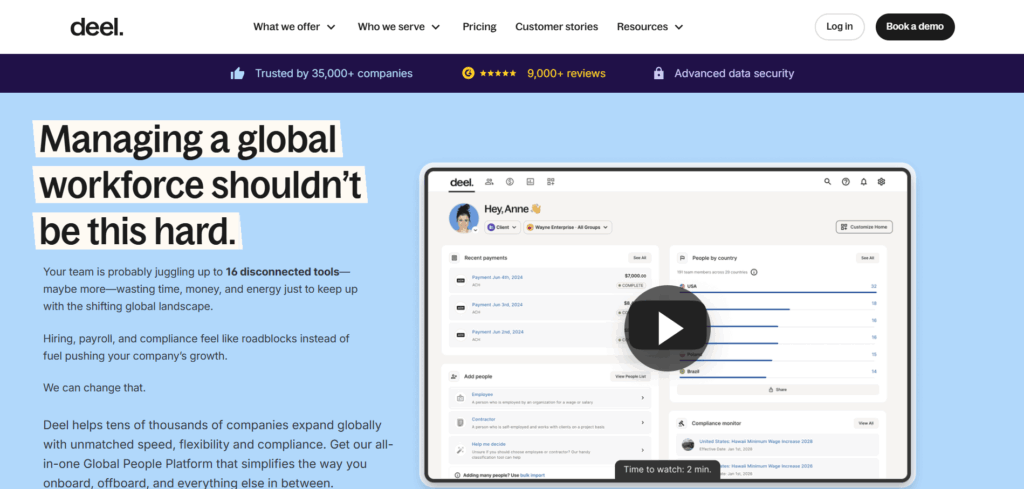
Country coverage: 150+ countries, mix of owned and partner entities.
Why it leads: The most product-driven EOR on the market. Deel’s platform consolidates EOR, contractor management, global payroll, HRIS, IT provisioning, equity, and immigration into a single login. Public API, transparent FX spread (0.5–2 percent disclosed in their help center), and the largest customer base of any provider with over 35,000 companies.
Where it falls short: Onboarding speed has been reported as slower than competitors during peak demand. Deep enterprise compliance audits sometimes still go through Remote or G-P.
Best for: Growth-stage companies that want one platform for global hiring and tooling, not just an EOR.
Remote
Headline rate: $599/month annual ($699/month month-to-month).
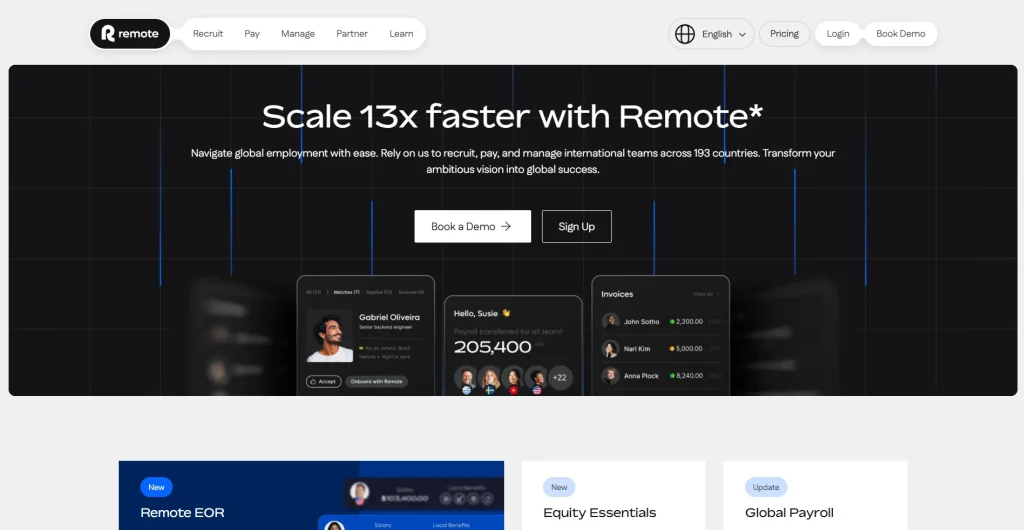
Country coverage: 85+ owned entities, 180+ countries through coverage.
Why it leads: 100 percent owned entities in core markets including Mexico. When your legal team asks who actually employs your worker, the answer is a Remote-owned Mexican subsidiary. No deposit, transparent pricing, free HRIS up to 200 employees.
Where it falls short: Smaller product surface than Deel. Less integrated with IT and equity tooling.
Best for: Compliance-conscious legal teams who prioritize entity ownership over platform breadth.
Velocity Global (now Pebl)
Headline rate: Promotional $399/month, standard $599/month per employee.

Country coverage: 185+ countries, mix of owned and partner entities.
Why it leads: Rebranded as Pebl in September 2025 with a heavier AI positioning. Strong in M&A integration, immigration alongside EOR, and unusual-market coverage. Long operational history in Mexico.
Where it falls short: Less transparent pricing. Third-party analyses report setup fees of $500–2,000 per employee, offboarding fees of $500–1,000 per employee, and FX markups in the 2–5 percent range, which add meaningful total cost of ownership versus competitors at the same headline rate.
Best for: Enterprise buyers with M&A or immigration needs adjacent to EOR, where the depth justifies the premium.
Globalization Partners (G-P)
Headline rate: Quote-based, generally $999–1,200+ per employee per month.

Country coverage: 180+ countries with 125+ owned entities.
Why it leads: The original EOR. Deepest enterprise compliance posture, most legally conservative interpretation of local law in audited markets, and the longest track record. Mexican operations are mature and well staffed.
Where it falls short: The premium pricing is real and the platform UX is dated next to Deel and Remote.
Best for: Fortune 1000 buyers and regulated industries (financial services, pharma, defense) where audit defense matters more than price.
Papaya Global
Headline rate: From $650 per employee per month.
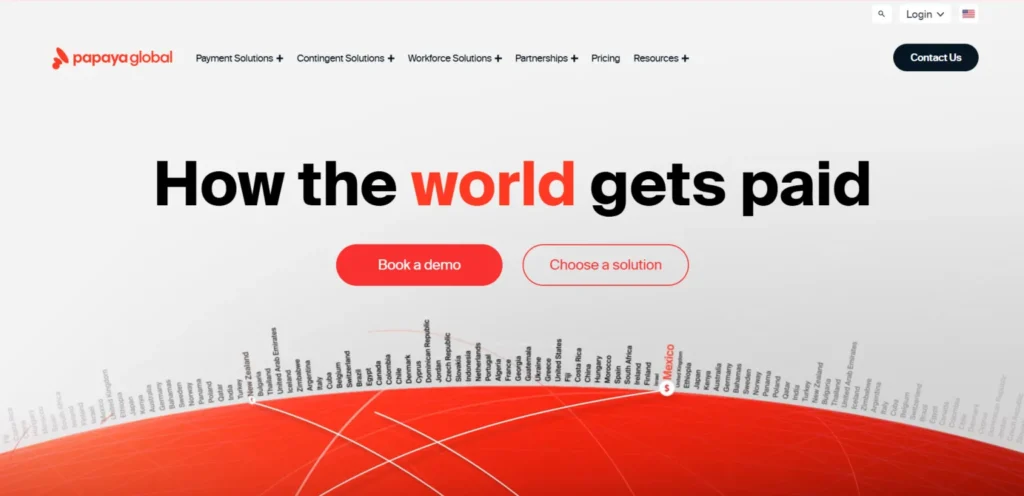
Country coverage: 160+ countries.
Why it leads: Strongest payroll analytics layer of any EOR. Built to support global payroll consolidation across owned entities and EOR coverage simultaneously, which is rare.
Where it falls short: Heavier product than smaller teams need. Onboarding is more involved.
Best for: Mid-market and enterprise companies running hybrid models with both owned entities and EOR coverage.
Multiplier
Headline rate: Flat $400/month per employee.

Country coverage: 150+ countries.
Why it leads: Best flat-rate value on the market. Simple pricing, no setup fees, fast onboarding. Solid Mexico coverage with local payroll experts on staff.
Where it falls short: Smaller product footprint than Deel. Less brand recognition with conservative legal teams.
Best for: Cost-sensitive growth-stage companies that want a clean, predictable monthly bill.
Remofirst
Headline rate: From $199 per employee per month.

Country coverage: 185+ countries via partner network.
Why it leads: Cheapest credible option in 2026. Predictable pricing, low setup friction, useful for very small teams or budget-constrained startups.
Where it falls short: Partner-entity model means more variability in local execution quality. For complex Mexican compliance issues, the response time and depth do not match Deel, Remote, or G-P.
Best for: Bootstrapped startups making one or two hires in Mexico where price is the binding constraint.
Side-by-side: 2026 EOR provider comparison for Mexico
If you want a deeper, side-by-side comparison of any two of these on Mexico-specific criteria, our provider comparison library at peorient.com/eor-providers covers head-to-head analyses including total cost of ownership models, FX spread analysis, and onboarding speed benchmarks.
How to Choose Your EOR Provider for Mexico
Headline price is the worst way to pick an EOR. We have seen too many companies optimize for the cheapest monthly fee and lose more than the savings on FX spread, onboarding delays, or compliance gaps. Here is the nine-point checklist Peorient uses with clients.
1. REPSE registration and Mexican entity ownership
Ask the provider directly: are you REPSE-registered, and do you employ workers through a Mexican entity you own, or through a local partner? Owned entities give you a cleaner audit trail. Partner-network providers can still work, but you want full transparency on who actually signs the contract and runs payroll.
2. Total cost of ownership, not headline price
Build a 12-month total cost model that includes the monthly fee, FX spread on payroll funding, setup fees, offboarding fees, immigration support if needed, and any add-on tooling (HRIS, expense, equity). On a 100,000 USD annual salary, a 2 percent FX spread alone is a 2,000 USD difference. Get FX markup quoted in writing.
3. Mexico-specific local expertise
Ask who handles your Mexican payroll questions. Is it a generalist customer success rep with a script, or a Mexico-based labor law specialist? Ask for the time-to-resolution benchmark on Mexican-specific compliance issues. The answers differ widely.
4. Onboarding speed
Top-tier providers can onboard a Mexican hire in 5 to 10 business days. Expect 3 to 7 days for the IMSS registration alone. Ask for an onboarding SLA in writing, and ask what causes delays. Missing tax ID (RFC), missing CURP, or address verification issues are the usual culprits.
5. Severance and termination handling
This is where weaker providers leak money. Ask how the provider funds severance: do they require pre-funding, do they bill on termination, or do they roll severance accruals into your monthly invoice? Ask who calculates and pays the seniority premium, the constitutional indemnity, and the finiquito.
6. Mandatory benefits administration
Aguinaldo, vacation premium, and PTU each have specific timing and calculation rules. PTU in particular is complex because it is tied to the EOR’s Mexican entity profitability, not yours. Ask the provider exactly how they handle PTU for clients and whether you owe anything beyond the standard contributions.
7. CFDI compliance and SAT integration
Mexican payroll requires electronic invoices (CFDI) issued through the SAT system. This is non-negotiable and any working EOR has it covered, but ask to see the actual issued document to confirm formatting and timing match standards. New entrants sometimes cut corners here.
8. Currency and payment options
Most providers fund in USD, EUR, or GBP and pay employees in MXN. Ask what currencies you can fund in, what the spot vs. contract FX rate is, and whether the employee gets a stable MXN payout regardless of FX swings on the funding side.
9. References from current Mexican clients
Always ask for two or three references from clients with Mexican hires, not generic references from any country. Mexico operations differ enough from European or Asian operations that a glowing reference from a UK client tells you almost nothing about Mexico-specific delivery.
The 30-Day Onboarding Timeline
Here is what a clean Mexico EOR onboarding actually looks like, week by week, when both sides do their part.
Week 1: Setup and contracting
- Master Services Agreement signed between you and the EOR provider.
- EOR provides Spanish-language employment contract template aligned with Mexico’s Federal Labor Law.
- You provide candidate details: full legal name, RFC (tax ID), CURP, address, bank details, salary, role, start date.
- EOR drafts the offer letter and contract. Candidate reviews and signs.
Week 2: Registration
- EOR registers the new hire with IMSS within five business days of the start date (legal maximum).
- INFONAVIT and SAR registrations follow.
- State payroll tax registration if not already in place for that location.
- CFDI payroll setup, integration with SAT.
Week 3: Onboarding and first payroll cycle
- Hire receives EOR welcome materials, benefits enrollment, and tax forms.
- First payroll cycle prepared. Provider issues you the funding invoice (gross salary + employer contributions + service fee).
- You wire the funding.
- Hire receives first MXN payout.
Week 4: Steady state
- Monthly cycle becomes routine.
- Aguinaldo, vacation, and PTU accruals begin tracking automatically in the EOR system.
- Quarterly compliance review with your account manager.
Real-world friction usually comes from the candidate side, not the EOR. The most common delay is the candidate not having a current CURP or having an outdated address on file with the SAT. A good EOR will flag these on day one and help the candidate resolve them.
The Five Pitfalls That Sink Mexican EOR Engagements
Pitfall 1: Misclassifying employees as contractors
This is the single biggest risk in Mexican hiring. If you have a worker performing core business functions, on a regular schedule, taking direction from your team, that person is an employee under Mexican law regardless of what the contract says. Misclassification triggers retroactive IMSS contributions, penalties, and labor board exposure.
If you are weighing contractor vs. employee, our deep dive on employee versus contractor classification covers both US and Mexican rules in 2026.
Pitfall 2: Underbudgeting fully loaded cost
The 30 percent markup rule of thumb is wrong for Mexico. Use 40 to 45 percent. Add a severance provision from day one. Budget for PTU separately as a May lump sum, not a monthly accrual.
Pitfall 3: Ignoring the seniority premium
The seniority premium of 12 days per year of service applies to most terminations and accumulates regardless of cause. Companies that plan headcount as if seniority cost is zero get surprised when long-tenured employees move on.
Pitfall 4: Mishandling termination paperwork
Mexican law requires written termination notice (aviso de rescisión) at the moment of termination or within five business days. If you fail to deliver it correctly, even a clearly justified termination becomes legally unjustified, and full constitutional severance applies. Always run terminations through your EOR’s legal team.
Pitfall 5: Choosing the cheapest provider for a complex hire
Budget providers work for straightforward, single-employee hires. They struggle with edge cases: cross-border equity grants, multi-state hires, executives with complex compensation, terminations at scale. If your situation is anything other than vanilla, pay for a provider with real Mexican operations.
What’s Coming Next: 2026–2027 Outlook
A few items on the regulatory horizon worth tracking.
- USMCA review on July 1, 2026: The North American trade framework comes up for scheduled review. Labor and energy commitments are the focal areas. Outcomes could affect automotive, technology, and any sector that relies on cross-border supply chains.
- 40-hour workweek operational rollout: First reduction (to 46 hours) takes effect January 1, 2027. Updates to attendance tracking systems must be in place by that date.
- Pension contribution increases: Employer SAR/AFORE contributions are scheduled to keep rising under the multi-year reform path, reaching approximately 10 percent by 2030.
- Expanded family leave: Mexico’s legislative agenda includes likely expansions to maternity and paternity leave, plus mental health and medical examination leave. None final yet, but probable within the 2026–2027 window.
- Stricter outsourcing inspections: Federal enforcement intensity is rising. Working with a non-REPSE-registered provider in 2026 is a meaningful risk.
Where to Hire in Mexico: Cities, Talent, and Salaries
Mexico is not a single labor market. Salary expectations, talent depth, and infrastructure vary sharply by city, and the right hiring location for your role depends on what you are building.
Mexico City (CDMX)
The largest talent pool in the country and the deepest market for senior roles across software engineering, finance, marketing, and management. CDMX is where you find people who have already worked at multinationals and global startups. Salaries run 15 to 25 percent above the national average. State payroll tax in CDMX is 4 percent, the highest in the country, which adds to fully loaded cost. CDMX is the default for headquarters-style roles.
Guadalajara
Mexico’s answer to Silicon Valley. Strong engineering and product talent, dense tech ecosystem, mature relationships with US tech companies. Salaries are 10 to 15 percent below CDMX for comparable roles, with similar talent quality in software and hardware engineering. Lower state payroll tax. Guadalajara is the most popular city for nearshore engineering teams in 2026.
Monterrey
Industrial heartland. Strong in manufacturing, supply chain, financial services, and B2B sales. Salaries trend higher than Guadalajara for senior commercial and operations roles, on par with CDMX in finance. Monterrey’s proximity to the US border makes it a logical fit for any role with cross-border coordination needs.
Mexicali, Tijuana, Ciudad Juárez
The Northern Border Free Zone. Higher minimum wage (440.87 MXN per day), strong manufacturing base, and dense maquiladora infrastructure. If you are hiring production, logistics, or hardware roles tied to US supply chains, the border cities are where the depth is.
Mid-tier and emerging cities
Querétaro, Puebla, Aguascalientes, Mérida, and León have all developed credible secondary tech and operations talent pools in the past five years. Salaries can be 20 to 35 percent below CDMX with comparable mid-level talent in some specialties. Talent depth at the senior level is thinner. These cities are most useful when you have a clear role profile and can wait a bit longer to find the right candidate.
Salary benchmarks: 2026 ranges for common roles (Mexico City)
These ranges reflect base salary only, before bonuses, equity, and the 40 to 45 percent fully loaded cost markup. Bilingual English-Spanish roles typically command a 15 to 25 percent premium over Spanish-only equivalents at the same level.
Converting Mexican Contractors to EOR Employees
This is one of the most common reasons companies first call Peorient. You have been working with a Mexican contractor for six months, two years, sometimes longer. The relationship is working, the contractor is effectively a full-time team member, and now your legal or finance team is asking whether the structure holds up under audit. Almost always, the honest answer is no.
Why contractor classification fails in Mexico
Mexican law applies a substance-over-form test. If the worker performs core business functions, on a regular schedule, under your direction, with company tools or systems, the relationship is an employment relationship regardless of what the contract says. Article 20 of the Federal Labor Law defines this as subordinación. Where subordinación exists, the worker is an employee.
The 2021 outsourcing reform tightened enforcement significantly. The SAT now actively reviews contractor invoices for indicators of employment, including consistent monthly amounts that do not vary with deliverables, full-time hours, exclusivity, and use of company email or tools. The risk is real and growing in 2026.
What misclassification actually costs
If a Mexican labor court or SAT audit reclassifies a contractor as an employee, the employer faces:
- Retroactive IMSS contributions covering the entire engagement (typically 25 to 30 percent of total payments made).
- Retroactive INFONAVIT and SAR contributions.
- Income tax withholding obligations the company should have handled.
- Penalties and interest on all unpaid contributions, often 50 to 100 percent of the unpaid amount.
- Full statutory severance if the relationship is terminated, calculated on the reclassified employment terms.
- Potential claim for retroactive Aguinaldo, vacation premium, and PTU.
On a 12-month engagement at 50,000 MXN per month, total exposure on reclassification can run 400,000 to 700,000 MXN, depending on tenure, severance posture, and penalties.
How EOR conversion works in practice
When done correctly, the conversion is clean and low-friction. Here is the sequence:
- Document the existing contractor agreement and termination point. The contractor relationship ends formally on a defined date, typically the last day of a calendar month.
- The EOR drafts a Spanish-language employment contract for the same person. Salary, role, and start date align with what the contractor was already earning, adjusted for the cost differential between contractor and employee structures.
- The new hire signs the employment contract. The EOR registers them with IMSS within five business days of the new start date.
- Payroll, benefits, and statutory contributions begin under the EOR structure. The contractor relationship is closed, the new employment relationship begins.
The cost adjustment is the trickiest part of the conversation. A contractor earning 50,000 MXN per month is not equivalent to an employee earning 50,000 MXN per month. The contractor was responsible for their own taxes and benefits. To preserve the worker’s take-home pay roughly equivalent, the gross employment salary needs to come down to about 35,000 to 40,000 MXN, with the rest of your prior contractor budget redirected to statutory contributions and benefits. A good EOR will model this for you and present a transparent comparison so the worker understands what is changing and why.
A Real-World Scenario: How Peorient Approaches a Mexico Build-Out
Ready to Hire in Mexico?
If you have read this far, you are probably weighing a real decision. Mexico is a strong market in 2026, the EOR ecosystem is mature, and the 2026 reforms make managed compliance more valuable than ever. But the gap between picking the right provider and the wrong one is large, and the right answer depends on your headcount, your timeline, your risk tolerance, and a dozen smaller variables.
That is exactly the conversation Peorient was built for.
Frequently Asked Questions