How to Vet EOR Service Providers: An Expert Checklist
EOR service providers help companies hire and pay employees in foreign markets without setting up local entities. They manage payroll, compliance, benefits, tax filings, visas, and HR admin, enabling seamless global workforce expansion.
- January 5, 2026
How to Vet EOR Service Providers: An Expert Checklist
EOR service providers help companies hire and pay employees in foreign markets without setting up local entities. They manage payroll, compliance, benefits, tax filings, visas, and HR admin, enabling seamless global workforce expansion.
- January 5, 2026

The global talent market has broken down traditional borders. This change lets businesses hire the best candidates, no matter where they are. However, it brings a challenge: understanding international labor laws, payroll rules, and benefits.
Employer of Record (EOR) service providers are crucial in this new work landscape. But with so many options available, making the right choice is vital. The right EOR partner ensures compliance, smooth operations, and happy employees. Picking the wrong one can lead to legal issues, hidden costs, and damage to your reputation.
This guide helps you vet EOR service providers. It focuses on what truly matters.
Most EORs handle legal employment and payroll after hiring a candidate. They usually don’t manage initial talent sourcing. For that, companies often use specialized recruitment agencies. To learn more about this process, check out.
Why Vetting EOR Service Providers is Critical for Global Expansion
Choosing an EOR is more than just finding a vendor; it’s key to a company’s global growth. The right EOR acts as an extension of your HR and legal teams. They follow local laws. This helps create a good experience for international employees. A poor choice can lead to issues like incorrect payroll, non-compliant contracts, and a lack of employee benefits. These problems can cause legal disputes and high employee turnover. The EOR is legally responsible for your workforce. So, it’s important to vet thoroughly to avoid financial and legal risks.
What to Look For: The Key Pillars of a Great EOR Partner
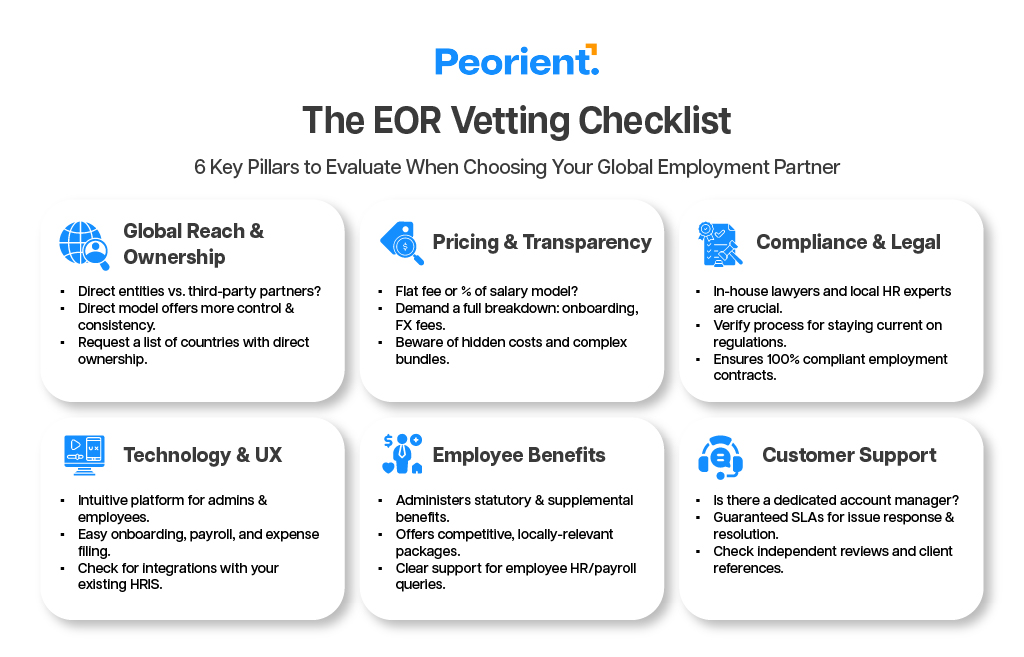
A structured evaluation process helps separate top EOR providers from the rest. Use this checklist for your discovery calls, RFPs, and provider comparisons. This framework helps you check operational strength, legal skills, and tech abilities. It ensures your choice fits both short-term and long-term needs.
The Ultimate EOR Provider Vetting Checklist
Effective evaluations require specific questions to uncover a provider’s capabilities. This checklist helps you see beyond the sales pitch.
1. Global Reach & Ownership Model
The key aspect of an EOR provider is how it operates in target countries. There are two main models: direct (owned-entity) and indirect (partner-dependent). A direct model means the provider owns legal entities in each country. This offers better control, accountability, and data security.
On the other hand, the indirect model relies on third-party local providers. This helps us reach many countries quickly. However, it might lead to uneven service quality and delays in communication. Request a list from potential providers. Include the countries where they have entities and where they use partners. This distinction is key for assessing risks. This is especially true in regions with complex data privacy laws, such as the EU’s GDPR.
2. Pricing Structure & Transparency
EOR pricing usually has two types: a flat fee per employee each month or a percentage of total pay. A flat fee helps with clear budgeting. On the other hand, a percentage model might save money for lower-salaried roles. However, the initial price doesn’t tell the whole story.
Request a detailed breakdown of all costs. This should cover onboarding fees, termination fees, currency exchange markups, and any deposits needed. Clarify what the base fee covers. Are statutory benefits included, or are they charged separately? Lack of pricing transparency is a major red flag and can lead to unexpected costs. A thorough cost analysis is vital in any EOR evaluation.
3. Compliance & In-Country Legal Expertise
The core value of an EOR is reducing compliance risks. This depends on its local legal and HR expertise. Ask if the provider employs in-house legal and HR experts in each country. These specialists can navigate local labor laws and changes effectively.
Also, understand how the provider creates and updates employment contracts. How do they ensure compliance with local laws? How do they handle changes in regulations related to termination or employee leave? A top EOR will have a proactive approach to HR compliance, backed by local expertise. Organizations such as the International Labour Organization (ILO) set global standards. These standards help shape local labor laws.
4. Technology Platform & User Experience
A modern EOR service uses a technology platform for both employers and employees. The platform’s quality affects operational efficiency and user satisfaction. For employers, it should be easy to onboard new hires, manage payroll, and access reports. It should connect with current systems, such as HRIS or accounting software, using an API. This integration keeps employee data accurate and streamlines HR tasks.
Employees should easily access payslips and manage their personal info on the platform. A difficult-to-use platform can frustrate employees and harm the employer’s image. Security is crucial. The provider must demonstrate strong data protection practices to keep sensitive information safe.
5. Employee Benefits & Support
To attract and keep top talent, competitive and relevant benefits are essential. Assess an EOR’s ability to offer benefits beyond the legal minimum. Look at the quality of health insurance, retirement contributions, and other perks. The provider should benchmark these against local market standards to ensure competitiveness.
The employee experience matters too. What is the onboarding process like? Who do new hires contact for HR or payroll questions?
A good support experience increases employee engagement and retention. So, it’s important to understand this in your evaluation.
6. Customer Service & Support Model
When issues arise, quick and effective customer support is crucial. Clarify the EOR’s support structure. Is there a dedicated account manager who knows your needs? Or is support handled by a general ticketing system?
Inquire about Service Level Agreements (SLAs) for response and resolution times. These agreements set measurable quality standards. Beyond promises, check third-party reviews and seek customer testimonials about support quality. Frequent complaints about payroll errors or slow responses are serious warning signs.
Red Flags to Watch For When Choosing an EOR
Watch for signs of issues with an EOR provider during the vetting process. Vague pricing models without a clear breakdown can hide costs. A provider’s hesitance to clarify if they work directly or with partners in key markets may indicate a lack of control. Be careful of user reviews that talk about payroll mistakes, compliance problems, or slow support. These are big red flags. Finally, high-pressure sales tactics pushing for long-term contracts can also be concerning.
Simplify the Search with Independent EOR Advisory
Doing this level of due diligence on many EOR service providers takes a lot of time and resources. Looking at pricing models, operational structures, and service levels can confuse even skilled HR teams.
Engaging an independent EOR advisory firm can streamline this entire process. An advisor handles the tough work of market research and provider vetting. They use their industry knowledge to make a shortlist of the best partners. This list matches a company’s needs, like target countries, employee count, and budget.
Peorient gives clear, data-driven recommendations and side-by-side comparison reports. This takes the guesswork out of your decisions. This approach helps businesses choose wisely and quickly. It ensures their global expansion is strong and meets all rules.
Frequently Asked Questions
-
What is the main difference between EOR service providers?
The main differences are in:
- Ownership model (direct vs. indirect)
- Pricing transparency
- Quality of the technology platform
- Depth of in-country legal and HR expertise
Some providers do well in certain areas or have better benefits. So, the "best" choice depends on what a company needs.
-
How much do Employer of Record services typically cost?
Costs vary widely. They usually have a flat monthly fee per employee, from $300 to over $1,000. Alternatively, they may charge a percentage of the employee's monthly salary, often between 10% and 20%. The final cost varies by country, needed services, and the provider's pricing model.
-
Can an EOR provider help with employee visas and work permits?
Yes, most EOR service providers handle visa and work permit sponsorship and processing. The level of support and costs can vary. So, it’s important to check each target country. Immigration laws are very specific.
-
What's the difference between an EOR and a PEO?
An Employer of Record (EOR) hires employees on behalf of a client company in a country where the client has no legal entity. A Professional Employer Organization (PEO) shares employment responsibilities with a client. It's often used in countries where the client has a registered legal entity. The key distinction is the need for a local entity.
-
How long does it take to onboard an employee through an EOR?
The timeline can range from a few days to several weeks. It depends on the country's rules, the contract's complexity, and how well the EOR provider handles onboarding. Countries with simple labor laws help companies hire faster than those with complex rules.
Understanding EOR Payroll: A Step-by-Step Guide for Businesses
EOR payroll enables companies to pay international employees compliantly through an Employer of Record without setting up a local entity.
-

Top HRIS Companies of 2026: An Advisor’s Guide
March 12, 2026 -

The Top Remote.com Alternatives: An Unbiased 2026 Review
March 9, 2026 -

Employer of Record France: Reviewed in 2026
February 16, 2026 -
Employer of Record China: Reviewed in 2026
January 20, 2026