Compare the average salary in India vs USA in 2026 with real data on wages, PPP, taxes, and living costs. Discover what the salary gap truly means for hiring, relocation, and savings.

Almost every Indian family has had the dinner table conversation. A cousin took a job in the US, the salary sounds enormous in rupees, and suddenly everyone at home feels underpaid. The number is real. What it buys is a completely different question.
Salary comparisons between India and the United States get distorted in two opposite directions. One camp multiplies a US package by the exchange rate and declares that Americans are rich beyond reason. The other camp waves it all away with purchasing power parity and insists a modest Indian salary is secretly equal to a six-figure American one. Both are partly right and mostly misleading.
This guide settles it with current data rather than vibes. We pull from the US Bureau of Labor Statistics, India’s Periodic Labour Force Survey, World Bank purchasing power figures, and 2026 salary surveys, then we translate the numbers into the two decisions people actually care about: where a company should hire, and whether a professional should chase a relocation.
If you run a company, the short version is that India offers world-class talent at a fraction of US payroll, provided you handle compliance correctly. Peorient is an independent EOR and PEO advisory that helps global employers do exactly that, so we have watched these comparisons play out across hundreds of real hiring decisions. If you are a professional, the short version is that the dollar figure is only the start of the story, and the savings rate is where the truth lives.
The US mean wage in 2026 sits near $66,000 a year; the US median for full-time workers is around $62,000. India's averages range from about ₹4 lakh to ₹9 lakh a year, depending on the dataset used.
Converted at the market rate of roughly ₹94 per dollar, US pay looks 10 to 15 times higher for comparable roles.
Adjusted for purchasing power parity — about ₹20 to one international dollar — the real gap shrinks to roughly 2 to 3 times.
For a software engineer, the nominal gap is the widest of all, often 10x or more, which is one reason global hiring in India keeps growing.
For employers, the headline salary is only 60 to 70 percent of the true cost of employment once benefits, statutory contributions, and compliance are added.
Here is the direct comparison most people are searching for. The US figure is many times the Indian figure in absolute dollars, but the everyday cost of living in India is far lower, which is why the lived experience of the two salaries is closer than the raw numbers suggest.
| Metric (2026) | India | United States |
|---|---|---|
| Average (mean) annual salary | ₹7 to ₹9 lakh ($7,400 to $9,500) | ~$66,000 |
| Median annual salary | ₹5 to ₹6 lakh ($5,300 to $6,400) | ~$62,000 |
| Typical urban professional | ₹55,000 to ₹75,000 / month | $4,500 to $6,500 / month |
| Minimum wage | No single rate, state floors ~₹5,300+/mo | Federal $7.25/hr, many states higher |
| Market exchange rate | ₹1 ≈ $0.0106 | $1 ≈ ₹94 |
| PPP conversion | ~₹20 to 1 international dollar | $1 to 1 international dollar |
| Forecast salary hike | ~9.1% (Aon, 2026) | ~3.5% to 4% (wage growth) |
Figures are blended from BLS, PLFS 2025, Glassdoor, Aon, and 2026 salary surveys. India numbers vary widely by source because of a large informal economy and uneven income distribution; read the next section before quoting any single figure.
Before comparing two countries, you have to understand that the word average hides two very different numbers, and the gap between them tells you how unequal a labour market is.
The mean adds every salary together and divides by the number of earners. A handful of very high earners drags it upward. The median is the salary of the person standing exactly in the middle of the line. Half earn more, half earn less. The median is almost always the more honest picture of a typical worker.
In the US the two numbers are close enough that either works for a rough comparison. The mean across all occupations is near $66,000 and the median for full-time workers is around $62,000, a gap of only a few thousand dollars. In India the two numbers diverge dramatically. A small population of technology, finance, and senior corporate earners pulls the mean far above the median, so the mean can read like ₹7 to ₹9 lakh while the median sits closer to ₹5 to ₹6 lakh, and the all-worker median (including informal labour) collapses to a fraction of that.
Many viral India versus US comparisons quietly swap the US median against the Indian mean, or compare a US base salary against an Indian total CTC. Always compare like with like: mean to mean, median to median, base to base. The rest of this guide labels every figure so you can do that.
India does not have one average salary, it has several, and the right one depends on who you are counting. The most authoritative government source is the Periodic Labour Force Survey (PLFS), published by the Ministry of Statistics and Programme Implementation. Its 2025 annual report put average monthly earnings for regular wage or salaried workers at about ₹24,217 for men and ₹18,353 for women.
That national figure includes everyone from a factory supervisor in a tier-3 town to an entry-level clerk, which is why it sits well below what most readers of this guide will recognise. The segment that global employers actually hire from, urban professionals in technology, finance, consulting, and corporate roles, typically earns ₹55,000 to ₹75,000 a month, and senior specialists earn multiples of that. The distance between the national salaried average and the urban professional average is roughly 2.5 times, and that single fact explains most of the confusion in India salary debates.
Location is the single biggest swing factor inside India. A metro tech hub can pay several times what a tier-3 town pays for the same job title, driven by cost of living, the density of multinational employers, and competition for talent.
| City tier | Examples | Typical monthly salary (professional roles) |
|---|---|---|
| Tier 1 metros | Bengaluru, Mumbai, Hyderabad, Delhi NCR, Pune | ₹50,000 to ₹1,20,000+ |
| Tier 2 cities | Jaipur, Indore, Chandigarh, Kochi, Coimbatore | ₹30,000 to ₹60,000 |
| Tier 3 and towns | Smaller district centres | ₹20,000 to ₹40,000 |
Industry is the other dominant lever. Technology, financial services, and specialised professional fields anchor the top of the pay scale, while construction, hospitality, and retail support sit lower.
| Industry | Indicative average annual salary |
|---|---|
| Legal and law enforcement | ₹8 lakh to ₹10 lakh+ |
| Information technology | ₹8 lakh+ |
| Banking, finance, insurance | ₹7.8 lakh+ |
| Sales and marketing | ₹6.7 lakh+ |
| Healthcare and pharma | ₹6.5 lakh+ |
| Engineering | ₹5.3 lakh+ |
| Food services and retail support | ₹4.2 lakh to ₹4.4 lakh |
Experience moves salaries in India faster than almost anywhere else, partly because demand for proven talent outstrips supply at the senior end. A fresher and a ten-year veteran in the same function can sit a full order of magnitude apart, which is another reason a single national average tells you so little.
| Experience | Typical annual salary (professional roles) |
|---|---|
| Fresher (0 to 2 years) | ₹3 lakh to ₹6 lakh |
| Early career (2 to 5 years) | ₹6 lakh to ₹12 lakh |
| Mid-career (5 to 10 years) | ₹12 lakh to ₹22 lakh |
| Senior (10+ years) | ₹22 lakh to ₹45 lakh+ |
India remains one of the fastest-rising salary markets in the world. Aon’s 2025 to 2026 survey of more than 1,400 organisations projects an average 9.1 percent salary increase in 2026, with non-bank lenders and real estate leading, and technology consulting trailing. Experience compounds quickly: a fresher might start at ₹3 to ₹6 lakh, a mid-career professional at ₹8 to ₹15 lakh, and a senior specialist or architect well into the ₹20 to ₹45 lakh range.
India has no single national minimum wage. Each state sets its own rates by skill category and industry, layered on top of a central floor. The result is a patchwork that can range from roughly ₹5,300 a month at the low end to well above ₹20,000 in higher-cost states for skilled work. The bigger 2026 story is structural: India’s four Labour Codes came into force on 21 November 2025, repealing dozens of older laws and introducing a uniform wage definition that pushes basic pay to at least 50 percent of total cost to company. For any employer, that changes how salaries must be structured, not just how much they cost.
The United States has cleaner, more centralised wage data than India, mostly because a far larger share of the workforce is formally employed. The Bureau of Labor Statistics is the gold standard. Its Occupational Employment and Wage Statistics put the mean annual wage across all occupations near $66,000, while its quarterly earnings report shows median weekly earnings for full-time workers of about $1,194 to $1,233, which works out to roughly $62,000 a year.
US earnings follow a clear arc. Pay climbs steeply through the twenties and thirties, peaks in the mid-forties to mid-fifties, then eases near retirement.
| Age band | Median weekly | Approx. annual |
|---|---|---|
| 16 to 19 | $648 | $33,700 |
| 20 to 24 | $792 | $41,200 |
| 25 to 34 | $1,125 | $58,500 |
| 35 to 44 | $1,332 | $69,300 |
| 45 to 54 | $1,376 | $71,600 |
| 55 to 64 | $1,302 | $67,700 |
| 65 and over | $1,222 | $63,500 |
Education is the strongest single predictor of US earnings. The median gap between a high-school diploma and a bachelor’s degree runs close to $30,000 a year, a difference that compounds enormously over a career. Geography matters almost as much. The highest-paying states cluster on the coasts (Connecticut, New Jersey, Massachusetts, Washington, California), while the lowest-paying states sit in the South and parts of the Midwest. A $62,000 salary is comfortable in Ohio and tight in San Francisco, which is the US version of India’s tier-1 versus tier-3 problem.
As in India, occupation is the strongest lever inside the US labour market. Management, technology, and specialised professional fields sit well above the median, while service, care, and retail roles sit below it. The spread between the top and bottom occupational groups is roughly four to one.
| Occupation group | Indicative average annual salary |
|---|---|
| Management | $110,000 to $135,000+ |
| Computer and tech | $100,000 to $150,000 |
| Healthcare practitioners | $85,000 to $130,000 |
| Business and finance | $80,000 to $100,000 |
| Education | $55,000 to $70,000 |
| Sales and retail | $40,000 to $55,000 |
| Food service and personal care | $30,000 to $40,000 |
The federal minimum wage is $7.25 an hour and has not moved since 2009, the longest freeze since it was introduced in 1938. In practice it is a floor that most of the country has already left behind: more than 20 states raised their own minimums for 2026, with Washington state and Washington, D.C. at the top, and the federal contractor minimum sits at $17.75. The tipped federal minimum remains $2.13 an hour, topped up by tips. For comparison, a full-time worker at the federal minimum earns about $15,000 a year before tax, which is still several times the Indian national salaried average in nominal dollars.
US base salary is only part of the cost. Employers add roughly 7.65 percent in FICA (Social Security and Medicare), plus health insurance, retirement matching, unemployment insurance, and paid leave. Loaded cost commonly runs 1.25 to 1.4 times base. India has its own version of this with Provident Fund, ESI, and gratuity, which we break down later.
Putting the two countries side by side in plain dollars produces a gap that looks almost unbelievable. That is precisely why the comparison goes viral, and precisely why it needs the context that follows in the next two sections.
| Comparison point | India | United States | Nominal multiple |
|---|---|---|---|
| Mean annual salary | ~$8,500 | ~$66,000 | ~7.8x |
| Median annual salary | ~$5,800 | ~$62,000 | ~10.7x |
| Software engineer (avg) | ~$10,000 to $13,000 | ~$130,000 to $150,000 | ~10x to 13x |
| Minimum wage (full-time) | ~$800 to $3,000/yr | ~$15,000/yr (federal) | ~5x to 18x |
| 2026 salary hike | ~9.1% | ~3.5% to 4% | India rising faster |
So the US clearly pays more in dollars, often by an order of magnitude. The interesting work is figuring out how much of that gap survives once you account for what a dollar and a rupee can each actually buy. That is the currency trap, and it is where most comparisons fall apart.
There are two completely different ways to convert a salary across borders, and confusing them is the most common error in this entire topic.
The market exchange rate tells you how many rupees you get when you sell a dollar. In June 2026 that is around ₹94 to the dollar. It governs international transfers, imports, and anything priced globally, but it says nothing about local living costs.
Purchasing power parity (PPP) tells you how much local currency you need to buy the same basket of goods and services in each country. By IMF and World Bank estimates, roughly ₹20 buys in India what one international dollar buys in the US. Rent, domestic help, a restaurant meal, a doctor’s visit, and a haircut all cost a fraction of the US price, so a rupee stretches far further at home than the exchange rate implies.
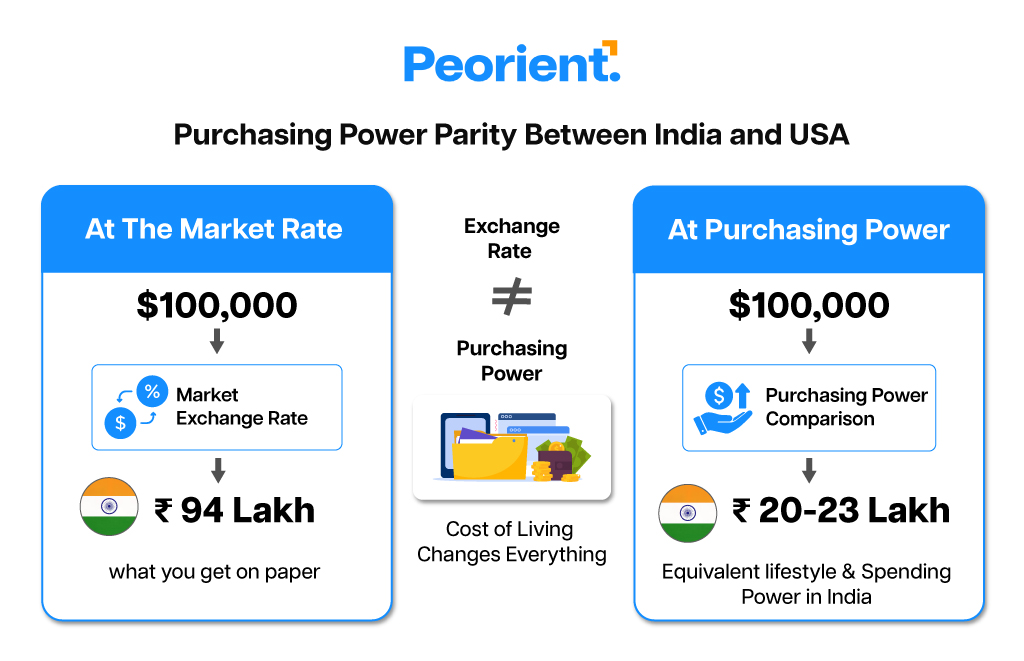
A $100,000 US salary converts to about ₹94 lakh at the market rate.
That sounds like a fortune in India.
But on a PPP basis, $100,000 of US purchasing power is equivalent to roughly
₹20 to ₹23 lakh of Indian lifestyle, not ₹94 lakh.
In other words, you would need about ₹20 to ₹23 lakh in India to live the way
$100,000 lets you live in the US.
Flip it around and the same logic narrows the salary gap:
the apparent 10x advantage of US pay becomes closer to a
2x to 3x advantage in real lived terms.
PPP is a powerful corrective, but it is not a magic equaliser, and honest comparisons admit its limits. PPP applies to spending, not to saving or investing. Dollars saved in the US can be invested in dollar assets and spent anywhere in the world; rupees saved in India are worth their rupee amount. PPP also smooths over quality differences (the median US apartment is larger, imported goods and international travel are priced at the market rate, not PPP), and it ignores the steeper salary growth and equity upside common in US tech. The fair summary is this: India is far cheaper to live in than the exchange rate suggests, but a US salary still wins on absolute savings and global optionality.
Use the market rate when you care about transfers, savings, investing, or buying anything global. Use PPP when you care about local standard of living. Quoting only one of them is how people end up shouting past each other.
Numbers feel abstract until you price the same life in both countries. The comparison below uses common everyday items and typical metro pricing. Indian prices reflect a tier-1 city like Pune, Bengaluru, or Hyderabad; US prices reflect a mid-cost metro, not the most expensive coastal cities.
| Everyday expense | India (tier-1 metro) | United States (mid-cost metro) |
|---|---|---|
| 2BHK / 2-bed rent (month) | ₹25,000 to ₹55,000 | $1,500 to $2,800 |
| Casual restaurant meal | ₹300 to ₹600 | $18 to $30 |
| Monthly home internet | ₹700 to ₹1,200 | $50 to $80 |
| Domestic transport (monthly) | ₹2,000 to ₹6,000 | $70 to $150 transit, more by car |
| Doctor visit (private) | ₹500 to ₹1,500 | $120 to $300 (pre-insurance) |
| Full-time domestic help | ₹8,000 to ₹20,000 | Rare / unaffordable for most |
Two structural differences sit underneath this table. First, services are dramatically cheaper in India because labour is abundant and inexpensive, which is why middle-class households routinely employ help that would be a luxury in the US. Second, the US bundles enormous hidden costs into categories Indians often get cheaply or publicly: health insurance, childcare, and higher education can each run into the tens of thousands of dollars a year and can swallow a large share of a seemingly high salary. A $62,000 US salary and a ₹15 lakh Indian salary can leave families with surprisingly similar discretionary income after the essentials are paid.
National averages blur into abstraction, so it helps to compare two real tech cities that companies actually hire in. Bengaluru is India’s largest technology hub; Austin is a fast-growing US tech centre that is cheaper than the coastal giants. Pitting a mid-level software engineer in each against the other shows the pattern in miniature.
| Factor | Bengaluru | Austin |
|---|---|---|
| Mid-level engineer salary | ₹14 lakh (~$14,900) | $135,000 |
| Typical 2BHK rent (month) | ₹35,000 | $1,900 |
| Loaded employer cost | ~₹17 lakh (~$18,100) | ~$175,000 |
| Salary as multiple of local rent | ~33x annual | ~70x annual |
The dollar salaries differ by about nine times, yet the lived gap is far smaller. The Bengaluru engineer spends a smaller share of income on rent and services, can afford help and conveniences that are out of reach for the Austin engineer, and often saves a higher percentage of net pay. The Austin engineer holds dollars, which travel and invest globally, and sits closer to the product and capital that fuel raises and equity. Both are doing well. They are simply doing well in different currencies of life.
Gross salary is the headline; take-home pay is the reality. Both countries tax income progressively, but the structures differ enough to shift the comparison.
India runs two parallel systems. The newer default regime offers lower slab rates with fewer deductions, while the older regime keeps higher rates but allows deductions for housing loans, insurance, and retirement savings. Most salaried professionals now find the new regime simpler and often cheaper. Effective tax rates for a typical urban professional commonly land in the 5 to 20 percent range, and take-home is often around 85 to 90 percent of gross for mid-level salaries before voluntary savings. Employers also deduct Provident Fund contributions, which are forced savings rather than tax.
US workers face federal income tax, FICA payroll tax of 7.65 percent on the employee side, and in most cases state and sometimes city income tax. A few states levy no income tax at all (Texas, Florida, Washington among them), which materially changes net pay. For a worker around the $62,000 median, the combined effective rate (federal plus FICA plus an average state) commonly lands in the 22 to 30 percent range, so take-home is often 70 to 78 percent of gross. Health insurance premiums are frequently deducted on top of that.
The US worker keeps a smaller percentage of a much larger gross,
while the Indian worker keeps a larger percentage of a much smaller gross.
The dollar gap narrows after tax, but it does not close.
Where the Indian professional pulls ahead is the savings rate:
lower living costs mean a larger share of net pay can be saved or invested,
even when the absolute amount is smaller.
No comparison is searched more often than tech pay, and for good reason: it shows the widest gap of any profession, and it is the engine behind the entire global hiring industry.
In India, an average software engineer earns roughly ₹8 to ₹12 lakh a year, which is about $8,500 to $13,000 at the market rate. Senior engineers and architects command far more, often ₹25 to ₹45 lakh, but the average sits low by global standards. In the US, the average software engineer earns $130,000 to $150,000, and total compensation at large technology companies (base plus bonus plus equity) routinely exceeds $200,000. The nominal gap for the same job title is therefore around 10 times, occasionally more.
| Software role | India (avg total) | US (avg total) | Nominal gap |
|---|---|---|---|
| Entry-level engineer | ₹4 to ₹8 lakh | $90,000 to $115,000 | ~12x to 18x |
| Mid-level engineer | ₹10 to ₹18 lakh | $120,000 to $160,000 | ~8x to 11x |
| Senior / architect | ₹25 to ₹45 lakh | $170,000 to $230,000+ | ~5x to 7x |
| AI / ML specialist | ₹20 to ₹50 lakh | $200,000+ | ~5x to 8x |
Why does the gap exist at this scale? Cost of living explains part of it, because US salaries have to cover US rent and US healthcare. Talent supply explains more: India produces a vast number of engineering graduates each year, so the market clears at a lower price even for strong candidates. And market access explains the rest, because a US-based engineer is closer to the customers, capital, and product decisions that command a premium.
The PPP adjustment compresses this gap the same way it compresses every other comparison. A $140,000 US engineering salary is worth perhaps ₹28 to ₹32 lakh of Indian lifestyle, which is squarely in senior-engineer territory in India. The lived gap between a strong US engineer and a strong Indian engineer is real but is closer to 2x than 10x. For employers, that 10x nominal gap on the same skill is the whole opportunity, and it is why building engineering teams in India through an Employer of Record has become a default strategy rather than a cost-cutting experiment.
Tech is the headline, but global employers hire across functions. The same pattern holds: a large nominal gap that narrows substantially on a PPP basis.
| Role | India (avg annual) | US (avg annual) |
|---|---|---|
| Data analyst | ₹6 to ₹15 lakh | $70,000 to $95,000 |
| Accountant / finance | ₹4 to ₹10 lakh | $60,000 to $85,000 |
| Digital marketing manager | ₹8 to ₹18 lakh | $75,000 to $110,000 |
| Customer support specialist | ₹3 to ₹6 lakh | $40,000 to $55,000 |
| HR manager | ₹8 to ₹16 lakh | $70,000 to $100,000 |
| Project manager | ₹12 to ₹22 lakh | $90,000 to $125,000 |
It is tempting to reduce the gap to a single cause, but it is the product of several forces stacking on top of one another.
None of these is permanent. India’s rapid salary growth, the rise of global capability centres, and the normalisation of remote work are all slowly compressing the gap, particularly at the senior and specialist end.
For a global employer, the salary gap is not trivia, it is a line item that can transform a budget. A US engineering team that costs $1.5 million a year in salary alone might cost a quarter of that in India for comparable skill, before you even count the lower overhead. But the saving is only real if you avoid the traps that turn cheap salaries into expensive mistakes.
In India, on top of base salary you carry Provident Fund (employer contribution toward retirement), ESI (state insurance for lower wage bands), gratuity (a tenure-based payout), a statutory bonus for eligible employees, and often health insurance. These typically add 15 to 25 percent on top of base, and the new Labour Codes change how the base itself must be structured. A salary that looks like ₹12 lakh on the offer letter can cost the employer meaningfully more once everything is loaded in. Our global payroll cost guide breaks down how these elements are priced.
To make that concrete, here is how a ₹12 lakh offer letter typically loads into a real annual cost of employment. The exact numbers depend on wage band, state, and how the package is structured under the new Labour Codes, but the shape is consistent.
| Cost component | Indicative annual amount |
|---|---|
| Base / CTC on offer letter | ₹12,00,000 |
| Provident Fund (employer share) | ~₹86,000 |
| Gratuity provision | ~₹58,000 |
| Statutory bonus / benefits (where applicable) | ~₹40,000 to ₹90,000 |
| Group health insurance | ~₹15,000 to ₹40,000 |
| EOR or payroll service fee | Varies by provider |
| Approximate loaded cost | ₹14 lakh to ₹15 lakh+ |
Even fully loaded, that total is a fraction of the cost of the equivalent US hire, which is the whole point. The risk is not the cost, it is getting the structure wrong: under-contributing to Provident Fund, mishandling gratuity, or misclassifying an employee as a contractor can trigger penalties that erase the saving. This is where independent advice pays for itself.
| Option | Best when | Watch out for |
|---|---|---|
| Set up an entity | 20+ hires, long-term commitment to India | Months to incorporate; ongoing compliance load |
| Use an EOR | 1 to 20 hires, speed and compliance matter | Per-employee fees add up at scale |
| Engage contractors | Short projects, true independent work | Misclassification risk under Indian law |
For most companies hiring their first handful of people in India, an Employer of Record is the fastest compliant route, because the EOR is the legal employer and absorbs payroll, tax, statutory benefits, and filings. As headcount grows past 20 or so in one country, an international PEO arrangement or your own entity can become more economical. Either way, you will want an HR information system to run it, and smaller teams should look at HRIS options built for small businesses.
If you are weighing an Indian salary against a US one, resist the urge to compare gross dollars. Compare three things instead, in this order.
The relocation decision is rarely about the salary number alone. It is about visa stability, distance from family, quality of life, and what you are optimising for over a decade. The data should inform that choice, not make it for you.
One scenario breaks the entire comparison in the most favourable direction, and it is growing fast. An Indian professional who works remotely for a US or European company can earn a salary linked to global rates while spending in rupees at Indian prices. That combination produces a savings rate that neither a typical US worker nor a typical Indian worker can match.
The figures are not always full US parity. Many global employers pay a location-adjusted rate that sits above the Indian market but below the US level, often landing somewhere around 50 to 70 percent of a comparable US salary. Even at the lower end of that range, the math is striking. A remote engineer earning the equivalent of ₹40 lakh while paying Bengaluru rents keeps more, in real terms, than peers in either country.
For employers, this is the same opportunity viewed from the other side. You access senior global talent without relocation, visas, or US-level payroll, and you do it compliantly through an Employer of Record that handles the Indian employment relationship while the work happens for your team. The catch is the same as ever: remote does not mean rule-free. The person is still an Indian employee with Indian statutory rights, and treating them as a contractor to dodge that is the classic, expensive mistake.
Several forces are actively reshaping both markets this year, and they all point toward a slowly narrowing gap.
This tells you the transfer value, not the lived value. A US salary buys far less US lifestyle than the same dollars buy in rupee terms in India.
PPP applies to spending, not saving or investing, and it ignores quality and global optionality. It narrows the gap; it does not erase it.
For employers, statutory contributions and benefits add 15 to 40 percent on top of base in both countries. Always budget the loaded cost of employment.
Only if compliance is handled. A misclassified contractor or a botched Provident Fund filing can cost far more than the salary you saved.
The average salary in the USA dwarfs the average salary in India in plain dollars, by something like 10 times for comparable roles. That gap is real and it is not closing overnight. But it is also the most over-read statistic in global pay. Once you account for what each currency buys at home, the difference in lived standard of living shrinks to roughly two to three times, and the Indian professional often wins on savings rate.
For employers, that arithmetic is the entire case for hiring in India: world-class talent at a fraction of US payroll, as long as you treat compliance as seriously as cost. For professionals, the dollar figure is only a starting point, and the smarter questions are about savings, currency, and the decade ahead. Either way, the right move is to compare like with like, separate the exchange rate from purchasing power, and budget the full cost rather than the headline number.
Estimates range from about ₹4 lakh a year (broad national average including informal work) to ₹7 to ₹9 lakh a year (mean for salaried professionals). The median for urban professionals is roughly ₹5 to ₹6 lakh. In dollars, that is about $4,000 to $9,500 depending on the measure.
The mean across all occupations is near $66,000 a year, and the median for full-time workers is around $62,000, based on Bureau of Labor Statistics data. Pay varies sharply by age, education, occupation, and state.
In raw dollar terms, US salaries are roughly 10 to 15 times higher for comparable roles. Adjusted for purchasing power parity, the real gap narrows to about 2 to 3 times.
On a purchasing power basis, yes, roughly. $100,000 of US purchasing power is equivalent to about ₹20 to ₹23 lakh of Indian lifestyle, even though it converts to about ₹94 lakh at the market exchange rate. The PPP figure reflects living costs, not transfer value.
A large talent supply, lower local living costs, a weaker currency in dollar terms, and distance from the highest-value customers all push Indian engineering salaries below US levels. The same forces make India attractive for global employers building teams.
Often a higher percentage stays in the Indian worker's pocket because effective rates for mid-level salaries tend to be lower, while US workers face federal tax, FICA, and usually state tax. But Americans keep a smaller share of a much larger gross, so the dollar take-home is still far higher.
Plan for the base salary plus 15 to 25 percent in statutory contributions (Provident Fund, ESI, gratuity, statutory bonus) and benefits, plus any EOR or payroll fees. The new Labour Codes also require basic pay to be at least half of total CTC.
For roughly 1 to 20 hires, an EOR is usually faster and cheaper because it avoids incorporation and ongoing entity compliance. Beyond about 20 hires in one country, your own entity often becomes more economical. Peorient helps model this for your specific situation.
Slowly, yes. India's salaries are rising around 9 percent a year against 3.5 to 4 percent US wage growth, global capability centres are pulling senior Indian pay upward, and remote work is decoupling salary from location. The gap is compressing fastest for AI, machine learning, and senior specialist roles, but a large nominal difference will persist for years.
On a percentage basis, Indian professionals often save more of their net pay because living costs are far lower, even though the absolute amount saved can be higher for US workers thanks to much larger salaries. The remote-work scenario, an India-based professional on a global salary, produces the strongest savings rate of all.
Benchmark against the role, city tier, and experience band rather than the national average, then add 15 to 25 percent for statutory contributions and benefits. For a tier-1 metro professional role, base offers commonly start around ₹55,000 to ₹75,000 a month and rise quickly with seniority. An independent advisor can pressure-test the number before you make the offer.

Written by
Lead India Employment and Payroll Specialist · 13+ years experience
Priya is Peorient's resident expert on hiring in India. Former senior HR Tax consultant at a Big 4 firm in Bengaluru and Head of Payroll Operations at a Pune-based EOR. Advocate enrolled with the Bar Council of Maharashtra and Goa. Has run state-level registrations in 14 Indian states.

Versatile.club Review 2026: The $149 vs $99-$399 Problem
Versatile.club publishes 3 different prices at once. Our independent 2026 review covers India EOR pricing, compliance and the $99 alternative.