Ending employment in India is governed by the four Labour Codes, which the government made effective from 21 November 2025, replacing 29 older labour laws (PIB release). For exits, two matter most: the Industrial Relations Code, 2020 and the Code on Wages, 2019. The rules change with how the job ends and who the employee is, so a resignation, a dismissal for misconduct and a retrenchment each carry different notice, pay and paperwork.
This guide is for foreign companies with staff in India, and for the employer of record that employs them on their behalf. It covers notice, retrenchment compensation, the Worker Re-skilling Fund, the final settlement, gratuity and severance, with a worked example on a ₹60,000 monthly salary. Every rule links to the labour ministry’s Compliance Handbook for Employers Under the Four Labour Codes or to the Code itself on India Code. For the wider rulebook, start with our India employer compliance hub.
What are the legal ways to end employment in India?
Employment in India usually ends in one of five ways: resignation, dismissal for misconduct, retrenchment, the end of a fixed-term contract or retirement. The Industrial Relations Code defines retrenchment as the employer ending a worker’s service for any reason other than disciplinary punishment, and it excludes voluntary retirement, superannuation, non-renewal of a contract, the end of a fixed-term tenure and termination for continued ill-health (Section 2, Industrial Relations Code).
That definition is why the label matters. A role cut because a project ended is a retrenchment, with notice and compensation attached. A dismissal after a proven breach of conduct rules is not.
Who counts as a worker under the Industrial Relations Code?
A worker is anyone employed to do manual, unskilled, skilled, technical, operational, clerical or supervisory work for pay, apart from a few excluded groups. The definition on page 33 of the handbook leaves out people employed mainly in a managerial or administrative capacity, and supervisors earning more than ₹18,000 a month.
The test turns on the work, not the job title or the salary. An individual-contributor software engineer, a support executive or an accountant doing technical or clerical work can fall inside the definition at any salary. A team lead who mainly supervises and earns above ₹18,000, or a department head who manages, usually falls outside it.
It matters because retrenchment notice, retrenchment compensation and the Re-skilling Fund are written for workers. For staff outside the definition, the employment contract sets the notice period and any severance, and the Shops and Establishments Act of the state where they work can add conditions. Our Shops and Establishments guide explains which state law applies to an office.
How much notice must an employer give to terminate an employee in India?
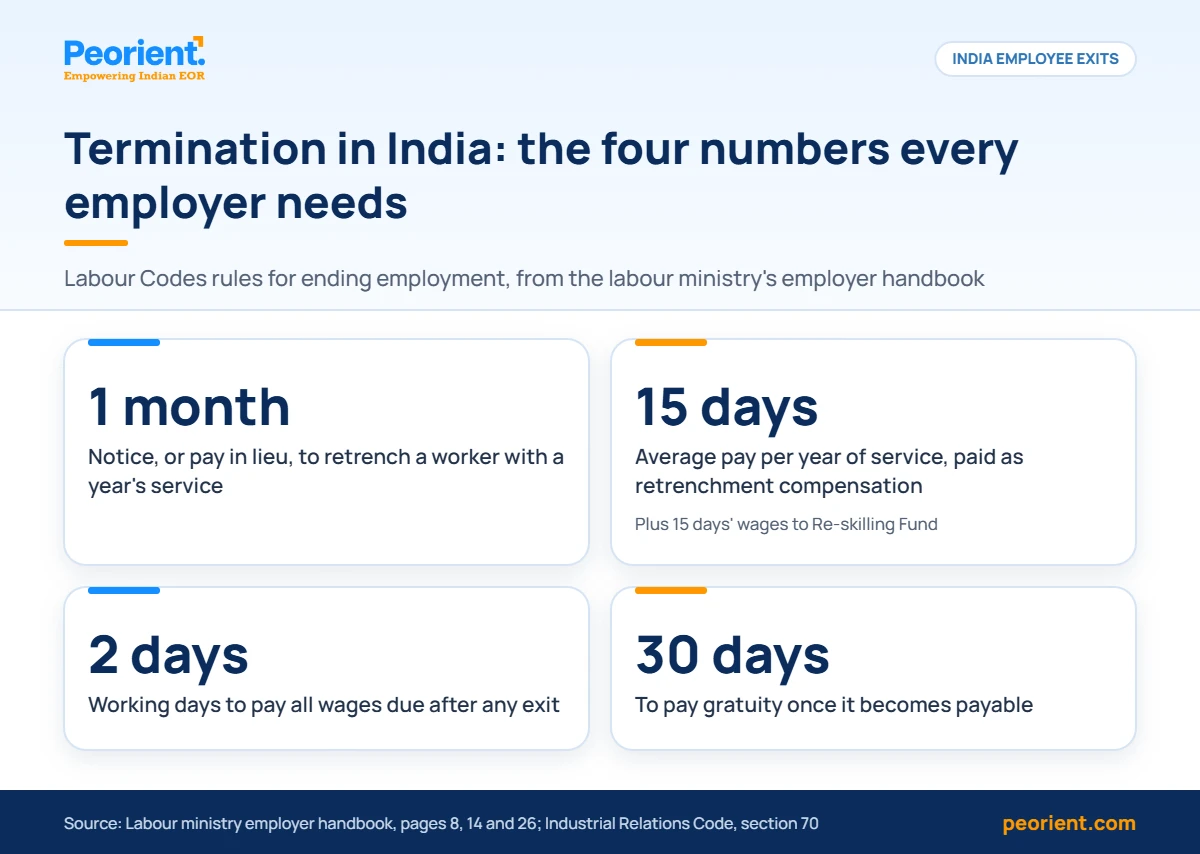
A worker with at least one year of continuous service must get one month’s written notice stating the reasons, or wages for the notice period in lieu, before retrenchment. That is the first condition in Section 70 of the Industrial Relations Code, which also requires the employer to notify the government or the authority it names.
Factories, mines and plantations with 300 or more workers must give three months’ notice and get prior permission (handbook, page 15). Office teams hired through an employer of record are rarely factories, mines or plantations, so the one-month rule is the one that usually applies.
Can the contract require more notice than the law?
Yes. The statutory month is a floor, and an offer letter can set a longer notice period for both sides. An employer can also pay salary for the notice period instead of asking the employee to work it out. Our notice period buyout guide shows how that payment is calculated and taxed, and notice period laws by country compares India with other markets.
How is retrenchment compensation calculated in India?
Retrenchment compensation is 15 days’ average pay for every completed year of continuous service, and any part of a year over six months counts as a full year. The rate is set in Section 70 and repeated on page 14 of the handbook. On top of it, the employer pays 15 days’ wages for each retrenched worker into the Worker Re-skilling Fund.
What does a retrenchment cost on a ₹60,000 monthly salary?
Take a worker on ₹60,000 a month with 6 years and 3 months of continuous service, retrenched without working out the notice. Three months is under six, so six years count. On a 30-day month, 15 days’ pay is ₹30,000.
When do you need government permission to lay off or close?
Prior government permission is needed only in factories, mines and plantations with 300 or more workers. For them the handbook lists three months’ notice before retrenchment, and an application for permission at least 90 days before a closure, with a copy to the workers’ representatives (page 15).
Factories, mines and plantations with 50 to 299 workers do not need permission, but they must notify the government before a lay-off, retrenchment or closure and give at least 60 days’ notice of a closure (page 14). In both groups a laid-off worker is paid 50% of basic wages plus dearness allowance, and when ownership or management changes, workers with a year’s service are entitled to notice and retrenchment compensation.
How do you dismiss an employee for misconduct in India?
Dismissal for proven misconduct is not retrenchment, so no retrenchment compensation is due, but the process must be fair and on paper. The Code’s definition of retrenchment excludes punishment by way of disciplinary action, which is why the record carries so much weight if the employee challenges the decision.
Standing orders apply to establishments with 300 or more workers (handbook, page 13), and where they apply, follow them. Smaller employers should set out conduct rules and disciplinary steps in the contract or an employee handbook. A defensible process has five parts: a written charge, the employee’s written reply, a hearing or enquiry, a reasoned decision and a dismissal letter. Fines can be deducted only after the employee has had a chance to be heard (page 9).
Which protections apply whatever the reason?
A woman cannot be dismissed or discharged for absence on maternity leave taken under the law (page 26; see our maternity leave guide). A worker can also take an individual grievance to the Grievance Redressal Committee within one year, and the committee has 30 days to finish (page 12).
What must the full and final settlement include, and when is it due?
All wages due must be paid within two working days of the employee’s last day, whether they resigned, were dismissed or were retrenched (handbook, page 8). Gratuity has its own deadline of 30 days from the date it becomes payable (page 26).
A complete settlement statement lists:
- Salary for days worked in the final month, and any arrears
- Notice pay, if the employer ended the job without notice
- Retrenchment compensation, for a worker with a year’s service
- Leave encashment under the leave policy and state law, covered in our leave policy guide
- Any bonus or incentive already earned
- Gratuity, if the employee is eligible
- Lawful deductions only: income tax, employee PF and recoveries the law allows
Hand over the relieving letter, an experience letter and the annual TDS certificate, and support the employee’s PF transfer or withdrawal. Our EPF and ESIC guide covers the contribution side.
Is severance pay mandatory in India?
India has no general severance requirement beyond retrenchment compensation for workers. Managers and senior staff outside the worker definition receive what their contract or a negotiated exit agreement gives them, on top of statutory dues such as gratuity and earned leave.
Some employers add extra months of pay to secure a smooth handover and a signed release of claims. Treat that as a commercial choice: write the amount into a separation agreement, state how it will be taxed, and pay statutory dues as separate lines so the agreement cannot be read as replacing them.
How does termination work when you hire through an EOR?
With an employer of record, the EOR is the legal employer, so it issues the notice, runs the final settlement and pays gratuity, while you decide whether the person leaves. The statutory cost is the same as if you employed them directly, and the EOR passes it through on its invoice.
Before you sign, ask any provider three questions: who drafts and signs the termination letter, how it meets the two-working-day wage deadline, and whether it charges an offboarding fee. Remunance, our first pick for India, employs teams on its own Indian entity and runs payroll and statutory filings there; read our Remunance review. Compare it with other providers in our Best EOR in India guide and the India EOR Price Index, or weigh an EOR against your own company in EOR vs subsidiary in India.
Peorient is affiliated with Remunance and may earn a referral fee.
What is the step-by-step checklist for terminating an employee in India?
Work through these nine steps in order, and keep a copy of every notice and calculation.
- Classify the exit: resignation, misconduct, retrenchment, end of a fixed-term contract or retirement.
- Check whether the employee is a worker under the Industrial Relations Code, and how long they have served.
- Read the contract, any standing orders and the state Shops and Establishments Act for notice and procedure.
- For misconduct, complete the disciplinary process and record the decision.
- For retrenchment, serve one month’s written notice with reasons, or pay in lieu, and notify the government.
- Calculate notice pay, retrenchment compensation, leave encashment and gratuity.
- Pay all wages due within two working days, and gratuity within 30 days.
- Pay 15 days’ wages for each retrenched worker into the Worker Re-skilling Fund.
- Issue the relieving letter, experience letter and TDS certificate, and settle PF.
What else do employers ask about termination in India?
How can Peorient help you handle an exit in India?