Hiring in India? Get 10% off Remunance EOR fees for a full year through Peorient.10% off Remunance EOR fees for a year

Claim the offer
10% off Remunance EOR fees for a year via Peorient. Claim offer
Gratuity calculator 2026 featured image: a desk with a packed box, a calculator and an envelope on a last working day

Gratuity Calculator 2026: How Much Gratuity Will You Get?

Enter your last drawn basic pay and DA and your years of service to see the gratuity your employer owes, how much of it is tax-free, and what it grows to over a career.

Free for companies

Hiring in India or abroad?

Tell us the country, team size and start date. We compare EOR, PEO and payroll providers and send you a shortlist with quoted fees in 2-3 business days.

Get my free shortlist

No obligation. You decide which providers, if any, contact you. How Peorient is free

Table of Contents

A gratuity calculator works out the lump sum your employer owes you when you leave: last drawn monthly basic pay plus dearness allowance, multiplied by 15, divided by 26 and multiplied by your years of service. On ₹50,000 a month after 7 years and 7 months, that comes to ₹2,30,769, because a final part year of more than six months counts as a full year. The calculator below follows the labour codes in force since 21 November 2025, including the one-year rule for fixed-term staff and the ₹20 lakh cap.

Need to know

Quick Answer

Gratuity is last drawn basic pay plus DA × 15 ÷ 26 × years of service. Permanent staff qualify after five years and fixed-term staff after one. It is capped at ₹20 lakh, and up to ₹20 lakh over your working life is tax-free.

  • Gratuity = last drawn basic pay + DA × 15 ÷ 26 × completed years, with a final part year of more than six months counted as a full year.
  • Permanent employees qualify after five years of continuous service; fixed-term employees after one year since 21 November 2025.
  • There is no minimum service when a job ends through death or disablement.
  • Payable gratuity is capped at ₹20 lakh, and the ₹20 lakh tax-free limit applies across your whole career.
  • Your employer must pay within 30 days of the date it becomes payable, or pay interest on the delay.
₹
Basic pay plus dearness allowance in your last month. Not CTC.
₹
Used for the labour codes’ 50% wage rule. Leave 0 to skip.
years
months
Completed years, then extra months. More than six extra months counts as a full year.
Fixed-term staff qualify after one year.
₹
The ₹20 lakh tax-free limit is for your whole working life, not per job.

Gratuity payable

₹0

Line itemAmount
Years of serviceGratuity at this pay

Rules for 2026 under the Code on Social Security, 2020: gratuity is 15 days of wages for each year of service, worked out as last drawn wages × 15 ÷ 26 × years, with a part year of more than six months counted as a full year. Wages are basic pay, dearness allowance and retaining allowance; if allowances outside wages are more than half of total pay, the excess is added back. Permanent staff qualify after five years of continuous service and fixed-term staff after one year; there is no minimum on death or disablement. Payable gratuity is capped at ₹20 lakh. Up to ₹20 lakh over your working life is tax-free for private-sector employees, worked out on basic pay and DA. Government employees follow their own rules. An estimate, not legal or tax advice.

How is gratuity calculated?

Multiply your last drawn monthly basic pay and dearness allowance by 15, divide by 26 and multiply by your years of service. The 15 stands for 15 days of wages for each year and the 26 for the working days in a month, so each year of service earns a little over half a month’s basic pay. A final part year of more than six months counts as a full year, so 7 years and 7 months is paid as 8, while 7 years and 6 months is paid as 7. This is the standard formula for monthly paid employees, as Aditya Birla Sun Life sets out.

Peorient calculations using the formula under the Code on Social Security, 2020.
WhoBasic pay + DA a monthServiceYears countedGratuity
Permanent employee who resigns₹50,0007 years 7 months8₹2,30,769
Fixed-term employee at contract end₹40,0002 years 4 months2₹46,154
Permanent employee who resigns₹30,0004 years 6 monthsNot yet eligible₹0
Employee retiring₹1,50,00025 years25₹20,00,000 (formula gives ₹21,63,462)

Wages here means basic pay, dearness allowance and retaining allowance. HRA, conveyance, bonus, overtime and commission are left out. Under the labour codes, if the left-out parts add up to more than half of your total pay, the excess is added back to wages, as Business Today explains. That raises gratuity for anyone whose basic pay and DA are below half of gross pay. Enter your gross monthly pay in the calculator to see the effect: on ₹50,000 basic pay within ₹1,50,000 gross, 10 years of service pays ₹4,32,692 instead of ₹2,88,462.

Who is eligible for gratuity in 2026?

  • Permanent employees: after five years of continuous service with the same employer, according to Aditya Birla Sun Life.
  • Fixed-term employees: after one year of continuous service, pro rata, under the labour codes in force since 21 November 2025.
  • Death or disablement: no minimum service applies.
  • Employer size: the usual threshold is 10 or more employees. Below that, gratuity is not compulsory, though an employer can still pay it.

The one-year rule does not apply to permanent employees. A permanent employee who resigns after three years is not owed gratuity.

Do 4 years and 240 days count as five years?

Sometimes. The law treats 240 working days in a year as a full year of continuous service, and the Madras, Kerala and Delhi High Courts have used that to count four years plus 240 days in the fifth year as five years, according to a LiveLaw analysis of the case law. The Supreme Court has not settled the point, so an employer may still refuse. If you are a few months short of five years, ask HR in writing how they count your service before you resign.

How much gratuity is tax-free?

For private-sector employees covered by the gratuity law, the tax-free amount is the lowest of three figures: the gratuity you receive, ₹20 lakh, and the 15/26 formula worked out on basic pay and DA. The ₹20 lakh limit was notified in March 2018 and covers your whole career, so tax-free gratuity from an earlier job uses up part of it. Since 1 April 2026 the exemption sits in Schedule II of the Income-tax Act, 2025, in place of section 10(10) of the 1961 Act, as TaxClue notes. Anything above the exempt amount is taxed as salary.

Two cases catch people out. If the 50% wage rule raises your gratuity, the exemption is still worked out on basic pay and DA, so the extra can be taxed: in a Business Today example, gratuity of ₹13.85 lakh may have only ₹10 lakh exempt, leaving ₹3.85 lakh taxable. And if your employer has fewer than 10 employees but pays gratuity anyway, the tax-free part is half a month’s average salary over the last 10 months for each completed year of service.

Source: TaxClue on Schedule II of the Income-tax Act, 2025.
Your situationTax-free gratuity is the lowest of
Private employer covered by the gratuity lawGratuity received; ₹20 lakh less earlier exemptions; basic + DA × 15 ÷ 26 × years
Private employer with fewer than 10 employeesGratuity received; ₹20 lakh less earlier exemptions; half a month’s average salary × completed years
Central or state government employeeFully tax-free
Free EOR Advisory

Hiring in India and budgeting for gratuity?

Gratuity is a liability from an employee’s first day, at about 4.81% of basic pay. An employer of record provisions it, runs payroll and handles exits for you. Tell us your hiring plan and Peorient will send a shortlist of providers with quoted fees.

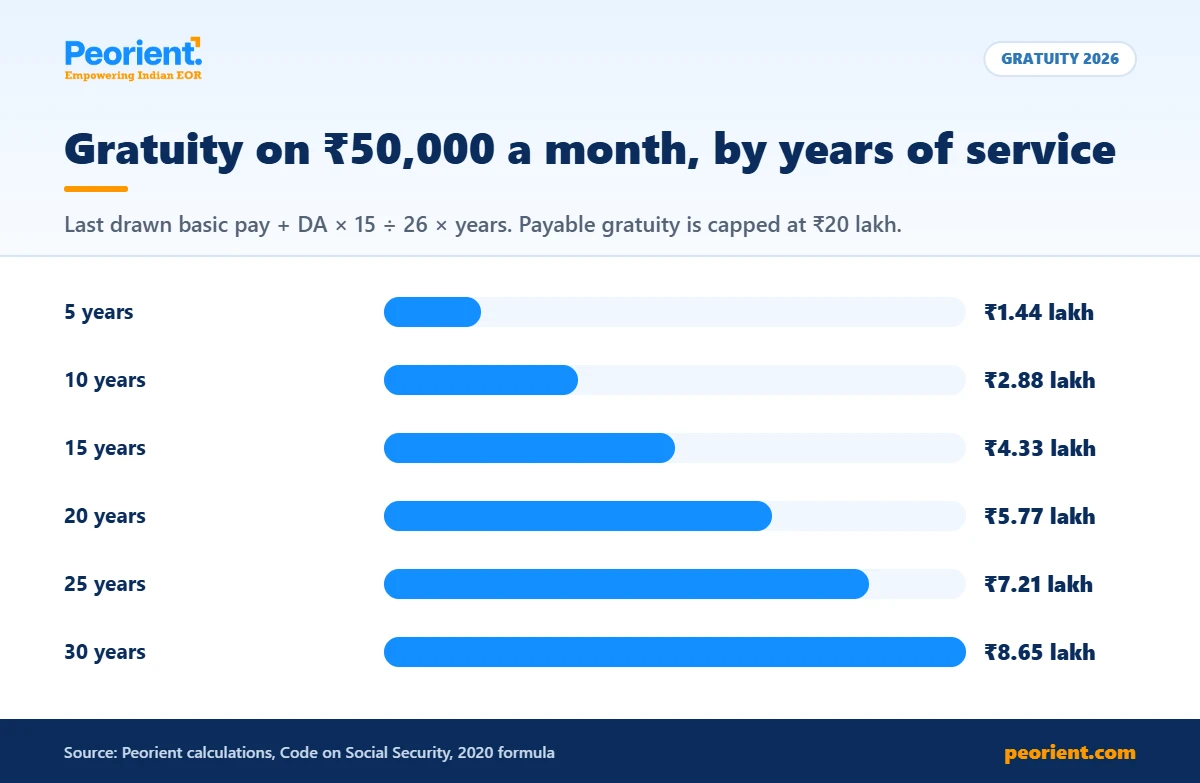
How much gratuity do you get after 5 to 30 years?

Gratuity grows in a straight line with service at the same pay, so doubling your years doubles the amount. The ₹20 lakh cap only bites at high pay: on ₹1 lakh of basic pay and DA it is not reached even after 30 years, while on about ₹1.73 lakh it is reached at 20 years.

Peorient calculations at constant last drawn pay. In practice pay rises, and gratuity uses your final month’s pay for every year served.
Years of service₹25,000 basic + DA₹50,000 basic + DA₹1,00,000 basic + DA
5₹72,115₹1,44,231₹2,88,462
10₹1,44,231₹2,88,462₹5,76,923
15₹2,16,346₹4,32,692₹8,65,385
20₹2,88,462₹5,76,923₹11,53,846
25₹3,60,577₹7,21,154₹14,42,308
30₹4,32,692₹8,65,385₹17,30,769
Bar chart of gratuity on ₹50,000 basic pay plus DA a month: ₹1.44 lakh after 5 years, ₹2.88 lakh after 10, ₹5.77 lakh after 20 and ₹8.65 lakh after 30
At the same pay, every extra year of service adds the same amount, a little over half a month’s basic pay and DA.

When must your employer pay gratuity?

Within 30 days of the date it becomes payable, which is normally the day your employment ends. If the employer pays late, simple interest runs from the due date until payment, under section 56 of the Code on Social Security, according to Aditya Birla Sun Life. An employer can hold back gratuity only on the grounds the law sets out, such as loss caused by your wilful negligence or serious misconduct; a routine dispute like an unreturned laptop does not let them withhold the whole amount.

Gratuity is paid with your other exit dues. Our full and final settlement guide lists everything that should be in the final payout, and the leave encashment calculator works out what unused leave adds.

Why does gratuity appear in your CTC?

Many offer letters show gratuity at 4.81% of basic pay. That is 15 ÷ 26 ÷ 12, one month’s share of a year’s gratuity. It is a cost your employer sets aside, not money paid to you each month, and if you leave before you qualify you do not receive it. Our in-hand salary calculator shows how the gratuity line in a CTC affects take-home pay, and the EPF calculator covers the other retirement benefit in your salary. Employers can find the compliance side, including funding and insurance, in our gratuity rules guide for employers.

What else do people ask about gratuity?

  • Is gratuity paid on resignation?

    Yes, if you qualify: five years of continuous service as a permanent employee, or one year on a fixed-term contract. The amount is the same as on retirement.

  • Is gratuity calculated on basic pay or gross salary?

    On wages, which means basic pay, dearness allowance and retaining allowance. Under the labour codes, if allowances outside wages are more than half of your total pay, the excess is added back, as Business Today explains.

  • What is the maximum gratuity amount?

    ₹20 lakh for private-sector employees under the gratuity law, the limit notified in 2018. An employer can pay more, but anything above the tax-free limit is taxed as salary.

  • Do I get gratuity after 4 years and 8 months?

    Not automatically. Several High Courts have counted four years plus 240 working days as five years, but the Supreme Court has not settled the point, according to LiveLaw. Check with your employer before you resign.

  • Do fixed-term and contract employees get gratuity?

    Fixed-term employees qualify after one year of continuous service since the labour codes took effect on 21 November 2025. Gratuity is paid pro rata for the time served.

  • Is gratuity taxable?

    Only above the exempt amount. For most private-sector employees the first ₹20 lakh over a career is tax-free, worked out on basic pay and DA.

Hiring in India?

Gratuity, PF and exit payouts are part of what an employer of record handles for you. Send us your roles, salaries and start dates through the free shortlist form and Peorient will send quoted fees in 2 to 3 business days. See all our free HR and payroll calculators.

Priya Krishnamurthy

Written by

Priya Krishnamurthy

Lead India Employment and Payroll Specialist · 13+ years experience

Priya is Peorient's resident expert on hiring in India. Former senior HR Tax consultant at a Big 4 firm in Bengaluru and Head of Payroll Operations at a Pune-based EOR. Advocate enrolled with the Bar Council of Maharashtra and Goa. Has run state-level registrations in 14 Indian states.

EPF, ESI, gratuity Labour Codes Multi-state India TDS & Form 16
Still comparing
EOR options?

Get a sample Peorient report showing how we compare provider costs and explain our recommendations.