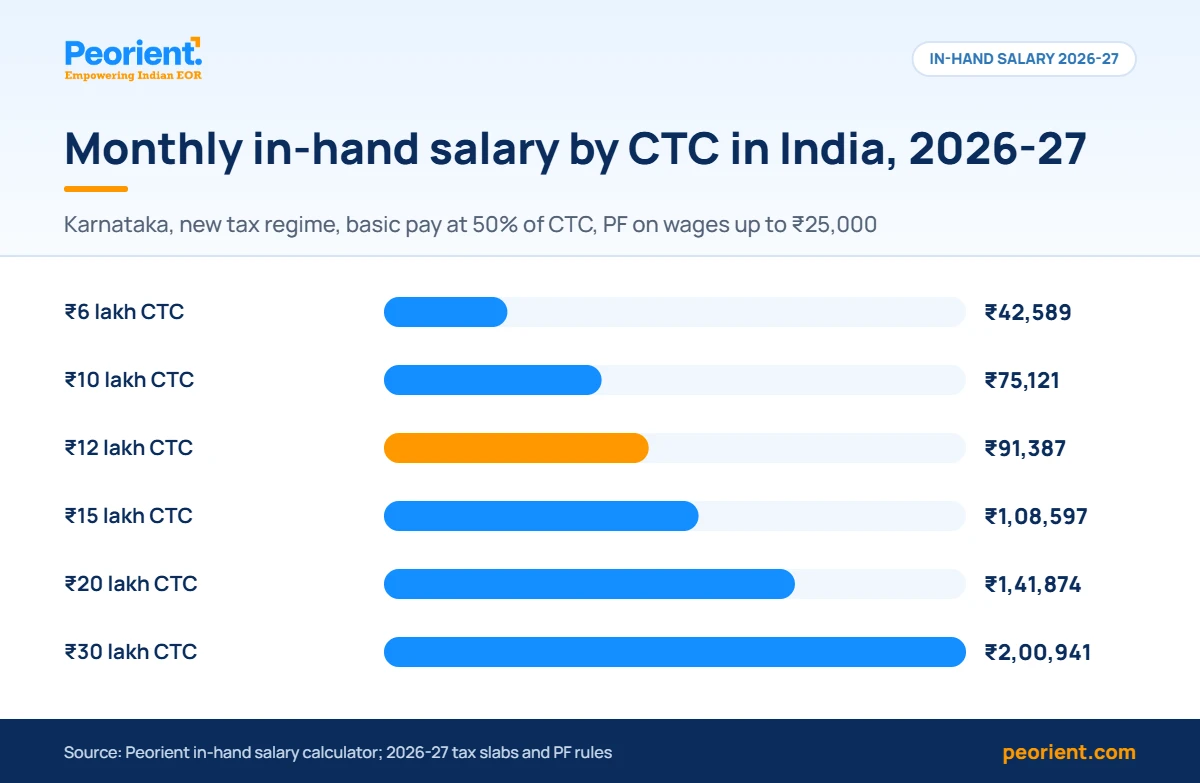
Your in-hand salary is your CTC minus your employer’s PF and gratuity costs, then minus your own PF, professional tax and income tax. On a ₹12 lakh CTC in Bengaluru with basic pay at half of CTC, that leaves ₹91,387 a month under the new tax regime in 2026-27. The calculator below works it out for your own numbers. It uses the 2026-27 tax slabs, which Budget 2026 left unchanged, the ₹25,000 PF wage ceiling in force since 17 September 2026, and the labour code rule that at least half of your pay counts as wages.
How much of your CTC do you take home in 2026-27?
Between 80% and 91% for most salaries. Take-home rises as a share of CTC up to ₹12 lakh, because PF stops growing at the ₹25,000 wage ceiling and no income tax is due, then falls as tax starts. The table uses the same rules as the calculator.
These figures assume basic pay at half of CTC, which is where most structures now sit. If you want to see how your salary compares with the national picture, our guide to the average salary in India has the latest government figures, and the city salary guide shows what the same CTC buys in each metro.
How is in-hand salary calculated from CTC?
Take out what your employer pays on your behalf to get gross salary, then take out what is deducted from you. Here is the ₹12 lakh example, a month:
- CTC: ₹1,00,000.
- Minus employer PF: 12% of wages up to ₹25,000, so ₹3,000.
- Minus gratuity provision: 4.81% of basic pay of ₹50,000, so ₹2,405. This is the 15 days’ pay per year of service that you receive when you leave after qualifying, as our gratuity guide explains.
- Gross salary: ₹94,595.
- Minus your PF: another ₹3,000.
- Minus professional tax: ₹2,500 a year in Karnataka, about ₹208 a month.
- Minus income tax: nil, because taxable income of ₹10,60,140 (gross pay less the ₹75,000 standard deduction) is under ₹12 lakh.
- In-hand salary: ₹91,387.
Income tax uses the new regime slabs of 5% from ₹4 lakh rising to 30% above ₹24 lakh, with no tax up to ₹12 lakh of taxable income, according to Business Today and PwC’s India tax summary. A 4% cess is added to any tax due.
How did the September 2026 PF ceiling change your take-home pay?
It cut it, if your employer pays PF only up to the statutory ceiling and kept your CTC the same. The EPF wage ceiling rose from ₹15,000 to ₹25,000 on 17 September 2026, so the ceiling-based PF deduction rose from ₹1,800 to ₹3,000 a month for you and the same for your employer. Because the employer’s share sits inside CTC, your gross pay falls too.
The money is not lost. It goes into your PF account, which earns interest and is paid out when you leave or retire. At ₹20 lakh the drop is smaller because the employer’s higher PF share is not taxed. If your employer already paid PF on full basic pay, nothing changed for you. Employers can check the cost side in our PF and ESIC calculator. To see what the higher ceiling does to your PF balance at retirement, use our EPF calculator.
How do the new labour codes change in-hand pay?
They can lower it if your basic pay was below half of your pay. Under the Code on Wages, allowances above 50% of total remuneration are added back to wages, so PF and gratuity are worked out on at least half of your pay, as Taxmann explains. The four codes came into force on 21 November 2025. How much it costs depends on how your employer pays PF:
When PF is capped at the ceiling, the rule mostly changes your gratuity provision, so the effect is small. When PF is paid on full basic pay, both PF and gratuity rise with wages and the cut is larger. In both cases the money moves into your retirement savings rather than disappearing.
Which tax regime gives you more in-hand pay?
The new regime, for most people. Its slabs are lower and it pays no tax up to ₹12 lakh of taxable income, so the old regime only wins when your deductions are large. These comparisons use the calculator’s rules:
Under the old regime you can claim HRA, 80C, 80D and home loan interest, which the calculator takes as two inputs. Under the new regime you get the ₹75,000 standard deduction but not professional tax or most other deductions, according to PwC.
How much professional tax comes out of your salary?
Up to ₹2,500 a year, depending on your state and salary. Some states charge nothing. The calculator covers the states below; our professional tax guide has the full slabs and sources for every state.
What does the calculator leave out?
- Bonus and variable pay. They are taxed when paid and can push your income into a higher slab.
- Employer NPS. Contributions reduce your taxable income under both regimes but are not modelled here.
- Reimbursements and meal cards. These usually sit inside CTC and are paid against bills rather than as salary.
- Other income. Interest, rent or capital gains raise your tax and can push you above ₹12 lakh.
- Insurance premiums inside CTC. Some employers include group health cover in CTC; subtract it from CTC before you enter it.
What should employers check when they set CTC in 2026?
- Keep wages at 50% or more. Structures with basic pay below half of pay now pay PF and gratuity on the higher figure anyway.
- Price in the ₹25,000 PF ceiling. Statutory PF can now reach ₹3,000 a month per employee on each side.
- Show take-home pay in offers. Candidates compare in-hand pay, so show it next to CTC.
- Budget for gratuity. Fixed-term staff now qualify after one year under the labour codes.
- Model the full cost. Our India hiring cost calculator and employer cost guide cover PF, ESIC, gratuity, insurance and EOR fees.
Foreign companies without an Indian entity can have an employer of record handle salary structuring, payroll and statutory filings. Our guide to hiring without an entity explains how, and the EOR comparison for India lists the fees.
What else do people ask about in-hand salary in 2026-27?
Setting salaries for a team in India?
Send us your roles, salaries and start dates through the free shortlist form. Peorient compares employer of record providers that structure pay under the labour codes and run payroll for you, and sends quoted fees in 2 to 3 business days.