Hiring in India? Get 10% off Remunance EOR fees for a full year through Peorient.10% off Remunance EOR fees for a year

Claim the offer
10% off Remunance EOR fees for a year via Peorient. Claim offer
Indian freelance developer working on a laptop at a home desk in Bengaluru

How to Pay Contractors in India: The 2026 Guide for Foreign Companies

GST export rules, the Letter of Undertaking, four payment routes with published prices, and the point where a contractor should become an employee. Checked against CBIC, GST Council and labour ministry sources in November 2026.

Free calculator

What will an India hire really cost you?

Salary, PF, gratuity, insurance and EOR fees in one number, in rupees and US dollars. Takes about 30 seconds.

Calculate my hire cost

Free, no sign-up. Ready to compare providers? Get a free shortlist

Table of Contents

A foreign company can pay an independent contractor in India without setting up an Indian entity: you sign a contract for services, the contractor invoices you, and you pay them by international transfer. The care goes into the paperwork around that payment. Indian GST law treats the contractor’s work for you as an export of services when five conditions hold, and the four labour codes, in force since 21 November 2025 (PIB release), decide whether the person is really a contractor at all.

This guide covers both sides, with the fees that Remunance, Deel, Remote, Oyster, Multiplier and Wisemonk publish for paying contractors, and the salary at which an employer of record costs less than keeping someone on contract.

Need to know

Quick Answer

To pay a contractor in India, sign a written contract for services, get an invoice for each payment, and pay in foreign currency to the contractor's Indian bank account, directly or through a contractor platform. Paid that way, the work usually counts as an export of services, so a GST-registered contractor can bill you without GST under a Letter of Undertaking.

  • You do not need an Indian entity to pay a contractor. It is a cross-border contract for services, and the GST registration and Letter of Undertaking are the contractor's, not yours.
  • Work for a foreign client is an export of services when all five conditions in section 2(6) of the IGST Act hold, including payment in convertible foreign exchange, or in rupees where the RBI permits.
  • Exports are zero-rated under IGST section 16. A contractor with a Letter of Undertaking in form GST RFD-11 can invoice you without IGST, and the LUT is valid for the whole financial year (CBIC Circular 8/8/2017-GST).
  • Contractor platforms charge $29 to $49 a contractor a month and a Contractor of Record $325 to $400, on Deel, Remote, Oyster and Multiplier pricing pages checked 3 to 5 November 2026. Remunance prices contractor payments below Wisemonk's 6% per payment.
  • A contractor who works full time, under your manager, for months, is a misclassification risk: the labour codes cover employment whether its terms are express or implied (labour ministry handbook, page 32). Moving them to an India EOR costs about ₹2.16 lakh a year more at ₹18 lakh.
★ Peorient’s #1 pick for India

Remunance: contractor payments and EOR from one India team

Remunance runs independent contractor onboarding, contracts and payments in India, with protection against permanent establishment risk, and its pricing page puts the fee below Wisemonk's 6% per payment. When a contractor starts to work like an employee, the same team can move them onto EOR employment.

  • Contractor service covers onboarding, contracts, secure payments and PE risk protection
  • EOR employment under its own PF, ESI, professional tax, LWF and TAN registrations
  • Founding team with 22+ years in India payroll, first as Remunance Systems, later acquired by ADP

Contractor payments: less than 6% per payment. EOR: USD 99, USD 149 or USD 199 a month by salary band, with salary and statutory costs at cost.

Through Peorient: 10% off Remunance’s EOR fee for your first 12 months.

Remunance is Peorient’s affiliated India partner; we may earn a referral fee.

Can a foreign company pay a contractor in India without an entity?

Yes. A foreign company can engage and pay an Indian independent contractor directly, with no Indian entity, registration or payroll. The relationship is a contract for services between your company and the contractor, who invoices you and is paid from abroad. Platforms are built around this: Remote’s Contractor Management plan keeps the contract between you and the contractor and handles the paperwork, according to its pricing page.

Two things decide whether the arrangement holds up. The first is tax: the contractor’s work has to qualify as an export of services, which depends mostly on where you are and how you pay. The second is employment: the person has to be genuinely independent. If they work like a member of staff, India’s labour codes can treat them as an employee whatever the contract says, and a contractor who negotiates or signs deals for you can create a taxable presence for your company, which our permanent establishment risk guide explains. If you have not yet decided between the two, our employee vs contractor guide sets out the trade-offs, and our guide to hiring in India without an entity covers the employee route.

How does GST work when you pay an Indian contractor?

When an Indian contractor works for a client abroad, the service is usually an export of services, which is zero-rated under GST. Section 2(6) of the IGST Act sets five conditions, and all five must hold:

  1. the supplier of the service is located in India;
  2. the recipient of the service is located outside India;
  3. the place of supply is outside India;
  4. payment is received in convertible foreign exchange, or in Indian rupees wherever the Reserve Bank of India permits;
  5. the supplier and the recipient are not merely establishments of a distinct person.

The last condition only matters if the Indian supplier is your own branch or office. For an outside contractor billing your overseas company, the conditions you influence are the fourth and, through the contract, the second and third.

Section 16 of the IGST Act makes an export a zero-rated supply. The contractor can then supply under a bond or a Letter of Undertaking (LUT) without paying integrated tax, and claim a refund of unused input tax credit. Under CBIC Circular 8/8/2017-GST, the LUT is filed in form GST RFD-11, is open to all registered persons except those prosecuted for tax evasion above ₹250 lakh, and is valid for the whole financial year.

GST rules for a foreign company paying an Indian contractor, from CBIC and GST Council sources checked in November 2026.
ItemWho does itThe rule
GST registrationContractorNeeded once aggregate turnover, which includes exports, passes ₹20 lakh a year, or ₹10 lakh in special category states (CBIC GST flier)
Letter of Undertaking, form GST RFD-11ContractorLets a registered contractor invoice exports without IGST; valid for the financial year (Circular 8/8/2017-GST)
Payment in foreign currencyYouMeets the fourth export condition; rupees only where the RBI permits (IGST section 2(6))
Invoice and payment recordsBothYour evidence that the recipient and the place of supply are outside India

That leaves you a short job: pay in the currency on the invoice, from your company’s overseas account, and keep the contract, the invoice and the payment confirmation together. When you take on a new contractor, ask whether they are GST registered and hold a current LUT. A contractor below the registration threshold simply invoices without GST.

What paperwork should you keep for each contractor payment?

Keep three documents for every payment: the signed contract, the contractor’s invoice and your bank’s payment confirmation. Together they show who supplied what, to whom, where, and how it was paid, which is what the export conditions and any later question about the relationship turn on.

What should the contract cover?

  • Scope as deliverables, such as features, reports or hours against a project, rather than a job description.
  • Fees, currency and invoicing schedule, matching how you will actually pay.
  • Intellectual property assignment to your company on payment, plus confidentiality.
  • Independence: the contractor sets their own hours, uses their own equipment, can work for other clients and is responsible for their own taxes in India.
  • Ending the contract by written notice from either side.

What should each invoice show?

  • An invoice number and date, your company’s name and overseas address, and the amount in the contract currency.
  • If the contractor is GST registered, their GSTIN and a note that the supply is made under LUT without payment of IGST.

When you pay, quote the invoice number in the transfer reference. It takes seconds and makes every payment easy to match to its invoice later.

What are the ways to pay a contractor in India, and what do they cost?

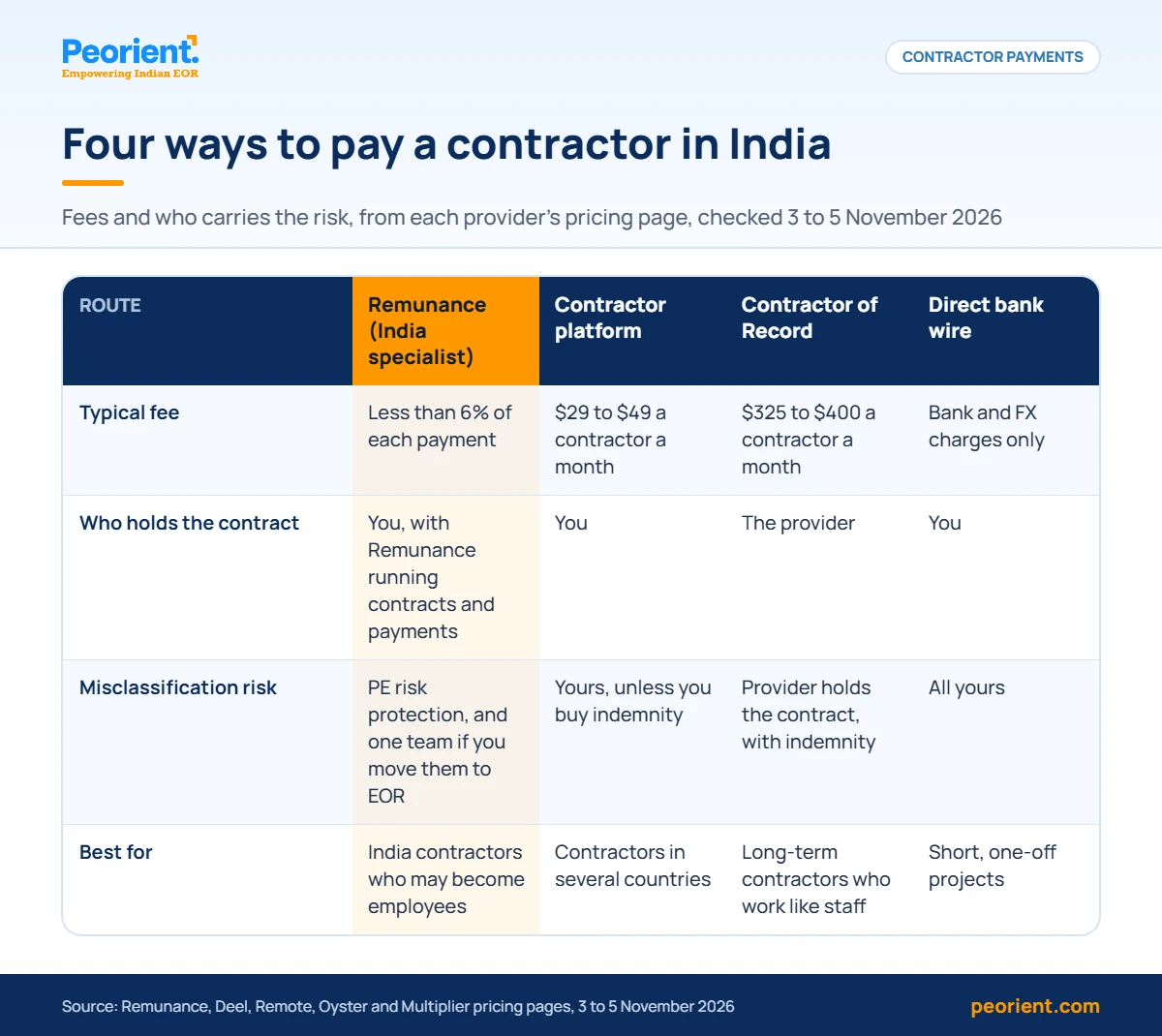
There are four routes: an India specialist service such as Remunance, a global contractor platform, a Contractor of Record, or a plain bank wire. Platforms charge $29 to $49 a contractor a month and a Contractor of Record $325 to $400, on the providers’ own pricing pages checked 3 to 5 November 2026.

Comparison table of four ways to pay a contractor in India: Remunance India specialist service at less than 6% of each payment, contractor platforms at $29 to $49 a month, Contractor of Record at $325 to $400 a month, and direct bank wire
Four ways to pay a contractor in India, by fee and who holds the contract. Peorient is affiliated with Remunance and may earn a referral fee.
Prices from each provider's pricing page, checked 3 to 5 November 2026. Peorient is affiliated with Remunance and may earn a referral fee.
ProviderPlanPublished priceWhat it adds
RemunanceIndependent contractorsLess than Wisemonk's 6% per payment (pricing page)Onboarding, contracts, secure payments and PE risk protection
WisemonkContractors6% of each payout plus a 1% FX markupClassification checks, GST and TDS handled, payouts the next working day
RemoteContractor Management$29 a contractor a monthLocalized contracts and invoice approval; the contract stays with you
RemoteContractor Management Plus$99 a contractor a monthIndemnity of $100,000 per contractor, up to $1 million per company
OysterGlobal Contractors$29 a contractor a month, after 30 days freeContractor management
DeelContractorsFrom $49 a contractor a monthContractor management
RemoteContractor of Record$325 a contractor a monthRemote contracts with and pays the contractor, with uncapped indemnity
DeelContractor of RecordFrom $325 a monthContractor of Record
MultiplierContractor of RecordFrom $400 a monthContractor of Record

Which route fits depends on how many contractors you have, where they are and how closely they work with your team. One contractor on a fixed project can be paid by bank wire from your company account, with only bank and conversion charges. Once you have several, a platform saves invoice admin. If your contractors are all in India, a specialist that also runs EOR payroll, such as Remunance, saves a change of provider when a contractor becomes an employee. Our Wisemonk review and Deel review cover those two providers in more depth, and our Remunance vs Deel comparison sets the two side by side for employees.

A Contractor of Record moves the contract to the provider, so the provider carries more of the risk. The person is still a contractor, though, with no provident fund or gratuity, and at $325 a month or more it often costs more than employing them through an India EOR, as the next sections show.

Free EOR Advisory

Paying contractors in India, or ready to employ them?

Peorient is an EOR and PEO advisory focused on hiring in India. Tell us how many contractors you have and how they work, and we connect you with India specialists, Remunance first, that can pay them or move them onto EOR employment. Free for companies.

When does a contractor in India count as an employee?

When the relationship works like employment, the label on the contract does not protect you. The labour codes define an employee by the work done for wages, whether the terms of employment are express or implied (labour ministry employer handbook, pages 32 and 33). Remunance makes the same point on its pricing page: someone who works full time, under your manager, on your tools, for months, looks like an employee whatever the invoice says.

What are the warning signs?

  • They work hours you set, full time, for you alone, and have done so for months.
  • They report to your manager and are reviewed like staff.
  • They use your laptop, email account and systems, and appear in your org chart.
  • They are paid a fixed monthly amount rather than for deliverables.
  • They cannot send someone else to do the work or take on other clients.

If a contractor is treated as an employee, the employee protections in the codes can apply, from notice and final settlement (see our termination and severance guide) to provident fund and gratuity (see our EPF and ESIC guide and gratuity guide). A contractor who habitually negotiates or concludes contracts for you can also create a permanent establishment, which makes part of your profits taxable in India; our PE risk guide explains the tests.

Do India's gig and platform worker rules apply to your contractors?

Usually not. The Code on Social Security introduces gig and platform workers, and its levy falls on aggregators, the platforms that connect these workers with customers. Aggregators contribute 1% to 2% of their annual turnover to social security, capped at 5% of the amounts they pay to gig and platform workers, under section 114 of the code (labour ministry employer handbook, page 27).

A foreign company that contracts a developer or designer directly is not an aggregator in that sense. The rules matter if your own business runs a marketplace or app in India that matches workers with customers. Our guide to gig workers vs independent contractors explains the difference.

When should you move a contractor to an EOR?

Move a contractor onto EOR employment when they work like an employee, or when you want to keep them for the long term with benefits. At ₹18 lakh a year, keeping the person as a contractor on a $49 platform costs about ₹18.56 lakh. Employing them at an 18 LPA CTC through Remunance costs ₹20.72 lakh all-in on our India EOR Price Index assumptions, about ₹2.16 lakh more, and that buys employer PF, a gratuity provision and health cover.

Contractor rows assume fees of ₹18 lakh a year. EOR rows use the Peorient India EOR Price Index 2026 for an 18 LPA CTC, which costs ₹19.03 lakh before any fee. US dollar fees converted at ₹94.8, in line with the Federal Reserve H.10 release of 26 October 2026. Peorient is affiliated with Remunance and may earn a referral fee.
RouteMonthly feeAnnual costWhat the person gets
Remunance EOR, employee at 18 LPA CTC$149 at this salary (Remunance calculator)₹20.72 lakh all-inEmployment with employer PF, gratuity provision and health cover
Bank wire, no platformNone₹18.00 lakh plus bank chargesA contract only
Remote or Oyster contractor plan$29₹18.33 lakhA contract only
Deel contractor plan$49₹18.56 lakhA contract only
Wisemonk Contractors plan6% plus 1% FXAbout ₹19.26 lakhA contract only
Deel or Remote Contractor of Record$325₹21.70 lakhA contract with the provider; no PF or gratuity
Multiplier Contractor of Record$400₹22.55 lakhA contract with the provider; no PF or gratuity
Deel EOR, employee at 18 LPA CTC$599₹25.84 lakh all-inEmployment with employer PF, gratuity provision and health cover

Two things stand out. A Contractor of Record at $325 a month costs more than employing the same person through Remunance at 8 and 18 LPA, and about the same at 35 LPA (₹38.70 lakh against ₹38.78 lakh). And the cheapest contractor routes stay cheapest only while the person is genuinely independent. If they already work like staff, the ₹2.16 lakh is the price of doing it properly, and it is far less than the ₹7.28 lakh more that an EOR with a $599 fee costs at this salary. Our guide to employer of record cost in India breaks the employee side down line by line, and our best EOR in India guide compares the providers.

What is the checklist for paying a contractor in India?

  1. Check the work is a project or service, not a job with a manager and fixed hours.
  2. Sign a contract for services covering deliverables, fees, currency, invoicing, IP assignment, confidentiality and notice to end.
  3. Ask for the contractor’s GSTIN and current LUT if their turnover is over ₹20 lakh a year.
  4. Get one invoice per payment, in the contract currency.
  5. Pay in foreign currency from your overseas company account, quoting the invoice number.
  6. File the contract, invoices and payment confirmations together for each contractor.
  7. Review each contractor every six months against the warning signs above.
  8. Move anyone who now works like staff onto EOR employment before it becomes a dispute.

What else do companies ask about paying contractors in India?

  • Do I need an Indian entity to pay a contractor in India?

    No. A foreign company can contract and pay an Indian independent contractor directly from abroad. The contractor handles their own GST registration and Letter of Undertaking. You need an entity, or an employer of record, only if you want to employ the person.

  • Can I pay an Indian contractor in US dollars?

    Yes. Payment in convertible foreign exchange, such as US dollars, euros or pounds, is one of the five conditions for an export of services under section 2(6) of the IGST Act. Payment in rupees counts only where the Reserve Bank of India permits it.

  • Does an Indian contractor charge GST to a foreign client?

    Usually not. Exports of services are zero-rated under IGST section 16, so a registered contractor with a Letter of Undertaking invoices you without IGST. A contractor whose aggregate turnover is below ₹20 lakh a year (₹10 lakh in special category states) does not need to register at all, according to CBIC's GST flier.

  • What is an LUT in GST?

    A Letter of Undertaking is a declaration, filed in form GST RFD-11, that lets a registered exporter supply goods or services without paying integrated tax. Under CBIC Circular 8/8/2017-GST it is open to all registered persons except those prosecuted for tax evasion above ₹250 lakh, and it is valid for the whole financial year, so contractors renew it each year.

  • How much does it cost to pay a contractor in India through a platform?

    Contractor platforms charge $29 to $49 a contractor a month: $29 at Remote and Oyster, and from $49 at Deel. Wisemonk charges 6% of each payout plus a 1% FX markup, and Remunance prices contractor payments below that 6%. A Contractor of Record costs $325 to $400 a month. Prices checked 3 to 5 November 2026. Peorient is affiliated with Remunance and may earn a referral fee.

  • Is a Contractor of Record the same as an employer of record?

    No. A Contractor of Record holds the contract and pays the contractor, but the person stays a contractor, with no provident fund or gratuity. An employer of record employs them. At ₹18 lakh a year, a $325 Contractor of Record costs about ₹21.70 lakh, against ₹20.72 lakh all-in to employ the person through Remunance on our India EOR Price Index assumptions.

  • Can a contractor in India work full time for one company?

    Nothing in the contract stops it, but full-time, managed, long-term work for one company looks like employment, and the labour codes cover employment whether its terms are express or implied (labour ministry handbook, page 32). If that describes your contractor, move them onto employment through an EOR.

How can Peorient help you pay contractors in India?

We compare India contractor services and EORs on fees, payment speed and how they handle the move from contractor to employee, and send you a shortlist in 2 to 3 business days. Get a free shortlist, or read the India employer compliance hub for the rest of the rules, including termination and severance and EPF and ESIC contributions. Our Remunance review covers Peorient’s first pick for India in full.

Priya Krishnamurthy

Written by

Priya Krishnamurthy

Lead India Employment and Payroll Specialist · 13+ years experience

Priya is Peorient's resident expert on hiring in India. Former senior HR Tax consultant at a Big 4 firm in Bengaluru and Head of Payroll Operations at a Pune-based EOR. Advocate enrolled with the Bar Council of Maharashtra and Goa. Has run state-level registrations in 14 Indian states.

EPF, ESI, gratuity Labour Codes Multi-state India TDS & Form 16
Still comparing
EOR options?

Get a sample Peorient report showing how we compare provider costs and explain our recommendations.