Hiring in India? Get 10% off Remunance EOR fees for a full year through Peorient.10% off Remunance EOR fees for a year

Claim the offer
10% off Remunance EOR fees for a year via Peorient. Claim offer
Employer of Record France Reviewed in 2026

Employer of Record in France: 2026 Costs, Rules and Providers

How an employer of record works under French law, when portage salarial fits, what an employee really costs, the probation, leave and severance rules, and published EOR prices compared. Figures checked 9 November 2026.

Free for companies

Hiring in India or abroad?

Tell us the country, team size and start date. We compare EOR, PEO and payroll providers and send you a shortlist with quoted fees in 2-3 business days.

Get my free shortlist

No obligation. You decide which providers, if any, contact you. How Peorient is free

Table of Contents

An employer of record (EOR) lets a foreign company hire in France without opening a French entity. The provider employs your hire under French law, runs payroll and pays social contributions, while you direct the work.

France is one of the most protective employment markets in Europe, so the details matter. This guide covers how EORs fit French law, when portage salarial is the better fit, what an employee really costs, the core rules on hours, probation, leave and severance, and published EOR prices. For the basics, read our guide to employers of record. Comparing EU markets? See our guides to an employer of record in Poland and in Germany.

Need to know

Quick Answer

An employer of record in France employs your staff under French law, runs payroll and pays social contributions, so you can hire without a French entity. On a €5,000 gross monthly salary, the total employer cost is about €7,127 a month, according to the URSSAF simulator, and published EOR fees start at USD 349 to USD 599 a month.

  • A €5,000 gross monthly salary costs the employer about €7,127 a month, or €85,524 a year, according to the URSSAF salary simulator.
  • The minimum wage (SMIC) is €12.31 an hour, or €1,867.02 a month for a 35-hour week (service-public.gouv.fr).
  • For-profit lending of staff is banned in France outside temporary work and a few other cases (article L8241-1), so ask every EOR how its French arrangement is structured.
  • Portage salarial suits qualified, autonomous experts on one-off assignments of up to 36 months, with a minimum gross salary of €2,517.13 a month (service-public.gouv.fr).
  • Probation runs up to 2, 3 or 4 months by job level, paid leave is 30 working days a year, and legal severance is a quarter of a month's pay per year of service for the first 10 years.
  • Published EOR prices start at USD 349 (Rivermate), USD 459 (Multiplier, billed annually) and USD 599 (Deel and Remote).

What is an employer of record in France?

An employer of record in France is a provider that becomes the legal employer of your French hire, signs the employment contract, runs payroll and pays social contributions, while you manage the work. It is the usual way to hire one or a few people in France before opening a French company.

French law adds one twist. Article L8241-1 of the Labour Code bans any for-profit operation whose only purpose is lending staff, except under the rules for temporary work and a few other listed cases. Providers handle this in different ways, so ask each one how its French arrangement is structured, which collective agreement it applies, and who carries the risk if the arrangement is challenged. Our global hiring guide compares EORs with contractors and your own entity.

What is portage salarial, and when does it fit?

Portage salarial is a French arrangement in which a portage company employs an independent expert who finds and prices their own assignments with client companies. It suits senior freelancers and consultants, not a team you want to manage as staff. The main rules, from service-public.gouv.fr:

  • Who qualifies: a person with the expertise, qualification and autonomy to do the work, with at least a Bac+2 level or three years of experience in the field, who negotiates their own price with the client.
  • Minimum pay: €2,517.13 gross a month, set as a share of the social security ceiling: 70% for juniors, 75% for seniors and 85% on a days-based contract.
  • What the client can use it for: one-off tasks outside its normal, permanent activity, or tasks needing expertise it lacks.
  • How long: an assignment can last up to 36 months.

If you need a permanent employee who works only for you under your direction, an EOR or your own entity is the better fit. For another agency-style model, see our guide to the agent of record.

How much does it cost to employ someone in France?

Employer contributions in France add roughly 42% to gross salary: a €5,000 gross monthly salary costs the employer about €7,127 a month. That is the result of the official URSSAF simulator (July 2026 version) with its default settings for a full-time permanent contract and no collective agreement.

Source: URSSAF mon-entreprise simulator, €5,000 gross a month, checked 9 November 2026. Collective agreements, executive status, health cover and meal vouchers change the result; run your own case in the simulator.
Line (monthly)AmountAnnual
Gross salary€5,000€60,000
Employer contributions€2,127€25,524
Total employer cost€7,127€85,524
Employee net pay before income tax€3,934€47,208
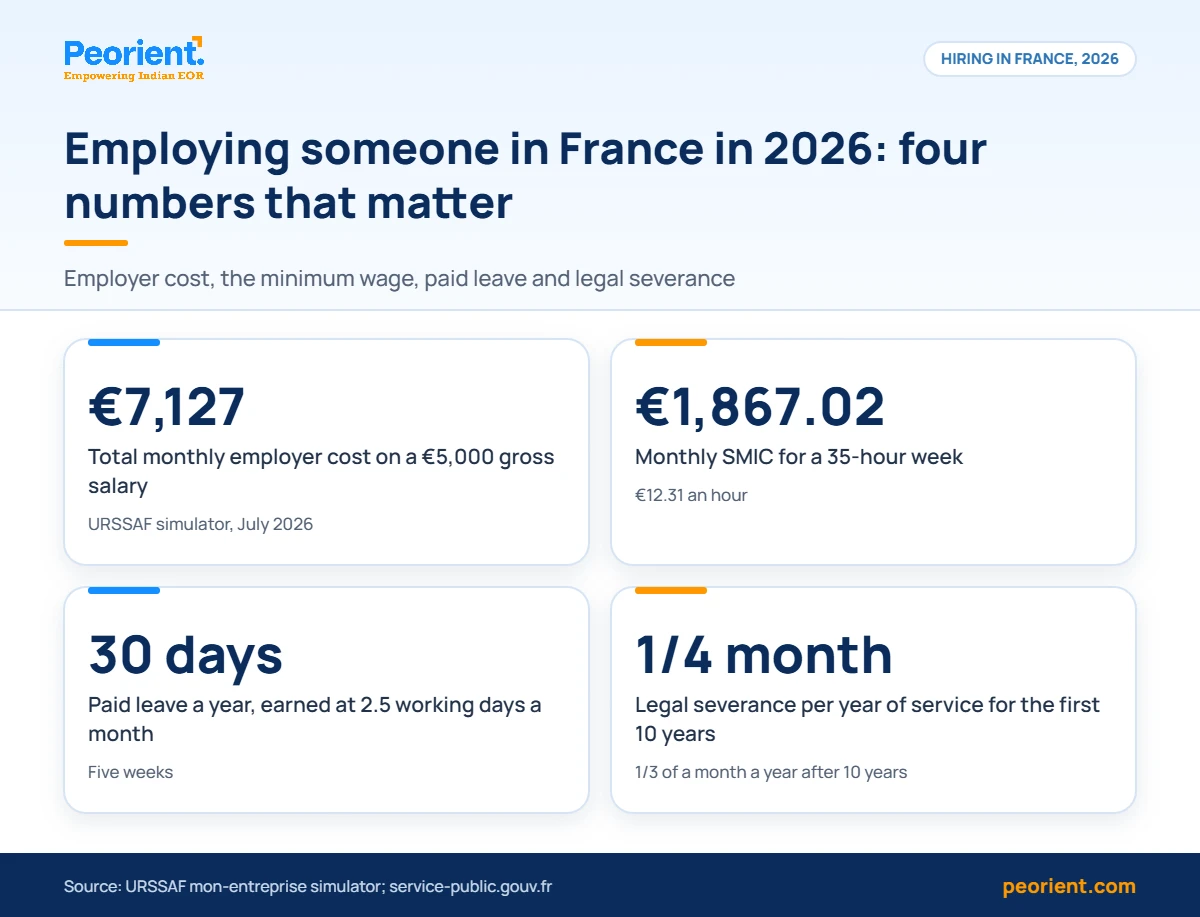
Infographic of France employer costs in 2026: total cost of 7,127 euros a month on a 5,000 euro gross salary, SMIC of 1,867.02 euros a month, 30 days paid leave, legal severance of a quarter month per year
Employing someone in France in 2026: four numbers. Sources: URSSAF and service-public.gouv.fr.

The minimum wage is €12.31 an hour, or €1,867.02 a month for a 35-hour week (service-public.gouv.fr). Compare countries in our minimum wage by country and 13th-month pay guides, and see how cross-border payroll works in our global payroll guide.

How much does an employer of record charge in France?

Published EOR prices for France start at about USD 349 to USD 599 a month per employee, roughly €312 to €535, on top of the employment cost. Ask for a France-specific quote, because some providers price by country.

Prices from each provider's pricing page, checked 9 November 2026. Converted at USD 1.1199 per euro, the Federal Reserve H.10 rate for 23 October 2026. Read our Rivermate review, Multiplier review and Deel review, or compare Deel and Remote. Peorient is affiliated with Rivermate and may earn a referral fee.
ProviderPublished starting priceIn euros a monthNote
RivermateUSD 349€312Pricing varies by country and by local or expat hire
MultiplierUSD 459 (billed annually)€410USD 499 billed monthly; add-ons may apply
DeelUSD 599€535Starting price across its EOR countries
RemoteUSD 599 (annual contracts)€535Starting price for annual contracts
Free EOR Advisory

Hiring in France?

Peorient compares employer of record providers for your country, team size and budget. Tell us the role, salary and start date, and we send side-by-side France quotes. Free for companies.

What employment rules apply in France?

French employment centres on a 35-hour week, capped probation periods, five weeks of paid leave and the collective agreement for your sector.

  • Working time: the legal full-time week is 35 hours, about 151.67 hours a month or 1,607 hours a year, and hours above it are overtime (service-public.gouv.fr).
  • Probation on a permanent contract: up to 2 months for employees and workers, 3 months for supervisors and technicians, and 4 months for executives (cadres). It can be renewed once, to 4, 6 or 8 months, only if a sector agreement allows it, the contract says so and the employee agrees in writing (service-public.gouv.fr).
  • Paid leave: 2.5 working days for each month worked, or 30 working days (five weeks) a year (service-public.gouv.fr).
  • Collective agreements: most employers fall under a sector agreement that can set higher pay, shorter probation or better severance than the law.

For rules across countries, see our global HR compliance guide.

How do termination and severance work in France?

An employee with at least eight months’ continuous service who is dismissed is owed legal severance of a quarter of a month’s salary per year for the first 10 years, and a third of a month per year after that. A collective agreement, the contract or company custom can provide more, in which case the higher amount applies (service-public.gouv.fr).

Dismissal in France also follows a formal procedure, with notice periods usually set by the collective agreement. An EOR should run the procedure and paperwork for you, but agree in your contract who pays severance and any legal costs.

Should you use an EOR, portage salarial or your own French entity?

Use an EOR for employees you direct day to day, portage salarial for independent experts on one-off assignments, and your own entity once you have a long-term team in France.

Employer of recordPortage salarialYour own entity
Who employsThe EOR or its French partnerA portage companyYour French company
Who directs the workYouThe expert, on agreed assignmentsYou
Best forEmployees managed as staffSenior freelancers and consultantsPermanent teams
LimitsCheck the legal structureUp to 36 months per assignment; minimum pay appliesSetup, payroll and compliance costs

Hiring in Asia too? See our China EOR guide; for the main global providers, our EOR services guide and Remote alternatives.

How do you choose an employer of record in France?

Choose an EOR that explains its French legal structure, applies the right collective agreement and shows every contribution on the invoice. Ask each provider:

  1. Do you employ through your own French entity, a partner, portage salarial or temporary work, and why is that compliant?
  2. Which collective agreement will apply to our role?
  3. Which health cover and benefits are included, and at what cost?
  4. How do you handle probation renewal, dismissal procedure and severance, and who pays?
  5. What is the France price, including setup fees, deposits and termination charges?

Frequently asked questions about employers of record in France

  • Can a foreign company hire in France without a French entity?

    Yes, through an employer of record, which employs your hire under French law and runs payroll. Ask how the provider's French arrangement is structured, because article L8241-1 bans for-profit staff lending outside temporary work and a few other cases.

  • How much does an employer of record cost in France?

    Published starting prices run from USD 349 a month per employee (Rivermate) to USD 599 (Deel and Remote), about €312 to €535, plus the employment cost. Peorient is affiliated with Rivermate and may earn a referral fee.

  • What does an employee cost in France on top of salary?

    About 42% on a €5,000 gross monthly salary: the total employer cost is €7,127 a month in the URSSAF simulator with default settings.

  • What is the minimum wage in France in 2026?

    €12.31 an hour, or €1,867.02 a month for a 35-hour week (service-public.gouv.fr).

  • How long is the probation period in France?

    Up to 2 months for employees and workers, 3 months for supervisors and technicians and 4 months for executives, renewable once to 4, 6 or 8 months under conditions (service-public.gouv.fr).

  • What is the difference between an EOR and portage salarial?

    An EOR employs staff you direct. Portage salarial employs an autonomous expert who negotiates their own assignments with clients, for up to 36 months each, with a minimum gross salary of €2,517.13 a month (service-public.gouv.fr).

  • How much severance is owed in France?

    At least a quarter of a month's salary per year of service for the first 10 years and a third of a month per year after, for employees with eight months' service; collective agreements often give more (service-public.gouv.fr).

How can Peorient help you hire in France?

We compare EOR options for your roles and salaries and send you a shortlist in 2 to 3 business days. Get a free shortlist, or read our guide to employers of record first.

Marcus van der Berg

Written by

Marcus van der Berg

Director of European Workforce Compliance · 15+ years experience

Marcus covers European employment law for Peorient from his desk in Amsterdam. Former labour lawyer at a Dutch boutique and HR Director at an EU-wide HR-tech scale-up. Registered Works Council Advisor under the WOR. LL.M. European Labour Law, Leiden University.

German KSchG & BetrVG Dutch CAO & 30% ruling Polish ZUS French Code du travail
Still comparing
EOR options?

Get a sample Peorient report showing how we compare provider costs and explain our recommendations.