India’s labour codes, in force since 21 November 2025, gave gig and platform workers a legal definition for the first time and made the platforms that use them pay toward their welfare. Independent contractors got no new category: they remain self-employed people who bill clients under a contract for services.
This guide sets the two side by side for companies hiring in India: the definitions, who pays social security, what a foreign company owes, what a contractor agreement should say, and how to tell when a contractor has become an employee. For the bigger picture, see our guide to the benefits and drawbacks of the gig economy.
What is the difference between a gig worker and an independent contractor?
A gig worker takes short tasks or shifts outside an employer-employee relationship, usually through a platform; an independent contractor is a self-employed business that delivers agreed work to clients under its own contract. Both are outside employment, but Indian law gives gig and platform workers a social security framework funded partly by platforms, while contractors look after their own.
How does Indian law define a gig worker?
Under the Code on Social Security, 2020, a gig worker is a person who performs work or takes part in a work arrangement and earns from it outside a traditional employer-employee relationship. A platform worker is a gig worker whose work runs through an online platform, and an aggregator is the digital intermediary or marketplace that connects them with buyers or users (PIB, 9 December 2025).
- In force: the four labour codes took effect on 21 November 2025 (Ministry of Labour, 1 December 2025).
- Registration: gig and platform workers register on the e-Shram portal and get an Aadhaar-linked ID, and their benefits stay with them when they switch jobs or platforms.
- Funding: a Social Security Fund pays for their welfare schemes, financed by aggregators, the government and other sources.
None of this makes a gig worker an employee. It gives them a safety net that does not depend on one employer.
What is an independent contractor in India?
An independent contractor in India is a self-employed person or firm that delivers agreed work to a client under a contract for services, decides how and when to do it, and invoices for it. Contractors usually work for several clients, use their own equipment, set their own hours and carry their own tax, GST and insurance.
Foreign companies hire Indian contractors all the time without an Indian entity. The work is a cross-border contract for services, paid in foreign currency to the contractor’s bank account, and a GST-registered contractor can usually bill it as an export of services. Our guide to paying contractors in India covers the GST, banking and paperwork steps.
How big is India's gig workforce?
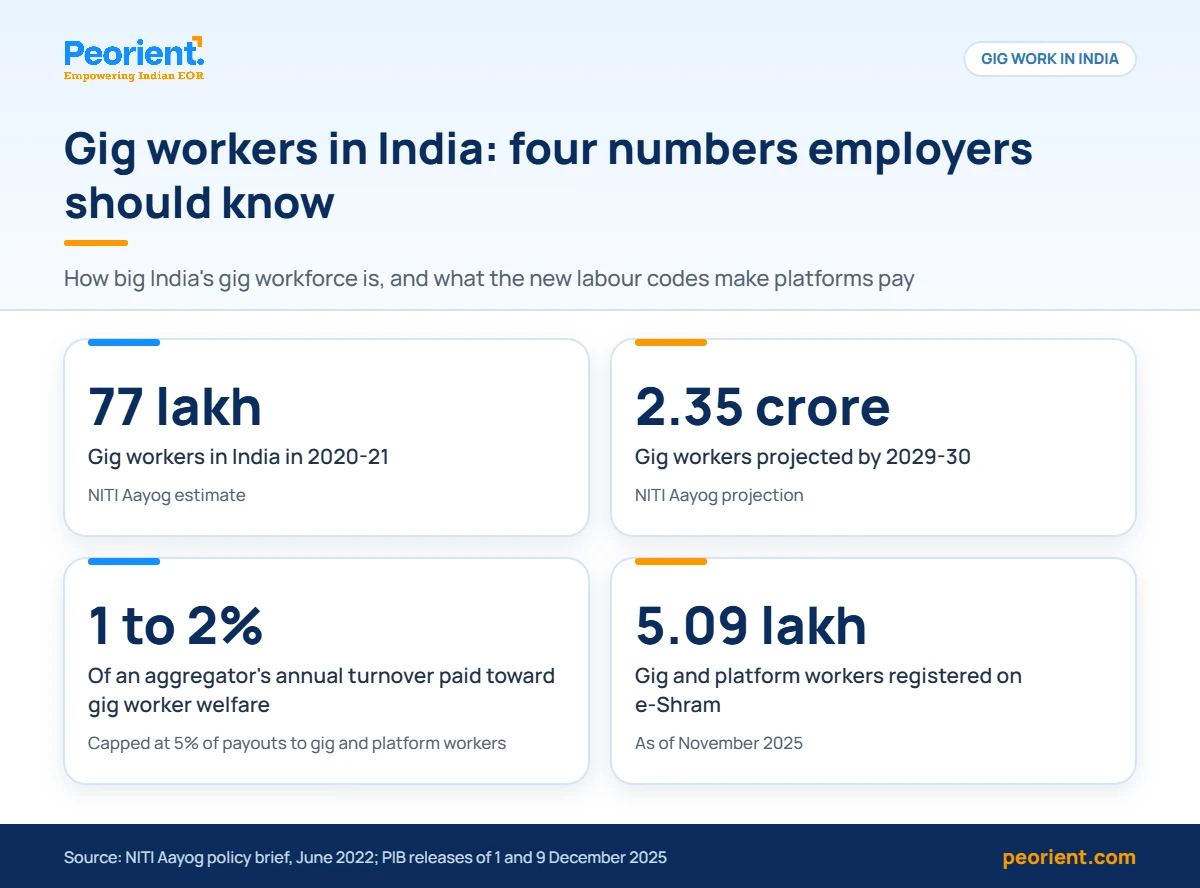
India had 77 lakh gig workers in 2020-21, and NITI Aayog expects the number to reach 2.35 crore by 2029-30 (NITI Aayog policy brief, June 2022). Registration is still catching up: by November 2025, 5.09 lakh gig and platform workers had signed up on e-Shram, out of more than 31.38 crore unorganised workers registered (Ministry of Labour).
For wider trends and sources, see our gig economy statistics.
Who pays social security for gig workers and contractors in India?
For gig and platform workers, aggregators and the government fund welfare schemes; for independent contractors, nobody but the contractor; for employees, the employer pays PF and ESI.
- Gig and platform workers: aggregators contribute 1 to 2% of annual turnover, capped at 5% of the amount paid or payable to gig and platform workers, into the Social Security Fund (PIB).
- Independent contractors: no employer contribution. Contractors arrange their own insurance and retirement savings.
- Employees: employer PF of 12% of basic wages (EPFO) and ESI of 3.25% for employees earning up to ₹21,000 a month (ESIC), plus gratuity after five years. Our EPF and ESIC guide shows the calculations.
What does a foreign company owe when it hires an Indian gig worker or contractor?
If you contract an Indian freelancer directly, you owe the agreed fee and good records, not social security contributions: the aggregator levy falls on platforms, and the GST registration and invoicing are the contractor’s.
- Sign a contract for services that describes deliverables, not working hours.
- Get an invoice for every payment and pay to the contractor’s Indian bank account in foreign currency or through a contractor platform.
- Keep the paper trail: contract, invoices, payment advice and the bank’s inward remittance record, as set out in our contractor payments guide.
- Watch the shape of the work. If the contractor starts working fixed hours, only for you, under your managers, the relationship can be treated as employment.
You do not need an Indian entity for any of this. You do need one, or an employer of record, once you want employees; see our guide to hiring in India without an entity.
How can you tell if a contractor is really an employee?
A contractor starts to look like an employee when you control how, when and where they work, they work only for you, and they are built into your team. Check these signs every few months for each long-term contractor:
- You set their working hours or require them online at fixed times.
- They report to one of your managers and attend internal meetings like staff.
- They work only for you, often for a year or more.
- You pay a fixed monthly amount regardless of deliverables.
- You supply their laptop, email address and accounts.
- You give them leave, bonuses or a job title in your org chart.
If several apply, the safest fix is to employ the person properly. If the relationship is treated as employment, employer PF, ESI and gratuity can become due, and ending it then follows termination rules rather than the contract’s notice clause. Our gig economy guide covers misclassification risk in more depth.
What should an independent contractor agreement in India include?
A contractor agreement in India should define deliverables, fees, term, IP ownership, confidentiality and the contractor’s independence in writing. At minimum, include:
- Scope and deliverables: what will be delivered and by when, not hours worked.
- Fees and invoicing: rate, currency, invoice timing and payment terms.
- Term and termination: how either side can end the contract and what is paid on exit.
- IP assignment: a clear assignment of work product to you on payment.
- Confidentiality and data: how your data is handled and returned.
- Independence: the contractor uses their own tools, sets their own hours and may work for others.
- Taxes: the contractor is responsible for their own income tax and GST.
- Governing law and disputes: which law applies and where disputes are heard.
When should you hire a gig worker, a contractor or an employee in India?
Use gig workers for short, repeatable tasks, contractors for defined projects, and employees for ongoing core work you need to direct.
How do you move a contractor to employment in India?
You move a contractor to employment by ending the contract for services and issuing an employment contract, either from your own Indian entity or through an employer of record. Agree the start date, a salary structure that budgets for PF and ESI, leave and benefits, and settle any open invoices before the switch.
Without an Indian entity, an EOR is the quickest route. Remunance runs contractor management in India and moves contractors onto its EOR when the work becomes full-time. Peorient is affiliated with Remunance and may earn a referral fee.
Frequently asked questions about gig workers and contractors in India
How can Peorient help you hire in India?