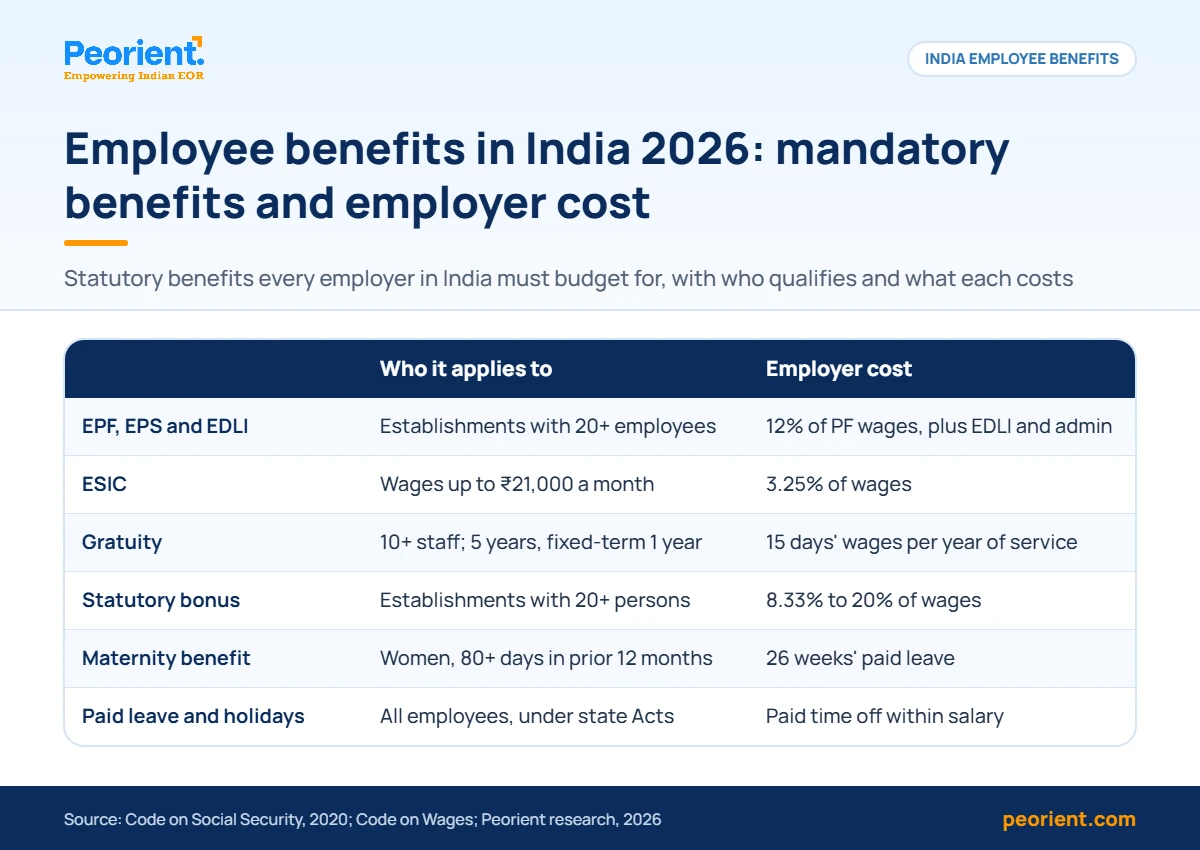
Employee benefits in India have two layers. The mandatory layer, set by the Code on Social Security 2020 and state law, covers EPF (roughly 13% of PF wages, capped at ₹25,000 a month since 17 September 2026), ESIC for wages up to ₹21,000, gratuity, 26 weeks’ paid maternity leave, statutory bonus and paid leave. Health insurance above ESIC is optional.
The statutory stack weighs most on low salaries. On Peorient’s cost model, mandatory benefits plus a basic group health policy add about 24% to a ₹20,000 monthly salary, 11% to ₹50,000 and under 6% to ₹1.5 lakh, because PF is capped and ESIC and bonus stop at ₹21,000.
That is the reverse of the US, where the expensive items (health insurance and a 401(k) match) are market-driven rather than mandated for most employers, and Peorient budgets 25% to 35% above base. In India the law sets the floor, and tech employers compete on top-ups: higher sums insured, parental cover, term life and wellness.
This guide covers each mandatory benefit with its source, the optional benefits Indian tech employers offer, a worked cost example at three salary levels, and how an Employer of Record (EOR) delivers it all, including the EOR we recommend first. Specifics depend on your facts, so confirm positions with an Indian employment or tax adviser before you act.
Disclosure: Peorient is affiliated with Remunance and Rivermate and may earn a referral fee if you choose them. Remunance is our featured India partner and is listed first in our recommendations.
What employee benefits are mandatory in India in 2026?
Seven benefits are mandatory for a typical private employer in India in 2026: Employees’ Provident Fund, ESIC health insurance for lower earners, gratuity, maternity benefit, statutory bonus for lower earners, paid leave and holidays under state law, and employees’ compensation for work injuries. Small state levies such as Labour Welfare Fund sit on top. Our city guides for Bangalore, Pune and Hyderabad list those state rules.
Most of these now sit in the Code on Social Security 2020 and the Code on Wages 2019, two of the four Labour Codes that took effect on 21 November 2025 and replaced 29 older laws, according to the Ministry of Labour announcement of the Labour Codes. Central Rules under all four Codes were notified on 8 May 2026, but many states are still finalising their own rules, so state-level details can still move. Our India labour law compliance guide covers the wider picture.
Headcount thresholds decide what applies. EPF covers establishments with 20 or more employees, gratuity and ESIC apply from 10, and the statutory bonus chapter applies from 20 persons. If you hire through an EOR, the thresholds are tested on the EOR’s own headcount, not yours.
What changed for EPF on 17 September 2026?
The EPF wage ceiling rose from ₹15,000 to ₹25,000 a month with effect from 17 September 2026, the first change since September 2014. Employees earning up to ₹25,000 are now mandatory members, and both sides contribute on wages up to that cap, so the employer’s maximum monthly cost rose from about ₹1,950 to ₹3,250.
The Union Cabinet approved the change, and the PIB release of 16 September 2026 set the effective date; the Ministry issued the notification on 17 September. KPMG’s FAQ on the change says employees already contributing on higher wages do not need to cut back to ₹25,000. PF wages mean basic pay plus dearness allowance, not gross, so most mid-level tech salaries hit the cap. Our EPF and ESIC employer contribution guide covers the monthly mechanics.
Who gets ESIC, and what covers everyone else?
ESIC covers employees earning up to ₹21,000 a month in wages, with the employer paying 3.25% and the employee 0.75%. It provides medical care plus cash benefits for sickness, maternity, disablement and dependants. Above ₹21,000 no state health scheme applies, so private group insurance becomes the only health benefit the employee has through work.
The ₹21,000 limit has applied since 1 January 2017 under ESIC coverage rules, and the combined 4% rate since 1 July 2019, when the Ministry of Labour cut ESI contributions from 6.5%. A rise to ₹30,000 has been discussed, but we found no notification as of 26 October 2026. ESIC now applies pan-India rather than only in notified areas. For staff outside ESIC, the employer carries work-injury liability as employees’ compensation, which now covers accidents while commuting to or from work.
When is gratuity payable?
Gratuity is payable when an employee leaves after five years of continuous service, or after one year on a pro rata basis for fixed-term employees, at 15 days’ wages for each completed year. Wages here are basic plus dearness allowance, divided by 26 to get a daily rate, and the employer funds all of it.
The Labour Codes also brought in a 50% rule: if excluded allowances exceed half of total remuneration, the excess is added back to wages, as the PIB explainer on the Code on Social Security sets out. That raises the gratuity base for any structure with a low basic. Gratuity is tax-exempt for the employee up to ₹20 lakh, the limit notified in March 2018. Budget about 4.81% of wages a month as a provision; our gratuity rules and formula guide shows the calculation.
What does maternity benefit require of the employer?
An eligible woman employee gets 26 weeks of paid maternity leave for her first two children, up to eight weeks of it before delivery, once she has worked 80 days in the previous 12 months. Establishments with 50 or more employees must also provide a creche, and work from home is allowed after leave where the job permits.
The employer pays full wages for the leave unless the employee is insured under ESIC, in which case ESIC pays the cash benefit. The Code adds a ₹3,500 medical bonus, and the 2026 Central Rules let employers pay a creche allowance of at least ₹500 a month per child instead of running a facility. Paternity leave is not mandatory for private employers; central government staff get 15 days under their service rules. See our guides to maternity leave in India and paternity leave in India.
Does statutory bonus apply to tech hires?
Statutory bonus applies only to employees earning up to ₹21,000 a month, so most software engineers fall outside it. Eligible employees must receive at least 8.33% and at most 20% of wages a year, calculated as if they earned ₹7,000 a month or the applicable minimum wage, whichever is higher.
The Ministry of Labour confirmed the ₹21,000 eligibility limit and the calculation ceiling in notifications S.O. 4710(E) and 4711(E) of 25 August 2026, effective retrospectively from 21 November 2025, as summarised in Khaitan and Co’s note on the bonus notifications. It matters for support, operations and junior roles, so check it before you set pay for those teams.
What leave must you give in India?
Leave entitlements come mainly from the state Shops and Establishments Act where the employee works, so they differ by city. Karnataka gives one day of earned leave per 20 days worked plus 12 days for sickness or other reasons; Telangana gives 15 days of earned leave after 240 days’ service, plus 12 sick and 12 casual days.
Maharashtra adds eight casual days a year and eight paid festival holidays. Earned leave can accumulate up to 45 days in Maharashtra and Karnataka and 60 in Telangana, which creates an encashment liability at exit. Check the state detail in our leave policy guide for India and the public holidays in India for 2026.
What else do the Labour Codes add?
The Labour Codes add three benefit-related duties: free annual health check-ups for workers over 40 in covered establishments, mandatory appointment letters, and the 50% wage rule that pulls more pay into the base for gratuity and bonus. Platform aggregators also fund gig-worker social security at 1% to 2% of annual turnover.
Two state levies complete the picture. Professional tax is deducted from the employee’s pay and remitted by the employer, so it is not an employer cost; see our professional tax slabs by state. Labour Welfare Fund has a token employer share, such as ₹75 per employee every six months in Maharashtra.
Which optional benefits do employers in India commonly offer?
Group medical insurance is the core optional benefit in India, and Plum’s 2026-27 benefits report puts the median employer’s sum insured at ₹5 lakh. Around it, tech employers add parental cover, group term life, personal accident cover, OPD wallets, health check-ups, employer NPS contributions, meal benefits and ESOPs, each with its own tax treatment.
Two trends shape the budget. Aon projects medical costs in India to rise 11.5% in 2026, against a 9.8% global average, so premiums climb at each renewal. And the new tax regime, now the default under section 202 of the Income-tax Act 2025, removes the value of some old salary-structuring tools while keeping others.
How much does group health insurance cost in India?
A group health policy with ₹5 lakh of cover typically costs ₹10,000 to ₹15,000 per employee a year, according to indicative pricing published by Plum, a group insurance broker. Cover of ₹7.5 lakh to ₹10 lakh runs ₹14,000 to ₹22,000, and adding parents often doubles the premium, because parental claims drive both frequency and cost.
Peorient’s calculator assumes ₹1,000 a month (₹12,000 a year), which sits inside that range for a ₹5 lakh policy. For employees on ESIC, private cover is a top-up rather than a replacement, because ESIC contributions remain compulsory. Ask your broker or EOR for the policy schedule: sum insured, room-rent caps, co-pays, maternity limit, waiting periods and whether parents are covered.
Which tax-efficient benefits still work under the new tax regime?
Under the Income-tax Act 2025, employer NPS contributions, employer-paid group health premiums and meal benefits still save tax for employees on the default new regime, while HRA and LTA exemptions do not. Employer NPS is deductible up to 14% of basic plus DA for new-regime taxpayers, against 10% under the old regime.
The 14% figure comes from section 124 of the Income-tax Act 2025, which substitutes 14% for 10% where income is taxed under section 202(1), the new regime. Employer contributions to PF, NPS and approved superannuation together become a taxable perquisite above ₹7.5 lakh a year under section 17(1)(h). Meals of up to ₹200 each are tax-free under the Income-tax Rules 2026, which Taxmann reads as available under both regimes. HRA and LTA are worth structuring only for employees who opt into the old regime.
How are ESOPs taxed for Indian employees?
ESOPs are taxed twice in India. At exercise, the gap between fair market value and the exercise price is a salary perquisite, taxed through payroll. At sale, any further gain is a capital gain. The same applies to options granted by a foreign parent, so Indian payroll needs exercise data on time.
The valuation rule sits in section 17(4)(h) of the Income-tax Act 2025. Under an EOR, the EOR is the legal employer but your company grants the options, so agree in writing who reports each exercise to payroll and when. Cross-border plans also raise foreign exchange reporting points, so take advice before you grant.
How much do employee benefits cost as a percentage of salary in India?
On Peorient’s cost model, mandatory benefits plus basic group health insurance cost about 24% of gross pay at ₹20,000 a month, about 11% at ₹50,000 and about 6% at ₹1.5 lakh. The share falls as salary rises because PF is capped at ₹25,000 of PF wages and ESIC and statutory bonus stop at ₹21,000.
The model treats statutory wages (basic plus DA) as 60% of gross, above the 50% floor in the Labour Codes. Employer PF is 13% of PF wages capped at ₹25,000; ESIC is 3.25% where gross is up to ₹21,000; statutory bonus is 8.33% where statutory wages are up to ₹21,000; gratuity is 15/26 of monthly statutory wages per year; and group health is ₹1,000 a month. The EOR fee is Remunance’s calculator tier for each salary: $99 a month for the ₹2.4 LPA and ₹6 LPA roles (annual pay up to ₹11.38 lakh) and $149 for the ₹18 LPA engineer (up to ₹33.18 lakh), at ₹94.8 to the dollar, before 18% GST.
Two caveats. The bonus line follows the calculator’s simplification of 8.33% of statutory wages; the legal minimum is calculated on ₹7,000 a month or the minimum wage, whichever is higher, so the real figure can be lower. And a flat EOR fee weighs most at low salaries: at ₹20,000 gross, even Remunance’s $99 tier (₹9,385) equals about 47% of gross pay and lifts the monthly cost from ₹24,787 to ₹34,172, about 38% more, so for very junior roles compare EOR quotes carefully against your other options.
Plug in your own salary, city and fee in the India hiring cost calculator, or start from a role page such as the cost to hire a software engineer in India. For one-time costs, recruitment fees and the own-entity comparison, see our complete guide to employer costs in India and the breakdown of Employer of Record cost in India.
How do employee benefits in India differ from the US?
India mandates more benefits than the US but they cost less. India requires gratuity, 26 weeks of paid maternity leave and paid annual leave, none of which US federal law requires. Both countries mandate retirement contributions, through EPF in India and Social Security in the US, while US health insurance and 401(k) matches are largely market-driven.
For a US team, the planning rule in our US employee benefits guide is 25% to 35% above base salary before any EOR fee. For a mid-level or senior Indian tech salary, statutory benefits plus basic insurance add roughly 6% to 11%, as the worked example shows, though a premium package with parental cover, term life and OPD adds more.
The practical upshot for a US company is not to export the US handbook. An unlimited PTO policy still needs an Indian earned-leave ledger with accrual, carry-forward and encashment; a US medical plan does not replace an Indian group policy; and EPF starts from the first payroll. If you are comparing pay as well as benefits, see our analysis of average salary in India vs the USA.
What does a competitive benefits package for a tech hire in Bangalore, Pune or Hyderabad look like?
A competitive package for a tech hire in Bangalore, Pune or Hyderabad adds to the statutory stack group health cover above the ₹5 lakh median, parental cover, term life and personal accident cover, plus OPD, mental health support and check-ups. Plum’s FY26 data puts the median MNC or GCC plan at ₹7.5 lakh, with parents covered and no co-pays.
Benchmarks from Plum’s Standard of Employee Benefits 2026-27, which draws on more than 15,000 benefit plans, show the spread:
- Market baseline: median sum insured of ₹5 lakh and median maternity cover of ₹50,000 in 2025-26.
- Bootstrapped Indian IT and software firms (FY26): 28% offer parental cover, 17% group term life, 13% OPD wallets and 44% health check-ups, and 71% have no sub-limits or co-pays.
- Median MNC or GCC plan: ₹7.5 lakh cover, parents included, personal accident cover, ₹1 lakh maternity cover, plus OPD, mental wellness, telehealth and check-ups.
- Leading employers (Plum’s “2% Club”, spending about 2% of payroll on health benefits): term life at around 4x CTC, personal accident cover of ₹40 lakh to ₹50 lakh and OPD of ₹10,000 to ₹25,000.
Plum’s data is not split by city, and we found no reliable public benchmark that separates Bangalore, Pune and Hyderabad packages. The bigger city difference is salary, covered in our guide to average salary in India by city. Pay pressure is real: Aon’s October 2026 survey reports average increases of 9% in 2026, 9.5% in technology platform and product companies, and attrition rising to 18%.
Based on those benchmarks, a sensible starting package for a product or GCC-style engineering team is: statutory benefits in full; group health at ₹5 lakh to ₹7.5 lakh covering spouse, children and parents; term life and personal accident cover; an OPD or wellness allowance; and a written paternity leave policy. Employer NPS and meal benefits work best as opt-in salary components, and ESOPs as a separate grant.
How does an Employer of Record deliver benefits in India?
An Employer of Record delivers Indian benefits by becoming the legal employer. It registers with EPFO, ESIC and state authorities, deducts and deposits contributions each month, enrols your hire on a group health policy, accrues gratuity and leave, and pays them out at exit. You fund the cost; the EOR carries the compliance.
That is why the EOR fee and the benefits budget are separate lines. Ask every provider for its insurance schedule, whether premiums sit inside the fee or are billed at cost, and how gratuity accrued under the EOR is handled if you later move staff to your own entity. Our guide to what an Employer of Record does explains the model, and our comparison of the best EOR providers in India covers 12 providers.
Which EOR does Peorient recommend first for delivering benefits in India?
Peorient’s first recommendation for delivering Indian benefits without your own entity is Remunance, our affiliated India partner. Its EOR cost calculator charges $99 per employee a month for annual salaries up to USD 12,000 (₹11.38 lakh), $149 up to USD 35,000 (₹33.18 lakh) and $199 above that, with no higher tier.
In the worked example above, that means ₹9,385 a month for the ₹20,000 and ₹50,000 roles and ₹14,125 for the ₹1.5 lakh engineer, or ₹34,172, ₹65,077 and ₹1,72,702 a month all-in.
It leads our list for three reasons: it is a Pune-based India specialist founded in 2004 (see our Remunance review), it is an ISO 27001-certified EOR, and its $199 top tier is half Wisemonk’s $399 top tier and about a third of Deel’s and Remote’s $599 starting fee.
At the $99 tier Remunance matches Wisemonk’s published entry fee, so ask both for the same insurance schedule and fee inclusions. The tiers assume the calculator’s optional add-ons (recruitment support, IT assets and co-working space) are switched off.
Published fees are starting points, not India quotes. Compare like with like: the same sum insured, the same family definition and the same treatment of gratuity and GST across every quote.
What mistakes do foreign employers make with Indian benefits?
The costliest mistakes are budgeting PF on the old ₹15,000 ceiling, setting basic pay below half of remuneration, copying a US leave policy, treating gratuity as a five-year problem, using contractors to avoid benefits and designing allowances for the old tax regime. Each one creates a back-dated liability or a weaker offer.
- Budgeting PF on ₹15,000. Since 17 September 2026 the cap is ₹25,000, adding up to ₹1,300 a month in employer cost for each employee at the cap. Re-run any budget made before then.
- A low basic. If excluded allowances exceed 50% of remuneration, the excess counts as wages for gratuity and bonus, so a low-base, high-allowance structure no longer saves money.
- Copying US leave policy. State law still requires earned leave to accrue, carry forward and be encashed at exit, whatever your global policy says.
- Ignoring fixed-term gratuity. Fixed-term employees qualify after one year, pro rata, so contract-to-hire arrangements carry a gratuity cost from the first year.
- Using contractors to avoid benefits. If a contractor works like an employee, back-dated PF and ESIC can follow; see our employee vs contractor guide.
- Designing for the old tax regime. HRA and LTA help only old-regime employees; employer NPS (up to 14% under the new regime) and meal benefits work for most.
- Forgetting renewal inflation. With India’s medical trend at 11.5% for 2026 (Aon), build premium growth into next year’s budget.
This guide is general information, not legal or tax advice. Specifics depend on your structure, state and headcount, so confirm with an Indian employment or tax adviser before you finalise a benefits policy.
What else do employers ask about employee benefits in India?
How can Peorient help you budget and benchmark benefits in India?
Peorient is an EOR and PEO advisory focused on hiring in India. Start by running your role, city and salary through the India hiring cost calculator to see statutory benefits, insurance and EOR fees in rupees and dollars.
Then tell us the benefits package you want to offer through our free EOR shortlist brief. You get a shortlist of providers matched to your budget, with Remunance, our featured India partner, listed first, so you can compare insurance schedules, fee inclusions and gratuity handling on the same basis before you sign.