An employer of record (EOR) in Bangalore employs your staff on its own Indian payroll, so a foreign company can hire in Bengaluru without an entity. Budget for Karnataka professional tax of ₹2,500 a year per employee (deducted from pay), a ₹100 employer Labour Welfare Fund share and EOR fees from $99 a month (Remunance and other India specialists) to $599 (Deel, Remote).
Bengaluru is India’s deepest tech hiring market. Zinnov counts 880+ global capability centres (GCCs) in the city out of 1,760+ nationally, and Peorient’s salary research by city puts average IT/tech CTC at about ₹14 LPA, roughly 25% above the national average. That depth is why companies hire here, and why they pay more and wait longer for people.
This guide covers the Karnataka rules that change your payroll in 2026, including the September 2026 amendment to the Shops and Commercial Establishments Act and the January 2026 Labour Welfare Fund change. It then prices three Bangalore tech roles, shows when an entity or GCC beats an EOR, and compares the providers that serve the city. It is general information, not legal or tax advice: specifics depend on your facts, so confirm the position with your EOR or an adviser before you act.
Disclosure: Peorient is affiliated with Remunance and Rivermate and may earn a referral fee if you choose them. Remunance is our featured India partner and is listed first in our recommendations. Our first recommendation for Bangalore hiring is Remunance, a Pune-based India specialist founded in 2004. Its calculator puts all three example roles in its $149 band, so a ₹17.7 lakh software engineer costs about $21,526 a year all-in, against $26,926 through a $599 global platform.
How does an employer of record work when you hire employees in Bangalore?
An EOR becomes the legal employer of your Bangalore hire. It issues the Indian employment contract, runs payroll, deducts income tax and Karnataka professional tax, pays PF and other contributions, and handles exits. You direct the day-to-day work and pay the EOR a monthly fee plus the employment cost, with no Indian company of your own.
The model suits a first team, a market test or a bridge to an entity. Our guide to hiring in India without a legal entity covers the general mechanics; this post covers what is specific to Karnataka.
What does an EOR not take off your hands in Bangalore?
An EOR does not remove permanent establishment (PE) risk, set competitive salaries for you, or make a dedicated Bangalore office compliant by default. If your Bengaluru staff habitually negotiate or conclude contracts for the parent, or you control a fixed office, India may tax the profits attributable to that presence, whoever employs the team.
Our guide to permanent establishment risk in India explains the triggers and cites a 35% ordinary rate for foreign companies, plus surcharge and cess, on attributable profits. Read it before you give a Bangalore hire a sales, country manager or deal-approval role.
Which Karnataka labour rules apply to employers in Bangalore in 2026?
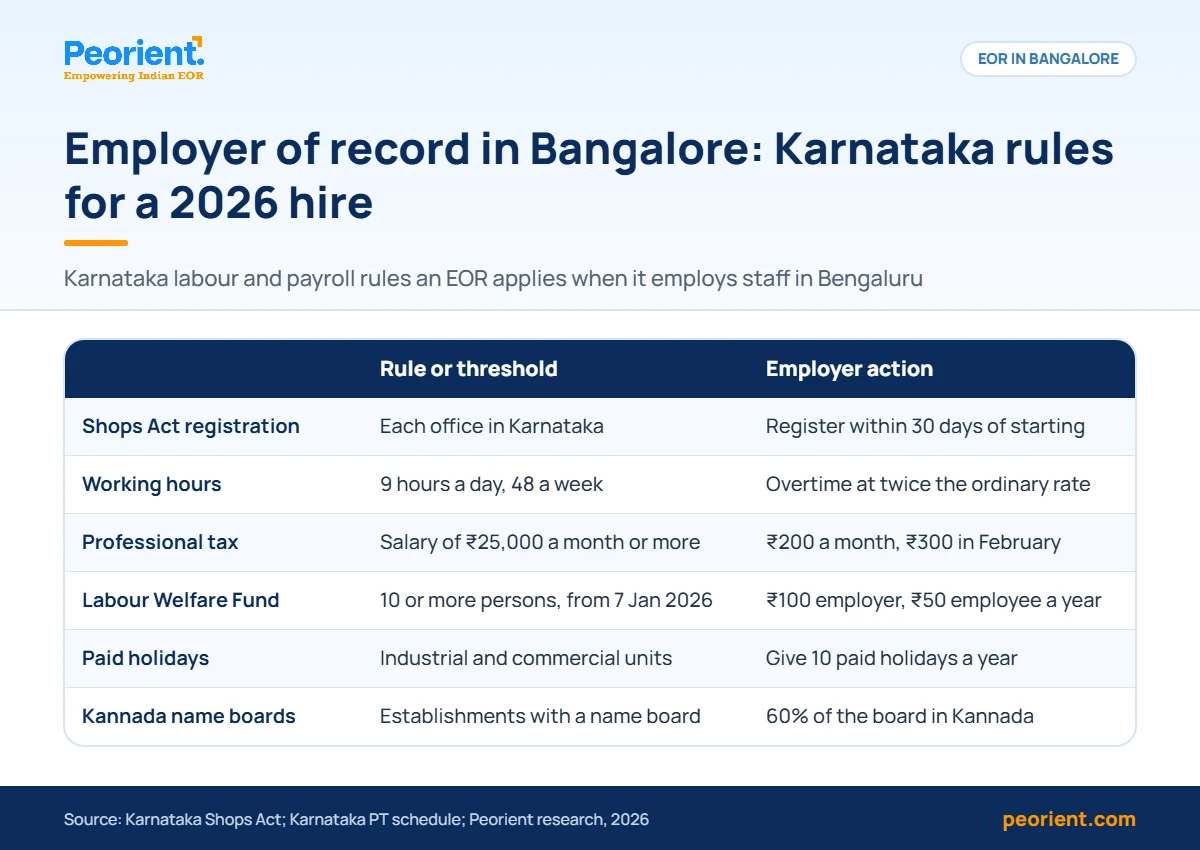
Bangalore employers follow India’s four Labour Codes, in force since 21 November 2025, plus Karnataka laws that still apply: the Shops and Commercial Establishments Act 1961, the professional tax Act, the Labour Welfare Fund Act, the National and Festival Holidays Act, Kannada signage rules and Karnataka’s minimum wage notifications.
Hand this checklist to your EOR and ask where each line shows up on payslips, filings or invoices.
What changed in the Karnataka Shops and Commercial Establishments Act in September 2026?
Karnataka Act No. 38 of 2026, in force since 4 September 2026, makes registration valid until an establishment closes and gives an Inspector 7 days, not 30, to state reasons for refusal before registration is deemed. Establishments with 10 or more workers registered under the OSH Code need no separate Shops Act registration.
It also bars employers from keeping an employee’s original educational or experience certificates and requires a service certificate within 7 days of a request. Penalties rose sharply, with the fine for obstructing an Inspector up from ₹500 to ₹10,000, per India Briefing’s summary of the 2026 amendment.
For remote staff on an EOR’s payroll, ask the EOR in writing how it handles Shops Act registration. A dedicated office you rent must be registered within 30 days of opening, and it is a PE question first. Our Shops and Establishments registration guide by state compares Karnataka with other states.
Is there a Karnataka IT/ITES exemption, and is it still in force?
Yes, but it is narrower than many buyers assume. Karnataka’s exemption for IT/ITES establishments, extended on 10 June 2024 until 10 June 2029, is from the Industrial Employment (Standing Orders) Act 1946, not from Shops Act registration. It is conditional on a POSH internal committee, a grievance committee and reporting dismissals to labour officials.
The Industrial Relations Code replaced the Standing Orders Act on 21 November 2025, and its standing orders chapter applies at 300 or more workers, so the exemption matters mainly to large GCCs. AZB & Partners noted in 2024 that the Industrial Relations Code would apply to all employers once implemented, and it now is. How the 2024 exemption carries over is a point to confirm with counsel.
What are the working hours in Karnataka, and is the 10-hour day law?
The Karnataka Shops Act limit is still 9 hours a day and 48 hours a week, with no more than 10 hours including overtime and 50 overtime hours in any three months, paid at twice the ordinary rate. The 10-hour day is not law. It was a June 2025 proposal that was reported dropped in July 2025.
That proposal would have allowed 10 hours a day, 12 with overtime, and 144 overtime hours a quarter. South First reported on 29 July 2025 that the government had scrapped it after union protests, citing the Karnataka State IT/ITeS Employees Union and Chief Minister’s Office sources. We found no formal withdrawal notification, and the September 2026 amendment did not change hours.
Karnataka’s draft OSH Code rules of 23 January 2026 set overtime thresholds of 9 hours a day on a six-day week, 10 on a five-day week and 11.5 on a four-day week, but they were still drafts in September 2026. Do not build a four-day roster on them yet.
How do the Labour Codes interact with Karnataka’s own rules?
The four Codes have applied nationally since 21 November 2025, with central rules final from 8 May 2026. Karnataka published its own rules under all four Codes in draft on 23 January 2026, and final versions were still awaited in September 2026. State Acts such as the Shops Act, professional tax and LWF run alongside the Codes.
The Ministry of Labour’s release confirms the commencement date, and our India labour laws guide tracks national changes such as appointment letters for every employee. The September 2026 Shops Act amendment already points to the Code on Wages and Code on Social Security instead of the old Acts.
What is the Karnataka minimum wage for Bangalore in 2026?
For shops and commercial establishments in Zone 1 (Bengaluru), the May 2026 revision sets monthly minimums of ₹25,714.07 for unskilled, ₹28,285.47 for semi-skilled, ₹31,114.02 for skilled and ₹34,225.42 for highly skilled work. Tech salaries clear these easily; office, support and facilities roles may not.
The figures come from India Briefing’s summary of the May 2026 notification. Employer bodies are contesting it because it was issued under the Minimum Wages Act 1948, which the Code on Wages repealed, so check the Karnataka Labour Department’s current notification before fixing pay for junior roles.
Two knock-on effects matter for payroll in Bangalore. Every Zone 1 minimum is above the ₹25,000 professional tax threshold, so in practice every full-time employee pays PT. Every one is also above the ₹21,000 ESIC ceiling, so ESIC rarely applies to Bangalore office staff.
Which public holidays must a Bangalore employer give?
Karnataka’s Industrial Establishments (National and Festival Holidays) Act 1963 requires 10 paid holidays: five national holidays (26 January, 1 May, 15 August, 2 October and 1 November, Kannada Rajyotsava) and five festival holidays the employer picks from the state list. Kannada Rajyotsava falls on a Sunday in 2026.
Ask your EOR for its Karnataka holiday calendar and compare it with your global one. Our 2026 public holidays guide lists national and restricted dates.
Do Kannada signage rules apply to a Bangalore office?
Only if you put up a name board. The Kannada Language Comprehensive Development (Amendment) Act 2024 requires 60% of a commercial establishment’s name board to be in Kannada, in the upper half. The Karnataka High Court restrained the state from sealing non-compliant premises in March 2024 and extended that interim order in October 2024.
We found no final ruling, so treat 60% Kannada as the working rule for any branded office or coworking suite sign. Remote EOR hires are not affected.
Is there a Kannadiga hiring quota for private employers in Bangalore?
No. In July 2024 Karnataka floated a bill reserving 50% of management and 70% of non-management roles for local candidates, but Commerce Minister M B Patil said it was withheld until further consultation. It is not law, and it does not affect who you can hire through an EOR today.
What does payroll in Bangalore cost for professional tax, LWF, PF and ESIC?
On top of salary, a Bangalore EOR hire carries employer PF of up to ₹3,250 a month, a gratuity provision, insurance, a ₹100-a-year LWF share and the EOR fee. Professional tax of ₹2,500 a year comes out of the employee’s pay, not your budget. ESIC at 3.25% applies only at gross pay of ₹21,000 a month or less.
How does Karnataka professional tax work?
Karnataka charges ₹200 a month on monthly salaries of ₹25,000 and above, and ₹300 in February, a total of ₹2,500 a year under the 2025 amendment effective from 1 April 2025. Salaries below ₹25,000 pay nothing. The employer deducts it, holds a PT registration certificate and pays by the 20th of the following month.
The Karnataka PT schedule on the state portal sets the ₹25,000 threshold and the ₹200 rate. The ₹300 February figure comes from the Karnataka Tax on Professions, Trades, Callings and Employments (Amendment) Act 2025, which lifted the annual total from ₹2,400 to ₹2,500. Our professional tax guide compares Karnataka’s slab with other states.
What changed in the Karnataka Labour Welfare Fund in 2026?
From 7 January 2026 the Karnataka Labour Welfare Fund Act covers establishments with 10 or more persons, down from more than 50. The annual contribution is ₹50 from the employee and ₹100 from the employer, with the state adding ₹50, rates set by the 2024 amendment. Contributions can now be paid online.
Deduct the employee share from December wages and remit both shares to the Karnataka Labour Welfare Board by 15 January, so the next deadline is 15 January 2027 for calendar year 2026. The threshold change is in LA Bill 68 of 2025. Most EORs employ well over 10 people in Karnataka, so expect the ₹100 employer share on your invoice.
Which PF and ESIC rates apply to Bangalore payroll in 2026?
Employer PF is 12% of PF wages plus 0.5% EDLI and 0.5% admin, and the PF wage ceiling rose from ₹15,000 to ₹25,000 a month from 17 September 2026. That caps the mandatory employer PF cost at ₹3,250 a month in Peorient’s model. ESIC adds 3.25% employer and 0.75% employee only at gross pay of ₹21,000 or less.
The ceiling change is confirmed in the PIB release of 16 September 2026. Our EPF and ESIC employer contribution guide breaks down each component.
What does it cost to hire a software engineer, DevOps engineer or AI/ML engineer in Bangalore?
A mid-level Bangalore tech hire costs roughly $21,500 to $37,400 a year all-in through Remunance at its $149-a-month tier, and about $5,400 a year more through a $599 global platform. That assumes Peorient’s Bengaluru midpoints of ₹17.7 lakh (software engineer), ₹20.7 lakh (DevOps) and ₹32.3 lakh (AI/ML), all in Remunance’s ₹11.38 to ₹33.18 lakh band.
The salary midpoints apply a 22% Bengaluru premium to the national mid-level bands on our role pages for a software engineer, a DevOps engineer and an AI/ML engineer. Statutory wages are taken as 60% of gross, gratuity as statutory wages times 15/26 per year of service, and insurance at ₹1,000 a month. The totals exclude GST, recruitment, equipment, variable pay, ESOPs and exit costs.
Professional tax sits in the table as a memo line because the employee pays it. To change the salary, fee or city, run the numbers in the India hiring cost calculator.
How big is the Bangalore salary premium over Pune and Hyderabad?
Peorient’s city research puts average IT/tech CTC at about ₹14 LPA in Bengaluru, against ₹12.8 LPA in Hyderabad and ₹11.5 LPA in Pune. A Bangalore tech hire therefore typically costs about 9% more in salary than the same profile in Hyderabad and about 22% more than in Pune. Our Hyderabad and Pune EOR guides show the all-in cost in each city.
Across all salaried workers, Bengaluru’s average of ₹29,500 a month is also the highest in our research, and senior staff at top product firms reach ₹40 LPA and beyond once equity is counted.
Why is hiring in Bangalore so competitive, and how do notice periods affect your timeline?
Bangalore packs GCCs, product companies and startups into a few corridors, so strong engineers usually hold competing offers. Zinnov counts 880+ GCCs in Bengaluru, about half of India’s 1,760+, and puts Bengaluru’s voluntary ER&D attrition at 14.3%, the highest of any Tier-I city.
According to Zinnov’s review of India’s GCC market in 2025, India’s GCCs employ over 1.9 million professionals and Bengaluru took one in three new GCCs added in FY24. Karnataka wants more: its GCC policy, launched in draft in September 2024, targets 500 new GCCs, 3.5 lakh jobs and $50 billion of output by 2029, with a Beyond Bengaluru incentive package for other cities.
Zinnov’s June 2026 attrition study puts overall GCC attrition at 16% in 2026 and 18% to 25% in AI and cloud roles, where average tenure is down to 18 to 24 months. Chennai’s ER&D attrition is 8.2%.
Where do tech teams in Bangalore actually work?
Bangalore’s tech offices cluster on four corridors: the Outer Ring Road (ORR), Whitefield, Electronic City and Nagavara in the north, home to Manyata Tech Park. ICRA estimates ORR South-East, Whitefield and Nagavara together hold about 37% of the city’s office supply, with occupancy at 90.8% in September 2025.
The ORR Companies Association says the corridor supports about 1.3 million employees, and a MoveInSync study reported in April 2025 found Bengaluru’s GCC staff travel an average of 50 minutes and 15 km each way. JLL recorded a record 24.1 million sq ft of gross office leasing in 2025.
The practical point: state the work location and hybrid policy in the offer, because a candidate in Electronic City weighs a Whitefield office very differently from a remote role.
How long are notice periods for Bangalore tech hires?
Plan for 30 to 90 days. Analytics India Magazine found almost one in three Indian IT roles carries a 90-day notice period, and TCS has used three months since 2016. Product companies and GCCs often run 30 to 60 days, so the candidate’s notice, not EOR onboarding, usually sets your Bangalore start date.
Many offers include a buyout so the candidate can leave early. A buyout is contractual, not a statutory right, and the formula depends on the old employer’s contract. Our notice period buyout guide has a worked example and the tax points.
Should you use an EOR, set up a subsidiary or build a GCC in Bangalore?
Use an EOR for a first team or a market test, a subsidiary once headcount and permanence justify the fixed cost, and a GCC when Bangalore becomes a long-term operating centre. Peorient’s illustrative model puts EOR-versus-subsidiary break-even near 9 employees at a ₹20,000 monthly EOR fee over two years.
The break-even moves with the fee: about 19 employees at ₹10,000 a month and about 5 at ₹40,000, according to our EOR vs subsidiary decision guide. Remunance’s $149 tier (₹14,125 a month) sits between the ₹10,000 and ₹20,000 points, so its break-even falls between about 9 and 19 employees. The same model notes that a group can use an EOR to recruit an early team while its entity is being prepared.
When does an EOR stop making sense in Bangalore?
An EOR stops making sense when Bangalore staff need to negotiate or sign contracts in India, when you want a branded office, or when headcount passes the break-even for your fee. At that point an entity is usually cheaper and cleaner, and it is the normal base for a GCC.
A GCC is an operating model rather than a legal form, as our guide to global capability centres explains. In Bangalore it competes with hundreds of established centres for senior engineers, so budget for the top of the salary bands.
Which EOR services in Bangalore should you compare?
Start with Remunance, Peorient’s first recommendation: a Pune-based India specialist whose calculator charges $99, $149 or $199 a month by salary band. Then compare Wisemonk (India company in Bengaluru North) and Asanify (Kolkata), both from $99, and global platforms Deel and Remote from $599. Each can employ staff in Bangalore, so the choice turns on price, coverage and service.
Disclosure: Peorient is affiliated with Remunance and Rivermate and may earn a referral fee if you choose them. Remunance is our featured India partner and is listed first in our recommendations.
Not every India specialist sold to Bangalore buyers is based here. Remunance’s head office is in Pune, at Gokhale Business Bay in Kothrud. Wisemonk’s India operating company, Storypeach Technologies, is in Karnataka (listed in Bengaluru North), though its website shows only its US parent’s Delaware address. Asanify’s website lists a Kolkata address. Any of them can employ in Bangalore; ask where the payroll team sits.
Our Remunance review, Wisemonk review and Deel review go deeper on service and contract terms, and the best EOR in India comparison covers 12 providers. Treat every published fee as a starting point and get a written quote for your salary bands.
What should you ask an EOR about Karnataka specifically?
Ask five Karnataka questions before you sign: whether the quote includes PT and LWF filings, which holiday calendar it uses, how it applies the Zone 1 minimum wage to non-tech roles, how it handles original documents now that employers may not keep them, and who registers any Bangalore office you rent.
- Ask for a sample payslip showing the ₹300 February PT deduction and the December LWF deduction.
- Ask how overtime is tracked against the 9-hour day and the 50-hour quarterly cap.
- Ask whether the contract template reflects the Labour Codes, including an appointment letter for every hire.
- Ask who answers a Karnataka labour inspector’s query, and how quickly.
Which EOR does Peorient recommend first for hiring in Bangalore?
Peorient recommends Remunance first for Bangalore hiring. It is a Pune-based India specialist founded in 2004, and its EOR cost calculator charges $149 a month for all three example roles in this guide, so a ₹17.7 lakh software engineer costs about $21,526 a year all-in.
What does Remunance charge at each salary band?
Remunance charges $99, $149 or $199 per employee a month, set by annual gross salary, with no tier above $199. Those are its calculator figures as checked on 26 October 2026, with the optional add-ons (recruitment support, IT assets, co-working space) switched off.
- $99 a month (₹9,385) for annual salary up to USD 12,000, about ₹11.38 lakh.
- $149 a month (₹14,125) from USD 12,001 to 35,000, about ₹11.38 lakh to ₹33.18 lakh.
- $199 a month (₹18,865) above USD 35,000, about ₹33.18 lakh.
What would the three Bangalore example roles cost through Remunance?
At the $149 tier, the software engineer costs about $21,526 a year all-in, the DevOps engineer $24,836 and the AI/ML engineer $37,414, each $5,400 a year below a $599 global platform. If the AI/ML salary of ₹32.3 lakh rises above ₹33.18 lakh, the $199 tier adds ₹4,740 a month, or $600 a year.
Wisemonk and Asanify advertise fees from $99. If either quotes $99 at these salaries, it costs $600 a year per hire less than Remunance’s $149 tier, so compare written quotes for your exact bands.
Why does Peorient put Remunance first?
Peorient puts Remunance first because it is our featured, affiliated India partner, and because three verifiable points support the ranking for Bangalore buyers: a long India track record, ISO 27001 certification and a top fee well below the global platforms.
- India specialist since 2004. It offers EOR, international PEO, subsidiary formation and contractor of record services, so it can also support a later move to your own entity.
- ISO 27001 certified. That matters when a provider holds your engineers’ payroll and identity data.
- Lower top tier. Its highest fee, $199, is about half Wisemonk’s $399 top tier and a third of the $599 starting price at Deel and Remote.
How long does it take to hire in Bangalore through an EOR?
Allow about 6 to 15 weeks from shortlist to first day for an experienced Bangalore hire. EOR set-up takes days to 2 weeks, with our Remunance review citing 1 to 2 weeks from candidate selection to payroll set-up and Wisemonk quoting 2 business days, but a 30 to 90 day notice period usually dominates the timeline.
If speed matters more than a specific profile, ask your recruiter to screen for notice period as early as for skills.
What else do employers ask about hiring in Bangalore?
How can Peorient help you hire in Bangalore?
Tell us your roles, salary bands and start dates through the free EOR shortlist brief and we will price Remunance, our first recommendation, at its calculator tier for your salaries alongside other EOR options suited to Bangalore hiring, with the Karnataka line items checked. It takes a few minutes and there is no obligation.
If you want to model costs first, use the India hiring cost calculator with a Bengaluru salary and the Remunance fee for that band ($99, $149 or $199), then bring the numbers to your shortlist call.