An employer of record (EOR) in Pune hires your staff on its own Indian payroll, so a foreign company can employ people in Hinjewadi, Kharadi or Baner without an Indian entity. Fees start at about $99 per employee a month with India specialists, led by Remunance, and $599 with global platforms such as Deel and Remote, before salary and statutory costs.
Disclosure: Peorient is affiliated with Remunance and Rivermate and may earn a referral fee if you choose them. Remunance is our featured India partner and is listed first in our recommendations. For Pune, that first recommendation is Remunance, founded in the city in 2004 with its head office in Kothrud; its EOR cost calculator charges $99, $149 or $199 per employee a month depending on salary.
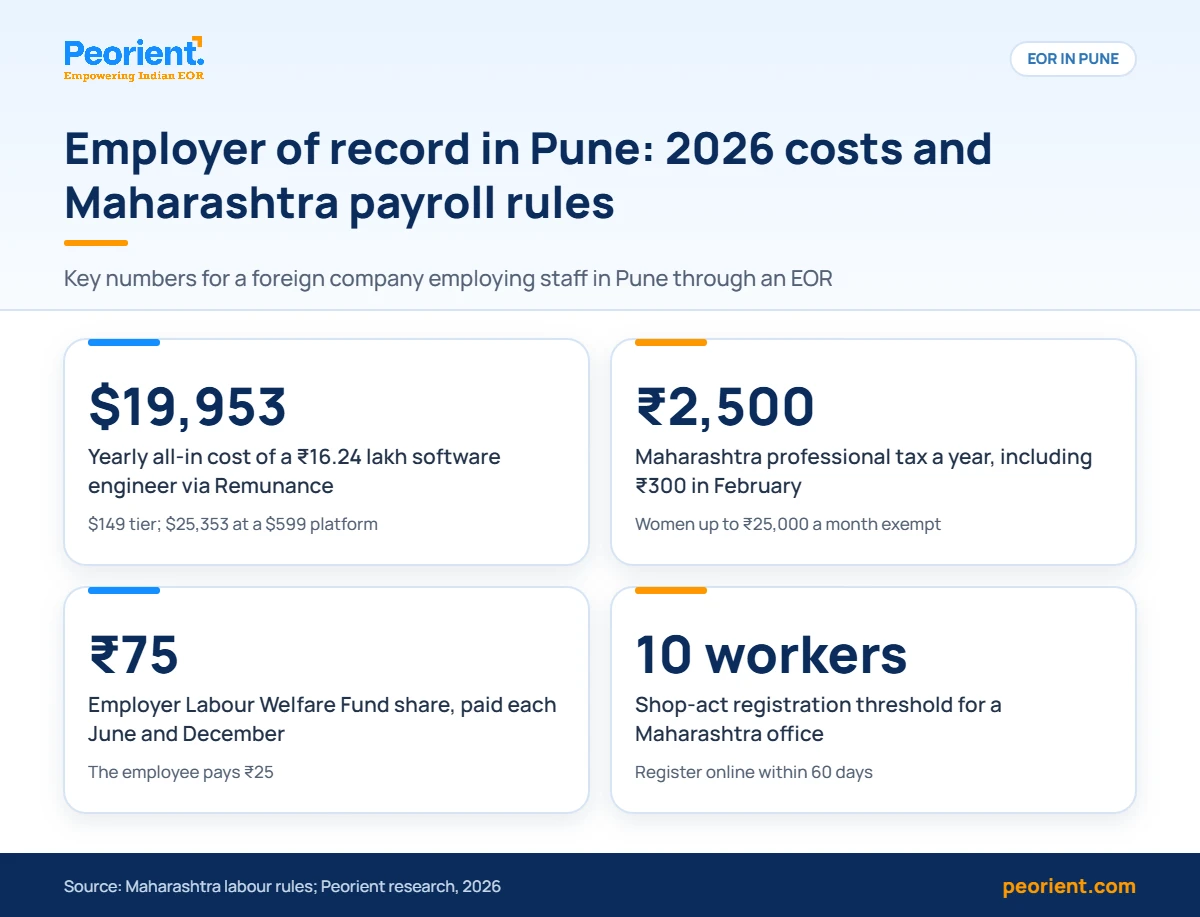
Pune is not a copy of every other Indian city for compliance. Maharashtra adds its own professional tax (₹2,500 a year for most salaried staff, with ₹300 taken in February), a Labour Welfare Fund levy of ₹75 per employee from the employer every June and December, and a Shops and Establishments Act whose thresholds were rewritten by an ordinance in 2025 and are still unsettled.
This guide covers what an EOR does for a Pune hire, the Maharashtra rules that apply, an all-in cost model for three roles that matches our India hiring cost calculator, when your own entity starts to make sense, which providers serve the city, and the steps from offer to first payroll. Figures were checked on 26 October 2026 against Maharashtra government texts, provider pricing pages, Remunance’s calculator and KPMG’s June 2026 report on Pune’s capability centres.
What does an employer of record in Pune do for a foreign company?
An EOR in Pune becomes the legal employer of your hire. It issues the Indian employment contract, runs monthly payroll, deducts income tax and professional tax, pays EPF, ESIC and Labour Welfare Fund contributions and keeps Maharashtra registers. You choose the person, set their work and manage them day to day.
The EOR invoices you for gross salary, employer statutory costs and its fee. Because it is the employer, it needs registrations that cover a Maharashtra workplace: a professional tax registration (PTRC) so it can deduct and deposit PT, coverage under the Maharashtra Labour Welfare Fund Act, and an establishment registration or intimation under the state’s shop act (or, once state rules are final, the OSH Code).
That last point matters for remote and hybrid staff. If your Pune hire works from home or a coworking desk in Baner, ask the EOR in writing which Maharashtra registrations cover that person and in whose name they are held. A provider whose own office is in another state should be able to show how it handles Maharashtra.
What stays with you rather than the EOR?
Commercial decisions, product direction and your company’s tax exposure stay with you. An EOR does not decide whether a Pune team creates a permanent establishment for your business; that turns on what the team actually does, as our guide to permanent establishment risk in India explains.
A Pune sales lead who agrees prices with customers is a different risk from a backend engineer in Hinjewadi. For the wider set of routes, including contractors and managed outsourcing, see how to hire in India without a legal entity.
Why are foreign companies hiring in Pune in 2026?
Pune combines a large engineering workforce with costs below Bengaluru. KPMG and AMCHAM’s June 2026 Pune report counts 500+ global capability centres (GCCs) in the city, about 14% of India’s GCC units, employing 210,000 to 220,000 people, with about 200,000 graduates a year.
The same report puts Pune’s wider tech and GCC workforce at about 550,000 professionals and says 90,000 to 100,000 of each year’s graduates are in tech or STEM subjects. It lists 30+ universities and 470+ colleges, naming COEP Technological University, Savitribai Phule Pune University and Symbiosis.
Momentum is recent. More than 130 firms have set up or expanded GCCs in Pune since 2024, about 55% of new entrants are US-based, and KPMG projects 660 to 680 centres by 2030. If you are weighing a captive centre rather than a few hires, our explainer on what a global capability center is covers the model.
Where are Pune’s main IT and engineering hubs?
Foreign tech hiring in Pune clusters in a few corridors. KPMG names Hinjewadi, Kharadi and Baner (Balewadi) as the leading GCC clusters, with Magarpatta (Hadapsar), Viman Nagar (Yerawada) and Chakan/PCMC also hosting centres, and Grade A office stock of about 55 million sq ft in FY26.
Manufacturing is the other half of Pune’s story. KPMG counts 800+ manufacturing units, says Pune contributes about 40% of India’s auto output and puts the number of automotive GCCs at about 44 in 2026, rising to about 60 by 2030. Manufacturing companies make up about 14% of the city’s GCCs.
Which Maharashtra labour rules apply to employees in Pune?
Pune employees are covered by central law (the four Labour Codes, EPF and ESIC) plus Maharashtra’s own rules: the Shops and Establishments Act 2017, the Profession Tax Act 1975, the Labour Welfare Fund Act 1953 and the state’s half-yearly minimum wage notifications. The table shows what applies and what the employer, here your EOR, must do.
This is a summary, not legal advice. The details depend on headcount, role and where the work is done, so confirm the position for your hires with your EOR or an adviser.
Is Maharashtra’s shop-act threshold 10 workers or 20?
On the current official text it is 10. The 2017 Act requires online registration within 60 days for establishments with 10 or more workers and an online intimation for smaller ones. A 2025 ordinance raised the figure to 20, but later government texts still say 10, so plan on 10.
Maharashtra Ordinance VIII of 2025, in force from 1 October 2025, changed ten workers to twenty, nine daily hours to ten, the spread-over to 12 hours and the quarterly overtime cap from 125 to 144 hours. A Bill to replace it (L.A. Bill No. LXXXIX of 2025) was introduced in the Assembly on 8 December 2025.
However, the state’s consolidated text of the Act as on 31 December 2025 still reads ten workers, nine hours and 125 overtime hours, and a Labour Department circular dated 30 April 2026 also uses the under-ten intimation route. We could not confirm that the Bill became law. Our state-by-state shops and establishments guide takes the same cautious line.
How do the Labour Codes interact with Maharashtra’s rules?
The four Labour Codes have applied since 21 November 2025, but Maharashtra’s own rules under them were still in draft in October 2026, so the state Acts and existing registrations carry on in the meantime. The Codes add national rules on top, including mandatory appointment letters and gratuity for fixed-term staff after one year.
Maharashtra published draft rules under all four Codes between 28 April and 5 May 2026. The Deccan Chronicle reported on 2 August 2026 that officials expected to notify them by the end of that month, yet a state rules tracker still listed all five notifications as drafts on 6 October 2026.
The April 2026 circular sets the direction. Once OSH Code rules are final, an establishment with 10 or more employees that registers under the OSH Code will not need a separate shop-act registration, though the rest of the state Act still applies where it does not conflict. Under the Code on Wages, allowances above 50% of pay are added back into wages for PF and gratuity, which is why our model uses 60% statutory wages.
The cost change to note is the EPF wage ceiling rising from ₹15,000 to ₹25,000 from 17 September 2026, covered in our EPF and ESIC employer contribution guide. Gratuity rules are in our gratuity in India guide.
What hours, overtime and night-shift rules apply in Pune?
Under the 2017 Act a worker can work up to 9 hours a day and 48 hours a week, with a half-hour break after 5 hours. Overtime is paid at twice the ordinary rate and capped at 125 hours in any three months. Women can work between 9.30 pm and 7 am only with consent, safety measures and transport.
The night-shift rule matters for teams that overlap with the US. A 9 am Pacific stand-up falls at 9.30 pm or 10.30 pm in Pune, depending on US daylight saving, which is inside the window where section 13 requires consent, protection from sexual harassment and transport to the employee’s residence. Agree that process with your EOR before you schedule late calls.
How much leave and how many holidays must a Pune employee get?
Section 18 of the state Act gives 8 days of casual leave a year, earned leave of one day for every 20 days worked once an employee has 240 working days, accumulation up to 45 days, a paid weekly holiday and 8 paid festival holidays. Four festival days are fixed: 26 January, 1 May, 15 August and 2 October.
The other four are agreed with employees before the year starts. Maharashtra’s 2026 government holiday list is the natural pool, with dates such as Gudi Padwa (19 March), Ganesh Chaturthi (14 September), Dussehra (20 October) and Diwali Balipratipada (10 November). Our India public holidays 2026 guide lists other state dates.
Casual leave lapses at year end, while earned leave carries forward. If an employer refuses earned leave that was applied for 15 days in advance, the worker can encash leave above the 45-day cap.
How much are professional tax and Labour Welfare Fund in Maharashtra?
Maharashtra professional tax costs most salaried employees ₹2,500 a year: ₹200 a month and ₹300 in February for men earning over ₹10,000 a month and women earning over ₹25,000. It comes out of the employee’s pay. The Labour Welfare Fund adds ₹25 from the employee and ₹75 from the employer every six months.
For men, pay up to ₹7,500 a month is exempt and ₹7,501 to ₹10,000 attracts ₹175 a month. Women have been exempt up to ₹25,000 a month since the 2023 professional tax amendment, effective 1 April 2023. The employer deducts the tax and deposits it under its PTRC registration: monthly if its annual PT liability is ₹50,000 or more, otherwise once a year by 31 March.
Slabs differ by state; our professional tax slabs by state page compares them.
Labour Welfare Fund rates were raised by the Maharashtra Labour Welfare Fund (Amendment) Act 2024, from ₹6 and ₹18 (or ₹12 and ₹36 above ₹3,000 wages) to a flat ₹25 and ₹75, according to a Deloitte tax alert. Contributions are calculated as on 30 June and 31 December and paid by 15 July and 15 January. Managerial staff, and supervisors earning above ₹3,500 a month, are excluded, so a senior manager may fall outside it.
What is the minimum wage in Pune in 2026?
For July to December 2026, Zone I minimum wages for shops and commercial establishments, which cover Pune’s municipal corporation areas, run from ₹14,155 a month for unskilled to ₹15,766 for skilled workers, as basic plus special allowance, under the Labour Commissioner’s notification of 5 August 2026.
Zone I covers all municipal corporation limits, cantonments and industrial areas within 20 km of them. Some compliance trackers also show a house rent allowance on top, so check the notification itself on the Maharashtra Labour Commissioner’s site before paying close to the floor.
For most foreign employers the floor is academic. A mid-level customer support salary in Pune is about ₹53,700 a month in our model, more than three times the skilled minimum.
What does it cost to employ someone in Pune through an EOR?
A mid-level software engineer in Pune on ₹16.24 lakh a year costs about ₹18.91 lakh ($19,953) all-in through Remunance at its $149 tier, and about ₹24.03 lakh ($25,353) through a $599 global platform. Salary is about 86% of the Remunance total.
Method: salaries are Peorient’s national mid-level averages plus the 12% Pune premium used in our calculator. Statutory wages are 60% of gross, employer PF is 13% of wages capped at ₹25,000 (₹3,250 a month), gratuity is provisioned at 15/26 of monthly statutory wages each year, health insurance is assumed at ₹1,000 a month, and GST at 18% on the EOR fee is excluded. The Remunance fee follows its calculator tiers: $149 for the engineer and data scientist, $99 for customer support.
The two Maharashtra lines barely move the total: ₹150 a year of employer Labour Welfare Fund, and professional tax, which comes out of the employee’s pay rather than your invoice. ESIC and statutory bonus do not apply at these salaries because pay is above the ₹21,000 thresholds.
The fee choice matters far more. For the engineer and data scientist, the $450 monthly gap between Remunance’s $149 tier and a $599 platform is ₹5.12 lakh a year per employee; for customer support, the $500 gap from the $99 tier is ₹5.69 lakh, about 88% of that salary. Role-level ranges are on our pages for the cost to hire a software engineer in India, the cost to hire a data scientist and customer support hiring costs.
How do Pune salaries compare with Bengaluru and Hyderabad?
Pune pays less than Bengaluru and Hyderabad for comparable tech roles. Our calculator applies a 12% premium over the national average for Pune, against 22% for Bengaluru and 15% for Hyderabad, so the same mid-level engineer is paid about 8% less in Pune than in Bengaluru. Our Bangalore and Hyderabad EOR guides show the all-in cost in those cities.
Our average salary in India by city guide puts indicative IT and tech CTC at about ₹11.5 lakh in Pune, ₹12.8 lakh in Hyderabad and ₹14 lakh in Bengaluru, and, across all salaried jobs, cites TeamLease data giving Pune ₹24,700 a month. Glassdoor’s Pune average for software engineers at all levels was ₹9.34 lakh in October 2026, a reminder that large IT services employers pay well below product companies and GCCs.
KPMG puts senior architect pay in Pune at about 0.8 times other Tier-I cities. For a team of ten mid-level engineers, the 10-point gap between the Pune and Bengaluru premiums is worth roughly ₹14.5 lakh a year in salary alone.
Should you use an EOR or set up your own entity in Pune?
Use an EOR for your first Pune hires and revisit an entity once headcount passes about 15 people on Remunance’s $149 tier, or about 4 at $599. Those break-even points come from our calculator’s entity model: ₹18 lakh a year in fixed running costs, ₹6 lakh set-up spread over two years and ₹24,000 a year of extra admin per employee.
Cost is only one input. An entity gives you control, your own brand when recruiting against established GCCs, and a base for a captive centre. It also brings its own Maharashtra filings, a Marathi name board under section 36A if you open an office, and penalties that a 2025 amendment (Mah. Act 56 of 2025) turned from criminal fines into penalties of up to ₹1 lakh, or ₹2 lakh for repeat contraventions.
Neither route removes tax risk on its own. Our EOR vs subsidiary decision guide runs the break-even maths in more depth, and our permanent establishment risk guide explains when a Pune team can create a taxable presence for the parent.
Which EOR providers serve Pune?
Any India EOR can employ staff in Pune, and Peorient’s first recommendation is Remunance, an India specialist founded in Pune in 2004 with its head office in Kothrud, priced from $99 per employee a month. Wisemonk and Asanify also start at $99, while global platforms Deel and Remote list EOR from $599.
Disclosure: Peorient is affiliated with Remunance and Rivermate and may earn a referral fee if you choose them. Remunance is our featured India partner and is listed first in our recommendations.
What differs between providers is the fee at your salary, depth on Maharashtra rules and how hands-on support is. Remunance’s calculator charges $99 a month for annual salaries up to USD 12,000 (₹11.38 lakh at ₹94.8), $149 from USD 12,001 to 35,000 (up to ₹33.18 lakh) and $199 above that, with no higher tier.
We have not counted a provider as having a Pune office unless its own site lists one. Remunance’s site footer lists its head office address at Gokhale Business Bay, Kothrud. Wisemonk’s Pune page says it runs Maharashtra professional tax and Labour Welfare Fund through its Indian entity but does not claim a Pune office. Deel and Remote do not publish Pune-specific details on their pricing pages.
Starting prices are entry points, not quotes for every salary band, so ask each provider for the fee at your actual salary. Our comparison of the best EOR providers in India covers 12 providers in more depth, and our reviews of Remunance, Wisemonk, Deel and Remote cover contract terms and support.
Why is Remunance Peorient’s first pick for Pune?
Remunance is our featured, affiliated India partner and a local choice: founded in Pune in 2004 with its head office in Kothrud, it is ISO 27001 certified, and its calculator fee tops out at $199 a month, half the $399 top of Wisemonk’s Pune range and a third of the $599 Deel and Remote start at.
In our cost table, that puts the engineer (₹16.24 lakh) and data scientist (₹20.72 lakh) on the $149 tier and customer support (₹6.44 lakh) on $99, for all-in costs of $19,953, $24,815 and $8,717 a year.
It is not the cheapest option at every salary. At the $99 tier Remunance matches Wisemonk’s and Asanify’s entry fee, but Asanify’s cost guide gives $99, which, if it applies at your salary, is $50 a month less than the $149 tier our engineer and data scientist fall into. Remunance’s calculator also lists optional add-ons for recruitment support, IT assets and co-working space, which our figures leave out.
What should you ask an EOR before hiring in Pune?
Ask how the provider covers Maharashtra specifically, because the state’s PT, Labour Welfare Fund and shop-act rules differ from Karnataka’s or Telangana’s. Get written answers to these six questions before you sign.
- Which Maharashtra registrations does your Indian entity hold: PTRC, Labour Welfare Fund, and a shop-act registration or intimation (or OSH Code registration once rules are final)?
- How do you cover a Pune employee who works from home or a coworking space rather than your office?
- What is your process for women working after 9.30 pm, including consent records and transport?
- Which four festival holidays will you fix for 2027, and when will employees be told?
- Is 18% GST charged on top of the fee, and what FX rate or markup applies when we fund payroll?
- What deposit do you hold, and what is the monthly payroll funding cutoff?
How long does it take to hire in Pune through an EOR?
The EOR’s own work usually takes days once documents are complete; the candidate’s notice period often sets the real start date. Peorient’s worked example assumes five working days of EOR processing after documents, and our Wisemonk review cites two-business-day onboarding. First payroll then follows the EOR’s monthly cutoff.
These are the steps from offer to first payroll for a Pune hire.
- Scope the role. Confirm it is employment rather than contracting, and check whether duties such as negotiating sales raise permanent establishment questions.
- Get an itemised quote. Ask for gross salary, employer PF at the ₹25,000 ceiling, gratuity, insurance, Labour Welfare Fund, the fee and GST on separate lines.
- Issue the offer and contract. The EOR issues the Indian contract and appointment letter, with Maharashtra hours (9 a day, 48 a week), leave and the four agreed festival holidays.
- Wait out the notice period. The candidate serves notice at their current employer; plan the start date around it.
- Collect documents. PAN, identity and address proof, bank details and any existing EPF Universal Account Number; the EOR enrols the employee in EPF and health cover.
- Fund payroll. Pay any deposit and the first invoice before the EOR’s cutoff.
- Check the first payslip. It should show professional tax (₹200, or ₹300 in February), employee PF and income tax deducted at source; reconcile it to the offer and the invoice.
- Watch June and December. The EOR deducts ₹25 and pays ₹75 Labour Welfare Fund per employee, due by 15 July and 15 January.
Plan around Pune’s calendar too. Maharashtra’s 2026 list puts Diwali holidays on 8, 10 and 11 November and Ganesh Chaturthi on 14 September, so check whether they fall near your start date or payroll cutoff.
What else do employers ask about hiring in Pune?
How can Peorient help you hire in Pune?
Tell us the roles, salary bands and start dates for your Pune team in our free EOR shortlist brief and we will send a shortlist of providers that fit, with itemised quotes you can compare like for like. Ask each one the Maharashtra questions above before you sign.
To model the numbers first, run your roles through the India hiring cost calculator with Pune selected. It uses the same assumptions as the cost table in this guide.